
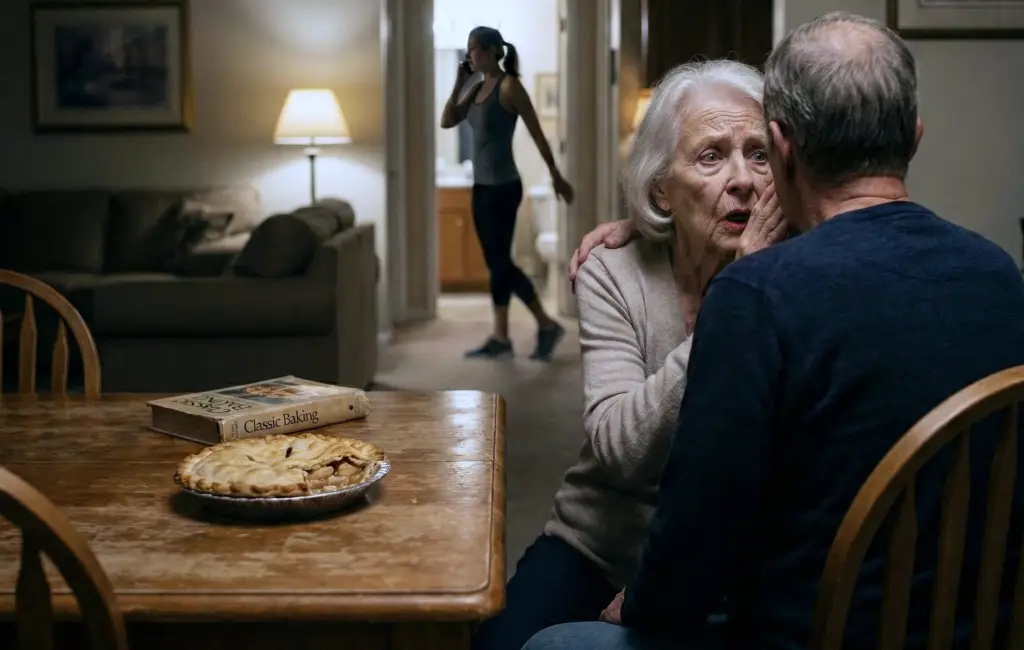
Seven years ago, Andrew took pity on an elderly woman and brought her into his home as a governess. Andrew Mitchell never thought that silence in his own home could become a threat. At 42 years old, and as the head of the procurement department at a large company, he was used to solving problems through other people’s hands: suppliers, contractors, and logistics managers.
At home, however, he was always the one who carried everything on his shoulders. Repairs, bills, vacation plans, and even choosing a school for his daughter; he had decided all of that. Christine, his wife, rarely interfered in household matters. She preferred to take care of herself, focusing on fitness, salons, and meetings with friends. Andrew didn’t object.
It seemed to him that this was how it should be; he earned the money, and she maintained the comfort. At least, that’s what he thought until that evening. It all started with small things, or rather, with how Christine latched onto these small things.
“Mrs. Barnes, you hung the towel on the wrong hook again!” his wife’s voice rang out from the bathroom sharply, almost with fury.
Andrew was sitting in the living room with a laptop on his knees, reviewing work correspondence, and he flinched at that intonation. Christine had never been particularly warm with the governess, but she hadn’t been rude either. Usually, she kept her distance, remaining politely cold. But now there was something new in her voice: anger, almost hatred.
From the corridor came the quiet, guilty voice of Mrs. Barnes. “I’m sorry, Christine. I’ll fix it right now.”
“And your coffee is too strong, I told you!” Christine snapped.
Andrew looked up from the screen. Coffee? Seriously? Mrs. Barnes had been living with them for seven years, since their daughter Liz turned eight. Back then, Andrew had met the old woman by chance. She was standing by a building entrance with a cardboard sign, looking for work and claiming experience with children. She looked exhausted, dressed in an old but clean coat, with an attentive and serious gaze that held not a drop of self-pity. Andrew felt compassion.
He offered her the position of governess. Christine wrinkled her nose but didn’t object; she had just gotten tired of taking her daughter to school and sitting over homework. Margaret Barnes turned out to be a godsend. She became almost like a real grandmother to Liz. She took her to school and picked her up, helped with math and literature, baked pies on Sundays, and read to her at night.
Liz adored her. Andrew also got used to the fact that there was always someone reliable in the house—calm, and without unnecessary words. Mrs. Barnes never interfered where she shouldn’t, didn’t get involved in family quarrels, and stayed in the shadows. But in recent days, something had changed. Christine seemed to be looking for a reason to lash out at the old woman. Andrew noticed but attributed it to his wife’s fatigue—maybe hormones, maybe stress.
He didn’t pay much attention to it until this evening.
“Mom, why are you yelling?” came Liz’s voice from her room. The girl looked out into the corridor, pursing her lips. At fifteen, she already knew how to look older; she was sharp and ironic, yet vulnerable. She had delicate features, long chestnut hair, and a piercing gaze.
“Mrs. Barnes has nothing to do with it. Don’t interfere,” Christine cut her off. “Go do your homework.”
“My homework’s done. And anyway, you’ve been kind of strange lately.”
“Liz, please,” Andrew intervened, trying to speak calmly.
“Your mother’s right, don’t get involved.” His daughter snorted and disappeared into her room, slamming the door.
Andrew got up and went to the kitchen. Mrs. Barnes was standing at the sink, silently washing cups. Her back was hunched, her gray hair neatly tucked under a scarf. She wasn’t complaining, nor was she defending herself.
“Mrs. Barnes, don’t pay attention,” Andrew said quietly. “Christine’s going through a difficult period right now.”
The old woman turned around. She looked at him with a long, studying gaze. Andrew suddenly felt uneasy. There was no offense in that look, but there was some kind of anxiety.
“Mr. Mitchell,” she said, her voice even quieter, almost a whisper. “You’re a good person, a very good person, and I’m grateful to you for these years.”
“What are you saying?” Andrew tried to smile. “That sounds like a goodbye.”
Mrs. Barnes didn’t answer. She just nodded and returned to the dishes.
The rest of the evening passed tensely. Christine locked herself in the bedroom, Liz sat with headphones on, and Andrew tried to finish reports. He sat with his laptop in the living room, eventually falling asleep on the couch. Around one in the morning, a strange sensation woke him, as if someone was standing next to him. He opened his eyes.
In the darkness, he made out a silhouette. It was Mrs. Barnes. She stood motionless, leaning toward him, and her lips moved soundlessly. Andrew shuddered, almost crying out. His pulse pounded in his temples.
“Mrs. Barnes, what happened?”
She put a finger to her lips. “Quiet.” Then she leaned even closer and whispered right in his ear. “You shouldn’t sleep tonight. Otherwise, you won’t wake up tomorrow.”
Without waiting for an answer, she silently left the room. Andrew sat on the couch, dumbfounded. What was that? Delirium? Had the old woman gone mad? Andrew lay back down, but sleep was gone. Mrs. Barnes’s words spun in his head: Otherwise, you won’t wake up tomorrow.
What nonsense. Maybe the old woman was developing dementia? Or was this some kind of metaphor? He lay like that for about twenty minutes, trying to convince himself that everything was fine. But the anxiety wouldn’t let go.
And then he heard footsteps. Quiet. Cautious.
Someone came out of the bedroom. Andrew opened his eyes slightly. It was Christine. She was barefoot, in a robe, sneaking down the corridor. Where was she going? He waited a few seconds, then silently got up and followed her. Christine went into the bathroom at the end of the corridor and pulled the door closed, but didn’t close it all the way.
Andrew crept closer and pressed against the wall. From behind the door came his wife’s muffled voice. She was talking on the phone.
“Yes, I’m telling you. Tonight specifically. Tomorrow he’s going on a business trip, understand? Different things can happen on the road.”
Andrew froze. The blood drained from his face.
“The brakes need to be damaged tonight,” Christine continued quietly but distinctly. “Otherwise, we won’t have time. He’s leaving early in the morning, around seven. On the highway… Well, you understand. The main thing is that it looks like an accident.”
A pause followed.
“No, he doesn’t suspect anything. Sleeping like the dead. Glenn, I’m serious. This is our chance. The house will remain mine, the insurance too. And we can be together.”
Another pause. Then a chuckle.
“You think I’m not scared? Of course, I’m scared. But I’ve already decided. You promised it would be clean. That no one would find out.”
Andrew leaned against the wall, feeling his legs giving way. His own wife. His Christine. The one he had lived with for seventeen years. The mother of his daughter. She was discussing his murder. Brakes. Business trip. Different things can happen.
Christine was saying something else into the phone, but Andrew was no longer listening. He slowly backed into the darkness of the corridor, returned to the living room, and sat on the couch. This was impossible. This was delirium. This was a dream. But no, this was reality.
Mrs. Barnes knew. She had somehow found out and warned him.
A few minutes later, Christine returned. She lay down on the bed in the bedroom as if nothing had happened. Andrew lay motionless, staring at the ceiling. Fragments of thoughts raced through his head. Glenn. Who was he? A lover? An accomplice? How long had this been going on? Why hadn’t he noticed?
And most importantly, what to do? Run? Where? To whom? To the police? With what—a story about an overheard conversation? No evidence. They’d consider him paranoid. Stay silent? Go on the business trip and risk his life? No. He needed to act. But carefully.
He remembered Mrs. Barnes’s words: Otherwise, you won’t wake up tomorrow. She had saved his life simply by warning him.
Andrew slowly exhaled. Good. So tomorrow morning he would pretend nothing had happened. He would say the business trip was canceled. Buy time. Find a way to protect himself. And learn the truth. The whole truth. Because if Christine was capable of this, it meant he didn’t know who he had been living with all these years.
Dawn came slowly. Andrew never closed his eyes. He lay there and tried to understand. When did it all start? When did Christine stop being the woman he loved? Or had she never been her?
A year ago, she had talked about divorce. Then it sounded sudden, like a blow to the gut. They were sitting in the kitchen. She was drinking coffee and suddenly said, “Andrew, we need to talk. I want a divorce.”
He was taken aback. He asked why.
She shrugged. “I’m bored. I’m tired. I want to live differently.”
Then she added that their daughter would stay with her. That they would divide the house. That she had a right to half. Andrew had begged then. Pleaded not to destroy the family. Promised to change, spend more time at home, work less.
Christine listened silently. Then nodded. “Okay. Let’s try again.”
He was glad. He decided that everything would work out. He tried to be more attentive, spend more time with his daughter, and gave his wife flowers. But something in Christine had changed. She became colder. More distant. She left home more often—to the gym, to see friends, shopping. Andrew didn’t interfere. He thought she just needed space.
Now he understood. All this time she had been preparing. Preparing to leave. But not just leave; to take everything. And for that, he had to disappear. He remembered how Christine had mentioned the house in the conversation. She was wrong. The house was built with his money before the marriage. In a divorce, she would get at most half of what was jointly acquired during the marriage, but she had no rights to the house. But if he died, then everything would pass to her and their daughter. Insurance. Inheritance. Everything.
And she would marry this Glenn. Live a new life. With his money. No. This wouldn’t happen.
He waited until the sky lightened outside the window. Six in the morning. Christine was still sleeping. Andrew got up, got dressed, and left the living room. In the corridor, he ran into Mrs. Barnes. She was already dressed, standing by the window, looking at the street.
“Mrs. Barnes,” he called quietly.
She turned around. Her eyes were full of worry. “You? You’re alright.” She exhaled.
“Thanks to you.” Andrew came closer. “How did you know?”
The old woman was silent for a moment, then answered. “I heard a conversation. Yesterday afternoon. Christine was talking on the phone in the garden. She thought I was in the house, but I had gone out for laundry. I heard fragments. About brakes. About a business trip. I didn’t understand right away. Then I put it all together.”
“Why didn’t you tell me earlier?”
“I was afraid of being wrong. Afraid I’d be misunderstood. That you wouldn’t believe me. So I decided to at least warn you.”
Andrew nodded. He understood. Such things are hard to believe, even hearing with your own ears.
“Thank you,” he said sincerely. “You saved my life.”
“What will you do?” asked Mrs. Barnes.
“I don’t know. But I’m not going on this business trip. And I’ll find out everything.”
He went downstairs and made coffee. When Christine appeared in the kitchen, he was already sitting at the table with a cup in his hands.
“Good morning,” she said, smiling tensely. “Are you packed already?”
“No,” Andrew answered calmly. “The business trip was canceled.”
Christine’s face froze for a second. Then she blinked. “How cancelled?”
“They called late last night. The supplier postponed the meeting to next week. So I’m not going.”
Christine stood, looking at him. Something like panic flashed in her eyes. Then she pulled herself together.
“Well, good. So you’ll stay with us?”
“Yes,” Andrew nodded. “I’ll stay.” He got up and started getting ready.
“Where are you going?” Christine asked.
“To work, by taxi. I’ll leave the car here.”
This was a lie, but Christine didn’t know. Andrew went outside, called a taxi, and left. In his head, a plan was already forming. He needed evidence. He needed help. And he needed time. Because the hunt had only just begun. But now he knew who was the victim, and who was the predator.
Andrew sat in the taxi and looked out the window, not seeing the streets rushing by. The driver was talking about something—traffic jams, weather—but the words didn’t register. One thought spun in his head: his wife wanted to kill him. Not just leave. Not just divorce. Kill. Physically eliminate him to take the house, the money, the insurance.
Seventeen years of marriage. Seventeen years he thought he knew this person. He thought they were a family. But it turned out that Christine was capable of this. Capable of planning his death, discussing details with her lover, smiling in his face, and wishing him goodnight.
The taxi stopped at an office building. Andrew paid, got out, and went up to the fourth floor. In the procurement department, he was greeted as usual. Colleagues nodded, said hello. Someone joked about the business trip. Andrew joked back, pretending everything was fine, but inside, he was empty.
He went into the director’s office and said that the business trip was canceled and starting tomorrow he needed time off for family circumstances. Then he went to his office, sat at his desk, opened the computer, and started searching: “Private Detective Boston.”
Dozens of websites, ads, and reviews appeared. Andrew read carefully, choosing. He needed a professional, not a charlatan or an adventurer. He needed a person who knew how to work cleanly, legally, and without unnecessary noise. Half an hour later, he settled on one name: Stephen Melford. Former operative, twenty years of experience in criminal investigation. Now in private practice. Reviews were restrained but positive. Works quickly. Doesn’t take questionable cases. Keeps his word.
Andrew dialed the number. A low, calm voice answered. “Stephen Melford?”
“Yes.”
“My name is Andrew Mitchell. I need help. Personal, delicate. Can we meet today?”
A pause followed. “I have time after six today. Let’s meet at a cafe. Write down the address.”
Andrew wrote it down. A cafe on the outskirts. A quiet place. Meeting scheduled for seven in the evening.
The day dragged on painfully slowly. Andrew tried to work, but his thoughts kept returning home. What was Christine doing now? Was she calling Glenn? Was she panicking because the business trip fell through? Or was she already coming up with a new plan? He remembered her face this morning when he announced the news. It wasn’t disappointment. It was anger. Annoyance. As if an important deal had fallen through.