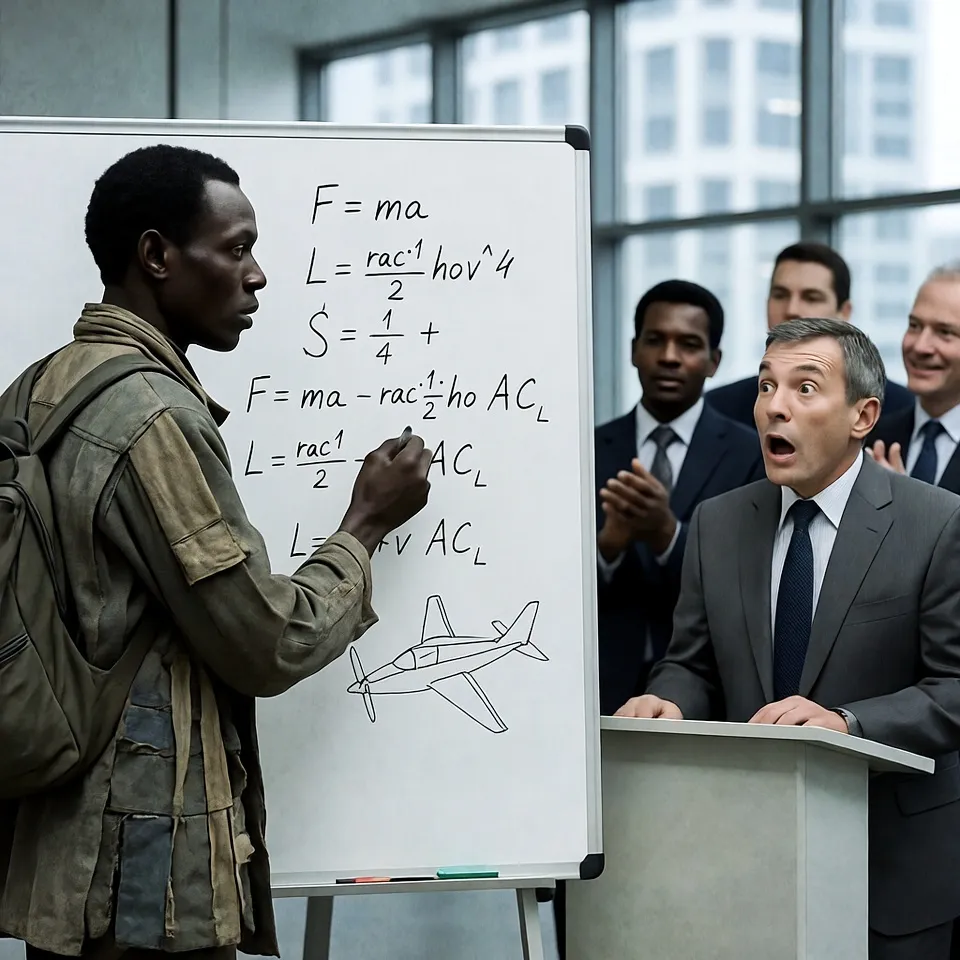
The marker let out a final, desperate squeak before falling silent. Inside the glass-walled boardroom at Aerospace Headquarters in Lagos, a diagram of an airplane sat marooned on the whiteboard, buried under a storm of incorrect solutions. It was a mess of lines crossing lines, arrows battling other arrows, and calculations that simply refused to agree.
Standing at the head of the room, the billionaire CEO, Johnson Uche, gripped the polished table with both hands. His knuckles were white. His eyes looked wet, and when he spoke, his voice trembled.
“We have 48 hours,” he said, the words heavy. “If we fail again, we lose the contracts. We lose… everything.”
The room, filled with the company’s top engineers, sat perfectly still, frozen in place. Not a single person spoke. The air felt thick and heavy, like the suffocating pressure of a nightmare you couldn’t force yourself to wake up from.
Then, a voice cut through the silence from the doorway. It was low, steady, and completely out of place in that high-stakes environment. “I can correct it.” Every head in the boardroom snapped toward the sound.
Standing by the door was a man who looked to be in his early forties. He wore a tattered coat, and his shoes were covered in a layer of fine dust. His beard was tangled, his hair rough and unkempt. He clutched a tired-looking brown bag close to his chest, holding it as if it were a priceless treasure.
The security guards flanking the entrance were already moving in, tensing to remove the interruption. Johnson lifted a single hand. “Wait.”
The guards froze. The stranger’s gaze didn’t waver; he wasn’t intimidated. He just looked at the failed diagram of the plane on the whiteboard, studying it with an expression one might give an old friend who had clearly lost their way.
“I can correct it,” he repeated, his voice just as steady as before. The entire room seemed to hold its breath.
Hours earlier, long before the city of Lagos had fully woken up, Williams Andrew had opened his eyes under the long shadow of the Echo Bridge.
The first weak morning light slipped between the massive concrete pillars. Someone nearby, perhaps Dunfoss, groaned as they stirred awake. A distant hawker started their day, calling out, “Pure water! Pure water!” and the sound bounced and echoed through the empty spaces under the bridge like a lonely bell.
Williams sat up on his flattened piece of cardboard, his bed for the night. He mechanically dusted off his coat and pulled his brown bag into his lap, hugging it. Inside that bag were the only three things he had managed to keep safe through all the turmoil. There was a heavily worn book on aeronautical engineering, a tidy bundle of old certificates, and a single pen that was only half-full of ink.
He pressed the old book to his chest, a gesture of comfort, much like a child holding a photograph of a home they missed. He walked to the public tap to wash his face, splashing cold water on his skin. He looked at his reflection in the ripples of the basin and tried to force a smile. The smile didn’t stay long.
He joined the early morning crowd and began his walk toward Victoria Island. As always, the silver letters on the side of the impossibly tall building pulled at his eyes. Aerospace.
He had learned to pass by it slowly, the exact way a starving person might pass a bakery, a feeling that was half-pain and half-desperate hope. But today felt different. There was a frantic energy. People with official badges were rushing inside, not walking. Cameras were flashing in the lobby. The entire building seemed to buzz with a palpable sense of worry.
He slipped through the main open door. He wasn’t being sneaky, just… small. He moved in the way a person walks when they are trying not to disturb the very air around them.
Near the top floor, looking through the glass, he saw the main boardroom. He saw the whiteboard, completely covered in wrong paths and failed equations. He saw Johnson Uche rub his eyes in exhaustion and whisper something to his assembled team.
“Forty-eight hours.” The words, though muffled, hit something deep inside Williams. He knew that number. He understood countdowns. He knew exactly how a good, smart team could get lost, taking one wrong step at a time, until they ended up in a place where nothing made sense anymore.
He felt a push from within. It was a quiet feeling, but it was strong and undeniable. He tightened his grip on the strap of his brown bag and, before he could second-guess it, he stepped forward.
Back in the boardroom, Johnson Uche studied the stranger who had just interrupted them.
“What did you say?” Johnson asked.
“I can correct it,” the man replied. “Let me try.”
Murmurs immediately rolled around the long table. “This is madness,” a young engineer muttered. “What can he possibly know that we don’t?” another whispered.
But Johnson’s eyes were tired in a way that made him unusually brave, or perhaps just desperate. He slid the black marker across the polished table.
“If you waste our time,” he said softly, but with steel underneath, “you waste my company. Don’t waste it.”
The room seemed to open up with a collective, silent gasp of surprise.
The stranger walked in. He smelled faintly of dust, sun, and old paper. He didn’t offer an explanation. He didn’t clear his throat. He simply picked up the marker, turned to face the chaotic whiteboard, and stood perfectly still for three long, agonizing seconds.
Then, he moved.
His hand was steady. He erased two angry-looking arrows that seemed to fight each other across the diagram of the wing. In their place, he drew one clean, gentle line, smooth as a river’s current. He circled a tiny box labeled ‘AOA’ and wrote next to it: Sensor drift under vibration.
He added three short equations—not too many, just enough to show the new path. He wrote, Feedback loop overreacts, and underlined it once. He even drew a small, simple smiley face near the tail, not to be funny or unprofessional, but to show the point where the plane’s design wanted to be at peace.
“What are you… what are you saying?” someone finally asked, breaking the silence.
The stranger spoke, using simple words, not complex jargon. “When the plane feels many small shakes—vibration—this little sensor,” he tapped the ‘AOA’ box, “thinks the nose is pointing too high. It panics.”
“The autopilot reacts to the panic and pushes the nose down, way too fast. The pilots feel this and fight it, pulling back. It becomes a tug of war. A few seconds of bad numbers can turn into a dangerous fall.”
He drew a tiny symbol that looked like a sieve. “We slow the panic down with a filter. This makes the sensor ‘listen’ better. Then, we teach the system to check two other helpers before it acts.” He tapped two other places on the diagram. “This one here, and this one here. Airspeed and vertical speed.”
“If all three agree, the system acts. If one sensor is ‘shouting’ all by itself, the system waits.” He wrote three clear steps on the side of the board: 1. Filter the noise. 2. Cross-check the helpers. 3. Soft hands on the nose. Soft hands.
It sounded so strange, and yet, profoundly true at the same time…