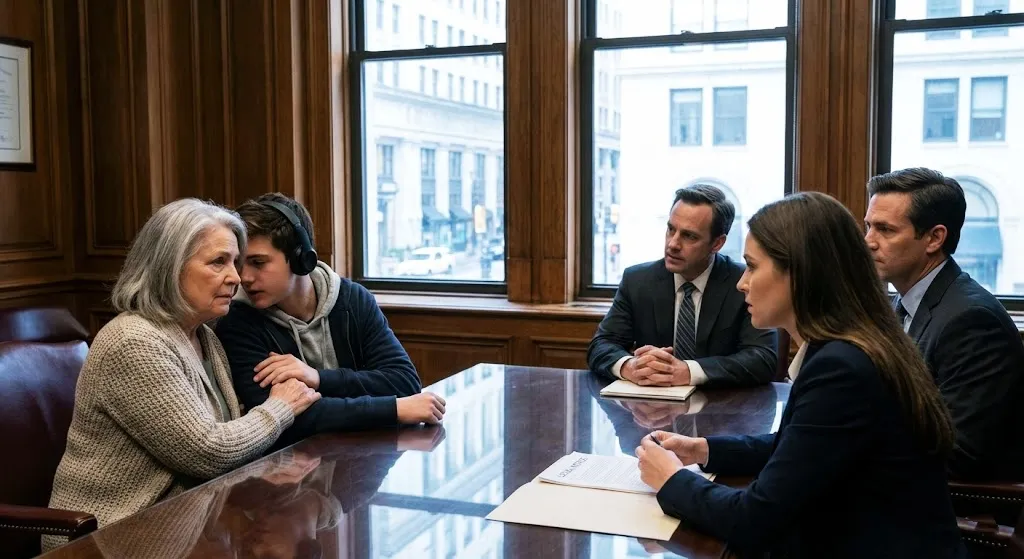

The scent of lemon polish hung heavy in the executive conference room, masking the sharper, metallic tang of anxiety that radiated from the men in suits. Lucia Vega froze, her hand stilling its circular motion on the mahogany table, as Victor Reeves, the billionaire CEO, waved a document in the air. The papers rustled loudly in the hushed room, covered in complex Mandarin characters that burned in Lucia’s throat. “Anyone who can translate this acquisition proposal gets my salary for a day, exactly $27,400,” Reeves announced, his voice tight with frustration. He nudged Lucia’s cleaning cart aside with the toe of his Italian leather shoe, treating the tools of her livelihood as mere obstacles in his path.
The room erupted in a ripple of laughter, a sound that felt less like amusement and more like a release of nervous tension among the wealthy. Lucia kept her gaze fixed on the wood grain, making herself small, a skill she had perfected over five years of invisibility. “Maybe we should just use Google Translate,” joked Derek Willis, the VP of Operations, the heavy gold of his Harvard class ring clinking against his crystal water glass. “It’s probably more reliable than whatever discount service we’d manage to find on this short notice.”
A vibration in her pocket pulled Lucia back to her own desperate reality. It was a reminder on her phone: the eviction notice. She had exactly 72 hours before the court hearing that would leave her family on the street. The number echoed in her mind—$27,000. It was the precise sum standing between dignity and absolute ruin, between a roof over their heads and the terrifying unknown. Her fingers instinctively sought the cool, smooth barrel of the jade translator’s pen tucked deep in her pocket.
It was her father’s final gift, a tangible piece of a heritage she was forced to deny, a skill hidden beneath the guise of unskilled labor. The pen felt heavy, a chance dangling right in front of her, taunting her with possibility. Would revealing her true self to these men, who looked right through her every day, bring salvation? Or would it merely invite a new, more painful kind of humiliation? The question hung in the stale air like a prophecy as she quietly slipped from the room, fading back into the role of the ghost they expected her to be.
Lucia hadn’t always been a ghost. Fifteen years ago, she was a bright-eyed eight-year-old who dazzled her teachers by switching effortlessly between three languages. Her mother, Min, a brilliant engineer from Beijing, had met her Dominican father, Rafael, during an international student exchange in Boston. Their love story had flourished despite the vast cultural differences, bound together by a shared, fierce passion for languages and the belief that education unlocked every door.
“Words build bridges between worlds, mija,” Rafael would tell her, his voice gentle and steady as he guided her hand to write characters that seemed to dance across the page. By the time she was ten, she was the bridge, translating conversations between her Chinese grandparents and her Dominican relatives, earning proud, beaming smiles from both sides of her family. The jade translator’s pen had been her thirteenth birthday gift, a symbol of that connection.
It was cool and weighty in her palm, its smooth green surface interrupted only by delicate carved characters that spelled out “Knowledge illuminates.” When she held it close, she could still smell the faint, comforting scent of sandalwood from her father’s study, where they had spent countless hours poring over texts in multiple languages. “This pen belonged to a great scholar,” her father had explained, his eyes shining. “Now, it belongs to another.”
Three months later, the world collapsed. Rafael Vega was laid off from Reeves Enterprises during a ruthless strategic restructuring. After fifteen years of loyally developing the company’s Asian market partnerships, he was discarded like obsolete hardware, sent away with a severance package that barely covered two months of rent. The health insurance disappeared overnight, leaving them exposed and vulnerable.
When his persistent cough was diagnosed as stage four lung cancer, the medical bills accumulated faster than the rejection letters from his job applications. Lucia could vividly remember the night her father returned from an interview at a competitor, his face the color of ash. “They can’t hire me,” he had whispered to Min, his voice trembling. “Reeves has blackballed me throughout the industry. He cited ‘proprietary knowledge,’ but it’s a seal on my career.” Six months later, Rafael was gone, leaving behind $43,756 in medical debt, a shattered family, and the jade pen that Lucia now carried as both a talisman and a burden.
Min took on three housekeeping jobs to keep them afloat, her engineering degree from Beijing University rendered useless without American credentials or connections. Lucia’s dream of a linguistic scholarship evaporated the moment Min’s first stroke hit, forcing the seventeen-year-old to abandon her senior year and find immediate work. Now, at twenty-three, Lucia’s life followed a punishing, relentless rhythm that left no room for dreams.
She cleaned offices at Reeves Enterprises from 4 PM to midnight, cared for her partially paralyzed mother until dawn, grabbed a scant three hours of sleep, and then translated academic papers online from 8 AM to 2 PM under the pseudonym “Linguistic Bridge.” The anonymous translation work paid $22 per hour—far better than her cleaning jobs, which ranged from $14 to $25—but clients were inconsistent. Worse, revealing her identity risked losing the healthcare coverage her mother desperately needed.
The math of their survival was a constant, looping tape in her mind: 60 hours of work each week, every single month. $1,200 for rent on their cramped one-bedroom apartment. $463 for her mother’s cocktail of medications. $275 for the payment plan on her father’s crushing medical debt. $190 for groceries. $145 for utilities. The arithmetic left absolutely nothing for savings, and certainly nothing for emergencies.
For five years, Lucia had moved through the corridors of Reeves Enterprises like a phantom, emptying trash bins while executives discussed billion-dollar deals mere feet away. She had learned the art of invisibility, polishing glass while her ears caught everything: strategic acquisitions, product launches, personnel changes. Her fluency in Mandarin, Spanish, and English transformed what was meaningless background noise for others into valuable intelligence for her.
She knew, for instance, that Victor Reeves had slashed employee retirement contributions while simultaneously purchasing a $14.2 million vacation home in Aspen. She knew that Derek Willis had shamelessly taken credit for the Singapore expansion strategy that a junior analyst, Priya Sharma, had actually developed. She knew the company’s public commitment to diversity was a veneer masking systemic wage gaps; the maintenance staff was 87% people of color, while executive leadership remained 94% white.
It was knowledge without power, intelligence without opportunity. Lucia cleaned their coffee rings while understanding every word they said about Asian markets, Hispanic consumers, and untapped multilingual demographics. The irony wasn’t lost on her, but irony didn’t pay bills or prevent evictions. And now, the terrifying 72-hour countdown had begun. Her mother’s disability appeal had been denied again, and the final eviction notice would be processed Monday morning.
Without $25,000 for back rent and legal fees, they would join the invisible ranks of the displaced—those who built, cleaned, and sustained the city without ever being welcomed by it. The document that started it all had appeared on Reeves’ desk at precisely 10:17 AM on Friday morning. Lucia noticed it because she was polishing the glass trophy case nearby, close enough to see the Shanghai postmark and the distinct logo of Huangtec Innovations, one of China’s largest semiconductor manufacturers.
She also noticed how Reeves’ perpetually composed face flickered with a momentary, genuine panic. By noon, the executive floor was in absolute chaos. Urgent meeting notifications pinged across monitors like digital gunfire. The translation team was scrambled, only for the bad news to be delivered: Lin, the head translator, was in Beijing visiting family, and his two associates were at an industry conference in Tokyo.
Lucia emptied wastebaskets methodically, moving through the commotion like a shadow, when Reeves burst from his office, waving the document. “Everyone in the conference room, now!” She should have left. Her shift technically ended at noon on Fridays, but curiosity—or perhaps fate—kept her lingering, wiping down already clean surfaces as the executives assembled. Reeves slammed the document onto the table, the sound echoing like a gavel.
“Huangtec is offering us exclusive manufacturing rights for our new processor,” Reeves barked. “This could double our market share in Asia.” “That’s fantastic news,” ventured Willis, though the confusion was evident in his voice. “It would be,” Reeves snapped, “if we could read the damn thing. They’ve sent it in Mandarin, and our translation team is unavailable. They want a response in 72 hours, or they’re taking the deal to Samsung.”
Lucia’s heart quickened in her chest. She recognized several characters visible on the cover page—technical terms her father had taught her, specific specifications for semiconductor manufacturing tolerances. “Can’t we use a service?” asked Priya Sharma. “For something this confidential and technical?” Reeves scoffed. “Do you want our competitive advantage leaked to every tech firm in Silicon Valley?”
The executives shifted uncomfortably in their chairs. Lucia’s cloth moved in silent circles on the credenza, her presence unnoticed. “I’ll make it worth someone’s while,” Reeves continued, his voice taking on a performative edge as he finally noticed her presence in the periphery. “Translate this 30-page proposal accurately in 48 hours, and I’ll give you my daily salary. That’s $27,400.” The room fell silent, then Willis laughed, and others joined in nervously.
“Maybe even the cleaning lady can try,” Reeves added, gesturing carelessly toward Lucia. “Though I doubt they teach Mandarin in housekeeping school.” More laughter followed, sharper and more cruel this time. Lucia kept her eyes down, but her fingers tightened around her cleaning cloth until her knuckles turned white. “We’ll divide it among the team,” Willis suggested, taking charge. “Use translation software for the first pass, then clean it up.”
“Fine,” Reeves conceded. “But remember, 72 hours until Huang walks. And these documents don’t leave this building—security protocols are in full effect.” As the executives dispersed, grabbing copies of the document, Lucia noticed two critical things. First, they were badly mistranslating even the title page, murmuring about “partnership opportunities” when the characters clearly indicated “exclusive manufacturing contract.”
Second, the 72-hour deadline aligned precisely with her eviction timeline. Reeves’ daily salary would cover her mother’s immediate medical needs and the overdue rent with room to spare. But revealing her skills could cost her job if she failed. Or worse, if she succeeded and threatened the executives’ fragile egos. And what if the document contained the same predatory policies that had destroyed her father’s career?
Would the same company that had ruined her family now profit from her hidden talent? And if she refused this chance, would she ever forgive herself? Lucia made her decision at 1:43 AM, standing in the dim, flickering light of her apartment kitchenette. Her mother slept fitfully in the converted living room, the medical monitors casting eerie blue shadows across her pale face. The eviction notice lay beside Lucia’s translation notes, the number 72 circled in red, counting down the hours until Monday’s court hearing.
She wouldn’t reveal herself directly—not yet. It was too risky. But she could test the waters, see how valuable her skills might prove to be. Saturday night found her back at Reeves Enterprises, her cleaning uniform serving as the perfect disguise for after-hours access. The executive floor stood empty and silent, the security guard nodding familiarly as she wheeled her cart past his station. “Working weekend overtime, Lucia?” “Mi madre needs medicine,” she answered, deliberately exaggerating her accent, playing the role they expected of her.
In the conference room, the executives had left their translation attempts scattered across the whiteboard. It was a mess of mistranslated technical jargon and mangled business terms. Lucia winced at their interpretations. Using her jade pen, she carefully corrected three critical sections, translating the complex semiconductor terminology with absolute precision. She signed it simply: “Night Owl.” The corrections were specific enough to demonstrate expertise, but limited enough to seem like helpful hints rather than a complete solution—a test balloon to gauge the reaction.
By Sunday morning, her anonymous assistance had created a stir. Arriving early with her cleaning cart, Lucia lingered near the conference room door, eavesdropping. “Who the hell is Night Owl?” Reeves demanded. “Security says nobody unauthorized entered the building,” Willis responded, sounding defensive. “Must be someone on our team.” Lucia watched through the gap in the door as Willis studied the whiteboard, his expression shifting from confusion to calculation.
Then, to her disbelief, he erased her signature. He turned to Reeves with a smooth, practiced smile. “Actually, I did this part,” Willis claimed. “I’ve been studying Mandarin privately. Didn’t want to make a big deal of it until I was more fluent, but given the emergency…” Reeves clapped him on the shoulder, beaming. “Finally, some initiative around here! Take point on this, Willis. Coordinate the team’s efforts.”
Lucia’s small victory turned to ash in her mouth. Willis had been promoted to project lead based entirely on her work. The injustice burned, hot and sharp, but she couldn’t afford the luxury of indignation—not with only 48 hours remaining before eviction. That night, with her mother finally asleep, Lucia spread the photographed documents across their small kitchen table. Working through the technical portions, she discovered something that made her blood run cold.
The contract included provisions for “workforce optimization requirements”—corporate speak for a clause that would allow Reeves to lay off 300 workers at the manufacturing plant in exchange for reduced production costs. Among those workers would be her mother’s cousin’s family, who had finally found stability after immigrating last year. Lucia sat back, the jade pen suddenly feeling heavy as a stone in her hand. She faced a terrible choice: complete the translation anonymously and enable more families to suffer, or reveal herself and risk everything.
Her phone buzzed with a text from her supervisor: “New security cameras installed in executive wing. All cleaning staff must complete tasks before 7 PM until further notice.” The window was closing. With her after-hours access restricted, Lucia resorted to desperate measures. During her Monday shift, she hid in bathroom stalls during breaks, translating frantically on scraps of paper. She worked through lunch in the supply closet, racing against both Reeves’s deadline and her own.
Now, there were just 58 hours until the eviction hearing. By Monday evening, she had completed translations for roughly 40% of the document. She carefully placed more anonymous “Night Owl” notes in the conference room, watching from afar as Willis continued claiming credit, growing more arrogant and confident with each successful interpretation she provided.
The countdown ticked mercilessly: 56 hours until eviction, 47 hours until Huangtec’s deadline. Lucia’s eyes burned from lack of sleep, and her hands cramped from writing. Her mother’s condition began to deteriorate, the stress of potential homelessness causing her blood pressure to spike dangerously. “Necesitamos un milagro,” her mother whispered that night, clutching Lucia’s hand with frail fingers. “We need a miracle.” What her mother didn’t know was that Lucia had the miracle within her grasp, if only she dared to reach for it.
“We have a security breach.” The words cut through Tuesday morning’s executive meeting like a blade. Lucia, arranging coffee service, kept her expression strictly neutral as the security chief played video footage showing a shadowy figure in the conference room after hours. “The cameras caught someone, but the angle doesn’t show a face,” he explained. “Could be industrial espionage. Investigate everyone,” Reeves ordered, his face red. “Especially maintenance staff with after-hours access.”
Lucia felt Willis’s gaze fixed on her. Had he connected her to the mysterious translations? By afternoon, security guards were interviewing all cleaning personnel. When Lucia’s turn came, she played her role perfectly: the simple cleaner who barely spoke English, confused by complicated questions. “No understand problem,” she repeated, hating herself for the stereotype but recognizing its protective power. “I clean only, no touch papers.”
The security chief seemed satisfied, but Willis lingered after the interview, his Harvard ring tapping rhythmically against the desk. “Interesting,” he said once they were alone. “You seem to understand English perfectly when I’m giving cleaning instructions.” Lucia shrugged, keeping her eyes downcast. “Instructions simple. Questions complicated.” Willis leaned closer, invading her personal space. “I think you understand more than you let on. Much more.”
That evening, Lucia found her locker had been searched. Her stomach dropped when she realized what was missing: the Jade Translator’s pen, her father’s gift, her talisman. “Looking for this?” Willis twirled the pen between his fingers when he cornered her in the empty break room. “Quite an unusual item for a cleaning lady. These characters here… they mean ‘knowledge,’ don’t they?” Lucia reached for it, but Willis pulled it back with a smirk.
“Security is very concerned about unauthorized items that could be used for corporate espionage. I’ve taken the liberty of filing a report.” By Wednesday morning, HR had issued Lucia a formal warning for “possession of unauthorized materials and suspicious behavior.” Without her jade pen, her connection to her father, Lucia felt unmoored, her certainty faltering. The eviction countdown showed 34 hours remaining.
Her mother had been taken to the emergency room with chest pains, depleting their meager savings for the ambulance co-pay. The apartment manager had posted the final eviction notice: 48 hours until they would change the locks. Desperate, Lucia used her lunch break to access Willis’ computer while he attended a meeting. What she discovered horrified her. Willis had deliberately mistranslated key sections of the Huang proposal—sections that would not only harm workers but potentially violate international trade laws.
Reeves was about to sign an agreement that could trigger investigations and massive fines. When she returned to cleaning duties, Willis was waiting. “I know it’s you,” he said without preamble. “The mysterious translator. I checked the personnel files. Your mother is Min Vega, formerly Min Liu from Shanghai. Your father worked here until we… how shall I put it? Right-sized him.”
Lucia’s mask finally slipped. “My father was an invaluable asset to this company.” Willis’ eyebrows rose. “Ah, so she speaks. I wondered how long you’d keep up the act. Give me back my pen,” Lucia demanded. “After I speak with immigration about your mother’s visa status,” Willis countered smoothly. “Expired, isn’t it? Since your father’s death? Would be a shame if authorities were notified.”
The threat hung between them, heavy and suffocating. Speak up and face deportation threats, or remain silent while hundreds lose their livelihoods and Reeves Enterprises commits corporate suicide. 30 hours until eviction. 24 hours until the Huang deadline. Lucia had never felt more trapped, or more determined.
The emergency board meeting began at 9 AM Thursday, exactly 24 hours before the Huangtec deadline. Lucia moved silently around the conference room perimeter, pouring coffee and arranging pastries as Willis presented his completed translation to Reeves and the board members. “As you can see,” Willis explained, pointing to his PowerPoint, “the terms are highly favorable. Huang is offering exclusive manufacturing at rates 15% below market, with minimal quality control oversight.”
Lucia winced at his mistranslation. The document actually specified stringent quality control protocols with 15% higher tolerance standards than the industry average. “Their only unusual request,” Willis continued, “is accelerated production scheduling using what translates roughly as ‘modified staff allocations.'” Lucia’s hands trembled as she refilled the water pitcher. Willis was deliberately obscuring the mass layoffs the contract would require.
“There’s a technical section about the ‘liudong moxing’ process that’s still unclear,” Willis admitted, butchering the pronunciation so badly that Lucia couldn’t stop herself from flinching. Reeves noticed. “Something wrong with the coffee girl?” All eyes turned to her. The moment stretched, her future balanced on a knife’s edge.
“Liudong moxing,” Lucia corrected softly, the proper tones flowing naturally from her tongue. “It means ‘fluid modeling system,’ not whatever he said.” The room froze. Willis’ face darkened. “Excuse me?” Lucia straightened her shoulders, sixteen years of language study overtaking five years of practiced invisibility. “You’ve mistranslated several critical sections. Liudong moxing refers to the semiconductor’s thermal management system, which requires specialized handling during manufacturing. It’s not about staff reallocation; it’s about technical specifications.”
“How dare you interrupt—” Willis began, but Reeves cut him off. “You speak Mandarin?” Reeves demanded, studying Lucia as if seeing her for the first time. “Mandarin, Spanish, and English,” Lucia answered, her heart pounding against her ribs. “I also read Japanese and Korean, though my speaking fluency is limited.” “She’s lying,” Willis interjected, his voice rising. “She’s just a cleaner.”
“My father was Rafael Vega,” Lucia continued, gaining confidence with each word. “He built your Asian market division before your ‘strategic restructuring’ five years ago. He taught me business Mandarin and technical terminology since childhood.” Recognition flickered in Reeves’ eyes. “Vega… I remember him.” “This is absurd,” Willis protested. “She’s probably working for our competitors!”
“Check my credentials,” Lucia challenged, pulling out her phone to display her profile on TranslationBridge.com. “I work under the username ‘Linguistic Bridge.’ I have a 4.98 rating with over 400 academic and technical translations completed, specializing in engineering and business documents.” Reeves took her phone, scrolling through the impressive client list and testimonials, his business instincts clearly wrestling with his prejudices.
“Willis, your translation mentions nothing about quality control protocols,” Lucia continued, addressing the board now. “It also obscures the fact that Huangtec is requiring you to lay off 300 manufacturing workers as a condition of the deal, which would violate three separate labor agreements you’ve signed.” The board members murmured, looking between Willis and Lucia. “This is outrageous,” Willis sputtered. “You can’t possibly—”
“Page 16, paragraph 4,” Lucia recited from memory. “The characters clearly state that Reeves Enterprises must implement workforce reduction measures of no less than 300 positions within 60 days of contract execution. I can read the entire section verbatim if you’d like.” Reeves studied her for a long moment, calculation replacing surprise. “You claim you can translate this entire document accurately?”
“I’ve already translated about 60% of it,” Lucia admitted. “I was leaving anonymous notes to help—the ones Mr. Willis has been taking credit for.” Willis’ face flushed crimson as heads turned toward him. “You were the Night Owl?” Reeves asked. Lucia nodded. A slow smile spread across Reeves’ face—not warm, but predatory, recognizing an opportunity.
“My offer stands,” he said. “Translate the complete document by tomorrow’s 9 AM deadline, and my daily salary is yours. $27,400.” “I want it in writing,” Lucia countered, surprising herself with her boldness. “And I want my pen back.” “Your pen?” Reeves frowned. “My Jade Translator’s pen. Mr. Willis confiscated it yesterday and filed it as ‘suspicious material.'”
All eyes turned to Willis, who reluctantly pulled the pen from his jacket pocket. “And I want a written contract guaranteeing my continued employment regardless of the translation outcome,” Lucia added, “with a confidentiality clause protecting my mother’s immigration status.” The room fell silent at her audacity. Reeves studied her with new interest, perhaps even respect. “Draw up the agreement,” he finally instructed his assistant. “And get Ms. Vega whatever resources she needs.”
As the jade pen was returned to her hand, Lucia felt its familiar weight—cool, solid, grounding. The countdown reset in her mind. 18 hours to translate the remaining document while her mother faced eviction in 36 hours. For the first time in years, she was visible. For better or worse.
Lucia worked through the night in a small conference room they’d assigned her, fueled by adrenaline and cheap vending machine coffee. Her fingers flew across the keyboard, the jade pen in her hand guiding her through complex technical terminology and subtle cultural nuances that machine translation could never capture. By 3 AM, her eyes burned, and the characters began swimming on the page. She had completed nearly 85% of the translation, carefully noting discrepancies between what Huangtec was actually offering and what Willis had claimed.
The truth was somewhere in between—not as rosy as Willis painted, but not as exploitative as she initially feared. The workforce reductions were “suggested,” not “required,” and Huang had included provisions for retraining programs. Her phone buzzed with a text from her neighbor who was sitting with her mother at the hospital. “Doctors want to keep her another day. Need $2,200 deposit for continued care.”
Lucia massaged her temples. 30 hours until eviction. 6 hours until her translation deadline. She allowed herself a moment of hope. Reeves’ money would solve their immediate crisis. She could negotiate with the landlord, pay the hospital, perhaps even find better housing closer to medical facilities. She rested her head on her arms, just for a moment, to clear her mind.
The crash of coffee splashing across her desk jolted her awake. Lucia gasped as hot liquid spilled across her handwritten notes and seeped into her laptop keyboard. “Clumsy me,” Willis stood over her, an empty coffee cup in hand, fake concern plastered across his face. “I was just bringing you a fresh cup. You looked so exhausted.”
Lucia jumped up, frantically dabbing at the spreading liquid with tissues. Her laptop screen flickered, then went black. “My translation,” she began, panic rising in her throat. “Don’t worry,” Willis said with a smile that didn’t reach his eyes. “I took the liberty of moving your digital files to my secure drive. For safekeeping. Can’t be too careful with such sensitive material.”
“Give them back,” Lucia demanded, her voice steady despite her racing heart. “I would, but… unfortunately, there seems to have been some sort of corruption. Technical glitch,” he shrugged. “These things happen.” The digital backup was gone. Four hours before the deadline, Lucia would need to reconstruct critical sections from memory and the coffee-stained notes that remained legible.
As Willis sauntered out, he called over his shoulder, “Reeves expects perfection, you know. One mistranslated clause could cost the company millions. I’m sure he’ll understand if you need to… withdraw from the challenge.” Lucia’s phone buzzed again. This time it was her landlord: “Eviction processor coming tomorrow morning instead of Monday. Legal approved acceleration due to repeated late payments.”
She stared at the ruined papers, the dead laptop, feeling the walls closing in. Three hours of work lost. Mother in the hospital. Eviction imminent. Willis had outmaneuvered her at every turn. For one moment, she considered giving up, walking away, finding another cleaning job somewhere Reeves and Willis couldn’t touch her. Then her phone rang again—the hospital. Her mother’s condition had worsened. They needed payment authorization for additional treatment immediately.
Lucia worked frantically, recreating translations from memory, her hand cramping around the jade pen. Two hours passed. Three. As dawn broke, exhaustion overtook her. Her head drooped, eyes closing despite her best efforts.
She awakened to Reeves standing over her, Willis smirking behind him. The wall clock showed 8:47 AM. 13 minutes until the deadline. “I expected this,” Reeves announced, taking in her disheveled appearance, the scattered papers, the coffee stains. “People should stay in their lanes. Housekeepers clean, executives execute. That’s why I’m rich and you’re… well, exactly where you belong.”
He turned to his assistant. “Draft a termination notice. Clearly, Ms. Vega violated company policy by accessing confidential documents without proper authorization.” “But our agreement,” Lucia protested, her voice raspy. “Was contingent on delivery,” Reeves cut her off. “And you failed to deliver. I can explain—” “Call TranslationPro,” Reeves instructed Willis, ignoring her. “See if they can start from scratch this afternoon. We’ll have to ask Huang for an extension.”
Willis’ triumphant expression said everything. Lucia sat frozen, watching her one chance at saving her family collapse under corporate cruelty. Her father’s voice echoed in her memory: Words build bridges between worlds. But what happened when those bridges were deliberately burned? Had she risked everything only to end up in a worse position than before?
As Reeves turned to leave, Lucia’s gaze fell on her bag, where the edge of a notebook peeked out. Her father’s research journal. She’d brought it for reference, forgotten until this moment. “Wait,” she called out, a new clarity cutting through her exhaustion. Reeves paused at the door, irritation evident. “We’re done here.”
“My father worked on this exact technology,” Lucia said, pulling out the journal. “The GX500 Semiconductor Series. He was part of the original development team before Huangtec acquired the patent.” She flipped through the journal, finding her father’s detailed notes on the manufacturing process—diagrams, specifications, testing parameters. “Information not even included in the Huang documents, because they assumed Reeves Enterprises already understood the foundational technology.”
“These notes contain details about the thermal modeling system that aren’t explained in the proposal because they’re proprietary knowledge.” Lucia stood straighter, confidence returning. “I can complete this translation with technical precision no translation agency could match. You have ten minutes.”
Reeves paused, calculating. “Ten minutes,” he said.
Lucia worked with renewed focus. Her father’s journal opened beside her, the jade pen moved across the paper with certainty, filling gaps, clarifying ambiguities, noting technical specifications that the Huang document only referenced obliquely. At precisely 8:58 AM, she walked into the boardroom where executives had gathered for the Huang video conference. She placed the completed translation before Reeves, who scanned it skeptically.
“The video call is starting,” his assistant announced. Reeves hesitated, glancing between the translation, Willis, and Lucia. “Ms. Vega, perhaps you should…” “I’ll wait outside,” Lucia said, turning to leave. “Actually,” came a voice from the video screen, “we would prefer if Ms. Vega stayed.”
Everyone turned to the large display where Lin Huang, CEO of Huangtec, appeared with his executive team. Beside him sat a familiar face. “Mr. Zhang,” Lucia whispered. “Ms. Vega,” Zhang said in Mandarin, “it is an honor to meet Rafael’s daughter. He spoke of your linguistic gifts often.” Lucia responded in flawless Mandarin, her surprise giving way to understanding. “The honor is mine, Mr. Zhang. I didn’t realize you were aware of my employment here.”
“We weren’t,” Lin Huang interjected, “until our intelligence team noted someone was accurately translating our deliberately complex proposal. Few people could navigate those technical terms correctly.” Reeves looked between them, understanding nothing of the rapid Mandarin exchange. Lucia switched to English. “Mr. Huang says they included technical complexities as a test. They wanted to see if Reeves Enterprises still retained the expertise my father helped build.”
“And do we pass this test?” Reeves asked cautiously. “That depends,” Lucia answered, switching back to Mandarin to address Huang directly. “The proposal contains ambiguities regarding workforce requirements that could be interpreted as requiring layoffs. Was this intentional?” A subtle smile crossed Huang’s face. “Very perceptive. We have concerns about Reeves’ labor practices since Mr. Vega’s departure. The workforce language was deliberately ambiguous to see how they would interpret it.”
Lucia turned to Reeves. “Huangtec is concerned about your company’s approach to workforce management. They included that section as a character test.” Willis stepped forward. “This is ridiculous. She’s making this up to—” “Perhaps,” Lucia interrupted, “Mr. Willis would like to explain why he deliberately mistranslated key sections and sabotaged my work?”
She pulled out her phone, showing security footage she’d recovered during her night of research—Willis clearly visible pouring coffee on her computer and deleting files from her directory. The room fell silent. Reeves’ expression hardened as he watched the indisputable evidence. “Mr. Willis,” he said quietly, “you’re fired. Security will escort you out.”
As Willis was removed, protesting loudly, Huang spoke again in Mandarin. “We will proceed with the contract on one condition: that Ms. Vega oversees the implementation as our cultural liaison.” The jade pen moved confidently across Lucia’s notes as she translated the conversation in real-time, its smooth surface catching the light, leaving crisp blue characters that smelled faintly of sandalwood and possibility. It was no longer a memento of loss, but an instrument of her authority.
“They insist on working directly with me as a condition of the deal,” Lucia explained, the power dynamic in the room shifting palpably. Reeves studied her, recognizing the leverage she now held. With the Huang deadline minutes away and millions at stake, he had no choice. “Fine,” he conceded. “Ms. Vega will oversee the cultural aspects of the implementation.”
The video call concluded with Huang expressing his pleasure at finding Rafael Vega’s legacy alive at Reeves Enterprises. As the executives dispersed, Reeves approached Lucia. “It seems I underestimated you.” “Many people do,” she replied simply. “Our agreement stands.” He wrote a check for $27,400—his daily salary. “Though it appears you’ve earned considerably more than that.”
As cameras recorded the official contract signing for company records, Huang made one final request via email: a $50,000 signing bonus specifically designated for cultural consultancy services provided by Lucia Vega. With $77,400 in hand—enough to save her mother’s medical care, stop the eviction, and provide breathing room for the first time in years—Lucia finally allowed herself to exhale. The jade pen rested in her hand, no longer a burden of the past, but a key to her future.
Six months later, Lucia sat in her new office: Director of International Relations at Reeves Enterprises. Floor-to-ceiling windows offered a view of the city where she’d once felt invisible. Her desk, polished walnut—not the pressed composite of lower-tier employees—held a framed photo of her mother, now receiving specialized care in a facility close to their new two-bedroom apartment.
The jade translator’s pen rested in a small crystal stand, its polished surface catching the morning light. When she held it now, the sandalwood scent mingled with the fresh orchids she kept beside her father’s photograph—two sensory connections, one to her past, one to her present. Her first official act as director had been establishing a scholarship fund for employees’ children named for her father, and implementing a comprehensive review of the company’s layoff policies.
Her second had been rehiring workers from her community with proper benefits and language-appropriate training materials. The contract she’d negotiated with Huangtec had increased Reeves’ Asian market share by 32% in two quarters. The board members who had once looked through her now addressed her as “Ms. Vega,” with the same deference once reserved for Reeves himself.
Even Victor Reeves had developed a grudging respect for her, not from any moral awakening, but from the simple arithmetic of profit: her cultural insights and linguistic precision had opened doors previously closed to the company. As Reeves himself had put it in the last shareholders’ meeting, “Ms. Vega’s unique perspective has proven unexpectedly valuable.” Lucia smiled at the corporate-speak translation of “I was wrong about her.”
Her assistant knocked gently. “Your mother’s physical therapist called. The improvements are continuing ahead of schedule.” “Gracias,” Lucia answered, allowing herself the small pleasure of using Spanish openly in these halls where she’d once hidden her multilingual identity. Her phone chimed with a calendar reminder: The monthly board meeting in 15 minutes.
Six months ago, she had been invisible in that room, wiping fingerprints from water glasses while executives made decisions that affected thousands of lives. Today, she would present her international expansion strategy, a plan projected to create 450 new jobs and increase company valuation by 18%.
As she gathered her materials, her gaze fell on a newspaper clipping framed beside her father’s photo. The business section headline read: Reeves Enterprises Stock Soars on Asian Partnership: New Director Credits Immigrant Father’s Legacy. The article highlighted her unconventional rise from maintenance staff to executive leadership, with analysts praising the company’s “unexpected talent discovery” as a model for corporate diversity.
What the article didn’t mention was the twenty-eight other maintenance and support staff members who had been promoted after Lucia implemented her “Hidden Talents” initiative—a company-wide program that encouraged employees at all levels to showcase their skills and education. The former security guard with an engineering degree from Nigeria. The cafeteria worker who spoke five languages. The IT help desk technician with a gift for product design.
Willis, meanwhile, had become a cautionary tale in corporate circles after his attempted sabotage went public. No major tech firm would touch him now. The last Lucia had heard, he was teaching business communication at a community college, ironically educating the very demographic he had once dismissed. Reeves himself remained unchanged at his core—driven by profit rather than principle—but he had learned to recognize talent regardless of its packaging. He still referred to Lucia’s rise as “lightning in a bottle,” rather than acknowledging the systemic barriers that had kept her hidden. But actions spoke louder than words, and his willingness to reform hiring and promotion practices had real-world impact beyond performative statements.
As Lucia walked toward the boardroom, employees greeted her by name—some in English, others in Spanish or Mandarin—each interaction a small bridge between worlds. She carried her father’s jade pen not as a secret talisman, but as a visible symbol of her heritage and expertise. The board members rose when she entered, a sign of respect that still surprised her.
As she prepared to present her vision for the company’s future, Lucia thought of her mother, now taking college courses online to refresh her engineering credentials, and of the cleaning staff who now looked her in the eye instead of averting their gaze. Visibility had its price—the scrutiny, the pressure, the knowledge that she represented more than just herself in these rooms. But invisibility had cost far more: the talent wasted, the voices unheard, the bridges unbuilt.
“Good morning,” she began in three languages, watching the board members’ appreciative nods. “Today, we’re going to discuss how embracing multiple perspectives transforms not just our culture, but our bottom line.” Lucia clicked to her first slide, displaying the 32% market share increase alongside the 24% improvement in employee retention since implementing her initiatives. Numbers spoke every language, especially in boardrooms.
“Talent doesn’t always arrive in expected packages,” she continued. “But companies that recognize it, regardless of its wrapping, gain the competitive advantage. Let me show you how.” The jade pen moved confidently across her notes as she led the company’s leadership into a future her father could only have dreamed of—one where bridges between worlds became highways of opportunity.
Has someone ever underestimated your potential? Did you have a moment when you finally showed your true value, just like Lucia? Share your story in the comments below.