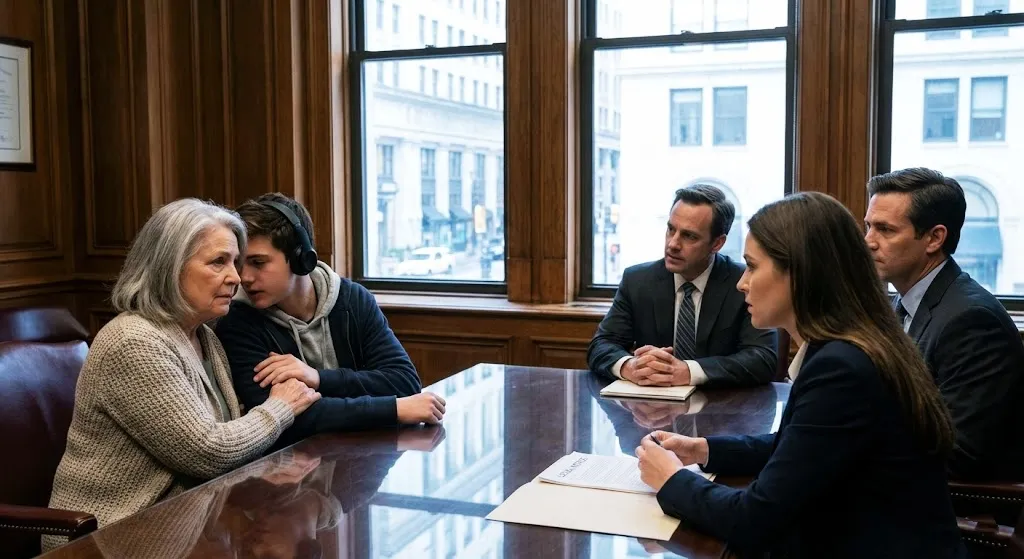

Sometimes, the specific threat that ends a life is precisely the one that experts are paid to overlook. Twenty of the world’s finest physicians could not save the billionaire dying in the penthouse suite, yet the woman who mopped their floors spotted exactly what they had missed. Victor Blackwell was rapidly deteriorating within the confines of his four-million-dollar hospital suite, a space that looked more like a five-star hotel than a medical facility. Machines beeped rhythmically and specialists frowned over clipboards, but death was approaching regardless of the world-class minds puzzling over his case.
Angela Beaumont slipped into the room, practicing the art of invisibility she had perfected over years of service. The night shift was a blessing in that regard; it meant fewer eyes to look through her as if she were made of glass. She inhaled the sterile mix of heavy antiseptic, expensive cologne, and something else—something faint and metallic that didn’t belong. Her mind, trained in chemistry long before she ever picked up a mop, jolted with sudden recognition.
She froze near the bed, her eyes locking onto the patient. She noted the distinct yellowing of his fingernails, the specific, patchy pattern of his hair loss, and the subtle, dark discoloration along his gum line. Her heart began to race against her ribs. The answer crystallized in her mind with the clarity of high-grade laboratory glass, terrifying and undeniable. She knew exactly what poison was killing him, but she also knew the crushing reality of her station: who would listen to a housekeeper when twenty specialists had already failed?
Johns Hopkins Medical Center housed many secrets, but none were as guarded as the ultra-luxury wing where wealth purchased privacy. Victor Blackwell’s suite was a testament to this, with medical equipment cleverly disguised behind mahogany panels and soft, ambient lighting. The tech billionaire had paid for exclusivity, demanding America’s top diagnostic minds solve the mystery of his decline. Angela methodically dusted the room’s expensive surfaces, her movements efficient and economical, born of the necessity of a single mother working the night shift.
Yet, while her hands worked, her eyes missed nothing, categorizing symptoms and analyzing patterns that the doctors, in their search for complex diseases, had overlooked. Ten feet away, Dr. Thaddeus Reynolds addressed his team of specialists. He was silver-haired, Harvard-educated, and possessed a voice that never needed raising to command absolute attention. “Gentlemen, we’ve exhausted conventional pathways,” he stated, frustration edging his tone. “Mr. Blackwell’s symptoms defy standard diagnosis. His liver function continues to deteriorate, and neurological symptoms are worsening. We must consider more exotic approaches.”
Angela kept her head down, scrubbing a stain, but her ears remained open. She had learned this skill in college, absorbing complex lectures while taking meticulous notes, back before life had brutally intervened. Fifteen years ago, Angela had been the star of her chemistry department, a scholarship student on the fast track for medical research. Then came the accident that took her parents, leaving her with three younger siblings to support. She had withdrawn mid-semester, promising to return, but the demands of survival had never allowed it.
“The cleaning staff needs to finish quickly,” Dr. Reynolds announced, his eyes sliding over Angela without truly seeing her. “We have important matters to discuss.” His words dismissed her presence without directly addressing her, a slight she had grown accustomed to. Angela nodded, keeping her face neutral despite the familiar sting of being treated as an obstacle rather than a human being. They saw the uniform, the cart, and the mop, never suspecting the sharp scientific mind that lay behind them.
She had maintained her passion for chemistry through the years, devouring library books, watching online lectures, and reading scientific journals during her lunch breaks. She possessed knowledge without credentials, a dangerous combination in a hospital hierarchy. As she wiped the final surfaces, Angela’s eyes caught Blackwell’s chart left on a counter. She noted the puzzling symptoms: peripheral neuropathy, alopecia, digestive issues. To the doctors, these were classic presentations misattributed to separate conditions, but to Angela, they formed a coherent picture.
Dr. Reynolds swept past her, brushing her aside without acknowledgment to consult with a colleague. Angela stepped back, becoming part of the wall, the furniture, the background noise. Dr. Reynolds walks past me every day like I’m a coat rack, she thought, a bitter realization settling in. That’s why he never notices what I see. Her gaze shifted to Blackwell’s personal items, specifically the expensive grooming products arranged neatly on the bathroom counter.
The hand cream stood out—an imported, exclusive brand she recognized as high-end. She noted that its position had changed since yesterday; someone had moved it, and it sat prominently on the nightstand now. Angela filed the observation away, knowing that in chemistry, small inconsistencies often revealed the grandest answers. The suite door opened, and a well-dressed man entered. Angela recognized him immediately from the business magazines she read: Jefferson Burke, Blackwell’s former rival turned supportive friend during this illness.
“Victor’s resting,” Dr. Reynolds informed the visitor. “His condition hasn’t improved.” Burke nodded solemnly. “I brought his favorite hand cream,” Burke replied, placing an elegant black jar on the nightstand. “It’s imported from Switzerland. Small comfort, I know, but he insists it’s the only brand that doesn’t irritate his skin.” Angela watched closely as Burke positioned the jar, ensuring it was the most accessible item on the table.
Something in his careful placement triggered her analytical mind; it was too deliberate, too insistent. Later, as she cleaned an adjacent room, Angela overheard two residents discussing Blackwell’s case in hushed tones. “Strangest symptom progression I’ve ever seen,” the first said. “It’s like he has multiple conditions simultaneously.” The second replied, “Reynolds thinks it’s an autoimmune cascade, but the tests keep coming back inconsistent. Meanwhile, the richest man in tech circles gets weaker while we chase theories.”
Angela paused, wringing out a cloth, connecting the fragments in her mind. The symptoms, the mysterious decline that defied standard treatment, and the expensive hand cream that appeared with clockwork regularity. A hypothesis formed, terrifying in its implications, but she needed more observation to be sure. That night, she adjusted her cleaning schedule to include Blackwell’s room specifically during his sleeping hours.
She studied his chart updates whenever the nurses looked away, noting new symptoms that further confirmed her suspicions. The pattern was becoming unmistakable to someone with her specific background in toxicology. As her shift finally ended, Angela stared at her reflection in the employee bathroom mirror. She saw a practical, forgettable uniform and a face that was tired but still sharp with intelligence. “They don’t see me,” she whispered to the empty room. “But I see everything.”
The alarms erupted at 2:17 AM. Angela heard the “Code Blue” announcement while cleaning the adjacent room and froze. Doctors rushed past her, their lab coats flying. Victor Blackwell had deteriorated suddenly. She paused her work, her heart racing with a mix of fear and adrenaline. Through the partially open door, she watched the emergency unfold. “Liver enzymes critical, kidney function dropping, neurological responses diminished,” a resident reported, his voice tight with tension.
Dr. Reynolds strode in, immediately taking command of the chaos. “Full toxicology panel, again! Something’s causing this cascade failure.” Angela edged closer to the doorframe, drawn by both human concern and scientific curiosity. The medical team worked frantically, monitors beeping faster, nurses rushing with medications. “Could it be environmental?” suggested Dr. Park, a younger physician with a thoughtful face. “Something in his food, water, or personal products?”
Dr. Reynolds dismissed the suggestion with a cutting glance. “We’ve tested everything in this room twice. Focus on medical possibilities, not amateur detective work.” Dr. Park shrank back, silenced. The team continued their urgent intervention, eventually stabilizing Blackwell temporarily. As the crisis subsided and the doctors dispersed for consultations, Angela found an opportunity to slip into the room to empty the trash.
She checked his chart quickly, memorizing the new data points. Then her eyes returned to the bathroom counter and the hand cream. Something about the faint, iridescent sheen on the jar’s rim triggered a specific memory from her university days—a lecture on heavy metal poisoning. Angela moved closer, examining Blackwell’s fingernails as he slept. The discoloration pattern was subtle but distinctive, known as Mees’ lines.
She noted the particular quality of his hair loss and recalled the reported abdominal pain. She inhaled sharply. The symptoms matched thallium poisoning exactly as described in her old toxicology textbook. Could twenty specialists really have missed something so classically presented? Angela hesitated, then approached Sarah, a night nurse she had built a friendly rapport with over the years. “Excuse me,” Angela said quietly. “Has anyone checked Mr. Blackwell for thallium poisoning? His symptoms match exactly.”
Sarah’s expression shifted from friendly fatigue to dismissive annoyance. “Angela, I know you mean well, but please, these are the country’s top specialists.” Angela persisted. “But the pattern of—” Sarah cut her off, her voice cooling. “If you’re done eavesdropping, the bathroom needs cleaning. Leave the medicine to the doctors.” Angela stepped back, her cheeks burning with humiliation. She returned to her cart, the familiar weight of dismissal settling heavily on her shoulders.
But as she wheeled her cart down the corridor, certainty crystallized in her mind. She knew what was killing Victor Blackwell. The only question remaining was whether she would risk her job to make someone listen. Her thoughts raced through the possibilities. In her undergraduate toxicology course, thallium had been presented as the “poisoner’s poison”—colorless, odorless, and tasteless, difficult to detect unless specifically sought. She completed her shift mechanically, her mind entirely focused on Blackwell’s declining condition.
At home, she pulled an old textbook from her small but treasured collection, salvaged from her university days. The chapter on heavy metal poisoning confirmed every suspicion she held. Thallium was absorbed through skin contact, causing systemic damage while mimicking numerous other conditions. The next morning, Angela arrived early, determined to find a way to make someone listen. She watched as Jefferson Burke visited again, bringing another jar of the exclusive hand cream.
The routine was always the same: insisting it was the only brand Blackwell would use, and personally applying some to the sick man’s hands to show its quality. It was the perfect delivery system for a slow, deliberate poisoning. Angela weighed her options carefully. A direct confrontation would be dismissed immediately, as Sarah had demonstrated. She needed evidence—irrefutable proof that even Dr. Reynolds couldn’t ignore.
Victor Blackwell was running out of time, deteriorating by the hour. Angela checked his status through whispered conversations between nurses and glimpses of updated charts. During her break, she used the hospital’s public computer to research further. The symptoms aligned perfectly: the specific pattern of hair loss, the peripheral neuropathy progressing upward, the distinctive gastrointestinal issues. But why hadn’t it been detected? She scribbled a note on hospital stationary: Check for thallium poisoning, classic presentation.
She left the note on Dr. Reynolds’ clipboard while cleaning his office, hoping anonymity would lend the suggestion weight. The next morning, she arrived early and positioned herself near the doctor’s meeting room. Through the partially open door, she heard Dr. Reynolds’ voice, dripping with audible derision. “And apparently,” he said, “our cleaning staff has diagnostic opinions.” Laughter rippled through the room.
“Someone left an anonymous note suggesting thallium poisoning,” another doctor responded, chuckling. “We tested for heavy metals in the initial workup.” Reynolds dismissed it with a wave of his hand. “Exactly. Standard procedure. Cleaning staff playing detective. Next, they’ll be performing surgery.” Angela’s chest tightened, and her hands gripped her cleaning cart until her knuckles turned white. The dismissal stung deeply, but the patient’s life mattered more than her pride.
She formulated a new approach. Dr. Park, the younger physician, seemed more approachable than the others. During her afternoon shift, Angela timed her cleaning to intercept him in the hallway. “Excuse me, Dr. Park,” she began, her voice steady despite her racing heart. “About Mr. Blackwell. I believe he’s suffering from thallium poisoning. The symptoms match perfectly.” Dr. Park’s expression shifted from surprise to discomfort.
“That’s an interesting theory,” he said politely, “but we’ve tested for heavy metals.” Angela pressed on. “Standard tests might miss it if it’s being administered consistently in small doses. It’s in his hand cream.” He checked his watch, looking for an exit. “I appreciate your concern, but I need to be somewhere. Perhaps mention it to the nursing staff.” He walked away quickly. Angela stood alone in the hallway, invisible once more.
Later that evening, the head of security approached her as she cleaned the lobby. “Ms. Beaumont, we’ve had reports of you interfering with medical matters. This is a warning. Know your boundaries, or there will be consequences.” Angela nodded, her throat tight. She needed irrefutable proof. Gathering it meant crossing lines that could cost her the job her family depended on, but she couldn’t let a man die when she held the answer.
That night, alone in the employee break room, Angela made her decision. Victor Blackwell had perhaps days left. Her job security couldn’t outweigh a human life. She formulated a plan, drawing on chemistry knowledge that had lain dormant but never disappeared. She would need cleaning supplies, access to the lab, and perfect timing. Tomorrow, she would force them to see what they’d missed, or she would lose everything trying.
Jefferson Burke visited again that afternoon, staying only fifteen minutes but ensuring the hand cream was prominently placed. Angela observed from the hallway, noting how he encouraged the day nurse to apply it to Blackwell’s hands and arms. After Burke left, Angela performed routine cleaning in Blackwell’s bathroom. She studied the hand cream’s container; the expensive packaging revealed nothing, but the cream itself had that faint metallic sheen.
With practiced efficiency, Angela transferred a small amount of cream into a sterile specimen container she’d acquired from the supply room. The sample disappeared into her uniform pocket. That evening, Angela picked up her children from her neighbor’s apartment. Twelve-year-old Marcus and fourteen-year-old Tasha had grown accustomed to her exhaustion. “Mom, are you okay?” Tasha asked, noting Angela’s distraction. “Just a complicated situation at work,” Angela replied, forcing a smile. “Nothing for you to worry about.”
After the children were asleep, Angela spread her materials across the kitchen table: her old toxicology textbook, printouts from medical journals, and notes on Blackwell’s symptoms. The pattern was undeniable to trained eyes. Why couldn’t twenty specialists see it? Because thallium poisoning was rare, almost archaic, a throwback to old spy novels. They weren’t looking for it because no one expected a billionaire to be slowly poisoned by a trusted friend. And because no one listened to housekeepers.
Angela stared at her cleaning uniform hanging on the door, the physical embodiment of her invisibility. Tomorrow, she would risk everything to pierce that invisibility. She arrived early for her shift, carrying a small bag alongside her usual supplies. Inside were baking soda, aluminum foil, and small containers borrowed from the cafeteria—innocent items that, combined with standard cleaning solutions, could create a rudimentary but effective test for thallium.
Her first task was to collect evidence. During morning rounds, Angela timed her cleaning to overhear Blackwell’s latest symptoms. The progression matched perfectly: worsening neuropathy affecting speech, distinctive hair loss, rapid deterioration. She carefully collected another tiny sample of the hand cream. In a maintenance closet, Angela worked quickly, mixing solutions with practiced precision. The makeshift chemistry setup looked nothing like sophisticated hospital equipment, yet the principles remained sound.
She had performed similar tests in university labs, earning top marks for accuracy with minimal resources. The test result was immediate and damning: a specific precipitate formed, confirming the presence of thallium. She photographed the results with her phone. Next, Angela reviewed Blackwell’s visitor log, noting the pattern. Jefferson Burke’s visits always coincided with an escalation of symptoms. At 2:00 PM, Angela learned of an emergency conference in Blackwell’s suite. All specialists would be attending.
It was perfect timing. She changed into a freshly laundered uniform, straightened her badge, and gathered her evidence: test results, visitor logs, symptom timelines, and research printouts. Angela rehearsed her explanation mentally, drawing on knowledge from textbooks memorized years ago. She walked to the suite where the doctors were gathered, tension evident in their postures. Dr. Reynolds stood at the center, presenting the latest failed interventions.
Angela knocked once and entered without waiting for permission. Twenty pairs of eyes turned toward her. Dr. Reynolds’ expression shifted from surprise to irritation. “This is a closed medical conference. Please come back later.” Angela’s voice was steadier than her heartbeat. “Mr. Blackwell is dying of thallium poisoning,” she stated clearly. “I can prove it.”
Dr. Reynolds’ face hardened. “Security,” he began. Angela stepped forward, placing her evidence on the table. “The symptoms match perfectly,” she continued, ignoring him. “Progressive ascending peripheral neuropathy. Distinctive alopecia. Abdominal pain. Cognitive decline. It is a classical presentation.” She pointed to her photos. “I confirmed thallium presence in his hand cream, the imported Chamberlain brand he uses daily.”
“Absorption is through the skin, leading to slow poisoning over months,” she explained. “This is absurd,” Dr. Reynolds snapped. “You’re a housekeeper, not a physician.” Angela met his gaze levelly. “I was a chemistry honors student at Johns Hopkins before personal circumstances intervened. The poison is being introduced through the hand cream brought by Jefferson Burke. The timeline matches symptom progression perfectly.”
She laid out her evidence methodically. “Standard heavy metal panels might miss it because the poisoning is gradual, maintaining levels just below typical detection thresholds. But the cumulative effects are textbook.” Complete silence fell over the room. Dr. Reynolds opened his mouth to object, then closed it, examining her evidence more closely. Dr. Park leaned forward. “This actually makes perfect sense with the symptom progression,” he murmured. “The tests we ran might indeed miss gradual exposure.”
Another specialist nodded slowly. “The hair loss pattern and neuropathy presentation are consistent with thallium toxicity.” The silence deepened as twenty specialists confronted what they had missed—and who had found it. “It’s thallium poisoning,” Angela concluded quietly. “The symptoms are textbook if you know what to look for.”
Dr. Winters, the toxicology specialist, looked at her makeshift test results. “How exactly did you test for this?” he asked. “Sodium rhodizinate reaction,” Angela replied without hesitation, “modified for field testing with limited resources. The color change is unmistakable when thallium ions are present.” Dr. Winters raised an eyebrow, impressed. “That’s an advanced technique. It was covered in Professor Harrison’s advanced toxicology methods course,” Angela responded. Recognition flickered across several faces; Harrison was a legend.
“You were his student?” Dr. Park asked. “For one semester,” Angela answered, the old regret briefly visible. “Before I had to withdraw.” Dr. Reynolds examined her improvised test results with grudging attention. His expertise couldn’t deny the evidence before him, however unorthodox its source. “The concentration pattern suggests deliberate, sustained exposure,” Angela continued. “Each application delivers a sublethal dose that accumulates in tissues.”
The specialists began asking technical questions, which Angela answered with precise scientific terminology. With each response, her invisibility diminished. They were seeing her now—not her uniform, but her mind. “Run a focused thallium test immediately,” Dr. Park ordered, breaking the stunned silence. Two specialists rushed to comply. Dr. Reynolds remained frozen, staring at Angela’s data. “If you’re correct,” he said, his voice strained, “we’ve been poisoning him further with our treatments.”
“The chelation therapy would be ineffective,” Angela confirmed. “He needs Prussian Blue immediately to bind the poison.” A nurse returned breathless minutes later. “Rush toxicology confirms thallium at significant levels,” she announced. The room erupted in controlled chaos. Orders flew, protocols shifted, and security was contacted regarding Jefferson Burke. “The security footage,” Angela suggested. “Check when Burke delivered the hand cream. He likely applied some himself to establish trust.”
“Already requested,” Dr. Park nodded. “But how did you…?” Angela explained, “The pattern was clear once I looked for it. Mr. Burke always brought the same gift. Mr. Blackwell’s condition always worsened afterward.” The hospital security officer entered moments later. “We’ve reviewed the footage. Burke manipulated the cream when alone in the room. We’ve contacted the FBI.”
Prussian Blue treatment was administered immediately. Additional blood work confirmed Angela’s diagnosis completely. The room’s energy transformed from desperate resignation to focused hope. Three hours later, Victor Blackwell’s vital signs stabilized for the first time in weeks. Angela stood quietly by the wall, her presence momentarily forgotten in the flurry. Dr. Reynolds approached her, his tall frame seeming less imposing now. “Your intervention was…” he paused, struggling, “…completely correct.”
“How did you see what twenty specialists missed?” he asked, genuine confusion in his voice. “I’m invisible,” Angela replied simply. “I observe without being observed. I see patterns without preconceptions. And I never forgot my training.” Dr. Reynolds nodded slowly. “I owe you an apology. We all do.” Before he could continue, monitors indicated Blackwell was regaining consciousness.
“What happened?” Blackwell whispered hoarsely. Dr. Reynolds stood at his bedside. It was a critical moment of choice. He straightened his shoulders. “You were being poisoned with thallium, Mr. Blackwell. We missed it. All of us.” He turned toward Angela. “This is Angela Beaumont. She solved what twenty specialists couldn’t.”
Every eye turned to the housekeeper. Blackwell’s weak gaze found her. “Thank you,” he whispered, “for seeing what they missed.” The silence broke as Dr. Park began to applaud. Others joined until the sound filled the room. Angela stood taller, her expertise finally visible. The invisible barrier between medical staff and support personnel had cracked irreparably.
FBI agents arrived within the hour. They spoke with hospital security and requested statements. “You identified the poison, the delivery method, and the suspect through observation alone?” Agent Ramirez asked Angela, treating her with professional deference. “I recognized the symptom pattern and confirmed it through chemical testing,” she explained. The agent looked impressed. “Your observation likely saved Mr. Blackwell’s life.”
Dr. Park approached Angela later with a cup of coffee. “You should sit. You’ve been standing since this began.” The simple courtesy symbolized the shifting dynamics. “Your chemistry background… what was your focus?” he asked. “Toxicology and organic analysis,” Angela replied. “I was researching detection methods for environmental contaminants.” Dr. Park smiled. “You would have made an exceptional diagnostician.” “Life had other plans,” she responded without self-pity.
As she prepared to complete her shift, Dr. Reynolds intercepted her. “Ms. Beaumont,” he began awkwardly, “hospital administration has authorized paid administrative leave while you assist with the investigation.” The subtext was clear: they couldn’t have a housekeeper who had outsmarted the entire medical board scrubbing floors the next day. Angela nodded, understanding the complex recalibration occurring. “I’ll finish my current duties first.” Dr. Reynolds looked startled, then nodded with newfound respect.
When she finally left the hospital that evening, Angela looked up at the illuminated windows of Blackwell’s suite. Inside, the billionaire was recovering. The thought brought simple satisfaction—the clean resolution of a complex problem. Over the following days, the story spread. “Housekeeper solves medical mystery” became the whisper in every corridor. People saw her now, not just her function, but her capability.
One month later, Angela received a message that seemed surreal. Victor Blackwell requested her presence in his office. She arrived at Blackwell Innovations, escorted to the executive floor with deference. Blackwell looked thinner but very much alive. “Ms. Beaumont,” he greeted her, rising. “Please sit. I’m alive because you saw what others missed.”
He slid a folder across the desk. “Dr. Reynolds explained your background. Intelligence shouldn’t be wasted. I’ve established a foundation to support brilliant minds facing financial barriers. You are the first recipient.” Inside was documentation for a full scholarship to complete her chemistry degree, including a living stipend and guaranteed placement at Johns Hopkins Toxicology Department. “This isn’t charity,” Blackwell said. “It’s an investment.”
“My children…” Angela began. “The stipend covers childcare,” Blackwell assured her. “Are you ready to reclaim your interrupted path?” That evening, Angela told Marcus and Tasha the full story. “You saved a billionaire, Mom?” Marcus asked, wide-eyed. “I used knowledge I never stopped building,” she corrected gently. “And now we have a new chapter.”
Two weeks later, Angela entered Johns Hopkins through the main doors, student ID in hand. Dr. Reynolds nodded respectfully when they passed in the hallway. Dr. Park had become a mentor. On her first day assisting with a toxicology case, Angela stood in the lab, surrounded by equipment she once cleaned. She picked up a patient file, bringing to it the unique perspective of someone who understood that wisdom could be found in unexpected places.
Years later, at her graduation, Angela accepted her diploma while her children cheered. Dr. Park raised a toast at a small dinner that evening. “To Dr. Beaumont, who taught an entire hospital to see.” In her new office, Angela kept a small photo of herself in her uniform—not as a reminder of dismissal, but as a badge of the unique strength gained from years in the shadows. Her phone rang. “This is Dr. Beaumont,” she answered, her voice carrying the quiet confidence of someone who had proven her worth beyond all doubt. “How can I help you?”
The title felt right earned through unconventional pathways, but no less valid for the journey taken.
And as she listened to the case details, Angela recognized patterns and possibilities others might miss. Her mind connecting dots that remained invisible to those who had never learned to see from the shadows.