Snow drifted down in heavy, deliberate flakes, as though the heavens had decided to drape the entire city in a thick white shroud, muffling every trace of exhaustion and heartache beneath it.
Emily Johnson paused just outside the sliding glass doors of the medical center, the slim envelope clutched tight in her numb fingers. Her hands weren’t shaking; from the outside she still looked perfectly put-together, the way she always did before a pitch or a tense boardroom showdown.
But somewhere deep beneath that polished armour a cold knot of dread had started to twist. Inside this envelope, buried among sterile clinical phrases, waited her verdict: glioblastoma, stage four. That was all. Curtains.
She took one step forward and her legs felt poured in concrete. A gust whipped around the corner, sharp as broken glass, slapping her cheeks, tugging at her hair, clawing at the collar of her coat. Emily didn’t flinch. Cold no longer registered. Pain didn’t either. Where her mind once raced with quarterly projections, supply chains, and currency fluctuations, there was now only a low, syrupy drone: endless, suffocating.
Snow melted into the wet pavement and soaked through the soles of her Italian leather boots, leaving pale salt stains she once would have found unforgivable. Now it hardly mattered. The sky and the city blurred into one dull grey smear.
Bare tree branches clawed at the air like the gnarled fingers of some ancient crone pleading for mercy. Emily glanced up and felt an odd kinship: those brittle limbs and her own body suddenly seemed cut from the same fragile cloth, both teetering on the edge of breaking.
People streamed past: shopping bags swinging, earbuds in, kids tugging at sleeves, dogs straining at leashes, each headed somewhere that still mattered. Emily had nowhere left to go. No calendar alerts, no flights to catch, no tomorrow circled in red. Just the diagnosis burning a hole through her coat pocket.
She slowed in front of a toy-store window where a mechanical Santa waved on an endless loop while fake snow swirled inside the glass. Once that sight would have earned a wry smirk; now it tasted like ash. Who would bother sending her a Christmas card this year? Who even remembered she was still breathing?
The corner office on the thirty-second floor, the Forbes list, the private chef, the temperature-controlled wine cellar, the abstract paintings worth more than most people’s houses: suddenly it all looked less like success and more like props from someone else’s dream.
A city bus rumbled past and hurled a wave of filthy slush across her calves. She didn’t turn, didn’t curse. Nothing seemed worth the energy anymore.
In this strange, stripped-down clarity everything extra fell away: stock prices, designer labels, even her own name.
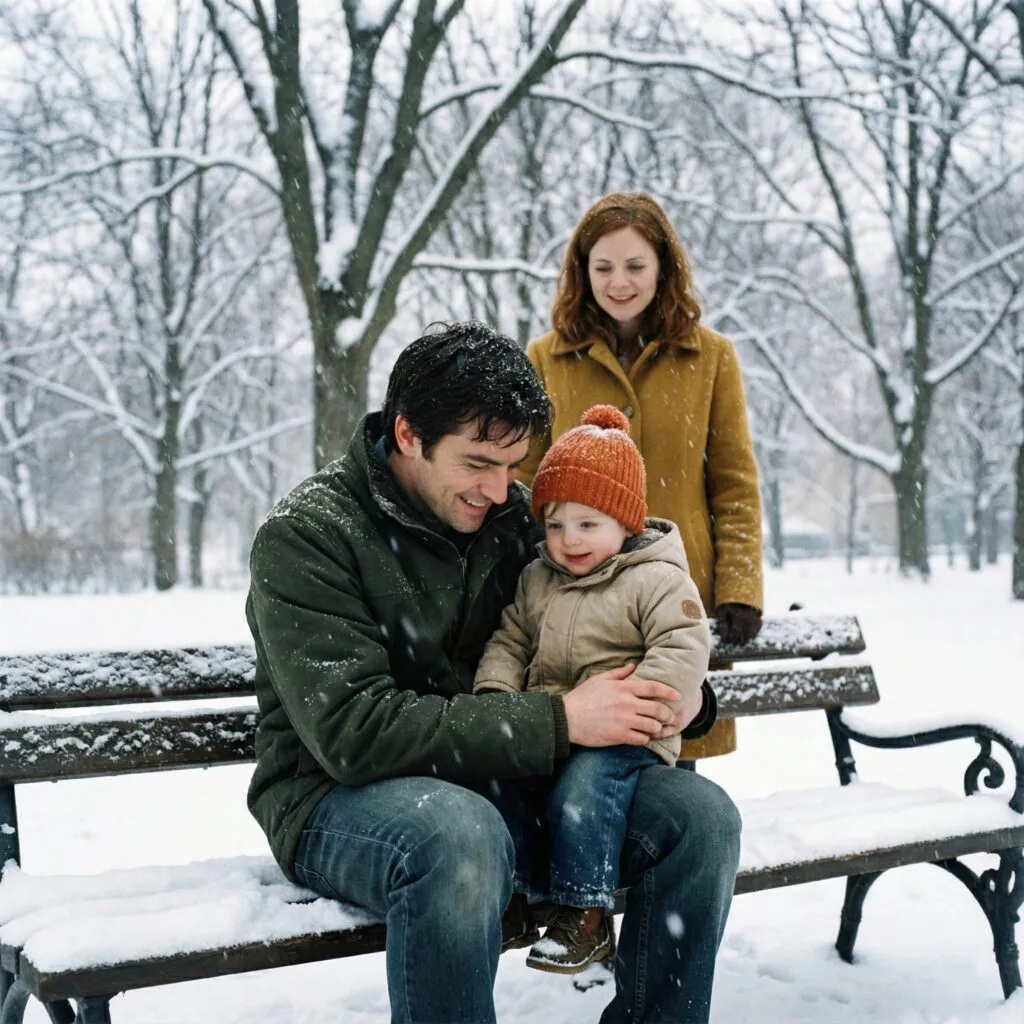
When she reached the little park, her feet slowed of their own accord. Beneath a flickering streetlamp, half-buried in fresh snow, sat a man and a small boy on a bench that looked more like forgotten scenery than a place for living people. The man had pulled the child close, as if his arms alone could keep the whole cruel world at bay. Snow already dusted their shoulders and capped their hair; they were turning into statues before her eyes.
Emily knew instantly they weren’t resting. They were simply out of places to be.
The boy couldn’t have been more than six: sharp little face, nose bright red, eyes enormous and ancient with worry. One mitten dangled from a cord like a broken promise. The man looked even more worn: unshaven, lips cracked, gaze carrying more sorrow than any one person should have to hold. They wore thin jackets that wouldn’t have kept out an autumn breeze, let alone this kind of cold.
She walked over without planning what she’d say. Something inside her chest contracted, a feeling so old she barely recognised it.
“You can’t stay out here,” she heard herself say, voice softer than she expected. “The little one: he’ll freeze.”
The man lifted his head slowly. No anger in his eyes, just bone-deep tiredness and the last scraps of pride. “Where else is there?” he asked, the words scraping out rough and low.
Emily swallowed hard. She had asked herself the same question at least a dozen times in the last hour.
“Home?” she offered, already knowing the answer.
A faint, bitter smile tugged at his mouth: no malice, just fact. “We had one once.”
The boy stayed quiet, staring straight ahead like cold and silence were the only things he trusted anymore.
“What’s his name?”
“Ethan,” the man said. “I’m David.”
“How long have you been sitting here?”
“Since yesterday afternoon. Tried the shelters first. With a kid and no paperwork… doors stay closed.”
A surge of fury rose in her throat: not only at the faceless system she herself had once defended as “necessary,” but at years of walking past people like this without ever really seeing them.
“Come with me,” she said quietly. “I’ve got heat. Tea. Blankets. The boy needs to get warm.”
David studied her for a long moment, then glanced down at his son. Ethan gave the tiniest nod, as if the decision belonged to him. Only then did David stand, lifting the child carefully against his chest. Ethan weighed almost nothing: far too little for his age.
Emily started walking. She reached out: not the crisp, professional handshake she gave investors, but an open palm, human and unguarded. For the first time in years someone took her hand not because protocol demanded it, but because they wanted to.
They moved through the falling snow together, their footprints quickly erased behind them, as if the city itself wanted to keep this moment secret.
David’s steps dragged; it wasn’t the cold slowing him: it was the hollow place where hope used to live. He hadn’t leaned on anyone in so long he’d forgotten how. And now he was following a stranger whose coat alone probably cost more than everything he’d owned in the past year. Yet there was no pity in her eyes, no superiority: just steady resolve.
Ethan had buried his blue-tinged face in his father’s neck, breath coming in uneven puffs, but he never once complained.
Emily walked a little ahead, stride even and sure, the way women walk when they’ve never had to doubt the ground beneath them.
The silence between the three of them wasn’t awkward; it was thick, full of separate storms.
Her driveway was empty when they arrived. She had already phoned Mrs. Harris with clipped instructions: guest room ready, extra blankets, heat turned up high. Normally the housekeeper peppered her with questions; tonight she simply said, “Yes, ma’am,” hearing something different in her employer’s voice.
Emily pushed open the front door and warmth rolled over them, carrying the scent of cinnamon and fresh baking. Ethan lifted his head, sniffed once, and something flickered across his small face: hope, fragile as a soap bubble.
David froze in the entryway, eyes sweeping the soaring ceiling, the polished floors, as if waiting for someone to shout that it was all a mistake.
“You can stay,” Emily said, trying to sound matter-of-fact so she wouldn’t frighten them away. “As long as you need. Until things get sorted.” She paused. “Are you hungry?”
No answer came, but she already knew the truth: hunger had stopped being about empty stomachs a long time ago.
“There’s soup on the stove,” she added gently. “Shower’s down the hall. Clean towels. Whatever you need.”
David stayed pressed against the wall, disbelief written all over him. “Why are you doing this?” he asked, voice barely above a whisper.
She met his eyes: really looked at him: and answered softly, “Because today I found out I don’t have any ‘later’ left either.”
Ethan slipped down from his arms and stood clutching his father’s leg, staring up at Emily the way children stare at storybook rescuers: quiet, wary, but unable to look away.
They followed her into the kitchen where steaming bowls already waited alongside thick slices of bread and a pot of tea. Mrs. Harris took one professional glance at the pair, sized up the situation the way only decades of service teach you to do, and simply nodded. No fuss, no questions.
Ethan stood uncertainly until David whispered, “Go ahead, buddy. Eat.” Only then did the boy climb onto a chair and begin: slow, careful bites, as though loud chewing might make it all disappear.
“Hot shower’s through there,” Mrs. Harris murmured to David. “I’ll find something that fits. My late husband left a few things.”
When David came back: hair damp, wearing an oversized but clean sweater: he looked ten years younger and completely lost. Emily led them upstairs to a guest room that felt more like a quiet embrace: wide bed, soft lamplight, thick duvet already turned down. She set a basket of folded clothes by the door, murmured goodnight, and pulled the door almost closed behind her.
Downstairs she poured herself tea and stared out at the endless snow. Without thinking she traced a finger through the fog on the window and wrote: Not the end yet.
Upstairs, under the gentle glow of the nightlight, Ethan curled into a tight ball and fell asleep almost instantly, cheeks finally pink again, breath slow and even.
David couldn’t sleep. He sat in the armchair by the window watching snow pile against the glass. A strange warmth was creeping back into him: not from the radiator, but from somewhere deeper. Yet every time he almost believed it, another voice hissed that nothing this good ever came without a price.
At dawn he finally dozed off, still upright in the chair, exhaustion winning over suspicion.
He woke to the smell of real coffee. Mrs. Harris’s voice floated in: “Breakfast is ready. The boy still sleeping?”
“Yeah,” David croaked, stretching stiff muscles. “Thank you.”
“Thank Emily Johnson,” she replied briskly, though her tone carried something warmer beneath it. “I just follow orders.”
The kitchen table looked like a magazine spread: oatmeal swirled with berry jam, warm rolls, sliced apples arranged in a fan, tea steaming in real cups. Ethan whispered, “Can I?” as though the food might vanish if he spoke too loudly.
David’s throat closed. “Of course, buddy. Wash your hands first.”
In those ordinary motions: drying his hands on a proper towel, carefully laying a napkin on his lap: David glimpsed the ghost of the normal life they’d almost lost forever.
Emily appeared around nine, barefoot in a cream cashmere sweater and soft trousers, hair loose, no makeup. She looked less like a corporate titan and more like someone you could actually talk to.
Ethan spotted her and half-rose from his chair, afraid he was in trouble.
“It’s okay,” she said, smiling the first unguarded smile David had seen from her. “Finish your breakfast.”
David stood. “Thank you. I don’t know how to:”
“No speeches at the table,” she cut in gently. “It’s just oatmeal, not a merger.”
He sat back down, cheeks warm, feeling suddenly off-balance. This woman didn’t treat him like a charity case; she treated him like a person.
After breakfast she suggested a walk in the garden. The snow had stopped overnight, leaving the world hushed and sparkling under weak winter sun.
Ethan raced ahead, stomping prints, shouting when he discovered tiny squirrel tracks near the gazebo.
David walked slowly, half-convinced he’d wake up any second back on that bench.
“He’s got light in his eyes again,” Emily said quietly, falling into step beside him. “You’re a good dad.”
He gave a short, bitter laugh. “Some dad. No home, no money:”
“From the world?” she finished when he stopped.
“From myself,” he muttered. “From every bad call, from poverty, from… everything.”
They reached a bench and sat. Ethan ran circles around them, leaving a spiral of footprints.
“I thought I had it all,” Emily said, voice low. “Turns out yesterday I learned I actually have nothing.”
David looked at her. For the first time he noticed the faint shadows under her eyes, the way her hands kept still in her lap like she was holding something invisible together by sheer will.
“You have a son,” she went on. “All I ever had were spreadsheets and red-eye flights. And not one person I could call just to talk.”
“And now?” he asked.
She gave a small, sad smile. “Now I want to spend whatever time is left doing something that actually matters.”
Something passed between them: not pity, not attraction exactly, but recognition. Two people who’d each lost everything in different ways, suddenly seeing the shape of it in the other’s eyes.
“We won’t impose long,” David said quietly. “Soon as I find work, we’ll get a room somewhere.”
“You’re not an imposition,” she answered firmly. “Sometimes people just need a corner of warmth to remember who they are.”
Mrs. Harris, for the first time in years, let herself sit in the good armchair before ten a.m. She watched David help Ethan with mittens, listened to the boy chatter about imaginary winter fairies, saw David actually laugh: a real, unguarded laugh that reached his eyes. Something softened in the housekeeper’s face.
“You know,” she said suddenly, “he believes in you.”
David turned. “Who: Ethan?”
“Him. And her.” She tipped her head toward the glass-walled office where Emily stood on a call, gesturing sharply. “She never brings anyone into this house. Not friends, not lovers, nobody. And she brought you.”
David opened his mouth, but nothing came out. Mrs. Harris stood, smoothing her apron. “Just something to think about.”
That afternoon Emily closed herself in her office. The heavy door clicked shut, sealing out laughter and clinking dishes and the small ordinary sounds of people existing together. Inside, only the desk lamp glowed over lab reports, scans, the word “metastases” stamped across pages like a death sentence in triplicate.
She felt no physical pain yet: just a strange, icy distance, as if the disease had already started erasing her from the inside out.
On a side table sat an old photograph: a little girl with crooked braids hugging a man in uniform. Her father. Dead when she was seven. Ever since, she’d done everything alone.
That evening, after Ethan was asleep, Emily found David in the living room nursing a mug of tea.
“I need to understand something,” she said, sinking into the opposite chair. “You could have kept walking that night. Why stay?”
He thought about it. “All my life I thought real men figure it out alone. Pull yourself up by your own bootstrasts and all that. Turns out when the swamp’s deep enough, bootstraps snap.”
She waited.
“I was a builder. Decent money sometimes. Then one client skipped town owing me six figures. Bank froze everything. My wife…” His voice cracked. “Blood clot. Two weeks from diagnosis to goodbye. COVID rules: they wouldn’t even let us into the hospital room at the end.” He swallowed hard. “After that it all unravelled. Apartment gone. Friends vanished. Family’s got their own problems. Nobody wants a broke single dad and a five-year-old.”
Emily leaned forward. “I know what it’s like to be needed by everyone but wanted by no one. The second you stop being useful, you’re invisible.”
“I just don’t want Ethan growing up thinking his dad’s a failure,” he said, voice raw. “He’s all I’ve got left.”
Something fierce and tender flared in her eyes. “You’re a better man than most who never lost a thing.”
The first days blurred into gentle rehabilitation. Ethan stopped flinching at sudden noises. He started singing made-up songs while colouring. David grew quieter, the old anxiety creeping back: this wasn’t his life. It was borrowed, and borrowed things always get reclaimed.
On the fourth morning he apologised over coffee and headed out into the frozen city to look for work. Everywhere the same polite or not-so-polite “no.” Coming home each night got harder. He’d force a smile for Ethan while his eyes gave away the defeat.
Emily noticed. Mrs. Harris noticed. Even Ethan seemed to walk softer around his father on those evenings.
Meanwhile Emily’s own body began sending quiet warnings: sudden weakness, a low constant hum in her skull. She blamed stress, weather, anything but the truth.
One dusk she came home to find David in the driveway shovelling the path in an old parka of hers, breath fogging, face set with stubborn pride.
“Job hunting?” she asked.
He leaned on the shovel. “Without proper ID they won’t touch me. We’ll be out of your hair soon.”
“Are you willing to freeze or drag your son back to the streets just to prove you’re noble?” she cut in, sharper than intended.
He looked away.
“Tomorrow someone will call,” she said more gently. “I made a few calls of my own. Documents fast-tracked. Ethan starts school next week. He needs a future, David.”
That same night she opened her laptop and read an urgent message from Olivia, her deputy: supply chain in chaos, need someone who actually understands real-world procurement.
She almost laughed. She’d just spent days watching exactly that person shovel her driveway out of pride.
She found Mrs. Harris folding laundry. “I think I may have found the hire we’ve been looking for for two years.”
The housekeeper raised an eyebrow. “David?”
“He just doesn’t know it yet.”
The day the new documents arrived David came through the door like a man who’d run a marathon and crossed the finish line. Eyes bright, shoulders squared, voice booming. “It’s done! Ethan’s enrolled for Monday, and I’m ready to work.”
Emily listened to him ramble, watched Ethan bounce around the hallway clutching his new backpack, and felt the moment she’d been waiting for arrive.
“I have a proposition,” she said when the excitement settled. “Come work for us. Supply department’s a mess. You know more about getting materials to a site on time and under budget than half my managers combined. And before you say charity: this is business. I need you.”
He stared, stunned. “In your company?”
“Mutual benefit,” she repeated firmly.
For the first time he didn’t see a saviour. He saw a colleague. An equal.
His first day felt like jumping off a cliff with no chute. Suits and skeptical glances everywhere. But David rolled up his sleeves, buried himself in contracts and price lists, and by day two had already shaved thousands off a shipping route nobody else had questioned. Within a week people started nodding hello in the hallway instead of looking through him.
Ethan blossomed: new friends, a teacher who called him “bright as a penny,” after-school robotics club.
Emily watched from the sidelines and felt her own hours growing thinner. Mornings were harder; sometimes the room tilted when she stood too fast. She kept the growing stack of medical reports locked in a drawer and pretended the calendar still belonged to her.
David noticed the new pallor under her makeup. “You should rest,” he said one evening. “We’ve got this.”
“There’ll be time for rest later,” she answered with a brittle smile. “Too much later.”
The weeks slipped by sweet and slow. The house that had echoed with silence now rang with footsteps, laughter, the clatter of breakfast dishes, Ethan’s endless questions, the soft “Tea?” that had become part of the evening rhythm.
She caught herself listening for David’s step in the hallway, lingering over the brush of his fingers when they both reached for the same coffee mug, memorising the way laughter changed his voice. And she saw him noticing too: the blanket that appeared across her lap on movie nights, the extra minute he let his hand rest on her shoulder.
She was terrified of the day one of them would say it out loud.
Because she already knew it couldn’t happen. Not ever.
“You want to take a trip?” David asked, eyebrows high, when she announced it over breakfast.
“Not just a trip,” Emily said. “Five days in Florida. Real ocean. Real sand. I want Ethan to remember something bigger than snow and empty benches.”
David laughed, startled, then looked at her more carefully. “You’ve never taken five days off in your life.”
“That’s the point.”
Mrs. Harris insisted on coming along “to keep the three of you from drowning in sunscreen and bad decisions,” and within forty-eight hours they were on a plane, Ethan’s nose pressed to the window, dolphin plushie clutched to his chest like a passport.
Florida was everything the brochures promised and more: salt wind, blinding light, the constant hush of waves. Emily felt the sun on her skin like forgiveness she hadn’t earned. They built crooked sandcastles, ate key-lime pie until their fingers stuck together, fell asleep to the sound of the Gulf breathing outside the balcony doors.
On the fourth morning she woke terribly dizzy. The room tilted when she sat up. She told herself it was the heat, the wine the night before, anything but the truth. By afternoon the dizziness had settled into a low, metallic hum behind her eyes. She kept smiling, kept taking photos, kept pretending.
That evening, after Ethan was asleep, she and David walked the shoreline barefoot. The tide pulled at their ankles.
“I need to tell you something,” she said quietly.
He stopped. The moon laid a silver road across the water.
“I’ve been lying by omission for weeks.” She took a breath that tasted of salt and endings. “You’re family, David. Second cousins. Our grandmothers were sisters. I found the birth records when we were restoring your documents. I should have said it the first night.”
He stared at her for a long time, waves rushing in and out between them.
“That’s why you asked if I could forgive someone who kept a secret out of love,” he said at last.
She nodded, tears slipping hot down her cheeks.
He reached out and brushed one away with his thumb. “Emily. Blood doesn’t cancel what we feel. It just… changes the shape of it. And whatever shape it is, I’m still grateful it exists.”
She leaned her forehead against his shoulder and cried the way she hadn’t since she was seven years old and they lowered her father’s casket.
The next morning she could barely stand. David carried her to the car, Mrs. Harris white-faced in the passenger seat, Ethan silent and huge-eyed in back. The local hospital confirmed what the scans back home had already whispered: bleeding in the brain, swelling, hours rather than days.
They flew her home on a medical jet. David held her hand the entire way; Ethan slept against his other side, clutching the dolphin whose blue felt had started to pill.
She lasted four more days.
Most of them she was lucid. She made David promise to keep the guest-room door open so Ethan wouldn’t be afraid of the dark. She signed papers that left everything: the house, the company, the foundation she’d quietly set up years ago: in trust for Ethan, with David as executor and guardian. She asked Mrs. Harris to stay on, “because somebody has to teach that boy how to make proper biscuits.”
On the last evening the winter sun came in low and golden through the bedroom windows. Snow had started again outside, soft and unhurried.
Ethan crawled onto the bed and laid his head on her shoulder the way he had the first night, when he was still half-frozen.
“Will you watch over us from the snow?” he whispered.
“Every flake,” she promised, voice barely there.
David sat on her other side, fingers laced through hers.
“I was so afraid of running out of time,” she told him. “Turns out I used it better in three months than in forty-two years.”
He couldn’t speak, so he simply pressed his lips to her knuckles.
When the monitors slowed and the room grew very quiet, Mrs. Harris took Ethan out to the hallway so David could have the final moments alone with her.
Emily’s last breath was soft, almost surprised, as if she’d just realised dying could be gentle after all.
Spring came early that year.
David kept the company running: first out of obligation, then out of something fiercer. He moved into the big bedroom only because Ethan had nightmares if the house felt too empty. Mrs. Harris taught the boy to crack eggs one-handed and to say “ma’am” without smirking.
On the first warm Saturday they went to the cemetery. Ethan carried a small bouquet of supermarket daisies tied with a blue ribbon he’d saved from Christmas. David carried a folding chair and a thermos of tea: two cups, habit now.
They sat in the new grass. Ethan arranged the flowers carefully.
“She said every snowflake,” the boy reminded his father.
David looked up. The sky was cloudless, bright, and endless.
“Then she’s watching,” he said.
That night Ethan asked if they could leave the guest-room door open forever.
David smiled, the first real one in months. “Forever’s a long time, buddy.”
“That’s okay,” Ethan answered. “We’ve got practice now.”
Much later, when David locked up the house and stood on the front steps breathing in the smell of turned earth and lilacs, he felt it: no grand cinematic moment, just a quiet certainty settling into his bones.
The story hadn’t ended under six feet of dirt.
It had only changed seasons.
He touched two fingers to his lips, then to the sky the way he’d seen Emily do once, tracing words in window-fog.
“Not the end yet,” he whispered.
Somewhere, in the warm dark behind the stars, a woman who had finally learned how to live smiled back.