The midday sun blazed relentlessly overhead, casting harsh shadows as Mary trudged along the pristine sidewalks of the wealthy district. The heat radiated off the pavement, stinging through the thin soles of her worn-out shoes. In her small, cramping hand, she gripped the handles of a heavy plastic bag weighed down by bright orange citrus fruits. She was only nine years old, yet she moved with the weary determination of someone who had carried the world on her shoulders for decades. Her feet throbbed from hours of walking, and a hollow ache in her stomach reminded her that she hadn’t eaten since dawn.
But Mary didn’t utter a word of complaint. Every painful step was a testament to her love for her mother, who lay bedridden in their tiny apartment, too weak to work and desperately in need of medicine they couldn’t afford. Selling oranges was the only way Mary could help, the only weapon she had against the poverty threatening to swallow them whole.
She moved methodically from one imposing residence to the next, reaching up to knock on towering gates, praying that someone—anyone—would open their heart and their wallet. The response was dishearteningly consistent. Most residents simply ignored her presence. A few bothered to answer, only to offer a sharp refusal and slam their heavy doors without a second glance at the desperate child on their doorstep.
Despite the rejection, Mary refused to surrender. Her mother’s voice echoed in her mind, a gentle reminder to stay strong and never stop trying. As she turned the corner, she found herself standing before the most magnificent gate she had ever encountered. Behind the wrought iron bars stood a sprawling mansion with gleaming white walls and towering windows, nestled amidst a lush tapestry of vibrant flowers and ancient trees. For a moment, Mary stood frozen, mesmerized. It looked like a palace plucked straight from the pages of a fairy tale.
However, beneath the grandeur, there was an unsettling atmosphere. The estate was too quiet, almost unnaturally still, as if the house itself was holding its breath in sorrow. It felt as though life had long since abandoned the premises. Taking a steadying breath to gather her courage, Mary approached the intercom and pressed the small button embedded in the stone wall.
Several long seconds ticked by, and Mary began to think the house was indeed empty. Suddenly, the speaker crackled to life. “Who is it?” a deep, resonant voice inquired.
Mary cleared her throat, trying to sound professional despite her fear. “Um, hello sir. My name is Mary. I’m selling oranges. Would you like to buy some? They’re very fresh and sweet.”
A heavy silence followed her pitch. Mary waited, her heart hammering against her ribs like a trapped bird. She was just about to turn away in defeat when the voice returned. “How much?”
Mary’s face instantly illuminated with hope. “Five oranges for two dollars, sir. Or ten for three dollars. It’s a really good price.”
There was another pause, longer this time. Finally, the man spoke again. “Wait there.”
Mary stood obediently by the gate, shifting the heavy bag from one aching arm to the other. Her throat felt like sandpaper, parched from the heat and lack of water. But the prospect of a sale kept her grounded; if this man bought her fruit, she could finally purchase the medicine her mother so desperately needed. That single thought gave her the strength to remain standing.
After what felt like an eternity, the sound of footsteps crunched against the gravel driveway. The electronic lock buzzed loudly, and the heavy gate swung open with a slow, majestic groan.
A tall, imposing man stood before her. He was dressed in immaculate clothing—a crisp white shirt and perfectly pressed black trousers. His shoes shone with a high polish, and the watch on his wrist looked valuable enough to buy Mary’s entire apartment building. His face was undeniably handsome but etched with exhaustion, his eyes harboring a deep, ancient sadness. Hints of gray peppered his hair, though he didn’t appear to be an old man. This was Marcus, though Mary did not yet know his name.
He looked down at the small girl in her frayed school uniform and dusty shoes. For a fleeting second, a strange emotion flickered in his dark eyes—surprise, perhaps, or a vague sense of confusion.
“Come in,” he said softly.
Mary hesitated on the threshold. Her mother had drilled it into her never to enter the homes of strangers. Yet, looking at this man, she sensed no danger. He didn’t look like a threat; he looked lonely. He looked crushed by the weight of his own silence.
“It’s okay,” Marcus said, noticing the apprehension etched on her young face. “I’ll buy all your oranges. You can stand right here by the gate if you’re scared.”
“All of them?” Mary’s eyes widened in absolute shock. “I have twenty oranges in my bag. That would be six dollars.”
Six dollars was a fortune. It was more money than she typically earned in three days of grueling work.
“Yes, all of them,” Marcus confirmed. He reached into his pocket and withdrew a sleek leather wallet. But as he opened it, he paused, looking at her more intently. “When did you last eat?”
As if on cue, Mary’s stomach let out a loud, rumbling growl. Her cheeks burned hot with humiliation, and she dropped her gaze to her scuffed shoes.
Marcus’s tired expression softened into genuine concern. “Come inside. Let me get you something to eat first. Then I’ll pay you for the oranges.”
Mary knew the rules. She knew she shouldn’t go in. But the hunger was a physical pain now, sharp and demanding. And the man’s voice was so gentle, contrasting with his sorrowful eyes. Slowly, she nodded and followed him through the gates.
The garden was even more breathtaking up close. It was a riot of color—crimson roses, snowy white lilies, and vibrant purple blooms whose names she didn’t know. A smooth stone path wound its way to the mansion’s grand front entrance. Everything was manicured to perfection, like a photograph in a glossy magazine. Yet, the emptiness was palpable. It was a garden devoid of joy, a place where no children played and no laughter echoed.
Marcus opened the massive front door, and Mary stepped into the foyer. She couldn’t help but gasp. The interior was cavernous. The ceiling soared so high she had to tilt her head back to see the intricate molding. Sunlight danced off crystal chandeliers and polished marble floors. The furniture was plush and pristine, looking as though no one had ever dared to sit on it. Gold-framed masterpieces adorned the walls.
Despite the luxury, the house felt cold. It wasn’t a temperature cold, but a spiritual one—the chill of profound loneliness. There were no smells of cooking, no hum of conversation, no music. Just a heavy silence that made Mary feel small and insignificant.
“Wait here,” Marcus instructed, gesturing to a velvet chair near the entrance. “I’ll bring you some food.”
Mary sat on the edge of the seat, terrified she might stain the expensive fabric with the dust from her clothes. Her eyes darted around the room, absorbing the details of a life she could barely imagine. This was what true wealth looked like. This man had a palace, beautiful possessions, and likely more money than he could ever spend. Why, then, did he look so broken? Why did his home feel like a mausoleum?
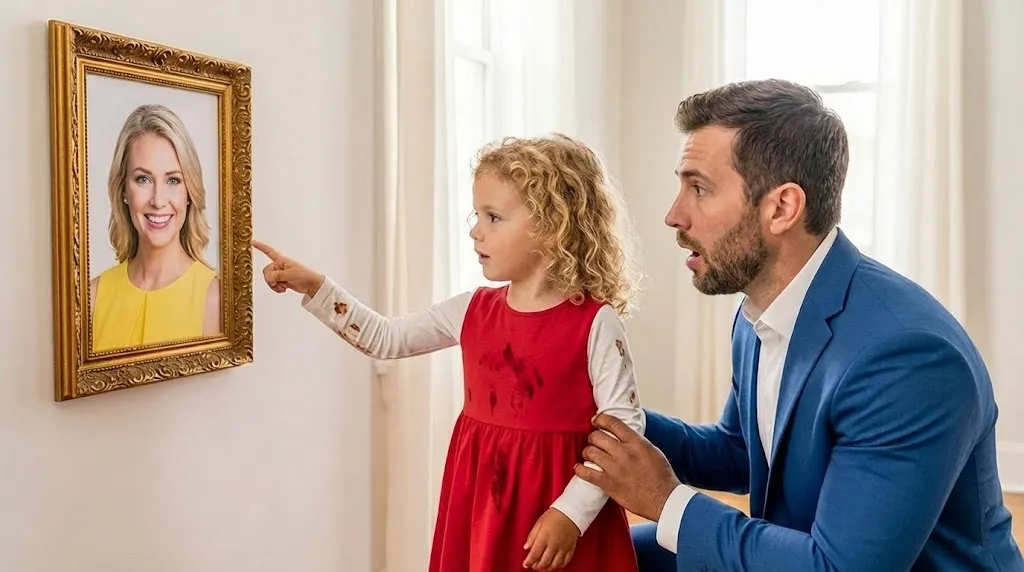
Then, something caught her eye. On a small, polished wooden table near the sweeping staircase sat a photograph in a stunning gold frame. The frame was new and expensive, but the photo inside appeared slightly aged and faded.
Compelled by a force she couldn’t explain, Mary stood up and approached the table. As she drew closer, her heart began to hammer against her ribs. She reached out and picked up the frame with trembling hands.
The woman in the photograph was younger and far healthier than the version Mary knew, but there was no mistaking her. She wore a lovely blue dress and was captured in a moment of candid laughter, looking at the person behind the camera with pure affection. Her long, dark hair cascaded over her shoulders, and her smile was radiant—a smile full of a joy Mary hadn’t seen on her mother’s face in years.
But Mary knew that face. She saw it every single day. Even though the woman in the picture looked different—vibrant, happy, full of life—Mary knew exactly who it was.
It was her mother. It was Clara.
Mary’s hands shook violently as she gripped the frame. Her mind reeled with a thousand questions. Why was her mother’s photo in this rich stranger’s house? Her mom had never mentioned knowing wealthy people. In fact, Clara never spoke of her life before Mary was born. Whenever Mary asked about her father or the past, her mother would withdraw, her eyes clouding with pain, and she would quickly change the subject.
Mary stood frozen, staring at the image, her thoughts tumbling over one another like crashing waves. How did this man know Clara? Why did he keep this picture on display? And why did her mom look so incredibly happy in it?
She heard footsteps approaching and spun around. Marcus had returned, carrying a silver tray laden with sandwiches, cookies, and a tall glass of cold juice. But the moment he saw what Mary was holding, he stopped dead in his tracks. The tray rattled in his hands.
His face drained of all color, turning as pale as the marble floor. His gaze locked onto the photograph, then snapped to Mary’s face, then back to the picture. For a long, agonizing moment, the room was silent. The quiet of the big house felt heavier, charged with sudden tension.
“That’s… that’s my mom,” Mary whispered, her voice barely audible. She held the frame up slightly. “Why is my mom’s picture in your house?”
Marcus’s mouth opened, but no sound emerged. He looked as though he had been struck by a physical blow. The tray in his hands shook violently, the juice rippling in the glass. Moving with the slow, deliberate caution of a man afraid he might collapse, he set the tray down on a nearby console table.
He turned back to Mary, his eyes wide with absolute disbelief. “Your… your mother?” His voice cracked, raw with emotion. “What is your mother’s name?”
“Clara,” Mary answered simply. “Her name is Clara.”
Marcus took a staggering step backward, reaching out to steady himself against the wall. His breathing became rapid and shallow. He scrutinized Mary’s face, searching her features—her eyes, her nose, the curve of her jaw—as if hunting for a ghost.
“Clara,” he repeated. The way he said the name sounded like a prayer and a question woven together. “Clara… she is your mother?”
Mary nodded, frightened by his intensity. Why was he acting so strangely? Why did he look on the verge of tears? “Sir, are you okay?” she asked, her voice trembling. “Do you know my mom?”
Marcus ran a hand through his hair, a gesture of profound distress. He walked to the nearest chair and sank into it heavily, as if his legs had simply given out.
“Know her?” he whispered, speaking more to the air than to the child. “Ah, yes. Yes, I knew her. A long time ago.” He looked up at Mary, his eyes now glistening with unshed tears. “How old are you?”
“I’m nine, sir. I’ll be ten in three months.”
Marcus closed his eyes and inhaled a sharp, shuddering breath. His hands were trembling visibly. Mary had never seen a grown man look so shattered. It was terrifying.
“Where is your mother now?” Marcus asked, opening his eyes. There was a desperate urgency in his tone. “Where is Clara?”
“She’s at home, sir. In our apartment. She’s very sick.” Mary’s voice wavered. “That’s why I’m selling oranges. To buy her medicine.” Tears welled in her own eyes as she thought of her mother lying on the thin mattress, coughing and weak. “The doctor says she needs medicine that costs thirty dollars. I’ve been trying to save up, but…”
“Take me to her,” Marcus interrupted, leaping to his feet. “Please. Take me to your mother. Right now.”
Mary took a step back, startled by his sudden intensity. “But… but I don’t understand. Why do you have her picture? How do you know my mom?”
Marcus looked at the little girl standing before him, clutching the photograph like a lifeline. He could see Clara in her face—the same eyes, the same gentle spirit, even the way she tilted her head in confusion. His heart pounded against his ribs, threatening to break through. Could it be possible? After all these years?
“Mary,” he said, fighting to keep his voice steady. “I need to ask you something very important. Do you… do you have a father?”
Mary’s face fell. It was the question she despised most in the world. It was the question that fueled the playground taunts. It was the question that made her feel perpetually incomplete.
“No, sir,” she said quietly, staring at the floor. “I don’t have a dad. Just me and mom. It’s always been just me and mom.”
Something inside Marcus shattered at those words. A choked sound escaped his throat, halfway between a gasp and a sob. He covered his face with his hands for a moment, struggling to contain the tidal wave of emotion crashing over him. When he looked up, his eyes were red and wet.
“Mary,” he said, his voice thick. “I think… I think I might know why your mother never told you about your father. And I think I might know why she had to leave and raise you alone.” He paused, searching for the right words. “But I need to see her. I need to talk to her. There are things… things that happened a long time ago that need to be explained.”…
Mary was thoroughly confused. Nothing made sense. Why was this rich stranger crying? Why did he care so much? “I don’t understand,” she said, her voice small and frightened.
Marcus knelt so he was eye-level with her. Up close, she could see the tears tracking down his cheeks. “I know you don’t understand,” he said gently. “And I know this is scary. But please trust me. I would never hurt you or your mother. I just… I need to see her. I’ve been looking for her for so many years, and now…” His voice broke. “Now you’ve found me.”
“You’ve been looking for my mom?” Mary asked, eyes wide.
“Yes,” Marcus whispered. “For ten years, I’ve been looking for her.”
Mary’s mind raced. Ten years. She was nine. That meant he had been searching before she was born. A thought began to take shape in her mind—a thought so massive and impossible she barely dared to entertain it.
“Sir,” she said slowly. “Why? Why have you been looking for my mom for ten years?”
Marcus looked at her, aching to tell her the truth. The words burned in his chest. But he couldn’t. Not yet. Not until he was certain. Not until he heard Clara’s side of the story.
“That’s something I need to talk to your mother about first,” he said softly. “But Mary, I promise you, whatever happens, everything is going to be okay. Better than okay.”
He stood up and retrieved his wallet. He pulled out several crisp bills and pressed them into Mary’s hand. She looked down and gasped. Five twenty-dollar bills. One hundred dollars.
“This is too much,” Mary protested, trying to hand it back. “The oranges only cost six dollars, and you already gave me money for medicine.”
“Keep it,” Marcus insisted firmly. “Use it for the medicine, for food, for whatever you need. And Mary…” He looked at her with an intensity that made her breath catch. “Tell your mother that Marcus wants to see her. Tell her that I know she’s alive, and I’m not angry. Tell her I just want to talk.”
“Marcus,” Mary repeated, testing the name. “Is that your name?”
“Yes.”
Mary looked at the photograph in her hand. “Did you… did you love my mom?”
Marcus’s face crumbled. A fresh tear rolled down his cheek, unchecked. “Yes,” he said simply. “I loved her more than anything in the world. And I never stopped.”
Mary didn’t know how to respond to such raw honesty. She felt a sudden, magnetic pull to get home. She needed to tell her mother about this strange, wonderful, confusing encounter.
“I should go,” Mary said. “I should go home and tell my mom.”
“Wait,” Marcus said. He moved to a sleek desk in the corner and scribbled on a piece of expensive stationery. “This is my phone number and address. Tell your mother to call me. Or if she won’t call, bring her here. Or…” He hesitated, looking uncertain. “Or tell me where you live, and I’ll come to you. Whatever makes her feel safe.”
Mary took the paper and folded it carefully, tucking it into her pocket alongside the fortune in cash. “I live in the old apartments on 7th Street,” she said. “Building C, Room 12. But… our place is very small. It’s not nice like this.”
“I don’t care about that,” Marcus said quickly. “I just need to see her.”
Mary nodded. She placed the photograph back on the table with reverence, then picked up her empty plastic bag. The sandwiches and juice lay forgotten; neither of them had an appetite anymore. Marcus walked her to the door, then paused.
“Mary,” he said. “One more question. Does your mother ever… does she ever talk about the past? About anyone she used to know?”
Mary shook her head. “No, sir. Whenever I ask about the old days or my father, she gets sad and quiet. She says the past is the past. But…” Mary paused. “Sometimes, late at night when she thinks I’m asleep, I hear her crying. And sometimes she whispers a name. I think… I think the name is Marcus.”
Marcus grabbed the doorframe to steady himself. “She says my name?” he asked, his voice barely a whisper.
“Yes. She sounds so sad when she says it. Like saying it hurts her.”
For a moment, Marcus couldn’t breathe. Clara had been whispering his name for years. She hadn’t forgotten.
“Go,” he managed to say. “Go home to your mother. Give her the medicine. And please… tell her I need to see her.”
Mary stepped out, but turned back one last time. “Sir? I mean, Marcus? Are you… are you my dad?”
The question hung in the air, fragile as glass. Marcus looked at the brave girl who had walked into his life selling fruit, and his heart broke and healed simultaneously.
“I don’t know for certain yet,” he answered honestly. “But Mary, I think I might be. And if I am…” His voice cracked. “If I am, I am so, so sorry I wasn’t there for you. I’m sorry you had to grow up without a father. If I had known you existed, nothing in this world could have kept me away.”
Tears streamed down Mary’s face. She didn’t fully understand the logistics, but she understood the emotion. She understood that this man had loved her mother. “I’ll tell my mom,” she promised. “I’ll tell her everything.”
With that, Mary turned and sprinted down the path, through the garden, and out the gate. She ran all the way home, her heart pounding in rhythm with her feet, clutching the money and a newfound hope in her chest.
She didn’t feel the heat or the exhaustion anymore. When she reached the dilapidated apartment building on 7th Street, she took the stairs two at a time. The building smelled of dampness and decay, the paint peeling from the walls like dead skin. But it was home.
She burst into Room 12. “Mom?” Mary called out, gasping for air. “Mom, you won’t believe what happened!”
The apartment was a single, cramped room. A thin mattress lay on the floor, a small table occupied the center, and a hot plate served as their kitchen. Clara lay on the mattress, shivering under a thin blanket despite the heat. Hearing Mary, she tried to sit up, but the effort triggered a violent coughing fit that racked her frail body.
“Mary,” Clara rasped when the coughing subsided. “You’re back early. Did something happen?”
Mary knelt beside her and pulled the crumpled bills from her pocket. “Mom, look. A man bought all my oranges and gave me this. One hundred dollars. We can buy your medicine and still have money for food.”
Clara’s eyes widened in horror. “What? Mary, that’s too much. Did you steal this?”
“No, Mom! I promise. A rich man gave it to me. He lives in a huge mansion. He was so nice and…” Mary stopped, the memory of the photograph flooding back. “Mom? The man’s name is Marcus.”
The color drained from Clara’s face instantly, leaving her looking like a ghost. Her hand flew to her mouth, eyes wide with terror. “What? What did you say?” she whispered.
“His name is Marcus,” Mary repeated. “And Mom… he had your picture. In his house. A picture of you in a blue dress, smiling.”
Clara began to shake—not from fever, but from pure fear. She gripped Mary’s arm with surprising strength. “Mary, listen to me. What did you tell him? Did he hurt you?”
“No, Mom, he didn’t hurt me! He cried when I told him you were my mother. He said he’s been looking for you for ten years.”
Clara let go, burying her face in her hands. “Oh no,” she moaned. “Oh no, no, no. He found us. After all this time.”
“Mom, you’re scaring me,” Mary said, tears welling up. “Why are you afraid? Marcus seemed good. He wants to help.”
“You don’t understand,” Clara cried, before falling into another coughing fit. When she recovered, tears streamed down her face. “Mary, we have to leave. We have to pack and leave the city tonight.”
“Why?” Mary cried out. “Why do we have to run?”
“Because his family will never let us be together! They’ll try to take you away from me! I’ve been hiding you to protect us!”
“Protect us from who?” Mary demanded.
Clara looked at her daughter’s confused face and realized the running was over. She was too sick, too tired. “Mary,” she said softly. “I need to tell you the truth. Marcus… Marcus is your father.”
Hearing it aloud stole the breath from Mary’s lungs. “He is my dad? Really?”
“Yes. And I loved him, Mary. I loved him so much it hurt.”
“Then why did you leave? Why didn’t you tell him about me?”
Clara’s face crumpled with regret. “Because I had no choice. His mother—your grandmother—she is a powerful, terrible woman. When she found out I was pregnant, she threatened me. She came with two men in the middle of the night. She said if I didn’t disappear, she would frame me for stealing and send me to prison. She said she would make sure I was locked away forever.”
Mary gasped. “That’s horrible!”
“She gave me money and told me to leave. I was twenty, pregnant, and terrified. I tried to call Marcus the next day, but his mother answered. She told me Marcus never wanted to see me again. So I ran. I named you Mary because it means ‘beloved.’ I told myself I was protecting you from rejection. But the truth is, I was a coward.”
Mary threw her arms around her mother. “Mom, Marcus didn’t know! His mother lied to both of you. When he found out about me today, he cried. He said he never stopped loving you.”
Clara’s breath hitched. “He said that?”
“Yes. He gave me his number. He wants to talk.” Mary handed her the note.
Clara stared at the handwriting she knew so well. “I don’t know if I can face him. How can I explain keeping his daughter secret for nine years?”
“The same way he’s asking you to forgive him for not finding you,” Mary said wisely. “Mom, we need help. You’re sick. We can’t keep running. Let’s be a family.”
Clara looked at the phone number, then at her daughter. She was tired of running. “Okay,” she whispered. “Tomorrow. When I’m a little stronger, we’ll call him.”
“Why not today?”
“I need to take the medicine first. I don’t want him to see me looking like death.”
Mary smiled through her tears. “Okay, Mom. Tomorrow.”
That night, Mary lay awake staring at the cracked ceiling, her mind replaying the day. She had a father. A real father. But she also had a grandmother who sounded like a monster. Beside her, Clara slept fitfully, occasionally whispering Marcus’s name in her fever dreams.
Morning brought sunlight and the smell of cooking. Mary had used some money to buy eggs and bread. Clara woke up looking slightly better; the medicine was working. They ate in silence, the folded paper with the phone number sitting on the table like a ticking bomb.
“There’s a payphone downstairs,” Mary said.
Clara nodded, wrapping the blanket around her shoulders. They descended to the lobby. Clara stared at the battered phone for a long time. “What if he’s angry?”
“He won’t be,” Mary assured her.
Clara dialed with trembling fingers. It rang once. Twice.
“Hello?” Marcus’s voice.
Clara’s heart stopped. “Marcus,” she whispered. “It’s… it’s Clara.”
Silence. Then a sharp intake of breath. “Clara? Is it really you?” His voice was a mix of shock, joy, and pain.
“Yes. It’s me.”
“Where are you? Mary said you were sick. Do you need a doctor?”
“Marcus, please. I’m okay. I just… I needed to explain.”
“You don’t have to explain anything over the phone. Tell me where you are. Let me come to you. I need to know you’re real.”
Clara gave him the address. “I’ll be there in twenty minutes,” he vowed.
Back in the room, Clara tried to tidy the pathetic space, shame washing over her. This was where she had raised his daughter. When the knock came, her legs nearly gave out. She opened the door to find Marcus, breathless and disheveled, his eyes red.
“Clara,” he whispered.
“I’m so sorry,” she sobbed. “Marcus, I’m so sorry for everything.”
He stepped in and pulled her into a crushing embrace. “Shh. It’s okay. You’re safe now.”
Mary watched, tears flowing. Marcus finally pulled back and knelt before Mary. “Hello, Mary,” he said softly. He reached out and touched her cheek. “You’re so beautiful. You have your mother’s eyes.”
“And your nose,” Mary quipped, trying to lighten the mood. “Mom says it doesn’t match my face.”
Marcus laughed through his tears. “I’m sorry about the nose. It runs in the family.” He pulled her into a hug. “I’m sorry I wasn’t there. If I had known… nothing would have kept me away.”
“I know,” Mary said into his shoulder.
Marcus stood and looked around the room, taking in the poverty. His jaw tightened. “Clara, why didn’t you come back?”
“Your mother,” Clara said. She told him everything—the threats, the men, the lies.
Marcus listened, his face darkening with rage. “My mother did this? She told you I didn’t want you?”
“Yes. She said I was ruining your life.”
“She lied,” Marcus said, his voice trembling with fury. “She destroyed ten years of our lives because of her pride. But she won’t hurt you again. Clara, money means nothing to me if you aren’t healthy. We are going to the hospital. Now.”
“It’s expensive…”
“I don’t care. Let me take care of you.”
They gathered their meager belongings—one bag held everything they owned. Marcus drove them in his sleek black car to City General Hospital. He bypassed the ER and called a private doctor, Dr. Peterson. Clara was admitted to a luxury private room with a garden view.
Tests revealed severe anemia and a respiratory infection, but Dr. Peterson assured them she would recover with rest and antibiotics. Marcus refused to leave their side. He ordered a feast from a nearby restaurant—chicken, rice, chocolate cake—and watched Mary eat with a full heart.
“Mary,” Marcus said that evening. “I believe you are my daughter with all my heart. But for legal reasons—to protect us from my mother—I need a DNA test. It will prove you are mine so she can never deny it.”
“Will it hurt?”
“Just a cheek swab.”
“Okay,” Mary agreed. “If it protects Mom, I’ll do it.”
Three days later, the results arrived. “99.9% match,” Marcus read aloud, his voice thick. “Mary, you are officially my daughter.”
They celebrated in the hospital room, a family reunited. But Marcus knew one task remained.
The next morning, he left Clara and Mary sleeping and drove to his mother’s estate. He found Catherine Adams in her morning room, sipping coffee.
“Marcus,” she said coolly. “You cancelled my brunch.”
“Where were you on March 15th, ten years ago?” Marcus demanded.
“How would I remember?”
“You remember. That was the night Clara disappeared.”
Catherine stiffened. “That girl? I saved you from a mistake.”
“You threatened her!” Marcus shouted. “You drove away the woman I loved! And she was pregnant!”
Catherine dropped her cup. “What?”
“She was pregnant. I have a daughter, Mother. A nine-year-old granddaughter you forced to live in poverty.”
“I… I didn’t know.”
“You didn’t care! But hear this: Clara and Mary are my family. They are moving in with me. If you ever threaten them again, you will never see me or your granddaughter. You will be cut off forever.”
Catherine looked at her son and saw a strength she couldn’t control. “I want to meet her,” she whispered, fear and perhaps regret in her eyes.
“You will. When Clara is ready. But remember: one wrong word, and you lose us all.”
Marcus returned to the hospital with the news. “She admitted it. And she’s terrified of losing me. She wants to meet you.”
A few days later, Clara was discharged. Marcus drove them not to the mansion, but to a fine restaurant. “I have something to do first,” he said. After dinner, he pulled out a small box.
“Clara, I bought this ten years ago. I never threw it away.” He opened it to reveal a diamond ring. “Will you marry me?”
“Yes,” Clara wept. “Yes.”
They moved into the mansion. Mary chose a room with yellow walls and filled it with toys. It was a time of healing. A month later, they held a small garden wedding.
Catherine attended. She apologized to Clara—stiffly, but sincerely. “I was wrong. I thought I was protecting him, but I only caused pain.” Clara, for Mary’s sake, agreed to let her try to be a grandmother, with strict boundaries.
Life settled into a rhythm of joy. The mansion, once a tomb of silence, echoed with Mary’s laughter. Marcus and Clara found their way back to each other, their love deepened by the years of separation.
Years later, Mary would tell her own children the story. “Your grandmother knocked on a stranger’s door to sell oranges,” she would say. “But he wasn’t a stranger. He was her father.”
It was a story better than a fairy tale, because it was true. It was proof that no matter the time or the distance, real love always finds a way back home. Beside the old photo of Clara on the table now stood a new one: Marcus, Clara, and Mary, smiling together—a family, finally complete.