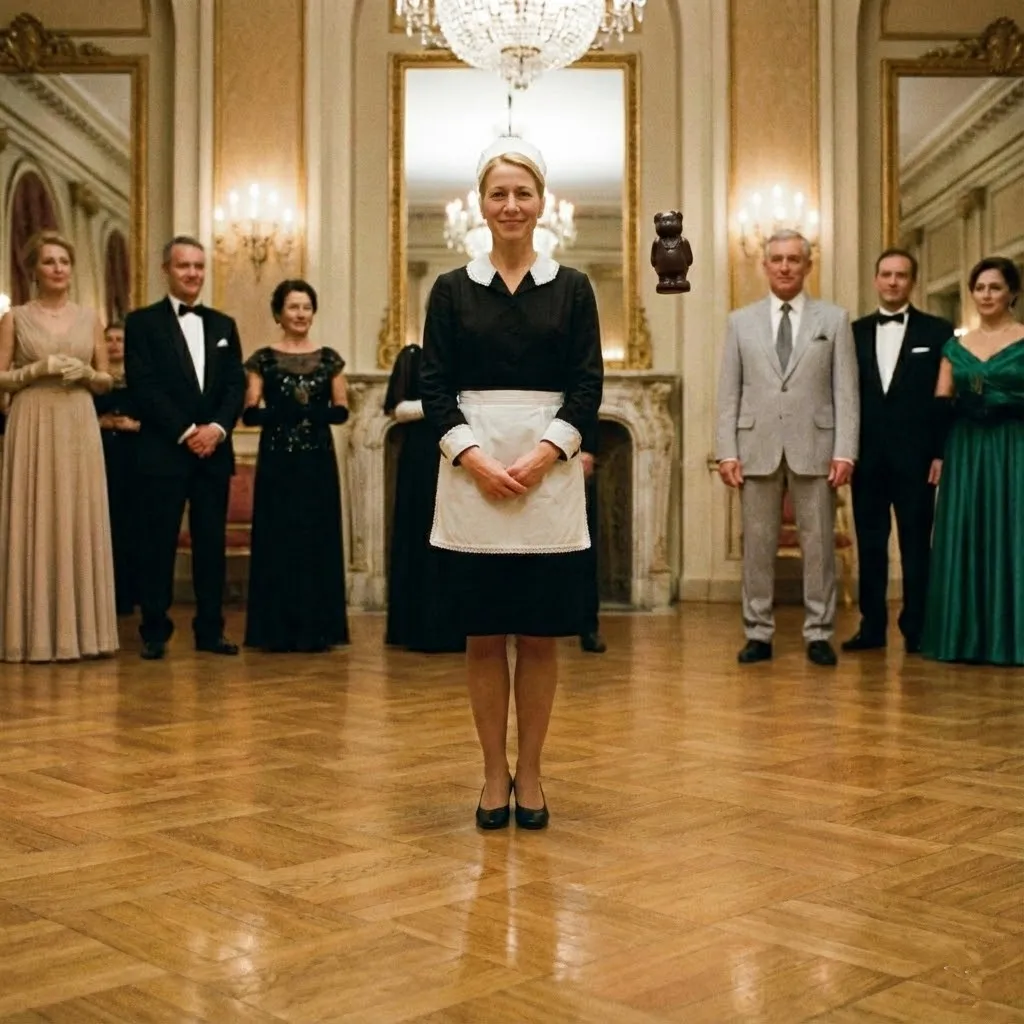
The Hartley estate didn’t just sit on the rolling hills outside Boston; it commanded them. Bathed in the amber warmth of the late afternoon sun, the stone manor looked less like a home and more like a fortress of solitude, framed by imposing ivy-covered columns and glass-paneled doors that reflected the sky. Inside, the atmosphere was thick with the specific kind of tension that accompanies old money. The ballroom, illuminated by the prism-fire of crystal chandeliers, hummed with the soft murmur of string music, the click of polished oxfords, and the polite, curated laughter of the city’s elite. It was the annual Hartley & Co. investor reception, a night where net worths were compared and expectations were whispered behind the rims of champagne flutes.
Chloe Sanders stood near the periphery, nervously smoothing the front of her crisp black uniform. She tucked a stray lock of blonde hair back into the tight bun secured at the nape of her neck. The agency had called it a “standard private estate function,” but nothing in her orientation had prepared her for the sheer scale of this, nor for the frost that seemed to linger beneath the elegance. She began to weave through the crowd, balancing a tray of intricate hors d’oeuvres, her eyes darting across velvet gowns and diamond cufflinks that caught the light. The air smelled of expensive lavender and beeswax, but underneath the perfume, the house felt sterile—untouched and cold….
That was when she saw her. Tucked away in the furthest corner of the cavernous ballroom, almost swallowed by the heavy shadows of the drapes, a little girl sat cross-legged on the floor by a silk-curtained window. She was wearing a pink dress that was slightly rumpled at the hem, a stark contrast to the pristine environment. A halo of blonde curls framed her face, shimmering as she stared down at a small music ring she was turning over in her hands. She spun it again. And again. Her eyes never lifted—not to the guests, not to the musicians, not to the room at large.
It was strange, Chloe thought, her brow furrowing. No one else seemed to notice the child. Servers glided past without breaking stride; guests turned their backs, oblivious. Confused, Chloe leaned in toward the head of the catering staff, a stern woman with a clipboard. “Excuse me,” Chloe whispered, nodding toward the corner. “Who is that little girl?” The woman barely spared a glance. “That’s Miss Amelia, Mr. Hartley’s daughter. She’s fine.” When Chloe lingered, the woman added, “She prefers to be alone. Just leave her be. She doesn’t like people.”
Chloe nodded and swallowed the tightness in her throat, returning to her rounds. Yet, as the evening wore on, she found her gaze magnetically drawn back to that corner. To the girl. To the heavy silence that seemed to build a wall around her. As the ballroom lights dimmed and the string quartet transitioned into a graceful waltz, the guests flowed like liquid silk onto the dance floor. Chloe, her tray finally empty, paused at the edge of the room. Amelia hadn’t moved an inch. She was still there, turning that little ring, trapped in her own world.
Deciding to ignore the earlier warning, Chloe set her tray down on a side table. With light, deliberate steps, she crossed the polished expanse of the floor, her shoes making no sound against the wood. She crouched down beside the child, keeping her distance so as not to startle her. “Hi,” she said, her voice dropping to a gentle hush. “I’m Chloe.” There was no response. Just the rhythmic, soft click-click of the spinning ring. Chloe waited, letting the silence settle comfortably between them rather than rushing to fill it.
Slowly, she extended her hand—not to grab, not to demand, but simply to offer. “Would you like to try dancing with me?” For a long, suspended moment, nothing happened. Then, the ring stopped turning. Amelia’s fingers hovered in the air, trembling slightly, before she reached out. Her small hand rested in Chloe’s, light as a bird. Chloe stood up slowly, holding the child’s hand as if it were made of spun glass. She led Amelia gently toward the edge of the dance floor, far enough from the crush of the crowd to be safe, but close enough to feel the vibration of the music.
Chloe began to sway, initiating a soft back-and-forth motion, guiding without applying any pressure. At first, Amelia stood stiff, her shoulders tense. But as the next measure of the waltz began, her foot moved. A tentative half-step, then another. A rhythm began to form. Suddenly, the atmosphere in the ballroom shifted. It wasn’t the music or the dancers that changed, but the room itself seemed to hold its breath. Conversations trailed off. Crystal glasses were lowered. A hush fell over the crowd, heavy and soft like fresh snow. Even the violinists seemed to dampen their strings, playing with a tender quietness.
At the very edge of the crowd stood a man in a tailored charcoal suit. He was frozen, his gaze locked forward, a wine glass forgotten in his white-knuckled grip. Liam Hartley. The CEO. The widower. The father. He didn’t blink. His daughter, who hadn’t let a soul near her in years, was holding hands with a stranger—and she was dancing. His jaw flexed, and his face was a mask of unreadable emotion. Was it grief? Awe? Fear? Across the floor, the girl in the pink dress turned beneath Chloe’s steady hand, and for the first time that evening, a smile broke across Amelia’s face. It was faint and fleeting, but undeniably real.
The music carried on, but a different melody—quieter, more fragile—had begun to rise in the room. It was a language of rhythm and trust whispering into the space between the woman and the child. Where silence had reigned for too long, something else had just stepped in. Something that looked a lot like hope.
Hours later, the guests had departed, their limousines winding down the long driveway. The music had faded, and the ballroom was quiet once more. Empty glasses were being gathered, crumbs swept away, and the chandeliers dimmed to a low, amber glow. Chloe walked back into the kitchen, her heart still fluttering in her chest. She half-expected the agency coordinator to fire her on the spot for crossing a line. Instead, the estate’s butler, an older man with a formal but kind demeanor, looked up from polishing silverware and offered her a small, surprising smile.
“You’re the first one to make her smile,” he said simply. Chloe blinked, taken aback. “I… I’m sorry if I stepped out of line.” The butler shook his head slowly. “You stepped in, Miss Sanders. Where most people walk around her.” Chloe looked down at her hands, still remembering the tiny warmth of Amelia’s fingers. “Does she ever talk?” she asked quietly. “Not in years,” the butler replied, his voice tinged with a quiet sadness. “Amelia has been different since birth, diagnosed early. Sound and rhythm seem to calm her, but she doesn’t do well with loud voices or touch. Most people just… avoid her.” There was no judgment in his tone, just the resignation of someone who had lived among these silences for too long.
Later that evening, as Chloe gathered her coat to leave, a deep voice stopped her in the hallway. “I’d like you to stay.” She turned. Liam Hartley stood at the edge of the corridor, his shirt sleeves rolled up and his jacket draped over one arm. His face was unreadable, his voice steady but low. “Sir?” Chloe asked. “You handled her with care,” he said, holding her gaze. “Most people treat her like a problem to be solved. You didn’t. That means something.” Chloe hesitated, shifting her bag on her shoulder. “I didn’t do anything special.”
“You didn’t look away,” he replied. “That’s rare enough.” He paused, searching for the right words. “I’m offering you a long-term position here. Permanent, if you’re willing.” Chloe searched his expression for any hint of charity or pity, but found only quiet gravity. She nodded slowly. “I’m willing.”
That night, unable to sleep in her new quarters, Chloe wandered the second floor to familiarize herself with the layout of the massive house. The corridor was lined with framed sketches and blueprints—pencil renderings of arches, flying buttresses, and chairs. It was a gallery of subtle beauty, all hand-drawn. As she passed Amelia’s room, she noticed the door was slightly ajar. Inside, the lights were dim, and a small tablet screen glowed in the corner.
Amelia stood in front of it barefoot, her pink nightgown brushing the floor. On the screen, a grainy video played: a woman in a white tutu spinning gracefully on a grand stage, her arms curved like wings. A ballerina. She was graceful, strong, and looked exactly like the little girl in the room, only grown. Amelia stood still for a moment, then began to sway, mimicking the movements. It wasn’t perfect—it was clumsy and unpolished—but it was done with intense effort and memory. Chloe remained outside the doorway, watching from the shadows, unmoving. She didn’t know the full story yet, only fragments, but seeing this child dancing alone to a ghost on a screen told her more than any words could. The house was full of expensive artifacts, polished wood, and gold-rimmed frames, but the thing that echoed loudest was the absence of touch, of voice, of warmth. And yet here, in the quiet dark, Amelia was dancing. Chloe knew, without being told, that this was only the beginning.
Morning light spilled softly into the sunroom the next day, filtering through high-arched windows and gauzy curtains that swayed like whispers in the breeze. Amelia sat cross-legged on the Persian carpet, her hands turning the tiny silver handle of a music box. It played the same delicate melody over and over, high notes falling like glass rain. Chloe had heard it repeating for an hour but hadn’t interrupted. Now, she approached. “That’s a beautiful sound,” Chloe said gently, kneeling beside her. “Can I see it?”
Amelia did not speak, but after a contemplative moment, she slid the music box across the floor. Chloe lifted the lid slowly. Inside, a tiny ballerina spun in place, twirling to the tune. The box was vintage, its lacquer slightly chipped, but clearly cherished. On the underside of the lid, a name was engraved in elegant script: Grace. Chloe’s breath hitched. She had seen the name before—in an old photo by the grand staircase, in a whispered comment from the staff. Grace Hartley. Liam’s late wife. Amelia’s mother. The ballerina figure inside wore a miniature white tutu, identical to the woman in the video.
That evening, Chloe pulled back the rug in the sunroom to clear a space by the grand piano. She played a slow, classical piece on her phone, then knelt and tapped her fingers lightly on the hardwood floor: one-two, one-two-three. Amelia watched, still as stone. Then, slowly, her foot moved. A light tap in rhythm. Chloe smiled and rose to her feet, letting the music guide her. She did nothing complex, just a turn, a sway, a soft slide across the wooden floor. She held out her hand. Amelia stood. No words, no eye contact, just quiet mimicry. Step by step, she mirrored Chloe’s movements—halting but precise, as if her brain translated rhythm more clearly than speech.
From that day on, they danced a little every afternoon. Chloe used movement to speak: a wave for hello, a tap for stop, a twirl for joy. Amelia responded in kind, building a vocabulary without words, a world made entirely of motion and music. It was in this rhythm that Chloe began to understand the child’s grief not as a void, but as a living memory.
One cloudy afternoon, Chloe passed the laundry room and overheard two maids folding linens. “She’s dancing again,” one whispered conspiratorially. “Who?” “Amelia. With the new girl.” The second woman lowered her voice. “He won’t like that.” “Who? Mr. Hartley?” “He forbade anyone from playing ballet music in the house. After the accident, he said it was over. Said it destroyed everything.” Chloe felt a cold shiver crawl up her spine.
That evening, as the sun dipped low and cast long shadows across the floor, she and Amelia were dancing again, this time a little faster. Amelia let out a breathy sound, almost a laugh—a rare, precious thing. Chloe turned, twirling gently, letting the girl lead. And then the door opened.
Liam stood at the threshold. He didn’t speak. His eyes locked instantly on the sight of his daughter spinning. Chloe halted mid-step, her heart hammering. Amelia didn’t notice; she kept moving, softly, her pink dress brushing her knees, the music box melody echoing from a Bluetooth speaker nearby. Liam’s jaw tensed, a muscle feathering in his cheek. He took a step forward, then another. “I told the staff,” he started, his voice tight and sharp as flint. “I told them not to bring that back into this house.”
Chloe froze. “I’m sorry,” she said quietly, stepping between him and the girl. “She responded to it. I wasn’t trying to—” But Liam was already turning away, his shoulders rigid, his voice low and final. “It doesn’t belong here anymore.” The door closed behind him with a soft, devastating click. The music faded. Amelia had stopped spinning. She looked up, sensing the shift in the air, her hands twisting the hem of her dress anxiously. Chloe knelt beside her, whispering, “It’s okay, sweet girl.” But deep down, she knew it wasn’t. She had opened a door lined with memory and grief that Liam Hartley had spent years trying to bolt shut.
The next morning, Chloe rose before dawn. She packed her few belongings and left a note on the kitchen counter: Thank you for the opportunity. I’m sorry if I crossed a line. She didn’t explain more; she didn’t dare. Her heart felt heavy as lead as she slipped out the servant’s entrance, passing the garden where Amelia had once spun in circles beneath the falling petals. Chloe paused, wondering if the little girl would notice she was gone, wondering if Liam would even care.
By evening, a light, persistent rain had settled over Boston. Thunder murmured faintly in the distance, low and tired. Chloe’s apartment was small but warm, tucked above a floral shop in Beacon Hill. She had just turned off the kettle when a knock sounded at her door. Gentle. Hesitant. She opened it to find Liam Hartley standing there, drenched under a black umbrella, holding her crumpled note in his hand.
“I don’t want you to leave,” he said simply. Chloe stepped aside without a word, allowing him to enter. He shook off the rain, looking out of place in her tiny entryway. He didn’t meet her eyes at first, studying the steam rising from the untouched cup of tea on the counter. “I reacted badly,” he admitted, his voice rough. “I was… surprised. Caught off guard.” Chloe nodded. “I understand. It wasn’t my place.”
Liam finally looked at her. His expression had shifted; he was no longer the stern CEO, but a man frayed at the edges, unraveling. “She looks like her,” he said quietly. “When she dances.” Chloe stayed silent, letting him speak. “My wife, Grace… she was light. That’s the only way I can describe her. When she danced, it was like the world bent around her, like nothing dark could touch her.” He paused, looking at the rain streaking the window. “That night, her final performance… she brought Amelia backstage. I told her not to, said I’d pick her up after. But Grace insisted. She said she wanted Amelia to see beauty before the world taught her anything else.”
He swallowed hard, the Adam’s apple in his throat bobbing. “The crash happened on the way home. Grace died on impact. Amelia…” His voice cracked. “She was in the backseat. The doctors said she suffered a brain injury—not severe, but enough to affect language, to affect how she connects.” Chloe’s eyes filled with tears, but she didn’t interrupt. “I buried Grace a week later,” Liam continued. “And every time I looked at Amelia, all I could see was what I’d lost. Not because of her—God, never because of her—but because I failed. I should have been there. I should have driven.”
He rubbed his temple, breathing shakily. “After the funeral, I locked Grace’s things away. I thought it was better to remove the reminders. No more ballet, no more music boxes, no more spinning.” He let out a bitter, dry laugh. “But Amelia never stopped. She found her way back to it anyway. I just chose not to see it.”
Chloe stepped closer, her voice soft. “I don’t think Amelia stopped hearing you or feeling you, Liam.” He looked at her, pained. “She doesn’t speak.” “No,” Chloe agreed. “But she listens.” She crouched down, mimicking the small hand motion she used with Amelia. “When I tap the floor,” she said, “she taps back. When I twirl, she follows. When I stop, she does too. It’s her way of talking.” Liam’s eyes glistened. “I know she misses Grace, but I also think she’s trying to come back to you. In the only language she has.”
The silence stretched between them like a string pulled tight, vibrating with unsaid things. Then, gently, Liam sank into a nearby chair. He looked older suddenly, not in years, but in weight, as if the grief he’d held for so long had finally been given permission to settle. “She called me Daddy once,” he whispered. “The day she was born. Just a gurgle, really. But Grace swore she meant it.” Chloe smiled sadly. “She still does.”
Rain pattered against the window like a lullaby. Liam leaned back, eyes closed for a moment. “I don’t know how to fix this.” “You don’t have to fix it,” Chloe said. “You just have to show up. She’ll meet you halfway.” And for the first time in a long time, Liam nodded—not as a tycoon with all the answers, but as a father ready, finally, to begin again.
Progress arrived quietly. It did not knock or announce itself with fanfare; it came in the form of a shrug. One morning, as Chloe helped Amelia stretch in the sunroom, she asked gently, “Was that fun?” For the first time, Amelia didn’t look away or continue spinning. Instead, she paused, thought for a second, and then shrugged her shoulders. It was a small, almost imperceptible motion, but it was a response. Chloe’s breath caught in her throat.
From there, the changes came like petals opening in spring. Amelia began choosing songs—soft piano pieces, lullabies, even a delicate violin duet she insisted on playing every afternoon. Sometimes, she would walk over and tug gently on Chloe’s sleeve, her eyes steady but silent. It meant: Let’s dance. She still didn’t speak, still recoiled from most touches and eye contact, but in those quiet rehearsals, she became something else: graceful, focused, almost luminous.
One rainy afternoon, while searching for clean linens in the storage room, Chloe came across a dusty trunk. Inside, carefully folded in acid-free tissue paper, were the worn but still beautiful ballet slippers of Grace Hartley—faded satin, with hand-stitched initials on the sole. Chloe held them like relics, unsure whether to be heartbroken or honored. She brought them to Amelia without a word. The little girl ran her fingers over the ribbons, then clutched the shoes to her chest like something sacred. She didn’t let go of them for the rest of the day.
That evening, Chloe approached Liam in his study. The fireplace flickered low, casting soft gold light along the spines of his architecture books. “There’s something I’d like to ask,” she said, hesitating in the doorway. Liam looked up, eyebrows raised. “I’d like to organize a small performance,” she said. “Just for her. The greenhouse would be perfect. It has space, light, and she feels safe there.” Liam didn’t answer right away. His fingers tapped lightly against his glass of scotch. “She’s never performed for anyone,” he murmured. “Not even me.” Chloe nodded. “But she’s ready. And I think… I think she wants you to see.” A long pause followed. Then Liam nodded once. “All right.”
Three days later, the greenhouse glowed in the late afternoon light. Paper lanterns hung from the ceiling beams, casting soft halos across the flagstone floor. The garden beyond the glass walls swayed gently in the breeze, and the air smelled faintly of rosemary and fresh soil. Only a handful of people were invited: Mrs. Alden, the butler, the gardener, and Liam. Chloe kept it intimate, respectful of Amelia’s fragile world.
The music started—light, familiar. Chloe stood off to the side, watching, holding her breath. Amelia stepped into the center wearing a simple white dress and her mother’s oversized ballet slippers. Her movements were slow at first, deliberate. She spun once, arms lifting in a practiced arc, then paused. Her eyes scanned the small audience and landed on Liam. He was seated in the back, hands clasped, jaw tight. He had not moved since she entered, but something in his posture shifted as Amelia’s gaze met his.
Then, without prompting, without hesitation, Amelia opened her mouth. Her voice was soft, rusty from disuse, but clear. “Daddy… watch me.”
The room froze. Liam’s hands slowly lifted to cover his mouth. His eyes brimmed with disbelief. Mrs. Alden let out a gasp. Even the gardener took off his hat, lowering it to his chest reverently. Chloe felt the sting of tears in her own eyes. Amelia did not wait for the world to catch up. She turned, arms outstretched, and began to move again, more freely now, as if speaking those three words had broken something open inside her. Each step was music; each twirl was a story.
When the song ended, the silence held. Then Liam stood. He did not speak. He only walked to the center of the floor and knelt, arms open wide. Amelia hesitated for a single beat, then ran to him, pressing her face into his chest. He held her tightly, burying his face in her hair, as if he’d just found something lost at sea long ago. From the edge of the greenhouse, Chloe watched. The first tear had fallen, and she knew it would not be the last.
The day after the greenhouse performance, the air in the Hartley household felt different—warmer, lighter, as if some unseen curtain had finally been lifted to let the light in. Liam had not spoken much that evening, but when he carried Amelia inside, he held her close with a quietness that said more than volumes. From that moment, he began to appear more often—not just in the periphery, but beside them. He stood at the doorway during Amelia’s morning stretches; he watched silently as Chloe helped her balance. Some days, he joined in, clumsy at first, uncertain where to place his hands or how to move. But Amelia didn’t mind. She would reach out, guide him, and once, she even giggled when he tripped on his own foot.
One afternoon, he brought an old record player down from the attic. “She used to dance to this,” he murmured, setting it up in the sunroom. The soft crackle of vinyl filled the space, and Chloe watched as Liam sat cross-legged on the floor beside his daughter, letting the music settle into his bones. The man she had once thought cold and distant was slowly becoming someone else: someone whose silences meant thought, not dismissal. Someone whose hands, though large and work-worn, could move with gentleness. And Chloe, despite herself, began to see him not just as a father healing, but as a man learning how to live again.
One late afternoon, rain tapped gently against the windows. Chloe had just gathered her things, coat in hand, ready to head home. She turned the corner into the hallway and stopped short. Liam was standing there, holding a record sleeve in one hand, his other tucked nervously into his pocket. He looked up, startled by her presence. “You leaving?” She nodded. “Just about to.” He hesitated, then stepped forward, offering the record cover. “It’s… one of Grace’s favorites. I was thinking of playing it. Just… thought it would be nice.”
Chloe smiled softly. “She had good taste.” Liam opened the door to the now-familiar sunroom. “You ever danced?” he asked, not quite meeting her eyes. Chloe’s breath caught. “Not really. Just… with Amelia.” A pause. Then Liam set the record on the player and adjusted the needle. The soft swell of a piano began to rise, old and golden. He turned to her. “I haven’t danced since the night she died,” his voice was quiet, unsteady. “But if you don’t mind… would you?” He extended his hand, uncertain.
Chloe hesitated, her heart fluttering. Then, slowly, she stepped closer and placed her hand in his. They stood there a moment, swaying to the rhythm, learning one another’s pace. Liam moved stiffly at first, every step a question. But Chloe guided him gently, her touch light but sure. The room felt suspended, time folding in on itself, the rain blurring the world outside into soft watercolor. At one point, he looked down at her, a half-smile playing on his lips. “I didn’t think I’d ever do this again.” Chloe didn’t answer, only met his gaze, steady and kind. And for a few minutes, there were no ghosts in the room. Just two people, learning to breathe in the same tempo.
Later that evening, while tidying the bookshelves in Liam’s study, Chloe reached for a stack of folders. As she moved one aside, something slipped from between the pages and fluttered to the floor. A ticket. She picked it up carefully. It was for a ballet performance: Swan Lake, Final Curtain, featuring Grace Hartley. The date stamped in the corner was three years old. Chloe’s eyes lingered on it. The edges were worn, the paper slightly creased but intact—preserved. She turned it over. On the back, in faint handwriting, one word had been scribbled: Always. She stood there for a long moment, holding the past in her hands. And somehow, without needing to ask, she understood. Liam had never really let go. But now, maybe, just maybe, he was learning how to carry it differently.
The late summer sun streamed through the tall windows of the Hartley residence, casting a golden glow on the polished floors. The evening was quiet, intimate—a reception for longtime investors of the Hartley Design Company. Soft jazz floated from a string quartet in the corner. Champagne glasses clinked gently, and low conversation hummed beneath the music. Chloe stood to one side of the ballroom, watching Amelia through the open doors leading to the garden terrace. The little girl wore her favorite pink dress, twirling slowly to a rhythm only she could hear. Liam had agreed to let her dance. Nothing official, nothing rehearsed—just a moment, a small gesture of courage. Amelia had tugged Chloe’s hand and pointed to the terrace just before the guests arrived. It was the first time she had ever asked.
Chloe lingered near the French doors, staying close but letting Amelia have the space. The child moved gently, fingers fluttering like butterfly wings. Her steps were unsure, but honest and real. Guests began to notice. Conversations faded. A few people drifted toward the open doors, watching from a respectful distance. But not everyone admired the scene.
Near the back, a man in a navy suit leaned toward another guest. His voice was soft but it carried. “Why is she letting her do that? No one wants to see a kid like that dance. It’s… awkward.” Chloe froze, her shoulders straightening, fingers curling slightly at her sides. She turned to face him. “Excuse me?” The man raised his brows, feigning innocence. “I just meant, it’s not a good look. For the company. Or the brand.”
Chloe stepped forward, her voice low but steady. “And that,” she said, “is why children like her grow up thinking they don’t belong. Because people like you decide they’re not right for your comfort, for your image. And they learn to shrink.” The man’s lips parted to retort, but another voice cut in like a blade.
“I suggest you stop talking.”
Heads turned. Liam stood near the entry, still and calm, but with eyes like glaciers. The room stilled around him. He walked forward, passing Chloe without a word, his eyes fixed on the man in the navy suit. “If anyone here,” Liam said, his voice resonating through the hall, “sees my daughter as an inconvenience, or believes she has no place in this home, in this company, or in this world… you are free to leave. Tonight. And don’t come back.”
No one moved. The man shifted uncomfortably, tugging at his collar. A few guests looked away, others stared down into their glasses. Chloe scanned the room. No one spoke, no one stood up, but no one applauded either. It wasn’t a cinematic victory, but it was a shift—a tectonic one. Liam’s voice softened, but carried clearly to every corner. “My daughter is not broken. She is not strange. She is simply herself. And I won’t let anyone make her feel less than that ever again.”
From the terrace, Amelia had stopped moving. She stood quietly at the threshold, watching her father. Her hands were still, but her fingers fluttered slightly, as if reaching for something unseen. Liam turned and held out his hand. Amelia hesitated, then walked forward, step by step, across the hardwood floor. She placed her small hand into his, and they stood there, side by side—not hidden, not pitied. Seen. Unapologetic. Whole.
The old theater smelled faintly of velvet curtains and worn wood, soft and welcoming in its imperfection. Chloe had spent weeks helping prepare it for this moment—scrubbing the dressing rooms, setting up the lights, organizing the parents of the other children invited to join the little show. But it was Amelia’s name, written at the very top of the program, that mattered most: Swan Lake, Children’s Variation.
A modest audience filled the rows. Family, friends, supportive teachers, and a few cautious board members who now saw things differently. And in the front row sat Liam, his hands clasped tightly in his lap, eyes fixed on the curtain. He was not a man known for nerves, but tonight he held his breath. The lights dimmed. A hush swept through the crowd. The music began—gentle, familiar, the opening notes of Swan Lake floating out across the theater like memory itself.
Then came the soft patter of small feet. Amelia stepped onto the stage in a white dress, her blonde hair braided into a simple crown, and on her feet, Grace’s ballet slippers, which fit her perfectly now. Chloe had found them weeks ago, wrapped carefully in a silk scarf at the back of an old chest. Amelia began to move, slowly, purposefully. Her arms opened like wings, her toes gliding with surprising grace. She did not perform with the precision of a ballerina trained for years, but her steps had soul. Her movements held emotion, the kind that only came from dancing not with the body, but with the heart. She twirled, dipped, and finally, just as the music swelled, spun into a final, perfect pirouette.
The room was utterly still. Then, applause erupted—loud, full, rising to the rafters. Some clapped with hands to their mouths, others with tears in their eyes. Liam stood slowly, his hands trembling. Chloe, beside him, turned to look. His face was wet with silent tears. But Amelia wasn’t done. Instead of bowing, she turned. She walked to the edge of the stage, her little slippers padding softly. Then, without a word, she reached out—first for Chloe, then for Liam—two small hands, gently tugging theirs toward her.
They hesitated, stunned, then stepped onto the stage, unsure what came next. Amelia didn’t speak. She simply placed their hands together. Liam looked at Chloe, startled, then smiling—something soft and raw breaking through in his eyes. He leaned slightly closer, his voice low enough that only she could hear. “Grace always believed someone would come,” he whispered. “Someone who wouldn’t look away, someone who’d help me see her again. You were that someone, Chloe.” Chloe swallowed, her throat thick with emotion. “She chose well,” he added, glancing at Amelia, who now stood between them, calm and still.
The spotlight held there, on the three of them, hand in hand, the applause swelling once more like waves crashing against the shore.
A few weeks later, Chloe accepted Liam’s offer to become Amelia’s full-time tutor and companion. It wasn’t just a job anymore; it was a bond, something lasting. Liam went one step further, announcing a new scholarship fund in Grace’s name, dedicated to supporting neurodivergent children in the arts. “Because every child deserves a stage,” he said at the press conference, “and someone who believes they belong on it.”
Amelia, in her pink dress, stood beside him that day. And Chloe stood just behind them, watching, her eyes warm and her heart full. Not every family is born; some are built, step by step, note by note, dance by dance. And under the theater lights, one such family had finally found its way home.