“You broke, mister?”
The voice didn’t ring out; it rasped, cutting through the low hum of the idling bus engine. It belonged to a girl standing in the aisle. She was small, skinny, and wore a hoodie two sizes too big that smelled of damp wool and exhaust fumes. She wasn’t looking at the floor; she was looking directly at the bus driver, then at the man in the suit.
Ethan Blake stood at the fare box, patting pockets that were currently empty. His wallet, his phone, his platinum cards—all gone in a thirty-second scuffle three blocks back.
“I said, no fare, no ride,” the driver repeated, his hand hovering over the lever to close the door. He looked tired, not malicious. Just a man on a schedule who’d heard every excuse in the city.
“I had my wallet a moment ago,” Ethan said, his voice tight. He felt the eyes of the other passengers boring into his back. Irritation, not sympathy. He was holding them up.
The girl stepped forward. She didn’t look like a charity worker. She looked like she was about to start a fight. She dug a fist into her pocket and slammed a handful of coins onto the metal tray. It wasn’t a delicate gesture.
“He’s paid,” she said flatly. “Drive.”
The driver counted the change with a heavy sigh, then jerked his head toward the back. “Move it.”
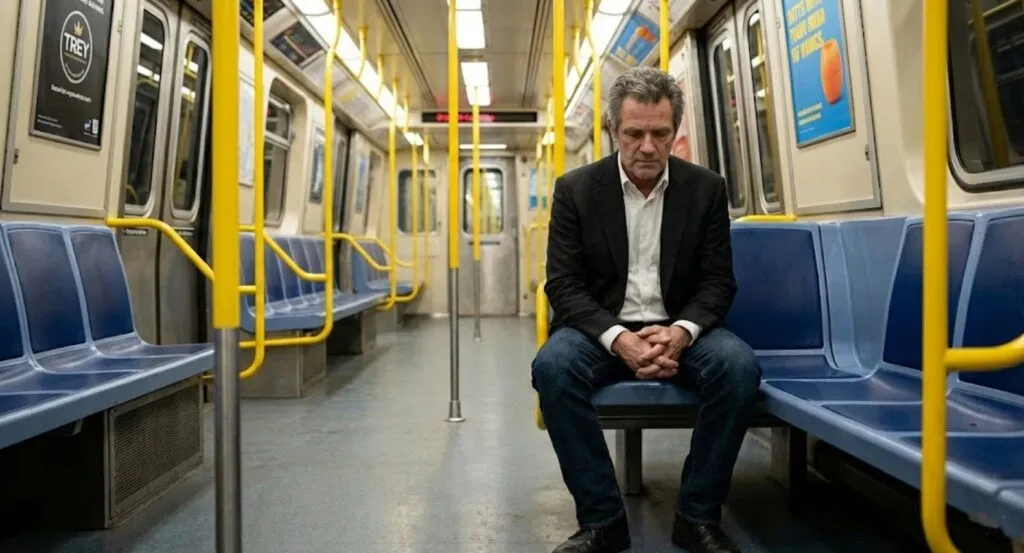
Ethan navigated the swaying aisle and sank into a plastic seat near the rear exit. The girl sat two rows ahead, staring out the window. She didn’t look back for a “thank you.” She adjusted her backpack—a red thing held together with duct tape—and pulled her knees to her chest.
Ethan waited until the bus hissed to a stop at 5th and Main before he stood up. The girl was getting off, too. He followed her onto the wet pavement.
“Hey,” he called out.
She spun around, shoulders hunched, instantly defensive. “I ain’t got nothing else. You took the last of it.”
“I don’t want money,” Ethan said, feeling the absurdity of his tailored Italian suit against the backdrop of the grime-streaked street. “I want to pay you back. I can get to a phone, call my office…”
“I don’t need your office,” she said, turning away. “You needed a ride. Now you got one. We’re even.”
“I’m Ethan.”
“Good for you, Ethan.” She started walking, her sneakers squelching on the wet concrete.
“What’s your name?”
She hesitated, glancing over her shoulder. “Maya.”
“Where do you live, Maya?”
She stopped and pointed toward the underpass of the 5th Street Bridge, where shadows pooled thick and heavy. “The Hilton,” she deadpanned. “Room service is lousy, though.”
She was funny. She was also terrifyingly young. Ten, maybe eleven. Ethan felt a cold knot in his stomach. He wasn’t a saint, but he wasn’t blind. “You’re on your own?”
“My mom’s away,” she said, the automatic lie slipping out smooth as oil. “She’ll be back.”
“When?”
“When she’s back.” She eyed him, assessing the cut of his jacket. “You asking a lot of questions for a guy who couldn’t pay a two-dollar fare.”
“I’m hungry,” Ethan said, changing tactics. “And I bet you are too. If I can get my assistant on the phone, I can get cash. Come with me to the diner on the corner. Ten minutes. If I’m lying, you leave.”
Maya weighed the risk against the hunger. The hunger won. “Ten minutes,” she said. “But if you try anything weird, I scream. I got a loud scream.”
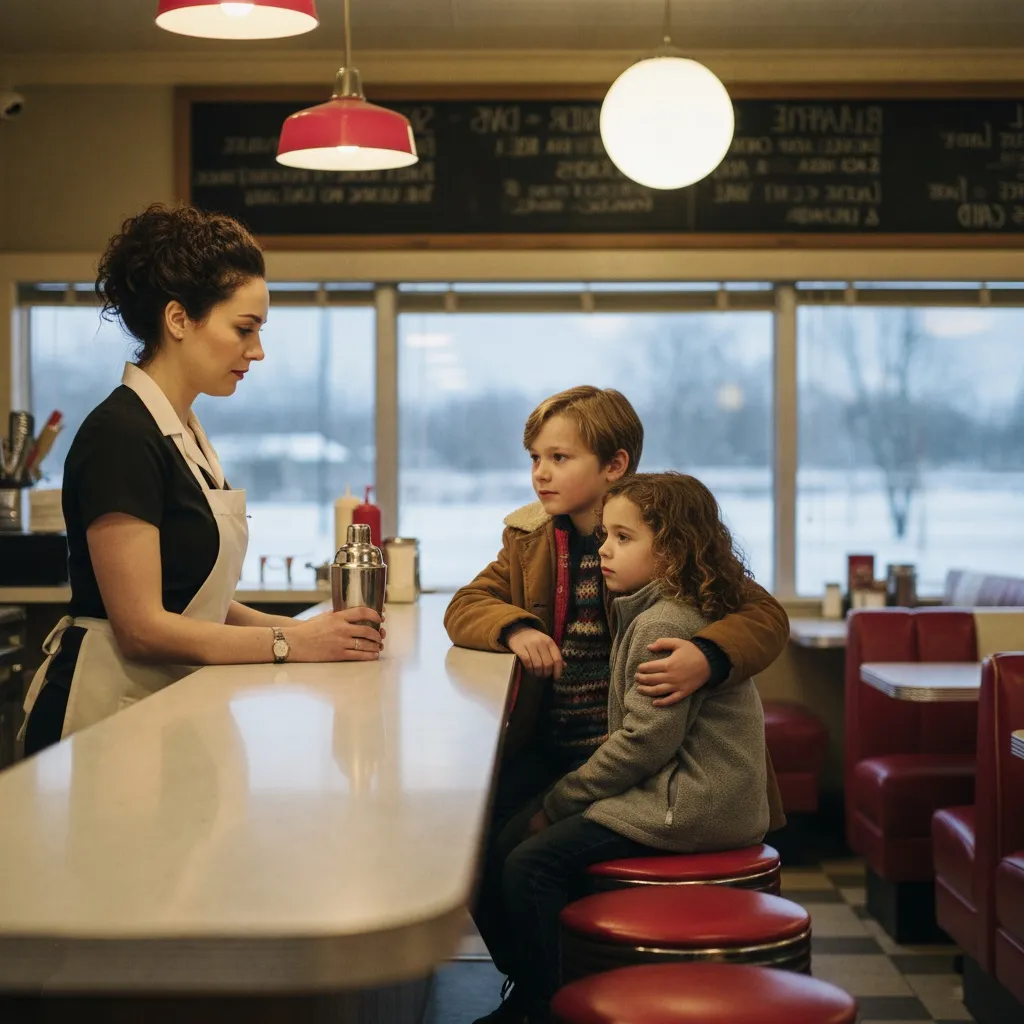
The diner was bright, loud, and smelled of grease and stale coffee. Ethan borrowed the waitress’s phone, made a humiliatng collect call to his office, and within twenty minutes, a courier arrived with an envelope of cash.
He ordered burgers. Maya ate like someone who didn’t know when the next meal was coming—quickly, guarding her plate with one arm.
“So,” Ethan said, watching her wipe ketchup from her chin. “School?”
“Sometimes,” she said. “When it’s cold. They got heat.”
“And when it’s not cold?”
“I recycle,” she said. “Cans, bottles. It adds up.”
Ethan looked at her. Really looked at her. He saw the dirt under her fingernails, the fatigue bruising the skin under her eyes. He was a board member of Blake & Holden. He moved millions of dollars across borders with a keystroke. He donated to the United Way every December. It was a tax write-off.
“This isn’t right,” he muttered.
“Tell me about it,” Maya said, taking a sip of her milkshake. “Usually they put more pickles on this.”
“No, I mean you. Here. Like this.”
Maya put the glass down hard. “Look, mister. I didn’t pay for your bus ride so you could give me a lecture. You think you’re the first suit to feel bad? You’ll go home to your nice bed, and you’ll feel guilty for an hour, maybe two. Then you’ll forget. It’s fine. That’s how it works.”
“I won’t forget.”
“Yeah, you will.” She stood up, grabbing the second half of her burger and wrapping it in a napkin. “Thanks for the food. I’m taking this to go.”
She walked out before he could stop her. Ethan sat there, the envelope of cash sitting uselessly on the table. She was right. He would go home. He would shower. He would sleep.
But he was wrong about the forgetting.
Two days later, Ethan walked into the boardroom. The air conditioning was set to a crisp sixty-eight degrees. Martin Hale, the CFO, was droning on about Q3 projections and risk mitigation.
“Ethan?” Martin asked, pausing. “You’re staring at the wall.”
“We have a surplus in the charitable trust,” Ethan said abruptly. “About four million?”
“Give or take,” Martin said, looking confused. “We usually disperse it to the Arts Council and the Zoo.”
“I want to reallocate it.” Ethan slid a folder across the table. “There’s a warehouse on Jennings and 8th. Former textile factory. It’s been in foreclosure for three years.”
“Jennings?” Martin scoffed. “That’s in the Ridge. It’s a war zone. What do you want to do? Flip it?”
“I want to house people,” Ethan said. “Not a shelter where they kick you out at 6 AM. A residence. No locks, no curfews, just… stabilization.”
The room went silent.
“Ethan,” Martin sighed, taking off his glasses. “You got mugged. It was traumatic. We get it. But buying a dilapidated building in a high-crime area isn’t a strategy. It’s a liability nightmare. The insurance alone—”
“I’m buying it,” Ethan interrupted. “With or without the firm. But if the firm passes, the firm doesn’t get the PR.”
Martin looked at the other board members. He saw the calculation in their eyes. “Fine,” Martin said tightly. “But it’s your project. If it sinks, it’s your reputation.”
It wasn’t a movie montage. It was hell.
Buying the building took three weeks. Getting the permits to renovate took another two months. The “Project Haven” site was a disaster of peeling lead paint, asbestos-wrapped pipes, and a roof that leaked like a sieve.
Ethan stood in the center of the cavernous main hall, holding a blueprint that made no sense. He was wearing jeans and work boots, covered in drywall dust.
“You’re doing it wrong.”
He turned. Maya was standing in the doorway, her backpack on one shoulder. He hadn’t seen her in six weeks, though he’d driven past the bridge every day hoping to spot her.
“Maya,” he said, exhaling. “I thought you vanished.”
“I saw the trucks,” she said, stepping inside. She looked around, unimpressed. “You bought this dump?”
“I’m fixing it up. For kids. Like you.”
She walked over to a stack of framed lumber. “You putting the bedrooms on the ground floor?”
“Accessibility,” Ethan said, quoting the architect.
“Stupid,” she said. “Ground floor means break-ins. People throw rocks through windows. Drunks bang on the glass. Kids won’t sleep. Put the beds upstairs. Put the kitchen down here.”
Ethan looked at the blueprints. Then he looked at the shattered windowframe nearby. “You think?”
“I know,” she said. “And don’t put bright lights outside the doors. It makes us feel like we’re being watched. Put them high up, soft lights.”
Ethan folded the blueprint. “You want a job?”
“I’m eleven.”
“I’m not paying you to work,” Ethan said. “I’m paying you for consultation. Cash. Ten bucks an hour.”
Maya narrowed her eyes. “Twenty.”
“Fifteen,” Ethan countered. “And lunch is included.”
“Deal.”
Maya didn’t magically transform into a happy child. She was a relentless critic. She told the contractors their security gates looked like prison bars. She told the painter that “hospital white” made people anxious and demanded warm yellow. She was rude, impatient, and absolutely indispensable.
But the problems kept mounting.
Three months in, the city inspector slapped a stop-work order on the door. Wiring violations. It would cost another fifty grand to fix. Ethan sat on a stack of drywall, head in his hands.
“You giving up?” Maya asked. She was eating a sandwich Ethan had brought her. She looked healthier now, the hollows under her eyes filling in, though she still refused to sleep anywhere but the bridge.
“I might have to,” Ethan admitted. “I’m bleeding money, Maya. The board is breathing down my neck. They say I’m throwing good money after bad.”
“They’re suits,” Maya said, chewing. “Suits don’t know anything.”
“I’m a suit,” Ethan reminded her.
“Yeah, but you’re learning.” She crumpled the sandwich wrapper. “Look, you can’t quit. My friend Layla… she got kicked out of her foster spot yesterday. She’s sleeping in a car. She’s asking when this place opens.”
The weight of it hit Ethan. It wasn’t just a building anymore. It was a promise.
“I need to make some calls,” Ethan said, standing up. “Finish your lunch.”
He called Martin. He called the Mayor. He called in favors he had been saving for a decade. He threatened to pull Blake & Holden’s campaign funding if the permits weren’t expedited. It was ugly, aggressive, corporate bullying.
And it worked. The work crews were back the next morning.
The threat didn’t always come from the city.
One rainy Tuesday, a man showed up at the site. He was lean, jittery, with eyes that darted around the equipment. He cornered Maya near the supply truck.
Ethan saw the body language from across the room—Maya shrinking back, the man leaning in too close. Ethan dropped his clipboard and crossed the distance in seconds.
“Is there a problem?” Ethan asked, stepping between them.
The man smirked. “Just catching up with my niece. Right, Maya?”
Maya stared at the floor. “He’s my cousin. Reggie.”
“Reggie,” Ethan said, keeping his voice level. “Maya’s working. You need to leave.”
“Working?” Reggie laughed. “She’s a kid. She belongs with family. I was thinking of taking her back to my place.”
Ethan saw the terror in Maya’s stillness. “She doesn’t want to go.”
“She’s family,” Reggie spat. “And who are you? Some rich guy playing daddy? You think you own her?”
“I think you’re trespassing,” Ethan said. He signaled to the large foreman, a guy named Miller who held a crowbar like a toothpick. Miller took a step forward.
Reggie backed off, hands up. “Fine. Whatever. But she owes me, man. She owes me.”
He left, but the air remained heavy.
“He put you on the street, didn’t he?” Ethan asked quietly.
Maya didn’t cry. She just kicked a loose nail across the floor. “He took my mom’s checks. Then he said there wasn’t room for me anymore.”
“He’s not coming back,” Ethan said. “We’ll put security at the gate. Real security.”
“He’ll try,” Maya said. “He smells money.”
“Then he’ll find trouble,” Ethan said. “I promise.”
Opening day wasn’t a gala. There was no champagne. There were just twenty nervous kids, three social workers, and a very tired Ethan standing by the door.
The building—now called “The Haven”—didn’t look like an institution. Thanks to Maya, the walls were a soft sage green. The common room had beanbags, not just stiff chairs. The smell was fresh paint and pizza, not bleach.
Maya stood by the intake desk, holding a clipboard. She was officially a resident now. It had taken months of legal wrangling with Child Protective Services, proving that she was an “emancipated minor consultant” housed in a specialized program, to keep her out of the foster system loop.
Ethan watched her check in a terrified seven-year-old named Leo.
“You got a toothbrush?” Maya asked the boy.
Leo shook his head.
“Okay,” Maya said, handing him a kit. “Blue or red?”
“Red.”
“Good choice. Red goes faster.”
She wasn’t soft. She wasn’t hugging him. She was practical. She was giving him control.
Martin Hale walked in, looking out of place in his cashmere coat. He looked around the room, taking in the murals painted by local artists, the quiet corners, the kids eating at the tables.
“It’s… cleaner than I expected,” Martin admitted.
“It’s barely holding together,” Ethan said honestly. “The boiler is acting up, and we’re over budget on food already.”
“The press is outside,” Martin said. “They want a statement. ‘CEO Saves the City.’ That’s the headline they want.”
Ethan looked at Maya. She was showing Leo how to work the water fountain. She looked back at him and gave a tiny, almost imperceptible nod.
“Tell them to wait,” Ethan said. “I’m busy.”
He walked over to the wall near the entrance. It was the only white wall left. Maya had asked to keep it blank.
“What’s this for?” Ethan asked her.
Maya pulled a marker from her pocket. “For the rules.”
“We have rules in the handbook.”
“Nobody reads handbooks,” Maya said. She uncapped the marker. She reached up and wrote, in slightly crooked block letters:
1. YOU STAY AS LONG AS YOU NEED.
2. NOBODY HITS NOBODY.
3. WE ARE STILL HERE.
She handed the marker to Ethan. “Your turn. Boss.”
Ethan looked at the wall. He thought about the bus ride. He thought about the cold nights. He thought about the fear of becoming invisible.
He wrote: 4. YOU ARE NOT A PROBLEM TO BE SOLVED.
“Corny,” Maya said, reading it.
“Maybe,” Ethan smiled. “But true.”
Six months later, the Haven was full. The boiler did break, twice. Reggie did come back, and was promptly arrested for trying to hop the fence. The money was always tight. The work was exhausting, thankless, and endless.
Ethan sat in his office—a converted closet—going over the electric bill. Maya knocked on the doorframe. She was taller now, clean clothes, hair braided. She looked like a kid. Almost.
“Layla passed her math test,” Maya said. “She needs a reward. Ice cream run?”
Ethan checked his watch. He had a board meeting in an hour. A merger worth millions.
“Let’s go,” Ethan said, grabbing his keys. “The meeting can wait.”
“You’re gonna get fired,” Maya warned, smirking.
“I own the company, Maya.”
“Yeah, well,” she shrugged, walking toward the door. “Even owners need to listen to their consultants.”
Ethan followed her out. He wasn’t a savior. He knew that now. He was just a guy who had finally paid his fare.