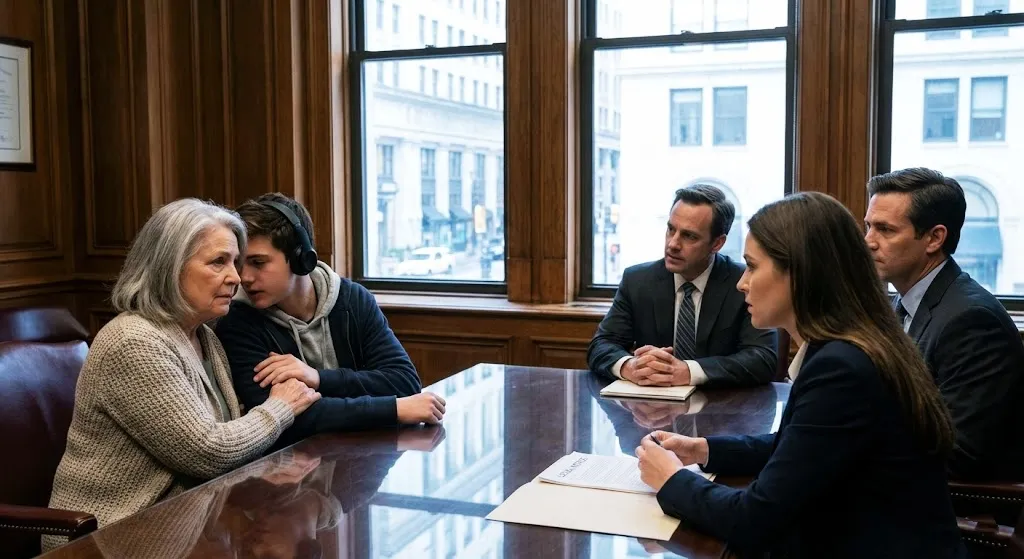
For seven years, a billionaire’s daughter lived trapped in silence. Her father owned half the city, but he couldn’t buy her a single sound. The best doctors in the world examined her—specialists from Germany, Japan, Switzerland—millions of dollars spent with zero results.
Then, one afternoon, a poor seven-year-old girl with no medical training stopped on a sidewalk, looked at her ear, and saw what every expert had missed. In less than two minutes, she pulled out something that changed everything. The billionaire’s daughter heard her first sound. Ever.
But what that little girl pulled out of her ear caused everything to go dark. Because it wasn’t a medical problem. Someone had put it there on purpose. And when they found out who, it destroyed everyone in that room.

It all started in a delivery room that was loud with beeping machines and doctors moving fast. But when the baby came out, everything stopped. There was no cry. The mother’s chest heaved, waiting. The father stood frozen at her side, staring at the tiny body in the doctor’s hands. The baby’s eyes were open—wide, staring at the bright lights above her—but her mouth didn’t move.
“Why isn’t she crying?” the mother whispered.
A nurse stepped closer, snapping her fingers near the baby’s ear. Nothing. She clapped her hands. Still nothing.
The doctor’s face went tight. “We need to run some tests.”
The father, one of the richest men in the state, felt his throat close up. He’d built hotels, owned companies, and controlled boardrooms with a single look. But right now, he couldn’t control the shaking in his hands.
They ran tests for hours: auditory response, neural pathways, brain scans. Every result came back the same. The doctor finally walked into the waiting room, clipboard in hand. His voice was soft, too soft.
“Sir, your daughter is healthy and strong, but she’s not responding to any sound.”
The mother covered her mouth. “What does that mean?” the father asked.
“She can’t hear.”
The words hung in the air like smoke.
“At all?”
The doctor shook his head. “We don’t know why yet, but right now, no, she can’t hear anything.”
That night, the father sat alone in the hospital room. His daughter was asleep in the small crib beside him, wrapped in white blankets. He whispered her name. She didn’t move. He said it louder. Nothing. He stood up, leaning over the crib, and spoke directly into her ear.
“Can you hear me? Please, baby, please hear me.”
Her tiny chest rose and fell, peaceful, unaware. He sat back down, head in his hands. His wife was asleep across the room, exhausted from labor. The nurses had left them alone. For the first time in his life, the billionaire felt powerless. He could buy anything, fix anything, make calls that changed entire industries overnight, but he couldn’t make his daughter hear his voice.
He pulled out his phone and started searching. Specialists, surgeons, experimental treatments—anything. The screen blurred as his eyes filled with tears. He wiped them away fast, as if someone might see. Then he looked back at his daughter. She was staring at the ceiling, eyes wide and curious, watching shadows move across the walls. She looked so calm, so perfect. But inside him, something had broken.
“I’ll fix this,” he whispered. “I don’t care what it takes. I’ll fix this.”
The baby blinked slowly, her tiny hand curling into a fist. The father made a promise he didn’t know he couldn’t keep. Not with money, not with power, not with anything he had. The only thing that would save her was something he’d never see coming: a little girl with no wealth, no name, and a gift no doctor could explain. But that was years away. For now, all he had was silence.
In public, the billionaire never flinched. In boardrooms, press conferences, and charity galas, he stood tall, shoulders back, face carved from stone. But at home, he was falling apart. Every morning, he walked into his daughter’s nursery before work. She’d be awake, staring at the mobile above her crib, watching the shapes spin in silence. He’d lean over and say, “Good morning, sweetheart.” She never turned her head. He’d clap his hands, snap his fingers, play music from his phone right next to her ear. Nothing.
His assistant started noticing things. Coffee left untouched. Meetings he zoned out of. Phone calls he forgot to return.
“Sir, are you okay?” she asked one afternoon.
He looked up from his desk, eyes hollow. “I’m fine.”
He wasn’t. At night, after his wife went to bed, he’d sit in his office with the door locked, medical reports spread across his desk. Audiology charts, brain scans, research papers. He read everything—cochlear implants, gene therapy, experimental surgeries in Europe. He called specialists in the middle of the night, offering whatever they wanted. Double their salary, triple it.
“Just tell me you can help her.”
But every conversation ended the same way: “We’ll do our best, but there are no guarantees.”
His hands would shake when he hung up. One night, his wife found him in the nursery at 3 AM, sitting on the floor beside the crib.
“You need to sleep,” she said softly.
“I can’t. She’s fine, she’s healthy… but she can’t hear me,” he said, voice cracking. “I tell her I love her every day and she has no idea.”
His wife knelt beside him, taking his hand. “She knows,” she whispered. “She feels it.”
He wanted to believe that, but it didn’t stop the ache in his chest. He started avoiding friends, stopped going to dinners, canceled trips. His business partners called, concerned.
“You’ve missed three meetings this week. I’ll be there next time.” But he wasn’t.
One afternoon, he was sitting in traffic, staring at nothing, when a car next to him rolled down its window. A toddler in the back seat waved at him, giggling. The father waved back. Then the toddler’s mom said something, and the kid turned around, laughing at whatever she’d said. The billionaire’s throat tightened. That kid could hear his mom’s voice. His daughter never would. He pulled over to the side of the road and sat there for twenty minutes, gripping the steering wheel, trying not to break down.
When he finally got home, his daughter was in the living room with a nanny, playing with blocks. He sat down on the floor beside her. She looked up at him and smiled. That smile hit him harder than any business loss ever had. She didn’t know. She didn’t know what she was missing. And maybe that was worse.
He reached out and touched her tiny hand. “I’m going to fix this,” he whispered. “I swear.”
But deep down, for the first time in his life, he didn’t believe his own words. He’d conquered everything, built empires, crushed competitors, shaped skylines. But he couldn’t give his daughter the one thing she needed most: a single sound. And it was destroying him from the inside out.
The billionaire flew in specialists from everywhere: Germany, Japan, Switzerland, Boston. The best ears, nose, and throat doctors in the world. They came with leather briefcases and confident smiles, ready to solve what others couldn’t. But one by one, they all said the same thing.
The first specialist was from London. He ran tests for three days straight—brain scans, hearing tests, neural imaging. On the fourth day, he sat down with the parents in his temporary office.
“Her auditory nerves aren’t responding. There’s no damage we can see. They just don’t work.”
The father leaned forward. “So fix them.”
The doctor hesitated. “Sir, it’s not that simple.”
“Make it simple. I’ll pay whatever it costs.”
“It’s not about money. The nerves are intact, but they’re not transmitting signals. We don’t know why.”
The billionaire’s jaw tightened. “Then find out why.”
The doctor looked down at his notes. “I’m sorry. I wish I had better news.”
The second specialist came from Tokyo. She was younger, sharper, known for impossible cases. She spent two weeks running different tests. New technology, advanced equipment, same result.
“I’ve seen cases like this before,” she said carefully. “Sometimes the brain just doesn’t process sound. We don’t have a cure yet.”
“Yet,” the father repeated.
“Maybe in ten years, twenty. But right now…”
“I don’t have twenty years.”
She nodded slowly. “I understand.”
The third doctor was American, from Stanford, top of his field. He didn’t sugarcoat anything. “Sir, I’ve reviewed everything. Your daughter’s case is what we call idiopathic hearing loss. That means we don’t know the cause.”
“So guess.”
“I can’t. And even if I could, there’s no surgery that would help. No implant that would work. Her nerves won’t carry the signal.”
The billionaire stood up. “You’re telling me there’s nothing?”
“I’m telling you the truth.”
“Get out.”
The doctor gathered his files and left quietly. The father tried fourteen more specialists after that. Some suggested experimental drugs. Others mentioned trials happening overseas. One doctor said, “Maybe it’s better to accept this early. Help her adjust instead of chasing hope.” The billionaire nearly threw him out of the house.
He wasn’t giving up. He funded research labs, donated millions to hearing loss foundations, and hired private scientists to study his daughter’s case specifically. But nothing changed.
One night, a surgeon from Switzerland called him. “I’ve been reviewing your daughter’s file,” he said, “and I need to be honest with you.”
“Go ahead.”
“There’s no medical error here. No blockage, no tumor, no infection. Her auditory system just doesn’t respond. And I’ve seen thousands of cases. This one… I can’t help.”
The billionaire sat in silence.
“I’m sorry,” the surgeon continued. “I know that’s not what you want to hear.”
“No, it’s not.”
“Sometimes, the answers we’re looking for don’t exist yet.”
The call ended. The billionaire sat alone in his office, staring at the wall. He’d thrown money at the problem, brought in the smartest people on Earth, and they’d all failed. Not because they didn’t care, but because they didn’t know. His daughter was healthy, strong, beautiful, but trapped in silence. And no amount of wealth could break her free.
He didn’t know that the answer wasn’t in a lab. It wasn’t in a medical journal. It wasn’t in the hands of a trained professional. It was in the hands of a little girl who hadn’t even been born yet. A girl with no money, no training, no reason to help, except one: she could feel things others couldn’t. And one day, she’d feel exactly what was wrong.
The billionaire’s daughter turned three, then four, then five. She grew into a quiet child—observant, gentle. While other kids ran around screaming and laughing, she sat on the edge of playgrounds, watching. Her father built her the biggest playroom money could buy—swings, slides, a treehouse with cushioned floors. But she rarely smiled there. She liked picture books, the ones with no words, just images she could understand without needing sound. Her parents hired the best sign language teachers, speech therapists, and specialists who worked with deaf children. She learned fast, picking up signs quicker than expected.
But learning wasn’t the problem. Belonging was. Other kids came over for playdates. Their parents were friends of the billionaire, trying to be supportive. The kids would run up to her shouting, “Wanna play tag?” She’d stare at their lips, trying to piece together what they were saying. They’d repeat it, louder, like volume was the issue. She still didn’t respond. Eventually, they’d give up and run off to play with each other. She’d stand by the fence, watching them laugh at jokes she couldn’t hear.
One day, her father found her sitting on the front steps of the mansion, chin in her hands, staring at the street. He sat down beside her.
What are you thinking about? he signed.
She pointed at a kid riding by on a bike. The kid was singing—badly, off-key—but singing.
I wanna do that, she signed back.
Her father’s chest tightened. You can ride a bike. I’ll get you one right now.
She shook her head. Not the bike. She pointed at the kid’s mouth.
Her father understood. She didn’t want the bike; she wanted the song. He pulled her close, and she rested her head on his shoulder.
At school, it was worse. The teachers tried, they really did. But the other kids didn’t understand. They’d wave at her, she’d wave back. Then they’d say something and she wouldn’t respond. They’d think she was ignoring them.
“She’s weird,” one kid said.
“She doesn’t talk,” another added.
She wasn’t weird; she was just different. And “different” felt like the loneliest word in the world. During recess, she’d sit under a tree, watching everyone else play. Sometimes a teacher would sit with her, trying to keep her company. But pity wasn’t friendship.
One afternoon, she pressed her hand against the classroom window during a thunderstorm. She felt the glass shake, felt the vibration of the thunder rolling through the air. That’s how she experienced sound: through feeling, through movement. But it wasn’t the same. She knew it wasn’t the same.
At night, her mother would tuck her in, kissing her forehead. “I love you,” her mother would say out loud, then sign it. The girl would sign it back. But when her mother left and closed the door, the girl would stare at the ceiling, wondering what “I love you” actually sounded like. Did it sound warm? Soft? Like a hug? She’d never know.
Her father checked on her every night, sometimes twice. He’d stand in the doorway watching her sleep, praying for a miracle he didn’t believe in anymore. She wasn’t sad because she was deaf. She was sad because everyone else had something she didn’t: a voice, a laugh, a connection. She wanted to belong, but the world didn’t know how to let her in. And so she stayed on the outside, watching life happen to everyone else.
Until the day everything changed. Until the day a little girl with no reason to care, cared anyway.
Across the city, in a cramped apartment above a laundromat, lived a girl named Skye. She was seven years old, skinny, quiet, with eyes that seemed too old for her face. Her mother worked two jobs: mornings at a diner, nights cleaning office buildings. Her father left before Skye could walk. No goodbye, no explanation, just gone. The apartment was small—one bedroom, a couch that folded out into a bed, a kitchen with a fridge that hummed too loud—but it was home.
Skye didn’t complain, ever. When other kids at school bragged about new toys, she stayed quiet. When they talked about family vacations, she nodded and smiled. She knew her mom was trying, and that was enough. But Skye was different in ways even her mom didn’t fully understand. She noticed things. Like when her teacher said she was fine, but her hand shook when she picked up her coffee. Or when a classmate smiled but had red eyes from crying in the bathroom. Skye saw through people—not in a mean way, but in a way that made her want to help.
One day, a kid in her class tripped and scraped his knee. He didn’t cry, just sat there staring at the blood. Everyone else kept playing, but Skye walked over, sat down next to him, and stayed there until he felt better. She didn’t say much—she didn’t have to—he just looked at her and nodded.
“Thanks.”..