
On Christmas Eve, the laughter of my three children echoed in my mind, not as a fond memory, but as a weapon. “Old man’s unbearable,” the text read. “Nobody wants to spend Christmas with him. Let him eat alone.”
They thought I was just a confused, lonely retiree who would take the insult in silence. They had absolutely no idea what they had just unleashed. The story I am about to share took place last Christmas, and it was a night that fundamentally dismantled everything I thought I understood about family loyalty.
Let me take you back to where it started. It was 7:00 PM on Christmas Eve in Seattle. The air in my kitchen was heavy with the rich, savory aroma of roasting turkey and the sweet spice of cinnamon.
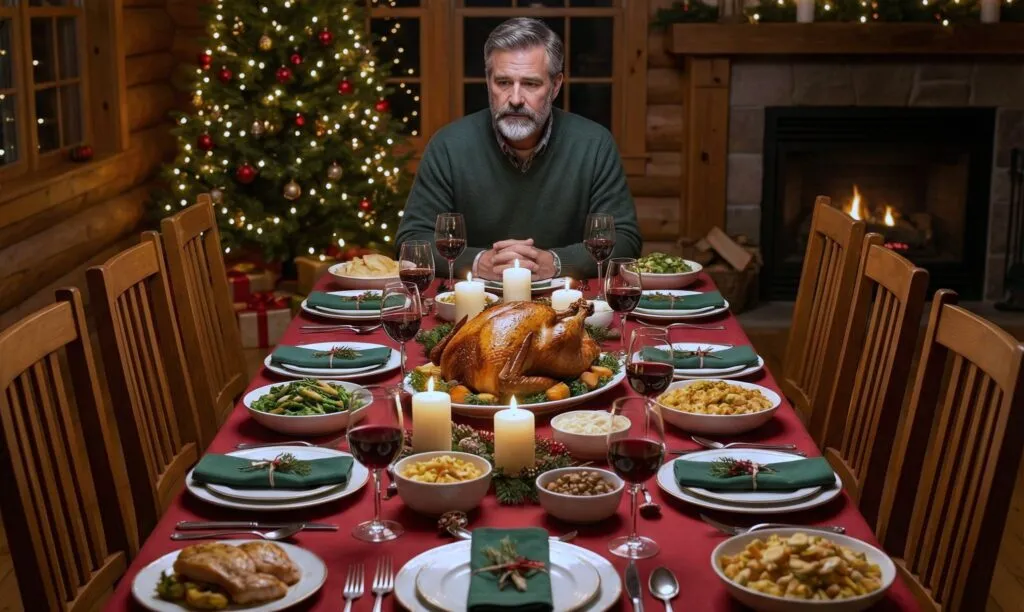
I had set the table for nine people with meticulous care. I had even brought out two smaller chairs, positioning them perfectly for Parker and Ella, my beloved grandchildren. Despite the empty room, I wasn’t wallowing in misery.
There is a distinct difference between being alone and being lonely. At 59, I had spent the last six years rebuilding my identity after my wife, Sarah, passed away. I wasn’t just sitting around; I taught cooking classes on Thursdays and maintained a food blog that had cultivated a respectable following.
I played chess with my friend Howard every Tuesday. I had a community. I had a purpose. I wasn’t simply a desperate old man peering through the curtains, waiting for children who never arrived.
However, this night was supposed to be the exception. Two weeks prior, I had extended an invitation to the entire clan. My three children—Warren, 34, and his wife Stella; Bryce, 31; and Blair, 27—were supposed to gather under my roof so we could be a family again.
Their responses in our group chat had been lukewarm at best. Warren had typed a noncommittal “maybe.” Bryce sent a lazy thumbs-up emoji. Blair hadn’t even bothered to open the message for three days. I chose to ignore the signs. I chose hope.
I spent three full days prepping. The turkey had been brining since Monday to ensure it was moist. I prepared Sarah’s signature cranberry sauce, spiking it with orange zest and a touch of bourbon.
I mashed Yukon gold potatoes until they were clouds of butter, baked a green bean casserole from scratch, and created a pumpkin pie with a crust so flaky it would bring a tear to your eye. Everything was flawless. Bing Crosby was crooning “White Christmas” on my vintage radio, and through the window, I watched the neighbor’s kids rolling a snowman in the damp Seattle chill.
The turkey sat on the counter, resting on Sarah’s grandmother’s platter—a dish reserved strictly for special occasions. At 7:30 PM, I wiped my hands on my apron and checked my phone, telling myself they were just battling the notorious I-5 traffic.
The screen lit up. There were new messages in the “Marshall Family” group chat. My heart leaped, expecting an ETA. Instead, I read a message from Blair: “Seriously, do we have to go? Old Man’s Unbearable. Nobody wants to spend Christmas with him.”
My stomach dropped. Then Warren replied: “I told Stella we’d be at her parents’ place. She’ll kill me if I bail.”
Then Bryce chimed in: “He’ll guilt trip us anyway. Let him eat alone.”
And then, the dagger. My youngest son added a laughing emoji.
I stared at the screen. I read it once, then twice, then a third time, hoping that if I read it enough, the words would rearrange themselves into a joke. My thumb hovered over the keyboard. I almost typed, “Wrong chat, kids. I can see this.”
But I stopped. I set the phone down on the counter with a steady hand. That steadiness surprised me. When Sarah died, I had collapsed in the hospital hallway, gasping for air. This sensation was entirely different.
It was colder. Cleaner. It felt like a surgical blade sliding between my ribs—so sharp that the pain doesn’t register immediately. I looked out at the dining room. Nine place settings. Unlit candles. The fine china.
Those two little chairs were waiting for Parker and Ella. All of this effort for people who were currently laughing about leaving me in solitude. The radio began playing “I’ll Be Home for Christmas,” and the irony was almost enough to break me.
Almost.
Instead of breaking, I walked to my desk and opened my laptop. The screen cast a blue glow in the dimming light. If my children believed they could discard me like table scraps and face zero repercussions, they were sorely mistaken. I made a decision right then that would alter the course of our lives.
Some people fall apart when they are betrayed. I set up a camera.
My cursor blinked on the screen. I could have confronted them privately. I could have begged for an apology. But what good would that do? They would offer half-hearted excuses and eye-rolls.
I was finished with half-heartedness. My anger wasn’t a raging fire; it was absolute zero. Sitting in that quiet kitchen, the realization hit me: this disrespect wasn’t a sudden event. It had been accumulating for years. I had simply been acting as their enabler.
I thought about the money. Three years ago, Warren, my eldest, had “borrowed” $50,000 for an investment opportunity. He never paid back a single cent. Now, he only called when he needed a free babysitter for Parker and Ella.
I would drop everything, feed them, and tuck them in, only for him to show up hours late, mutter a quick thanks, and vanish for months. Then there was Bryce. Two years ago, he took $20,000 for a real estate scheme. He lost it all.
Yet, somehow, in his mind, it became my failure. “You should have warned me it was risky, Dad,” he had said. He was 31 years old. Since when was I responsible for his gambling?
And Blair, my 27-year-old daughter. She was polished and perfect, her life curated for social media. I found out last year she had stopped inviting me to her events. A mutual friend had asked me, “Oh, you weren’t there?”
When I asked Blair, she admitted that a retired chef in a stained apron didn’t fit her “aesthetic.” I wasn’t Instagram-worthy. I had made excuses for them all. “They’re busy,” I’d tell myself. “They’re building their empires.”
But that text message—”Old man’s unbearable”—and that laughing emoji? That was intentional cruelty. I scrolled through my contacts until I found Jordan Hayes. He was the 23-year-old, tech-savvy son of my chess partner, Howard. I had helped Jordan out the previous year when he lost his job, letting him stay in my guest room rent-free.
He picked up on the second ring. “Mr. Marshall?”
“Jordan, I need your help tonight,” I said.
There was a pause. “Is everything okay?”
“Can you come over? I need someone who understands cameras and live streaming.”
“Yeah,” he said, sounding confused. “I can be there in 20 minutes.”
He arrived at 8:30 PM, looking concerned. I was still wearing my apron, the magnificent, untouched feast spread out on the table behind me.
“Mr. Marshall, what’s going on?”
“I need you to set up a camera,” I said calmly. “I’m going to eat Christmas dinner alone. And I want people to see it.”
His eyes went wide. “Like… live stream it?”
“Exactly.”
“Your kids didn’t show?” he asked tentatively.
“Something like that.”
He didn’t pry further. Perhaps the look on my face told him it was better not to. He unpacked his gear—a high-quality phone setup and a ring light he grabbed from his car.