The metal folding chair beneath me groaned, a sharp, metallic protest that seemed too loud for the hushed fellowship hall. The air in the room was thick, carrying the stale scent of burnt coffee mixed with the damp wool of winter coats and a lingering trace of lemon floor wax. On the wall, a plain analog clock ticked away the seconds, each click sounding like a judgment I wasn’t ready for.
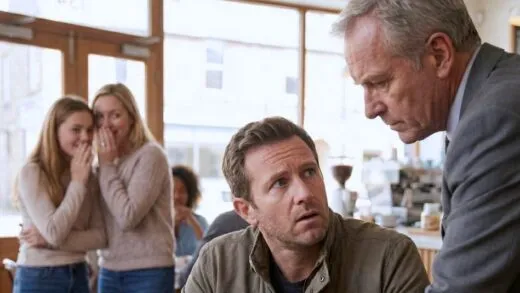
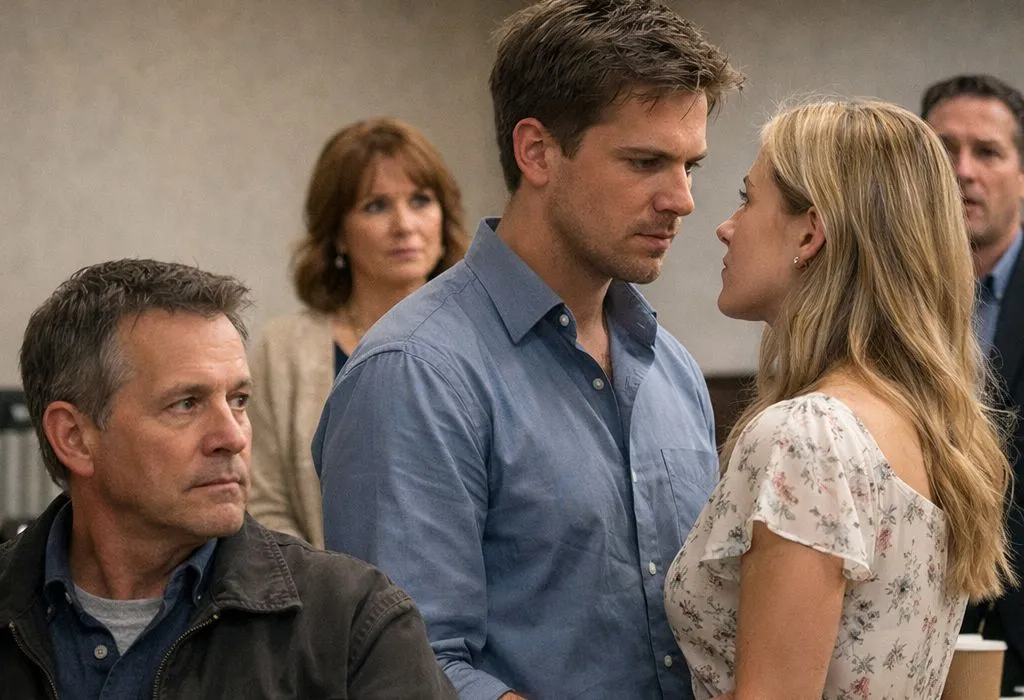
I heard someone take a sharp, shallow breath. From across the room, the distinct sound of a wedding ring tapping nervously against a Styrofoam cup broke the silence. Evan Caldwell was standing near the industrial coffee urn, his broad, honest face looking pale under the harsh hum of the fluorescent tube lights.
He looked down at the thin manila folder resting on my knee, then shifted his gaze to Kendra, my stepdaughter, before finally looking at Marla, my wife. His jaw tightened, the muscles bunching as if he were trying to chew through a bitter truth he had no desire to swallow. Finally, he turned his eyes to me. His voice wasn’t raised in anger; instead, it carried the hollow, steady weight of a man who has just realized he’s standing on a trapdoor.
“That is not what I was told,” Evan said softly. “And honestly, the lie hurts more than you know.”
The room didn’t just go quiet; it froze. It wasn’t the polite silence of a church service. It was the heavy, suffocating silence that descends when the truth walks through the door and everyone realizes it doesn’t care about their comfort. I didn’t smile. I didn’t feel any rush of victory.
All I could think, as the radiator clanked in the corner, was that I had raised her. I had been there. And they had tried to wipe me away like a smudge on a dirty windowpane.
Two days earlier, I had been standing in my own kitchen in Rockford, Illinois, surrounded by the warm, spiced aroma of pumpkin pie, listening to a sentence that would dismantle my life. It was the Monday before Thanksgiving, the day I discovered I had been written out of my own family’s history.
Outside, Rockford was wearing its typical late November expression—gray skies and a biting wind whipping off the Rock River, cutting through layers of clothing like it had a personal vendetta. The slush in the parking lot of the Members Plus Credit Union had turned that ugly, churned-up brown, the kind that forces you to stomp your boots twice before entering any respectable establishment.
I had just wrapped up a job on East State Street, rewiring an old storefront that still carried the musty ghost of mildew and stale perfume from a previous tenant. I am a union electrician, IBEW through and through, so my days are defined by consistency. Electrical wires don’t care about your feelings. They don’t care about your intentions. They only care if you make the connection correctly.
That binary nature has always been my comfort. In my trade, if you cross the wrong wire, a breaker trips. Sometimes, something burns. But at least the rules are absolute. I had learned the hard way that families can bend the rules until you no longer recognize your own reflection.
I walked into our modest ranch house off Alpine Road, my hands still carrying the faint, metallic scent of copper and insulation. Marla had the kitchen warm, the oven radiating that sweet promise of cinnamon and baked apples. She was wearing her public face, hair perfectly sprayed, lipstick applied, even though it was just me. It was as if she were rehearsing for an audience.
“Kendra texted,” she said, not looking up from the counter where she was rolling dough.
I loosened my heavy Carhartt jacket. “Everything all right?”
“She and Evan are coming by Wednesday. Just to say hi before they head out.”
“Head out where?” I asked.
Marla paused. It was a small hesitation, barely a heartbeat. But I have wired enough old houses to know the difference between a steady current and a dangerous flicker.
“To meet Evan’s family,” she said.
I blinked, confused. “Here?”
“No, in Madison.”
Madison wasn’t far, but it was far enough to require packing a bag. Far enough to require a plan.
“And I’m going too?” I asked, assuming the obvious. When your daughter’s stepdaughter gets legally engaged, you show up. You shake hands. You smile. You act grateful that someone sees the value in your kid.
Marla kept smoothing the pie dough with an intensity that suggested the flour had offended her. “It’s just going to be me.”
A sensation cold as ice water slid down my spine, and it had nothing to do with the drafty window. “Why?” I asked.
She sighed, the sound of someone exhausted by having to explain gravity to a child. “Frank, it’s complicated.”
That word. People throw it around like a heavy blanket. They think if they toss it over the truth, you won’t notice the jagged shape of the lie underneath.
“Kendra is bringing Darren,” she said quietly.
I stared at her. Darren Miles. Marla finally met my eyes. Hers looked tired. Not guilty, exactly, but resigned. Like she had already done the math and decided which path offered the least resistance.
“Kendra wants her dad there,” Marla said. “Evan’s family is very traditional.”
I almost laughed, but the sound died in my throat, coming out as a dry cough. “Traditional,” I repeated. “So, what am I? Bad manners?”
“Frank, please.”
I held up a hand to stop her. “I have been in this house for seventeen years, Marla. I have paid for half of everything in it. I have fixed every broken outlet, every leaky bathroom fan, every busted porch light.”
I took a step closer. “I drove Kendra to school when your car wouldn’t start in the dead of winter. I signed for her first reliable car when she was nineteen because Darren was nowhere to be found.”
Marla’s mouth tightened into a thin line. “Don’t do that.”
“Don’t do what?”
“Make it about money.”
I felt the blood rush to my face, hot and stinging. “It is not about money. It is about being there.”
Marla turned back to her pie, dismissing me. “It is one meeting, Frank.”
“One meeting,” I said slowly. “The meeting where the families look each other in the eye and decide who belongs.”
She didn’t answer. The fan on the oven kicked on with a hum. Somewhere in the living room, the old grandfather clock ticked. Tick, tick, tick. It felt like time was keeping score against me.
That night, I didn’t say much. I ate the chili Marla placed in front of me. I rinsed my bowl. I wiped down the counters out of habit, the way I always did. I marked my work hours in my little pocket calendar because that is who I am—steady, careful. The kind of man who believes a good life is built on a series of small responsibilities handled correctly.
But my chest felt tight. Not like a heart attack, but like my world was being squeezed down to a vanishing point.
The next morning, the betrayal arrived on my phone before my coffee had finished dripping. I was standing in the kitchen in my socks, watching the coffee maker sputter, when a notification popped up from Facebook. I don’t live on social media, but I keep an account because Kendra posts pictures there. Sometimes Marla does too, when she wants to prove to the world that we are happy.
It was a photo from Kendra. She had posted it late the night before, probably assuming I wouldn’t see it until much later. There they were: Kendra in a smart dress coat, hair curled, smiling like she had won a lottery. Marla was beside her, hand resting affectionately on Kendra’s arm. And Darren—Darren Miles—was standing on the other side, beaming like a proud father.
He looked the part. He looked like a man who hadn’t missed birthdays, or school concerts, or that one ugly winter when Kendra got sick and we sat in an ER waiting room for six hours under lights that made everyone look like corpses. Behind them in the photo was a restaurant sign in Madison, the kind with trendy string lights and a chalkboard menu.
The caption read: “Family night. So grateful to have Dad here for this.”
Dad. My thumb hovered over the screen. I felt a dull, high-pitched ringing in my ears. For a second, I was back in the Navy, nineteen years old, standing on a freezing deck, trying to keep my face neutral while the wind slapped me raw. You learn to keep your expression locked down. You learn to swallow your words.
But I wasn’t nineteen anymore. I was fifty-six, and the child I had raised was calling someone else “Dad” as if I had never existed.
Marla walked into the kitchen, still in her robe, her hair a mess because her public face wasn’t required yet. She saw the phone in my hand. She saw the look in my eyes.
“Oh, Frank,” she said, the way one might react to stepping in a puddle.
“Kendra posted it,” I said, my voice barely above a whisper.
Marla’s shoulders lifted in a shrug. “She’s excited.”
I turned the phone around so she could see the caption clearly. Her eyes flicked over the words. She didn’t flinch. She didn’t defend me.
“Darren is trying,” she said. “This is important to Kendra.”
“What about what is important to me?” I asked. My voice didn’t crack. I wouldn’t let it.
Marla looked away. And in that moment, I understood something that hurt worse than the Facebook post. Her silence wasn’t confusion. It was agreement.
The front door opened then, and Kendra breezed in, owning the air around her. A draft of cold wind followed her, her cheeks pink from the outside. She smelled of expensive perfume and winter air.
“Hey,” she said brightly. “Mom. Frank.”
Not “Dad.” Not even “Frank” with any warmth. Just a label to distinguish me from the furniture.
I held up my phone. “So, you met Evan’s family.”
Kendra’s smile faltered for a fraction of a second. “Yeah.”
“And you took Darren.”
She shrugged, casual as if I’d asked if she picked up milk. “He’s my dad.”
The words hit their mark, but the next ones hit harder. Kendra’s eyes sharpened, defensive. “Look, don’t make this into a thing. Evan’s family is… like that. They wanted a classy first impression.”
“And I’m not classy?” I asked.
Kendra exhaled, impatient. “Frank, you’re not my father.”