“She is nothing more than a simple housewife!”
My stepson’s laughter rang out in the courtroom, harsh and mocking. But then the Judge looked at me, and I saw the spark of recognition in his eyes. He knew exactly who I was.
My late husband bequeathed his entire empire to me. Furious, my stepson filed a lawsuit, alleging that I was an uneducated, manipulative homemaker who had taken advantage of his father. To ensure my destruction, he hired the most expensive attorney in the city.
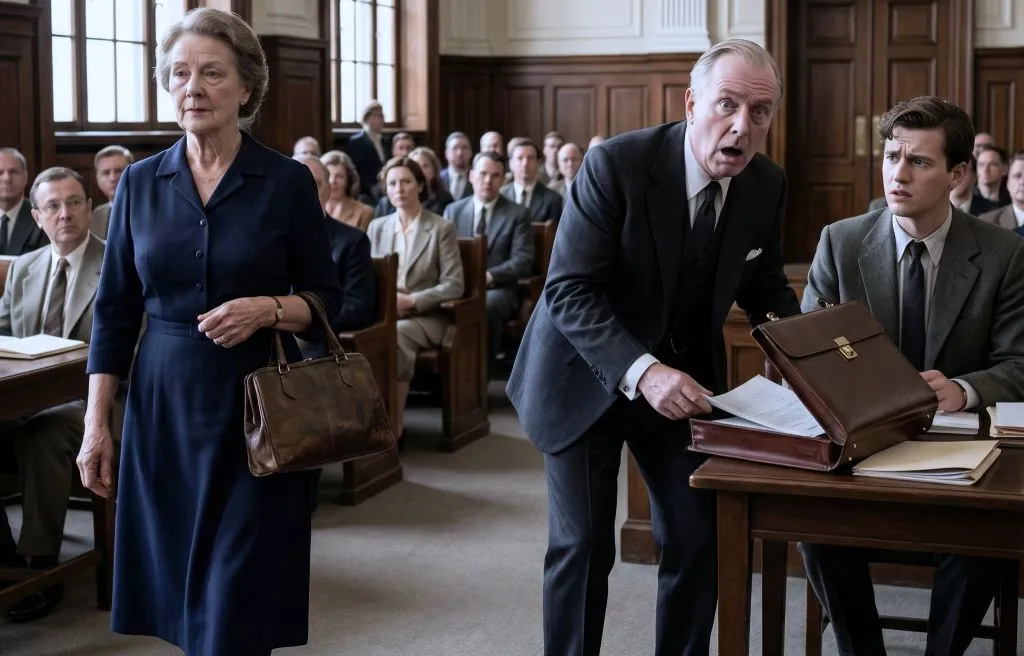
However, the moment I walked into the courtroom, the opposing counsel’s face drained of color. He dropped his briefcase, the loud thud echoing in the silence, and practically bowed.
“It is truly you,” he stammered. “I cannot believe it.”
My stepson had absolutely no clue who I really was.
“I am honored to have you here,” the lawyer whispered.
My name is Marsha. I am sixty-seven years old, and today I discovered exactly what it feels like to be dismissed as “just a housewife” in a room full of strangers.
The morning began just like every other morning had since Richard passed away six months ago. I brewed my coffee in the same ceramic mug he had purchased for our fifteenth anniversary. I took my seat at the kitchen table where we had shared twenty years of breakfasts, and attempted to pretend that the silence wasn’t crushing the life out of me.
The house felt immense now, far too quiet, and stuffed with memories that offered both comfort and agony.
Then, the doorbell chimed. A young man dressed in an ill-fitting, cheap suit handed me a thick envelope with a kind of stiff, formal politeness that immediately put me on guard.
“Mrs. Stone?” he asked. “These are legal documents. You need to sign here.”
My hands shook uncontrollably as I scanned the papers. Trevor, my stepson, was contesting Richard’s last will and testament. According to the legal jargon in front of me, I had manipulated his father into leaving me his entire estate.
The words “Undue Influence” seemed to leap off the page like physical blows. Gold Digger. Opportunist.
“Took advantage of an elderly man’s diminished capacity.”
I collapsed into Richard’s old leather armchair, the one where he used to read his evening paper, and felt the earth shift beneath me. Twenty years of marriage. Twenty years of caring for this family, nurturing them, loving them. And this was the result.
The courthouse smelled of stale wood polish and shattered hopes.
I walked down those imposing marble corridors wearing a simple navy dress—the very same one I had worn to Richard’s funeral—clutching my small handbag as if it were a lifeline. Every footstep echoed in the cavernous space, making me feel smaller and more invisible with every sound.
Trevor was already seated when I entered, resting his elbows on a polished mahogany table that likely cost more than most people’s automobiles. He was dressed in a charcoal suit that screamed wealth, his dark hair slicked back, wearing that familiar, arrogant smirk I had grown to loathe over the years.
Seated beside him was his attorney, Jonathan Pierce, whose reputation for ruthlessness preceded him like a storm warning. Three hundred dollars an hour, or so they said. He was the best money could buy.
I, on the other hand, had no lawyer. I could not afford one, not really. Not without touching the inheritance that Trevor was currently trying to steal from me.
“All rise,” the bailiff announced, and Judge Hamilton swept into the courtroom.
He was younger than I had anticipated, perhaps fifty-five, with graying hair at the temples and the sort of grave expression that comes from years of witnessing humanity’s worst moments.
The proceedings commenced with Jonathan Pierce’s opening statement. His voice was silky smooth and practiced, the kind of voice that could make a lie sound like absolute gospel.
“Your Honor, we are gathered here today because an innocent man’s final wishes have been perverted by a calculating woman who saw a golden opportunity in an aging widower’s loneliness.”
I felt the blood drain from my face. Around me, the handful of spectators in the gallery murmured their disapproval. Pierce continued, painting a portrait of me as a predator who had swooped in to rob Richard’s true family.
“Mrs. Stone,” he said, pronouncing my name with dripping disdain, “married the deceased after a suspiciously brief courtship. She has no children of her own, no career to speak of, and no independent source of income. She was, by all accounts, nothing more than a housewife entirely dependent on my client’s father for financial support.”
Trevor leaned back in his chair, wearing that same expression of superiority he had worn since he was twelve years old, back when I first married his father. I remembered trying to bond with him then. I remembered cooking his favorite pancakes on Saturday mornings, helping him with homework he insisted he didn’t need help with, and attending school plays where he pretended he didn’t see me in the audience.
“Furthermore,” Pierce continued, “Mrs. Stone isolated the deceased from his son, poisoning their relationship to ensure her position as the sole beneficiary of an estate valued at eight million, five hundred thousand dollars.”
The number hung in the air like an indictment. I had never thought of Richard’s money as “mine.” It was simply there, like the air we breathed—the foundation that allowed us to live in comfort while I took care of him, of our home, and of the life we had constructed together.
Judge Hamilton leaned forward. “And what evidence do you have of this alleged manipulation, Mr. Pierce?”
“We have documentation showing that Mrs. Stone actively discouraged my client from visiting his father during the final years of his life,” Pierce replied smoothly. “We have phone records and witness statements from neighbors who observed her controlling behavior.”
I wanted to stand up and scream. Those “discouraged visits” happened because Trevor only ever came around when he needed cash. Those phone records would show me desperately trying to reach Trevor when his father was dying, begging him to come home one last time.
But how does one prove love? How do you demonstrate twenty years of caring for another human being in a language that the law acknowledges?
Pierce gestured toward me dismissively. “Your Honor, we are dealing with a classic case of elder abuse. A woman with no marketable skills, no education beyond high school, who latched onto a vulnerable man and systematically turned him against his only child.”
That was when Trevor spoke for the first time.
“She is just a housewife!” he laughed, the sound bouncing off the courtroom walls like a slap in the face. “Your Honor, look at her. She can barely manage her own finances, let alone understand the complexity of my father’s estate. She probably doesn’t even know what half those assets are worth.”
The courtroom fell silent, save for Trevor’s chuckling. Judge Hamilton’s expression remained neutral, but something flickered in his eyes when he looked at me.
“Mrs. Stone, do you have legal representation?”
I stood up slowly, my legs feeling unsteady beneath me. “No, Your Honor, I am representing myself.”
“I see.” He made a note on his papers. “And what is your response to these allegations?”
My throat felt as dry as sandpaper. Twenty years of morning coffee and evening wine, of birthday dinners and anniversary celebrations, of holding Richard’s hand through two surgeries and countless doctor’s appointments. How do you compress an entire life into legal terminology?
“Your Honor, I loved my husband. Everything I did was to take care of him, to make him happy. I never asked for his money. I never even wanted it.”
Trevor snorted loudly. “Right. That is exactly why you married a man twenty-three years older than you.”
“I married Richard because he was kind,” I said, my voice growing stronger despite the tremors in my hands. “Because he treated me with respect. Because after my first marriage ended, he showed me what real love looked like.”
Pierce shuffled through his papers. “Your Honor, we can produce witnesses who will testify that Mrs. Stone frequently made comments about inheriting the deceased’s wealth. Her own neighbor heard her discussing the will just weeks before his death.”
Mrs. Chen. My stomach dropped. She had caught me crying on the front porch after Richard’s diagnosis, right after the doctor told us he had maybe six months left. I had been terrified—not of losing the money, but of losing him. Of being alone again.
But how would that sound in a courtroom?
Judge Hamilton glanced at his watch. “We will adjourn for today and reconvene tomorrow morning at nine o’clock. Mrs. Stone, I strongly advise you to consider obtaining legal counsel.”
As the courtroom emptied, I remained seated, watching Trevor and Pierce shake hands and laugh about something I couldn’t hear. The weight of the day pressed down on me like a physical force. I had been dismissed, diminished, and reduced to nothing more than a gold-digging housewife in a cheap dress.
But as I finally stood to leave, something inside me began to stir. Something that had been sleeping for twenty years, buried beneath casseroles and PTA meetings and anniversary parties. Something that remembered exactly who I used to be before I became Richard’s wife.
Trevor thought he knew me. Pierce thought he could destroy me with a few well-placed accusations. They had no idea who they were really dealing with.
That evening, I sat in Richard’s study, surrounded by the ghosts of our life together. The walls were lined with law books—his collection from his days as a corporate attorney—and photographs from our travels. Venice, Paris, the cabin in Vermont where we spent our last anniversary.
Everything felt fragile now, as if Trevor’s accusations had the power to erase twenty years of happiness. I poured myself a glass of the Merlot Richard had been saving for a special occasion that never came, and tried to make sense of what had happened in that courtroom.
The way Trevor had looked at me, like I was something dirty he’d stepped in. The way Pierce had dismissed me as if I were nothing.
“Just a housewife,” I whispered to the empty room, the words tasting bitter on my tongue.
But I wasn’t always just a housewife, was I? My fingers traced the spines of those law books, remembering when I had possessed my own collection. When I had worn power suits instead of aprons. When people stood up out of respect when I entered a room.
That life felt like a dream now, buried so deeply I sometimes wondered if I had imagined it all.
The phone rang, startling me from my thoughts. The caller ID showed a number I didn’t recognize, but I answered anyway.
“Mrs. Stone, this is Jennifer Walsh from Channel 7 News. I understand you are involved in a high-profile inheritance dispute. Would you be willing to comment on the allegations that you manipulated your late husband?”
I hung up without a word, but the phone rang again immediately. Then again. By the fourth call, I disconnected it entirely. Somehow, word had gotten out. Tomorrow, I would probably see my face on the morning news, portrayed as the wicked stepmother who had stolen a dying man’s fortune.
I climbed the stairs to our bedroom—my bedroom now—and caught sight of myself in the mirror. Gray hair pulled back in a simple bun, face lined with years of laughter and worry, wearing the same style of modest dress I’d worn for the past two decades. I looked exactly like what Trevor had called me: just a housewife.
But as I opened the jewelry box on my dresser to put away my wedding ring for the night, my fingers found something else. Hidden beneath the velvet lining was a small key I had forgotten about. The key to Richard’s desk drawer, the one he had always kept locked.
“For emergencies,” he had said when he gave it to me years ago. “When you need to remember who you really are.”
I had never understood what he meant, until now.
Back in the study, my hands trembling with something between fear and anticipation, I slid the key into the lock. The drawer opened with a soft click, revealing a manila folder marked: “Marsha — Personal.”
Inside were documents I hadn’t seen in twenty years. My law degree from Harvard, summa cum laude. Newspaper clippings from my early career. A photograph of me being sworn in as the youngest Superior Court Judge in the state’s history. Letters of recommendation from legal giants whose names still carried weight in courtrooms across the country.