I arrived early at my in-laws’ Christmas Eve party, planning to surprise them. The moment I stepped inside, I heard my husband’s voice booming from the living room.
“Madison is pregnant! We’re going to have a son!”
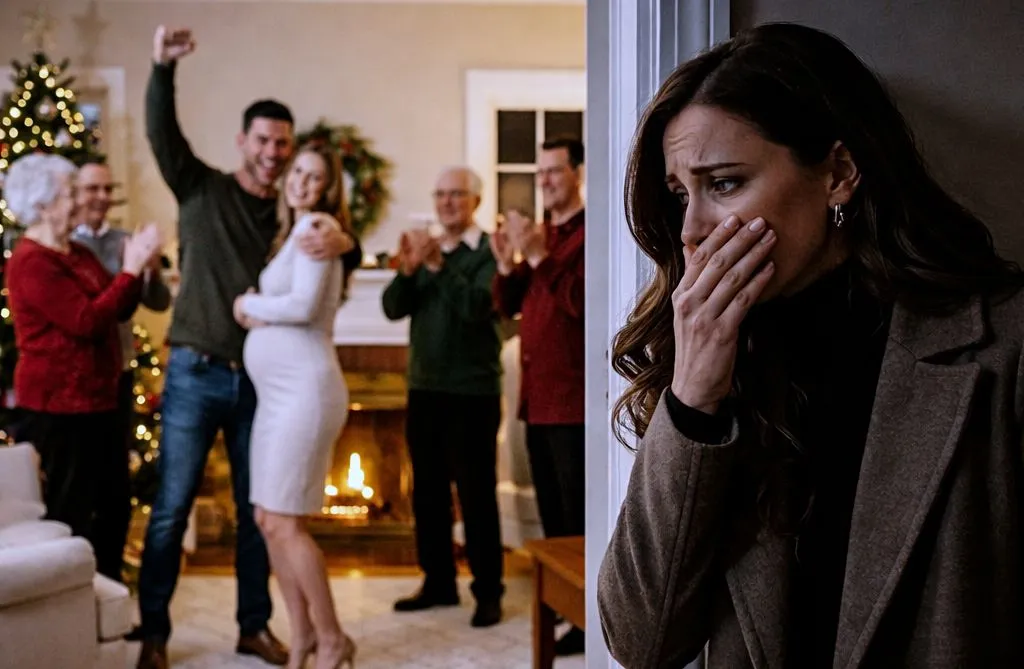
I froze right there in the hallway. I wasn’t pregnant. I peered cautiously into the living room and saw him, his arm tightly wrapped around his ex-girlfriend. Everyone was cheering, celebrating. Everyone in that room knew, except for me.
But this wasn’t just a betrayal; it was far worse than that. In the following weeks, I discovered that my entire life had been a meticulously planned lie. However, they had no idea who they were truly messing with.
I used to believe that knowing someone my whole life meant truly knowing them. I thought that a shared history meant trust and that family was forever. I was wrong about everything.
My name is Ava Sterling. I’m 28, and I’m a project manager at a high-end fintech company in Manhattan. My life, from the outside, looked perfect: a beautiful brownstone, a stable marriage, and a fast-track career. People envied me. They thought I had it all, but they had no idea what I’d been through to get there. They didn’t know the price I had paid for that apparent stability.
My life changed last year on Christmas Eve. That was the night the blindfold finally fell off. The betrayal had been there for years, right under my nose; I simply hadn’t been able to see it.
Let me rewind a bit. I need you to understand how I arrived at that moment. I’ve known Jackson Miller—Jax—since the day I was born.
Our parents were close friends, the kind who spent weekends together, took vacations, and celebrated every birthday. My parents were Jax’s godparents, and his parents, Carol and Charles Miller—whom I affectionately called Aunt Carol and Uncle Charles—were mine. It was the kind of friendship that seemed indestructible, built over decades.
We grew up playing in the same parks. We saw each other at weekend BBQs, birthday parties, and holidays. He was a part of my life even before I understood what that meant.
But our lives were different. Very different. My parents had money. My father was a successful entrepreneur, and my mother was a renowned architect. I attended the best private schools in the city. I had piano lessons, ballet, and French tutoring. We traveled through Europe on vacation. We lived in a large historic brownstone on the Upper East Side.
Jax, on the other hand, attended public schools. His family lived in a simple house in a middle-class neighborhood of Queens. Uncle Charles worked as a manager at a construction supply store, and Aunt Carol was a secretary at a medical practice. They lived comfortably, but without luxuries. At the time, I didn’t understand those differences; we were just kids playing together. But looking back now, I can see the signs.
I recall the way Aunt Carol looked at my mother’s jewelry. I remember how Uncle Charles would make comments about our house, our cars, and our trips. It was always with a smile, always disguised as a joke, but there was something there—a sting of bitterness that I was too young to recognize.
When I was 16, my parents were killed in a car accident. It was a rainy October night; they were returning from an anniversary dinner when a truck lost control on the highway. There are no words to describe that time. Even now, 12 years later, a part of me remains paralyzed at the exact moment the police knocked on the door at 2 AM.
After the funeral, Aunt Carol and Uncle Charles moved into my house. They came to live with me, to take care of me so I wouldn’t be alone. I was a minor, an orphan, and completely lost. They took me in; they were kind. They made sure to tell me that I would always have a family. At that moment, that saved me—or so I thought.
They managed my parents’ estate until I turned 21. When I came of legal age, I discovered my parents had left me a considerable portfolio: four condos and the brownstone where we lived, all completely paid off. My parents had invested well; they had planned the future, a future they never got to live with me.
Aunt Carol and Uncle Charles helped me with all the paperwork. They explained every detail and were patient with my questions. When I turned 21 and could technically take charge of everything alone, they asked if they could continue living in the brownstone with me. They said it would be better for everyone if we stayed together. I didn’t think twice. They were practically my family; they had cared for me during the worst years of my life. Letting them stay was the least I could do.
Generosity, gratitude, naivety. Three words that perfectly define who I was back then.
Jax and I started dating when I was 21. It felt natural, and everyone expected it. “You’re perfect for each other,” they said. “You grew up together; it’s like destiny.”
He was attentive and affectionate. He seemed to understand me. He knew my history, my pain, and my fears—or so I believed. Two years later, we married. Aunt Carol helped me organize everything. We chose the dress together, she came with me to fittings, and she gave her opinion on the flowers, the decor, and the invitations.
“Your mother would love being here doing this with you,” she told me several times, tears in her eyes. I believed she genuinely missed my mother, that she was filling that role out of love.
On the wedding day, Uncle Charles walked me down the aisle. He took my arm, looked at me with that fatherly smile, and spoke softly. “Your father would be so proud of you today.”
I cried. I thought it was beautiful. I thought it was family love, and I allowed it because I trusted them, because I believed it was real love.
Jax and I moved into one of the condos I had inherited. Jax said he wanted us to build our life together and that we didn’t need the big house. At first, it made sense. I worked a lot and was focused on my career. He had started working as a trader, operating from home, investing in stocks and crypto. At least, that’s what I believed he did.
The other three condos were rented out. Jax offered to handle everything. “You already work so much; let me manage the properties,” he said. “That way, you can focus on your career, and I’ll handle this side of things.”
It seemed like a fair arrangement. He sent me monthly reports and said he was reinvesting the profits, multiplying our wealth. I never questioned him. I trusted him completely. After all, why would I distrust him? He was my husband. He had grown up with me. His parents were my godparents. They lived in my house; we were family.
Two weeks before Christmas, Jax came home with a document. It was a power of attorney prepared by an attorney who worked with his family.
“It’s just to make things easier, honey,” he explained, smiling in that way that always reassured me. “That way, I can renew rental contracts without having to bother you at work, handle bank matters, and property registration issues. You’ll be free to focus only on your job.”
I took the document and skimmed it quickly. Legal jargon always gave me a headache. “I’ll read it carefully later,” I replied.
I saw something flash across his face. It was fast, almost imperceptible—a clench of his jaw, a different glint in his eyes—but he quickly smiled again. “Sure, no problem. Whenever you have time.”
I put the POA in a desk drawer and honestly forgot about it. Work was chaos. The company had a major project to close before the end of the year, and I was coordinating the entire team.
The company Christmas party was scheduled for the afternoon of December 24th. It started at 6 PM, and I had agreed with Jax that I would leave around 10 PM to head to his parents’ place for the traditional family Christmas Eve dinner. It was always like that. Every Christmas Eve, the brownstone that had belonged to my parents was filled with Jax’s relatives and his parents’ friends—people I barely knew. I always went, I always smiled, and I always appreciated being included because I still believed I was lucky to have this family.
That night, the company party was a little dull. Repetitive conversations, music too loud, drunk people discussing New Year’s resolutions. Around 8 PM, I decided to leave early and surprise Jax—arrive before planned and help with the final preparations.
I drove toward the brownstone, listening to Christmas carols on the radio. It was cold, with a light drizzle falling. The streets were decorated with lights blinking in every window, creating that atmosphere of forced happiness that Christmas always brings. When I parked in front of the house, I realized it was packed. Cars were everywhere, lights were on in every room, and music and laughter were spilling onto the street. The party was already in full swing.
I walked in the front door without knocking. I hung my coat in the foyer and headed toward the living room; the voices grew louder as I approached. I guess there were about 20 people laughing and celebrating. And then I heard Jax’s voice from the living room, clear and radiant.
“Madison is pregnant! We’re going to have a son!”
The world stopped. I stood there in the hallway, partially hidden by the wall. No one had seen me arrive. From my angle, I could see the entire room. Jax was in the center, his arm around Madison. Madison was a friend of his from high school, his teenage ex-girlfriend. They had dated for years before Jax and I started.
And there she was, smiling with a hand on her stomach, receiving hugs and kisses from everyone. Aunt Carol was crying with joy. Uncle Charles was applauding and shouting. Toasts were raised. Family friends congratulated them, saying things about how handsome the baby would be.
I felt my legs give way. I leaned against the wall to keep from falling. Someone in the crowd shouted, “But what about Ava? Does she know yet?”
The silence that followed lasted barely three seconds, but it felt like an eternity. Jax gave a somewhat forced smile. “Not yet. I need to sort out a few things first, some paperwork, but I’ll tell her at the right moment. So, no one here says a word when she arrives.”
Everyone laughed. My heart pounded. Paperwork. He meant the power of attorney.
There was a murmur of understanding in the room. Some people exchanged knowing glances. Aunt Carol nodded as if approving the strategy. Uncle Charles raised his glass to the future, and everyone toasted.
In that moment, everything began to make sense. The way they reacted, those looks, that charged silence—everyone there knew something I didn’t. There was a secret, a conspiracy. And that power of attorney was the final piece of the plan.
My stomach churned. It wasn’t possible. I had to be hearing things. But then Aunt Carol, my godmother, said loud and clear: “Finally, my son. After so many years, we are going to reclaim what is rightfully ours.”
And then I understood everything. Every smile, every gesture of affection, every word of comfort—it had all been a lie. A vast, elaborate lie spanning years. It wasn’t love; it never was. It was a scam.
I turned around, grabbed my coat, and slipped out of the house in silence, as quietly as I had entered. No one saw me; no one noticed. I got into the car, closed the door, and only then did the full reality hit me. I started to cry. Not a melodramatic movie cry, but a silent, painful sob that burned my chest and throat. Tears streamed down my face as I tried to process what I had just witnessed.
My marriage was a farce. My husband had a pregnant mistress. Aunt Carol and Uncle Charles, my godparents, were involved in a plot to steal my inheritance. And everyone, absolutely everyone in that room, knew and was complicit.
I drove back to the condo on autopilot. I don’t remember the road, I don’t remember stopping at traffic lights; I only remember crying and driving, crying and driving. When I got home, I wiped my tears, washed my face, and looked in the mirror. I barely recognized the person staring back. I looked smaller, more fragile, lost.
My phone vibrated. It was a message from Jax asking where I was.
I took a deep breath and replied: I decided to stay at the company party. It’s more lively than I thought.
He responded: Okay, have fun. See you in two weeks. We’re heading to Maui early tomorrow.
Of course, the annual trip. Since we married, his family went to visit relatives in Hawaii for Christmas and stayed until the first week of January. They knew New Year’s was always chaos at my firm, closing projects and reports, so every year, I stayed behind while they went on vacation. I never questioned it. After all, it was their time.
I just replied, Okay, have a good trip.
He sent a Merry Christmas followed by Love you with a heart emoji. I didn’t respond. I locked my phone screen and tossed it onto the sofa.
I sat on the living room couch in the dark and let the anger grow. Because I realized one thing right then: the crying was over. There was no longer room for pain, sadness, or tears. There was only room for strategy.
They thought I was an idiot. They thought I would always be that orphaned, lost girl, grateful for a family, trusting eternally, signing any paper, never questioning anything. They were wrong. I had grown up. I became a project manager because I was good at planning, organizing, anticipating problems, and creating solutions. I coordinated teams, managed crises, and made tough decisions every day.
And at that moment, sitting in the darkness of my living room, I made the most important decision of my life. They wanted to play? We would play. But this time, by my rules.
I stayed up all night. I didn’t sleep. I just sat there planning. First, I made a mental list of everything I knew. Jax was cheating on me with his ex, Madison. Madison was pregnant. His entire family and friends knew and supported it. The power of attorney was the final piece of a plan to transfer my assets to his family.
I hadn’t signed anything yet. This last point was crucial. I still had control of everything. I was still the owner of my properties and my accounts. Jax had no legal power over anything. As long as I didn’t sign that document, he couldn’t do anything.
I spent Christmas planning, thinking through every detail, every move I would need to make. I made mental lists, drafted strategies, and anticipated problems. This is how I worked as a project manager, and this is how I was going to handle this too. The next day, December 26th, I would put it all into practice.
When the sun rose, I knew exactly what my first step would be. At 9 AM, I called the lawyer who had handled my parents’ affairs. He had told me that if I ever needed anything, I only had to reach out.
“Mr. Harrison, this is Ava Sterling. James and Isabel Sterling’s daughter. I urgently need to speak with you.”
He must have detected something in my voice because he didn’t ask questions. He just said, “Come to my office.”
I showered, dressed, gathered all the property documents I had and the power of attorney Jax had given me, and drove downtown. Mr. Harrison’s office was in an old brick building in the financial district. I had walked those stairs since I was a child, always accompanied by my father. It was a place that smelled of old paper and strong coffee.
He greeted me with a hug. He was a man in his 70s with completely white hair and reading glasses hanging around his neck. He had been my father’s attorney for over 20 years.
“Sit down, Ava. Tell me what happened.”
I told him everything. The announcement at the party, the POA, the suspicion about the asset transfer. I spoke non-stop for almost 40 minutes. He listened in silence, taking notes, frowning at certain points. When I finished, he took off his glasses and rubbed his eyes.
“Ava, I need to tell you something.”
My heart pounded. “What is it?”
“Your father and Charles were partners in a business many years ago, an import company. It did very well at first, but then it hit a rough patch. Charles wanted to retire and sell his share. Your father bought him out for a fair price. He assumed all the risk. Charles took the money and left.”
He paused, taking a sip of coffee.
“Two years later, your father managed to turn the situation around. The company grew exponentially. That’s how your family became wealthy. But I don’t think Charles ever got over it.”
Mr. Harrison looked out the window for a moment. “Your father told me this story years ago. By his account, Charles had accepted it well at the time. The families remained friends, and the children grew up together. But now, seeing what’s happening, I believe there was always resentment.”
He looked back at me. “Charles and Carol probably always looked at your family’s life with bitterness. The class difference became very evident over the years, didn’t it? You had everything, and they struggled financially. And when your parents died, you were a vulnerable teenager with a considerable inheritance.”
He sighed deeply. “To resentful people, it must have looked like an opportunity. Looking back now, with everything you’ve told me, it’s clear that friendship always had a fragile foundation. The resentment over the business sale was likely never truly overcome. And you, Ava, became the perfect target.”
I felt as if a bucket of cold water had been thrown over me. So, that was it. The resentment had always been there, hidden, and I never saw it.
“Nobody saw it,” he clarified. “Your father certainly didn’t suspect anything, or he would have taken precautions.”
I closed my eyes. My parents never imagined that friendship concealed so much envy, so much greed. And now I was paying the price for the naivety of all of us.
“And this power of attorney?” I asked, pushing the document across the table.
Mr. Harrison put on his glasses and read it carefully. It took him nearly 15 minutes; he flipped pages, re-read sections, and made annotations. Finally, he placed the paper on the table and looked at me gravely.
“This gives Jax full authority over absolutely everything you own. He could sell the properties, transfer them, create mortgages, take out loans in your name—everything. With this document signed, you would lose complete control of your estate.”
I felt the anger surge again. “And if I had already signed it?”
“It would be very difficult to reverse. It would take years of litigation, and even then, there would be no guarantees. The best-case scenario would be proving coercion or fraud, but that is extremely complicated in marital cases.”
“And the properties? If we divorce, does he have a right to half?”
Mr. Harrison smiled for the first time since I arrived. “No. Everything you inherited is separate property. Under the law, inheritances received before or during the marriage do not enter into the community or marital property division. If you divorce today, Jax takes nothing.”
“Absolutely nothing?”
“Unless I voluntarily transfer the assets to his name,” I murmured.
“Exactly. It was the only legal way they had to get what they wanted.”
I opened the folder I had brought and placed all the rental contracts on the table. “I need you to review this. Jax has managed my properties for years. He says he reinvests the money, but I’ve never seen real proof. I want to know where that money has been going.”