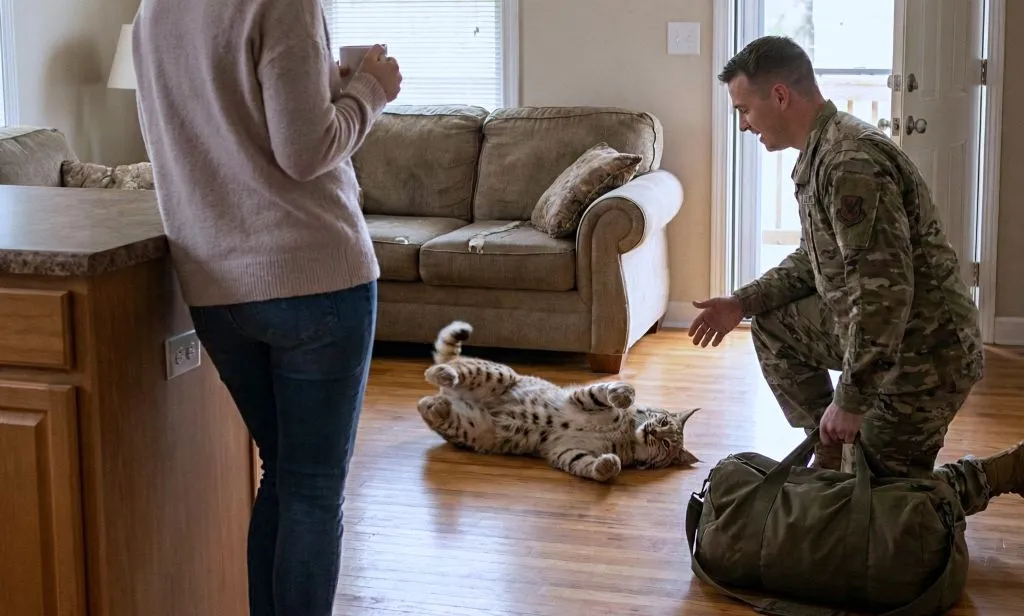
For twelve long months, the front door offered no answers. Yet, every single evening, the rescue bobcat positioned himself directly in front of it. His ears would tilt forward, his tail wrapped tightly around his paws, maintaining a vigil for a sound that refused to come.
We assumed it was just a habit he couldn’t break. We thought perhaps he had forgotten the specific person he was waiting for. We were wrong. We had no idea he was counting every single day.
His name is Axel. He is thirty pounds of spotted muscle, tufted ears, and amber eyes sharp enough to track a moth across a pitch-black room. I wasn’t the one who rescued him.
My brother did. He pulled Axel from a muddy roadside ditch after a car had clipped the mother bobcat, leaving the kitten there with a severe injury and slim odds of survival. My brother was the one who patched him up, bottle-fed him through nights filled with frightened cries, and taught him that human hands didn’t have to hurt.
Over the course of two years, they built something I didn’t think was possible between a man and a wild animal. They built a routine. A language. A bond.
Then, my brother deployed. It was overseas contract work. Twelve months minimum, maybe longer. He called it temporary.
Axel had no concept of “temporary.” During the first week, Axel ransacked every room. He checked under the bed, squeezed behind the couch, and sniffed inside the closets. He chirped at shadows and pawed frantically at the laundry hamper because the clothes inside still carried the right scent.
By week two, the frantic searching stopped. But the waiting began. Every solitary evening, right around sunset—at 5:47 PM, like clockwork—he would pad silently down the hallway and plant himself in front of that door.
He didn’t sit beside it, nor did he sit near it. He sat directly center-mass, posing as if waiting for a portrait he knew someone would eventually walk in to see.
His tail would curl neatly around his body. His ears swiveled like radar dishes toward every creak in the drywall, every car door slamming on the street, every footstep of a neighbor on the stairs. He would press his nose to the seam where the door met the floor, inhaling slow and deep, as if trying to extract a molecule of hope buried in the paint. Then, he would settle and wait.
During that first month, I tried everything to distract him. I bought new toys, and I cooked his favorite foods. I even moved his heavy bed closer to the living room to keep him company.
He ignored all of it. He would eat, sure, and play a little during the day. But the second the clock hit 5:47 PM, nothing else in the world existed. He had an appointment to keep.
What broke my heart wasn’t the waiting itself; it was the hope. Every single time a key jingled in the hallway outside, Axel’s head would snap up. His pupils would blow wide, his body would tense like a coiled spring, and his ears would lock forward.
And every time it turned out to be the wrong key, the wrong door, or the wrong person, his ears would slowly flatten. Not all the way down, just enough. Just enough to show that he knew.
Then he would resettle into that exact same spot, that same patient posture, as if saying, “Not yet.” Soon, I started wondering if he even remembered who he was waiting for. A year is an eternity for a bobcat.
Wild animals don’t process time and memory the way we do. They don’t hold onto ghosts the way people do. I remember looking it up at 2:00 AM one sleepless night, trying to convince myself this was just instinct, just a leftover neurological pattern.
But everything I read confirmed the hard truth. Bobcats remember scent. They remember routine. They remember the people who raised them. Axel remembered.
There was one specific toy he kept by the door with him during his vigil. It was a small canvas mouse my brother had given him on his very first night home, back when Axel was small enough to fit in one hand. The toy was shredded now, barely recognizable as a mouse, with stuffing leaking out of a tear in the side.
Yet, Axel carried it to the door every evening and set it down precisely beside his paws. He never played with it during these hours. He never tossed it or chewed it. He just kept it there like a beacon.
I asked my brother about it once during a crackling video call, mentioning that Axel still waited, still guarded that toy. My brother’s face did something I wasn’t prepared to see. He didn’t cry, but his jaw tightened visibly.
He looked away from the camera for a long time before he finally spoke. “Tell him I’m coming back,” he said.
I didn’t know how to translate that for a bobcat, but Axel didn’t need me to. Every night at 11:47 PM, exactly six hours after he had first sat down, he would finally abandon the door. Not a minute before, not a minute after.
Always 11:47 PM. He would stand, stretch his stiff limbs, pick up that canvas mouse, and pad back to his bed in the corner of the living room. He would sleep curled tight, nose tucked under his tail, as if trying to preserve a warmth that had already gone cold.
I started talking to him during those long evening vigils. I would sit on the couch, ten feet back, and just speak. I told him about my day. I told him my brother was safe.
I told him things I didn’t even believe myself. Axel never looked at me during those monologues. His eyes stayed locked on the wood grain of the door, but his ears would swivel back toward my voice, just a few degrees.
Just enough to let me know he was listening. But there was one thing that truly scared me. One behavior I couldn’t explain.
Some nights, when the apartment was dead quiet, Axel would make a sound I had never heard before. It wasn’t a growl. It wasn’t a chirp. It was something low and uneven, caught halfway between a trill and a whimper.
He would press his nose against the bottom door seam and make that sound—soft, searching, and desperate—like he was trying to call someone home through the gap. I didn’t tell my brother about that sound.
364 days. That is how long it had been. I had marked it on the calendar, not realizing I was counting down just as intensely as the cat.