A couple at a nearby table were quietly dabbing at their eyes. Even the stern-faced restaurant manager, who had been marching over to confront Thomas about the disturbance, stopped dead in his tracks. Thomas looked up, his hand still holding Layla’s, and addressed the entire room.
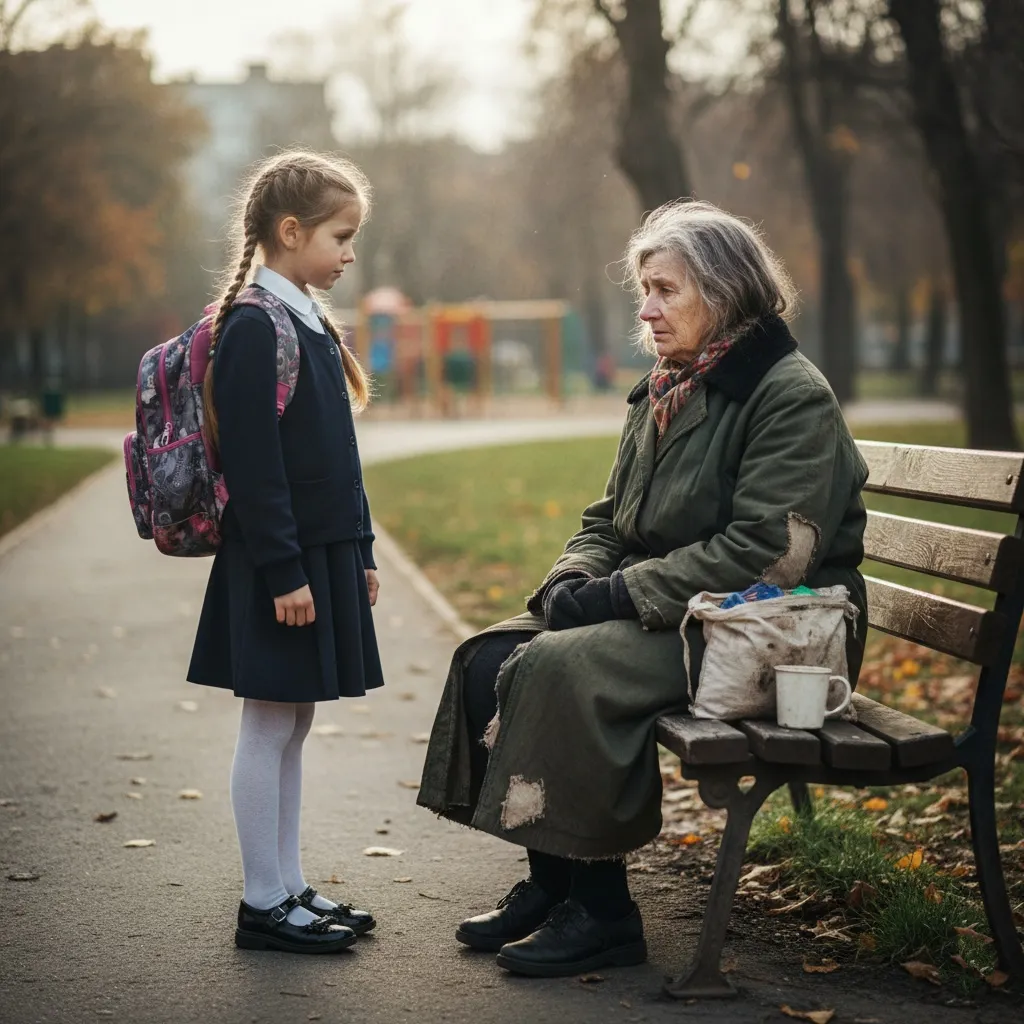
“She is seven years old. Seven.” His voice was steady. “And she has been wandering these streets all alone while the rest of us sit here, enjoying fine wine and ordering food we don’t even bother to finish.” The silence in the courtyard became heavier, almost suffocating.
“Look at her,” he continued, his voice tight with an emotion he couldn’t hide. “Do any of you have any idea how much courage it takes for a child to walk into a place like this and ask for help?” No one said a word. A few of the guests shifted uncomfortably in their expensive chairs, open guilt flashing across their faces.
Thomas then turned his attention back to Layla, his expression softening. He spoke so quietly that only she could hear him. “You don’t have to beg anymore, Layla. Not ever again. I’m going to take care of you.”
Layla blinked up at him, her wide eyes searching his. “You mean… you’re not sending me away?” “Never,” Thomas said, his own voice cracking. “You’re coming with me.”
“We’ll get you some warm clothes, and you’ll have a safe place to sleep. And tomorrow,” he added, “we’ll have pancakes for breakfast.” A small sob escaped Layla’s lips, and she suddenly threw her tiny arms around his waist, hugging him tightly. “I’ll be good, I promise! I’ll be so good,” she cried into his suit jacket.
Thomas hugged her back, holding her small, trembling body. “You already are, sweetheart,” he whispered. “You don’t have to prove anything to anyone.”
A quiet sniffle broke the stillness. The woman in pearls was no longer muttering; she was openly dabbing at her eyes with a linen napkin. A young waiter, not the one who had shooed Layla away, stepped back, visibly trying to hold back his own tears.
The entire restaurant had been silenced, not by a display of wealth or power, but by a simple, profound act of compassion. Thomas stood up, easily lifting Layla into his arms. “She deserves more than a meal,” he said, speaking to no one in particular.
“She deserves a life.” As he carried her through the tables and toward the exit, other diners began to rise to their feet, not in protest or to get a better look, but as a sign of quiet respect. One man quickly placed a $100 bill on Thomas’s table, tucking it under a glass with a small note that read, “For her future.”
Later that night, Thomas drove Layla home in his sleek black car. She was curled up in the passenger seat, wrapped in a warm blanket he’d kept in the back. “Are you rich?” she asked, her voice soft and sleepy.
Thomas managed a faint smile. “I used to think I was,” he answered honestly. “But tonight… tonight I finally feel like I have something that’s worth more than all the money in the world.”
Layla gave a sleepy smile, her eyes drifting closed. “You’re the nicest person I’ve ever met.”
Tears pricked at the corners of Thomas’s eyes. “And you, Layla,” he said gently, “are the bravest little girl I’ve ever known.”