Cade parked the truck, killed the engine, and stepped out. His boots crunched loudly against the packed ice.
The cold bit him immediately, seeking any gap in his gear, but his breathing stayed even. He approached slowly, his hand hovering near his belt out of habit, though there was no visible threat besides the biting wind.
Inside the cage stood the dog. A German Shepherd, full-grown, large and powerfully built, even in its visibly weakened state.
Snow clung to its thick black and tan coat, matting the fur, especially along the dark saddle of its back. Its ears were upright but trembling with a fine, continuous shiver, and its amber eyes tracked Cade’s movement with a razor-sharp focus.
The look wasn’t wild. It wasn’t pleading. It was alert in the way of an animal that had learned vigilance was the only survival skill that mattered.
One of its front legs favored the ground, bearing less weight than the other, a subtle limp that spoke of an old injury never properly tended to. The dog did not bark. That silence, more than anything else, told Cade this was not a case of a lost pet. This was not an accident.
He stepped closer, his eyes taking in the forensic details of the scene. He saw the empty metal bowl frozen solid to the floor of the cage. He noted the shallow scrape marks where desperate claws had tried to dig through the ice.
Then he saw the faint, hairless groove worn into the dog’s neck where a collar or tether had once pressed for far too long. This wasn’t abandonment born of panic or carelessness. This was methodical.
Someone had put the animal here knowing exactly what the mountain would do over time. They hadn’t brought a gun; they hadn’t wanted blood on the snow. They had assigned the winter, silent and thorough, to finish the task for them.
Cade knelt in the drift and met the dog’s gaze through the bars. Up close, he could see the animal’s chest rising shallowly, breath puffing white in the frigid air, muscles tight as if held together by stubbornness alone. The dog’s expression was not desperate.
It was watchful, almost assessing, as if weighing whether this man in camouflage was another part of the cruel pattern that had brought it here, or a break in the cycle. Cade reached out slowly, his palm open.
“Easy,” he said, his voice low and steady—the tone he used when approaching things that could still decide to fight back.
The dog sniffed the air, testing the scent, then took one cautious step forward, nails scraping against the metal floor. Breaking the rusted lock took less than a minute.
Cade used a compact tool from his belt, his hands working efficiently despite the numbness trying to set in. When the door swung open with a groan of metal, the dog hesitated. His muscles coiled, as if freedom itself had become an unfamiliar concept.
Then he stepped out, one careful movement at a time, and the full weight of his exhaustion finally became visible.
Cade shrugged out of his outer thermal layer without thinking and draped it over the dog’s back, feeling the violent shiver that ran through the animal’s body. He lifted the shepherd with controlled effort, surprised by the contradiction of the weight. The dog felt heavy with muscle, yet terrifyingly light with loss.
As Cade turned toward the truck, the dog twisted slightly in his arms and looked back toward the forest. His ears were pricked despite the freezing cold, his amber eyes fixed on the dark line of trees below the ridge.
He wasn’t looking at the cage. He was looking past it, deeper into the woods, as if something unseen still mattered there.
Cade paused, a familiar tightness forming in his chest. He had learned long ago to pay attention to moments like that, the quiet signals that didn’t explain themselves immediately. Then he adjusted his grip, carried the dog to the truck, set him gently on the passenger seat, and turned the heater on full blast.
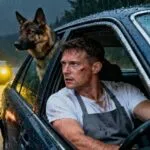
The drive down the mountain was slow. Cade kept one hand on the wheel and one resting near the dog, feeling the tremors ease only slightly as the warmth began to creep into the cab.
He noticed the specific way the dog reacted to sounds: the distant rumble of wind against the metal frame, the creak of the truck’s suspension hitting a pothole. Each noise was registered, processed, and remembered.
This was not a stray. This was an animal that had worked, that had been trained to associate patterns with outcomes. About a third of the way down the mountain, something happened that made Cade’s grip on the steering wheel tighten.
The dog suddenly lifted his head and let out a low, restrained growl—not aggressive, but urgent. His eyes were fixed on the rear-view mirror and the empty road behind them. Cade glanced back instantly.
There was nothing there—no headlights, no movement, just the endless white of the slopes and the gray of the sky. Yet the dog’s body remained tense, breath quickening as if responding not to what was present, but to what he remembered.
Cade slowed the truck anyway, scanning the surroundings with a practiced eye. The growl faded, replaced by a steady stare forward, but the moment lingered in the cab, heavy with unanswered questions. Whatever had put that cage on the mountain, it was not finished yet.
By the time Cade reached his cabin near Pineville, the sun had climbed higher, turning the snow into a blinding field of light. He carried the dog inside, set him near the wood stove, and fed him small amounts of water, careful not to rush the process.
The dog accepted the help without surrendering his awareness, his eyes following Cade’s every movement, ears flicking at every pop of the fire. Cade noticed the scar tissue along the dog’s shoulder and the faint burn mark on a piece of scorched nylon tangled deep in his fur.
It looked like a fragment of an old canine harness, damaged by heat or flame—a keepsake of another life. Cade leaned back against the kitchen counter and studied the animal. In another world, he might have called someone immediately, handed the problem over to animal control.
But the mountain hadn’t chosen someone else. It had chosen this road, this hour, this man. Cade felt the familiar weight of responsibility settle onto his shoulders, the same feeling he used to get before missions where the margin for error disappeared before the bird even touched down.
He did not know who had put the dog in that cage, or why, but he knew one thing with absolute certainty: this was not a story that ended with a rescue alone. The dog finally lowered himself onto the floor, his sides rising and falling more evenly now. His eyes met Cade’s again, steady and unblinking—not grateful, not afraid, but present.
Cade nodded once, a silent acknowledgment between soldiers. Outside, the wind moved through the trees, carrying the bitter cold down from the ridge, but inside the cabin, a fragile line had been drawn against it.
Somewhere beyond the tree line, unanswered and waiting, something lurked. And Cade understood, with a calm that surprised him, that he had crossed into that waiting the moment he broke the lock.
Cade brought the dog home just as the pale winter sun slipped behind the pines, leaving the town of Pineville wrapped in that heavy, blue-gray quiet that always arrived before the real night set in.
His cabin sat at the very edge of town, not aggressively isolated, but certainly not inviting. It was a structure built of timber and stone, practical and unadorned, designed for long winters and very few visitors.