He glanced at Bishop, who watched him with steady, unblinking eyes. “But this changes things.”
Bishop remained near Cade throughout the conversation, his presence calm but deliberate. When Nolan stood to leave, Bishop followed him to the door, then stopped, sitting squarely in front of it until Nolan turned back. For a long moment, man and dog regarded each other.
Nolan nodded slowly. “Looks like he’s made his choice,” he said.
That evening, as the light faded again, Cade sat on the porch steps with Bishop beside him, the forest quiet in that deceptive way that hid movement. Cade rested a hand on the dog’s broad neck, feeling the warmth there now, real and solid.
He understood something then with a clarity that settled deep in his gut. Whatever had been done to Bishop was not over, and whatever Bishop remembered was going to matter.
Warmth could save a body, but it could not erase a history written in muscle and instinct. And Cade, who had learned the hard way that memory was not an enemy but a signal, accepted that this chapter was only beginning.
The knock hammered against the wood just after noon, a firm, practiced rhythm that didn’t ask for permission; it announced an arrival.
Cade heard it from the back of the cabin, but he felt Bishop register it a half-second sooner. The dog rose from his place by the frosted window, his body stiffening into a line of pure tension, ears locking forward. A low vibration started in his chest, a rumble that never quite broke into a growl but carried more weight than a bark ever could.
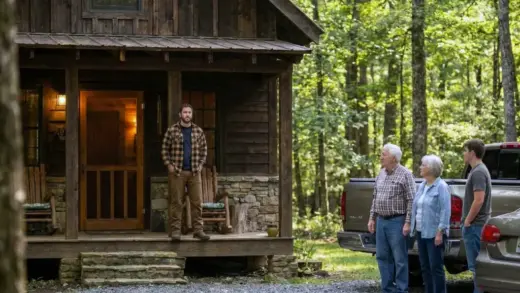
Cade crossed the room, wiped his hands on a rag, and opened the door. Three men stood on the porch, boots heavy with slush, wearing a confidence that felt rehearsed.
They wore canvas work jackets scuffed at the elbows and cargo pants dulled by sap and old dirt—the uniform of the region. On the surface, they looked like every other logging crew that passed through Pineville during the cutting season, but their faces told a different, harder story.
The leader was the tallest, with a long, narrow jaw and a beard trimmed just enough to look deliberate. His eyes kept flicking past Cade’s shoulder, trying to dissect the interior of the cabin.
To his right stood a broader man, his face flushed red from the cold, with restless hands that never stopped moving, fingers tapping a silent, agitated count against his thigh. The third man was shorter and wiry, standing slightly behind the others, his pale eyes hooded and his expression blank in a way Cade had learned to distrust on sight.
“We’re looking for our dog,” the tall one said. His voice was easy, almost friendly, but it didn’t reach his eyes. “Name’s Bishop.”
He pulled a phone from his pocket and held it up, swiping to a photo. The image was grainy and poorly lit, showing a German Shepherd at a distance. It could have been any dog of that breed if you didn’t know what to look for—the stance, the width of the chest.
“He went missing a few days back. Someone in town mentioned you brought a stray down from the mountain.”
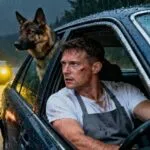
Before Cade could form a response, Bishop stepped forward. He didn’t rush. He simply planted himself squarely between Cade and the open doorway, filling the gap.
His posture changed completely: shoulders squared, head high, teeth not bared but the jaw set, hackles lifting along the dark ridge of his back like a raised flag. His amber eyes fixed on the men with a cold, absolute intensity that made the shorter man shift his weight to his back foot.
This wasn’t fear. It was recognition. Cade felt it like a distinct click inside his own chest.
“He’s recovering,” Cade said calmly, leaning against the doorframe but not blocking the dog’s line of sight. “If you believe he’s yours, there’s a process.”
The red-faced man snorted softly, a sound of dismissal. “Process?”
“Chip scan, veterinary records, proof of ownership,” Cade listed, his voice even, almost conversational. He didn’t move his hands from where they rested near his belt. He let Bishop hold the line. “He was found in a cage on the ridge. Hypothermic. Injured.”
The tall man’s smile thinned until it was just a line in his beard. “Accidents happen. Dogs wander into things they shouldn’t.”
He reached into his jacket and produced a folded piece of paper, smoothing it out with exaggerated care before extending it. “Here. Bill of sale. Breeder info. That should be enough to settle this.”
Cade took the paper but didn’t look down at it immediately. He watched their faces instead, noting the way the tall man leaned in just slightly, crowding the space, and the way the short one’s eyes tracked Bishop’s injured leg, calculating the weakness. Bishop growled then, a sound low and precise, and the tapping fingers on the red-faced man’s thigh went still.
Cade finally glanced at the document. It was a generic form, the kind you could print off the internet. The breeder’s name was misspelled, and the dates were inconsistent with the dog’s age. It was a prop, not proof. He handed it back.
“I’ll have the sheriff review this,” Cade said. “Until then, the dog stays.”
The tall man’s jaw tightened, the friendly veneer cracking. “You don’t have to make this difficult, friend.”
“I’m not,” Cade said. “The law is.”
Bishop took a half-step forward, his nails clicking once against the wood of the threshold—a warning shot. The men exchanged a quick look. The red-faced one turned his head and spat into the snow, wiped his mouth with the back of a gloved hand, and laughed without a trace of humor.
“You’re holding property that isn’t yours.”
Cade met his gaze, his eyes hard. “And you’re standing on my porch.”
The moment stretched, brittle as ice about to shear. Finally, the tall man stepped back, lifting his hands in a gesture of mock surrender.
“We’ll be back,” he said lightly, the threat clear in his tone. “Once you’ve had time to think about it.”
As they turned away, the shorter one looked over his shoulder at Bishop one last time, his eyes narrowing as if committing a specific detail to memory. Their truck roared to life at the bottom of the drive, tires spinning just enough to spray slush before the tread caught the pavement.
Bishop didn’t move a muscle until the sound of the engine faded completely. Then, he exhaled—a long, sharp breath through his nose. The tension eased from his frame, but it didn’t disappear. Cade closed the door and crouched beside him, resting a hand against the dog’s chest.
He could feel Bishop’s heart still racing—not from the adrenaline of the moment, but from something older. “You know them,” Cade murmured, not expecting an answer. Bishop’s ears twitched, acknowledging the truth.
Cade called Sheriff Nolan immediately. Nolan arrived within the hour, his heavy coat unbuttoned, his breath fogging in the cold air as he listened to the account. He studied the description of the men, snorted once in disgust, and made a note in his pad.
“We’ve been hearing things,” Nolan admitted, his voice low. “Illegal traps. Logging where it shouldn’t be. Crews that move fast, cut deep, and leave nothing but rumors behind.”
He looked down at Bishop, who stood watchful at Cade’s side, refusing to leave the room. “This dog didn’t wander into trouble,” Nolan said. “Trouble used him.”
By late afternoon, the road below the town saw more traffic than usual. Heavy trucks passed, their engines deep and steady, shaking the ground. Each time the sound reached the cabin, Bishop stiffened, a low rumble vibrating in his throat.