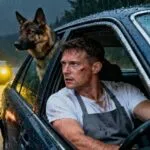
Bishop had reacted here two days earlier—the spot that cut through the alder thicket and disappeared into protected land. Bishop’s behavior changed as they approached the boundary. His pace slowed, his nose dropped low, and he angled his body into the wind. He avoided open ground instinctively, choosing paths where sound died quickly in the snow.
They found it just beyond a sharp bend in the creek, where the trees grew thick and the snow lay uneven and churned. A log deck stood half-hidden beneath heavy tarps the color of dead leaves, stacks of fresh-cut timber arranged with brutal efficiency. The scent of sap was sharp in the cold air, almost sweet, layered with the heavy, chemical stink of oil and diesel exhaust.
Nearby, crude trail cameras had been wired to tree trunks, their lenses aimed outward like unblinking eyes. Steel traps lay set in a widening ring around the perimeter, their jaws taped to keep them silent until the moment they were needed.
Cade’s jaw tightened. This was not opportunism. It was industrial planning.
They documented quickly: photos of the VIN numbers on the equipment, locations, camera angles. Bishop stayed close, alert but controlled, reacting only when Cade neared the hidden traps, guiding him around them with gentle nudges and sharp looks.
Then, without warning, Bishop froze.
His head snapped up, his ears pinned flat against his skull. Cade felt it a second later—the low, growing vibration of a heavy engine through the frozen ground. Headlights flared through the trees, sweeping across the tarps like searchlights.
A truck surged forward from a hidden access road, accelerating too fast for caution. Cade grabbed Bishop’s collar and pulled him back just as the vehicle plowed into the clearing, its horn blaring, engine roaring like a wounded beast. Someone shouted. The night fractured into chaos.
Cade moved instinctively, shoving Bishop toward the cover of the dense pines and rolling hard to his right as the truck’s grill tore past where he’d been standing. He hit the snow hard, the breath knocked loose from his lungs. The truck skidded, tires chewing the ice, fighting for traction to turn.
Bishop did not bark. Instead, he broke from cover and ran straight across the headlight’s path, a dark streak against the white snow, forcing the driver to swerve to avoid the impact. It was a trained move: draw the eye, create space, vanish.
Cade saw it with a clarity that hurt. This dog had done this before. The truck fishtailed, clipped a birch tree with a sickening crunch, and stalled long enough for Cade to scramble to his feet.
He seized the moment Bishop had purchased for him, retreating into the trees, moving low and fast, counting his breaths to keep his heart rate manageable. Shots cracked the air behind them—small caliber, wild and panicked—punching holes into the drifts and splintering bark.
Bishop stayed just ahead, glancing back once to confirm Cade was still moving. Then they were gone, swallowed by the darkness and the terrain they knew better than the intruders. They did not stop until the forest thinned and the creek reappeared, a ribbon of black ice under the moonlight.
Cade crouched, his lungs burning, a hand pressed to his ribs where he’d hit the ground. Bishop returned to his side, chest heaving, his eyes bright and focused. Cade pulled him close for a moment, burying his hands in the thick fur, feeling the tremor of adrenaline give way to something steadier.
“Good,” he murmured, the single word heavy with more meaning than praise.
They reached the cabin before dawn, the sky just beginning to bruise with purple in the east. Cade secured the doors, called Nolan with a brief, coded update, and sat on the floor beside Bishop as the first gray light crept across the floorboards. The cost of the night settled slowly in the room.
Cade’s hands shook slightly, not from fear, but from the weight of what he now knew. Bishop had not just survived his past. He had been shaped by it, honed into a tool, and then discarded when he broke expectation. And yet, when it mattered, he had chosen to protect.
Cade looked at the dog, saw the scarred leg, the steady eyes, the controlled breathing returning to normal. He understood the equation at last. Survival had a price. It always did.
For Bishop, it had been pain and abandonment. For Cade, it would be exposure, escalation, and the loss of any illusion that this could be resolved quietly. As the sun rose over Pineville, turning the snow to blinding white, Cade felt the line between hunter and hunted blur.
He had crossed it the moment Bishop ran into the headlights. There would be consequences now, for the men who thought winter erased evidence, and for the men who refused to let it.
Cade turned the evidence over in stages, the way he did everything that mattered—methodically, so nothing could be lost in the shuffle. First, he sat with Sheriff Nolan in a quiet back office that smelled of stale coffee, old paper, and winter coats drying on hooks.
Then, through Nolan, the call went up the chain to the Federal Wildlife Agents and a State Forestry Investigator who drove up from the south in an unmarked, mud-spattered SUV.
She carried herself with the contained confidence of someone used to being doubted by local men and proving them wrong by lunch. Her name was Elise Ward, a woman in her late forties, tall and spare, with gray threading through dark hair that was pulled back into a severe, practical bun.
Her eyes were sharp and steady behind wire-rimmed glasses, her voice calm, and her questions precise enough to leave no room for performance or evasion.
She didn’t raise her eyebrows at the notebook full of codes, the stack of fuel receipts, or the grainy trail cam footage Cade loaded onto her laptop. She only nodded, her eyes moving back and forth, cataloging, already fitting the jagged pieces into a frame that had existed long before Pineville ever called for help.
The notebook matched an open file from two winters back—an investigation into illegal timber trafficking that had stalled when crews moved fast and witnesses dried up.
The codes repeated across three different counties. The camera footage was clean and damning: trucks entering protected land after dusk, tarps lifting to reveal old growth, silhouettes working with practiced speed. No clear faces yet, but the patterns were undeniable.
Elise leaned back, closed the laptop, and said the words Cade had been waiting to hear: “Probable cause.”
She also said another word, quieter, looking directly at Nolan: “Careful.”