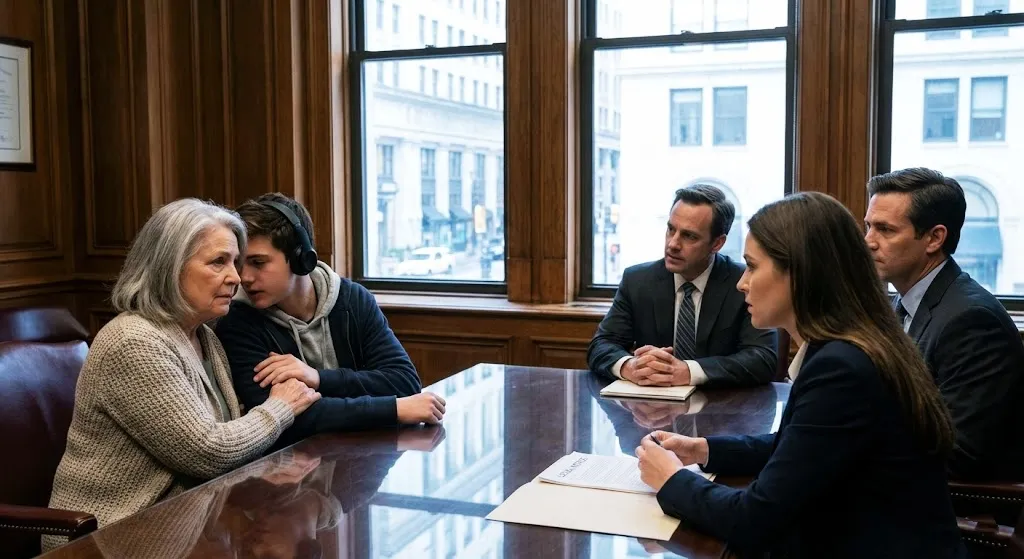
By the time they reached the final council member, an older white woman named Councilwoman Fletcher, the vote was tied four to four. Fletcher’s vote would decide everything. She sat forward slowly. Looked at Pierce. Then at Skye. “I’ve known Alan Pierce for eight years,” she said. “He’s been a colleague. A friend, even.” Skye’s heart sank. “But I’ve also been on this council long enough to recognize when something doesn’t smell right.” Fletcher’s voice hardened. “The bank records are damning. The recordings are damning. And frankly, Mr. Pierce, your explanation today was weak.” Pierce’s confident expression cracked. “More importantly,” Fletcher continued, “I listened to that little girl speak. And I believe her.” She looked at Skye. “I believe her because children don’t usually lie about being scared. They don’t make up stories about men with weapons threatening them in the dark.” She turned back to Pierce. “So my vote is yes. Remove him.”
The room exploded again. Five to four. Pierce was out.
Pierce jumped to his feet, face purple with rage. “This is illegal! I’ll sue! I’ll—” “You’ll pack your office,” the council president interrupted coldly. “You have 24 hours. Security, please escort Mr. Pierce out.” Two security guards approached. Pierce shrugged them off angrily and stormed toward the exit, his lawyers scrambling behind him. As he passed Skye’s row, he stopped. Looked down at her. “This isn’t over,” he hissed quietly. “You have no idea what you’ve started.” Evelyn stood up fast. “You threatening my grandbaby!” Pierce sneered. “I’m stating facts.” “Then state this fact,” Gavin said, standing beside Evelyn. “You just lost everything because you underestimated a nine-year-old girl. How’s that feel?” Pierce’s face twisted with rage. For a second, Skye thought he might actually swing at Gavin. But then the cameras turned toward them and Pierce seemed to remember where he was. He straightened his tie. Forced his face neutral. And walked out of City Hall with what little dignity he had left.
Outside, the crowd that had been watching on screens erupted in cheers. News reporters rushed toward the doors. Social media exploded. Skye sat in her chair, suddenly exhausted. Her hands were still shaking. Her heart still racing. “We won,” she whispered. “We won,” Gavin confirmed, grinning. Evelyn sat down heavily. “Lord have mercy. I need a drink and I don’t even drink.” Coach Marcus jogged over. “That’s how you throw, Skye. Strike three.”
But Skye didn’t feel victorious. She felt… empty. Relieved, but empty. Pierce was gone. That was good. But the field was still destroyed. The kids were still scared. The damage was still done. Winning one battle didn’t erase the war. Still, as they walked out of City Hall into a crowd of cheering supporters and flashing cameras, Skye allowed herself a small smile. Because sometimes, throwing the stone was enough. Even if Goliath didn’t die right away. Even if there were more giants to face. You still threw it. And that mattered.
The next morning, Pierce’s face was everywhere, but not the way he wanted. Disgraced councilman removed after terrorizing children. Pierce out, nine-year-old’s testimony seals his fate. From power to disgrace, how one girl brought down a politician. Skye sat at her kitchen table eating cereal, staring at the newspapers Grandma Evelyn had spread out. “How you feeling, baby?” Evelyn asked, pouring coffee. “Tired.” “That’s fair. You fought hard.” Gavin called at nine. “The mayor wants to meet with us. This afternoon. Says he wants to discuss moving forward.”
By three o’clock, they were in the mayor’s office—fancy, with leather chairs and a view of downtown. The mayor, a stocky man with gray hair, shook their hands warmly. “What you did took courage,” he told Skye. “Real courage.” “Thank you, sir.” “The city wants to help rebuild the field. Properly this time. Full funding. Security. Support.” Skye looked at Gavin, then back at the mayor. “Why now? Why not before?” The mayor shifted uncomfortably. “That’s a fair question. Truth is, we didn’t see what was happening until you made us see it.” “You should have been paying attention,” Skye said flatly. “You’re right. We should have.”
He pulled out papers. “We’re proposing a permanent community sports program. Multiple fields across the South Side. Coached by locals. Funded by the city.” Gavin read through the documents. “This is good. Really good. When does it start?” “Two months. We need permits, contractors.” “Two months.” Skye stood up. “Kids need something now. Not in two months when everyone’s forgotten about us again.” The mayor blinked, surprised. Evelyn smiled. “She’s got a point.” “What do you suggest?” the mayor asked. Skye thought for a moment. “Open our field next week. Even if it’s not perfect. Show people you mean it this time.” The mayor looked at his assistant, who nodded. “Deal,” he said. “One week.”
One week later, the field reopened. It wasn’t perfect. Some of the spray paint still showed through the fresh coat of blue. The grass was patchy. One section of fence still leaned crooked. But the lights worked. The bases were secure. And most importantly, people showed up. Fifty kids. Maybe more. Some Skye recognized. Others were new, drawn by the news coverage. Parents lined the bleachers, cautious but hopeful. News vans parked along the street, but this time they kept their distance. The mayor cut a ribbon at home plate. Gave a short speech about community and resilience that Skye barely listened to.
Then Gavin took the microphone. “This field doesn’t have my name on it,” he said. “It shouldn’t. I didn’t save it. Skye did.” He gestured toward the dugout where a new sign had been installed overnight. Grass letters on dark wood. THE SKYE WASHINGTON FIELD. ONE THROW CAN CHANGE EVERYTHING. Skye’s breath caught. She hadn’t known. Nobody told her. The crowd erupted in cheers. Evelyn wiped her eyes. “Go look at it, baby.”
Skye walked over slowly, reached up, touched the letters of her name. They were real. Permanent. Hers. “What do you think?” Gavin asked quietly, walking up beside her. “It’s…” She couldn’t find words. “It’s too much.” “It’s exactly enough.” He handed her something: her original ball, the one from the alley, finally released from evidence. Scuffed, worn, perfect. Skye held it tight against her chest.
“Speech! Speech!” kids started chanting. She climbed onto the dugout bench, ball in hand, looking at the crowd. “I’m not good at speeches,” she started. People laughed gently. “But I just want to say. We built this twice. Once with our hands. Once with our voices. And nobody can take that away from us.” She held up her ball. “This is just rubber in air. But it saved a life. Started a fight. Won a war.” She paused. “So remember, you don’t need to be big or rich or powerful to change things. You just need to be brave enough to throw.” The applause was deafening. Coach Marcus blew his whistle. “All right. Let’s play ball!” Kids scattered across the field, laughing, shouting, alive. And Skye. She stood on the pitcher’s mound, ball in hand, and threw the first pitch of a brand new beginning.
Six months passed like a dream that kept getting better. The field thrived. Eighty kids now played regularly. Three coaches. Coach Marcus hired two assistants. Weekend tournaments drew crowds from across the city. Skye’s fastball got faster. Her curveball nastier. College scouts started showing up, taking notes on a twelve-year-old who threw like she had something to prove. Because she did.
Gavin moved his office to the neighborhood. Started three more community programs: tutoring, job training, small business loans. He wasn’t just visiting anymore. He lived there.
Devin Harris? Pleaded guilty. Got two years, served six months, released early for cooperation. Last Skye heard, he was coaching Little League in another state. Trying to make things right.
Pierce? Disappeared. No political career. No power. Just another disgraced politician everyone forgot about.
One Saturday evening, after practice ended and kids scattered home, Skye sat on the pitcher’s mound alone. The sun set orange and gold behind the buildings. Gavin walked over, sat beside her in the dirt. “You know,” he said, “I’ve been thinking about that night in the alley a lot lately.” “Yeah.” “I was convinced I was going to die. Had made peace with it. Then I heard your voice.” He smiled. “This tiny, angry voice telling grown men to leave me alone.” Skye bounced her ball—the original one now kept in a display case at home; this was a new one—against the ground. “You think things would be different if I hadn’t thrown?” “I’d be dead. So yeah, pretty different.” “I mean for you. Like, if you lived but someone else saved you.” Gavin thought about that. “Honestly? I think I’d still be the same person I was before. Rich. Disconnected. Building things nobody needed.” He looked around the field. “But you didn’t just save my life, Skye. You changed it. Showed me what actually matters.” “Baseball?” He laughed. “People. Community. Using what you have to help others.” He paused. “You taught a billionaire how to be human again.” Skye leaned back on her elbows. “Grandma says one throw can change the world.” “Your grandma’s right.”
They sat in comfortable silence as stars began appearing overhead. “You scared?” Gavin asked. “About what comes next. You’re getting attention. Opportunities.” “Sometimes,” Skye admitted. “But I remember that night. How scared I was. How I threw anyway.” She looked at him. “If I could do that at nine, I can handle whatever comes next.” Gavin smiled. “Yeah. You can.” Skye stood, ball in hand. Wound up. Threw toward home plate one last time that day. Strike. Always a strike. Because some people are born knowing how to throw. And some people learn along the way that courage isn’t about being fearless. It’s about throwing anyway. A nine-year-old girl who proved that size doesn’t matter. Money doesn’t matter. Power doesn’t matter. What matters is courage and refusing to stay silent when you see wrong.