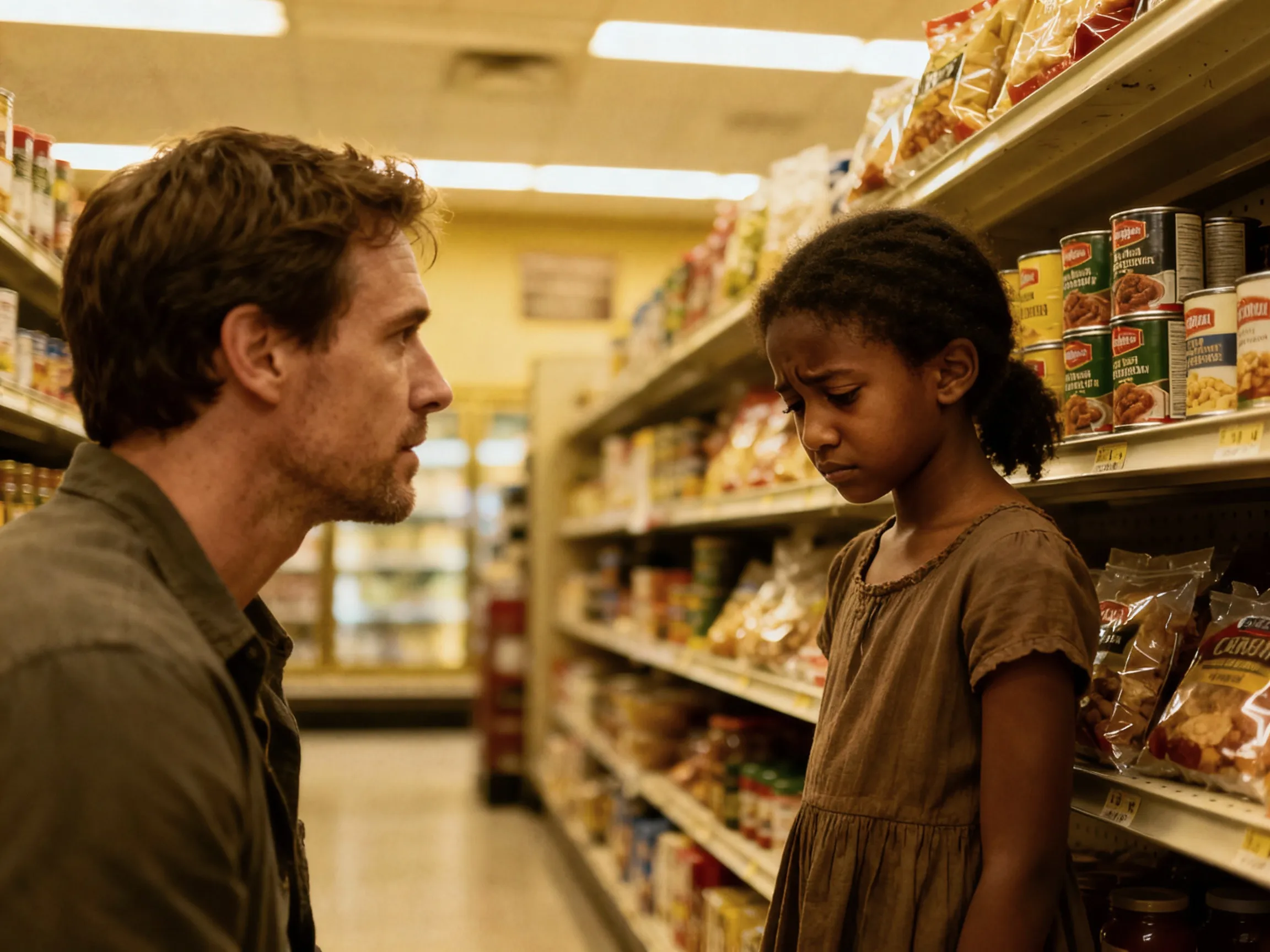
The apartment went quiet again. Somewhere outside, a siren wailed past. Finally, Skye spoke. “Can I get my ball back first?” Gavin blinked. “Your ball? The police took it. For evidence.” “It’s the only one I have.” Something twisted painfully in Gavin’s chest. This girl had saved his life, and in the process, she had lost the one thing she truly cared about. “I’ll get you ten balls,” he offered. “A hundred if you want.” “I don’t want a hundred,” Skye said firmly. “I want my ball. The one my grandma gave me.” Gavin nodded slowly. “I’ll make some calls. See what I can do.” “Okay,” Skye said. Then, after a pause, “And yeah. You can build the field.”
Evelyn’s eyes went wide. “Baby—” But Skye continued, looking at Gavin intently. “If you mess this up. If you make promises and don’t keep them? I’ll throw another ball at your head. And I won’t miss.” Despite the lingering pain, the fear, and the sheer uncertainty, Gavin laughed. A real, genuine laugh. “Deal,” he said. They shook hands. Her small hand disappeared in his. And in that moment, something shifted. Not just for them, but for the entire neighborhood. Because when a billionaire makes a solemn promise to a nine-year-old girl who saved his life, the world starts watching.
Two weeks later, Gavin Parker made good on his word. Skye stood on the corner of Roosevelt and Fifth Street with her grandmother, staring at a sight she never thought she’d see in her neighborhood. Construction trucks. Real ones. Three of them were parked around the old vacant lot—the same lot where kids used to find broken needles and shattered beer bottles. The same lot everyone avoided after dark. But now? Now there were workers in hard hats unloading equipment. Shovels. Wooden planks. Bags of concrete mix. Metal poles that looked like they would soon become fence posts. And right in the middle of it all, wearing jeans and a plain white t-shirt instead of an expensive suit, was Gavin Parker. His face still bore fading bruises. The stitches were gone, but the scars remained. He moved carefully, as if his ribs still hurt. But he was there. Actually there. Holding a clipboard and talking to the foreman like he’d been doing this his whole life.
“I can’t believe it,” Evelyn whispered, one hand covering her mouth. “He actually came back.” Skye didn’t say anything. She just watched. Waiting to see if this was real, or if it would all vanish like smoke. That’s when Gavin looked up and saw them. His entire face transformed, breaking into a genuine smile that reached his eyes. “Skye!” he called out, waving them over. “Get over here. I need your help.”
Skye glanced at her grandmother, who nodded. She walked over slowly, stepping around puddles and construction equipment. “What do you need help with?” she asked when she reached him. Gavin crouched down, wincing slightly, so they were eye level. “This is your field. So you get to make the first decision.” He pointed to a spot near where home plate would eventually go. “What color should the dugout be?” Skye blinked. “You’re asking me?” “It’s your field,” he repeated. “Your call.” She looked around at the empty lot. Tried to picture it finished. Painted. Beautiful. “Blue,” she said finally. “Dark blue. Like the night sky.”
Gavin wrote it down on his clipboard. “Blue it is. What else?” “Else?” “Yeah. Bases. Fence. The backstop. You’re the captain of this field. You decide.” “Captain.” The word made a warmth spread through Skye’s chest. “White bases,” she said, more confident now. “And the fence should be green. Real green. Like grass.” “Done.” He kept writing. “Anything else?” Skye thought hard. “Lights. Really bright ones. So kids can practice even when it gets dark early.” Gavin’s smile softened. “That’s a good idea. A really good idea.”
By noon, word had spread throughout the neighborhood like wildfire. Kids started showing up. First just a handful, then more. Curious faces peered through the chain-link fence, watching the workers dig and measure and build. Skye recognized some of them from school. Jamal from her math class. Twin sisters named Maya and Mara who lived two buildings down. A quiet kid everyone called Tick because he was always bouncing his leg. “Is this for real?” Jamal asked, pressing his face against the fence. “Like, we can actually play here?” “Yeah,” Skye said. “It’s for everyone.” “Even me?” asked Tick. He was tall for eleven, skinny, with a scar above his eyebrow. “I ain’t never played baseball before.” “Even you,” Skye confirmed.
By 3 o’clock, there were maybe twenty kids watching. By 4 o’clock, even more. Parents started showing up too, standing back with crossed arms, whispering to each other. Skeptical but curious. Gavin walked over to the fence and addressed the crowd. “Hey, everyone. I’m Gavin. Some of you probably saw me on the news getting my butt kicked.” A few kids giggled. Some adults didn’t laugh at all. “This field is going to be for you,” Gavin continued. “Free. No fees. No tryouts. No cutting kids who aren’t good enough. If you want to play, you play. That’s the rule.”
“Why?” one of the mothers called out. “What’s the catch?” “No catch,” Gavin said simply. “A little girl from this neighborhood saved my life. This is me trying to give something back.” “Rich people always say that,” another parent muttered. “Then they build something and kick us out when property values go up.” Gavin looked directly at the woman who spoke. “I can’t make you believe me with words. I can only show you with actions. So I’m asking you to give me a chance. Watch what I do. Hold me accountable. And if I mess up, call me out.” The crowd remained quiet. Uncertain.
That’s when Evelyn stepped forward. “I didn’t trust him either,” she said loudly. “Still not sure I do completely. But he showed up. That’s more than most people do. So I say we let him prove himself.” A few people nodded slowly. “And if he messes up,” Evelyn added with a pointed look at Gavin, “we know where he lives now.” That got some genuine laughs.
Over the next week, the vacant lot underwent a rapid transformation. The ground was leveled professionally. A proper pitcher’s mound rose from the dirt. White bases were installed, precisely where Skye had directed. The dugout was built and painted that deep, dark blue, just as she requested. And Gavin? He showed up every single day. Sometimes in the morning before his business meetings. Sometimes in the evening after them. Once, he even came at 10 at night just to check on something minor. The kids began calling him “Coach Gavin,” even though he insisted he wasn’t a coach. “I don’t know anything about baseball,” he admitted to Skye one afternoon while they watched workers install the backstop. “Then why are you building a baseball field?” she asked. “Because you know about baseball,” he said. “And because this neighborhood deserves something good. Something permanent.”
Skye was silent for a moment. Then, “You got my ball back yet?” Gavin winced. “Still working on it. The police are being difficult about releasing evidence.” “You promised.” “I know. And I will. I swear.”
Two days later, a silver car with tinted windows pulled up. A man in a polo shirt got out, carrying a large equipment bag. “Who’s that?” Skye asked. Gavin smiled. “That’s Coach Marcus. A real coach. Used to play minor league. I hired him to teach you kids the right way to play.” Coach Marcus was young, maybe thirty, with kind eyes and an easy smile. He walked over and shook Skye’s hand. “You must be the famous Skye,” he said. “Heard you’ve got an arm on you.” “I’m okay,” Skye said quietly. “Let’s see.” He pulled a ball from his bag—brand new, bright white, an official league ball—and handed it to her. “Show me what you got.” Skye looked at the ball. It felt wrong in her hand. Too new. Too perfect. Not like her ball. But she wound up anyway. Threw toward the backstop they’d just installed. The ball smacked dead center with a crack that echoed across the lot. Coach Marcus’s eyebrows shot up. “Okay. Okay. Yeah, you’re way better than okay.” Other kids were watching now. Jealous. Impressed. Curious. “Can you teach me?” Jamal called out. “Me too,” Maya added. “Everyone,” Coach Marcus said loudly. “If you want to learn, I’m here three days a week. Tuesdays, Thursdays, Saturdays. Bring yourselves. I’ll bring the equipment.”
That Saturday, seventeen kids showed up. They ranged in age from seven to fourteen. Different sizes. Different skill levels. Some had gloves. Most didn’t. But they all shared one thing: hope. For three hours, Coach Marcus ran drills. How to hold a bat. How to field a grounder. How to slide without breaking your ankle. And through it all, Gavin sat in a folding chair on the side, watching. Smiling. Taking notes. Sometimes answering work emails. But mostly, just being present.
When practice ended and the kids started heading home, Skye walked over to him. “You’re really staying, aren’t you?” she said. “I told you I would.” “People say a lot of things.” Gavin looked at her seriously. “I’m not most people. Not anymore.” He paused. “You changed me, Skye. That night in the alley. You showed me what actually matters.” “Baseball?” He laughed. “No. People. Community. Being part of something bigger than yourself.” He gestured toward the field. “This isn’t charity. This is me learning how to be a better human being.” Skye studied his face, looking for lies. For cracks. For signs he would disappear like everyone else eventually did. She didn’t find any. “Okay,” she said finally. “But I still want my ball back.” “I’m working on it,” he promised. “I swear I am.”
That night, Skye lay in bed staring at the ceiling. For the first time in months, perhaps years, something felt different. It felt like things were changing. Getting better. It felt like hope. And three blocks away, in a hotel room that Gavin had been living in since the attack, he sat at his laptop researching youth sports programs, equipment suppliers, and legal requirements for non-profit organizations. Because this wasn’t just about building a single field anymore. This was about building something that would last long after he was gone. Something that proved one night in an alley could change two lives, and maybe a whole neighborhood, forever.
Six weeks into the project, everything was going better than anyone could have expected. The field was nearly finished. Fresh dirt covered the infield. The grass in the outfield was coming in green and thick. The lights worked—big, bright stadium lights that turned night into day. The dugouts were painted that dark blue Skye had chosen, complete with benches that didn’t wobble. Practice now happened three times a week. Sometimes twenty kids showed up. Sometimes thirty. Coach Marcus taught them how to throw, how to hit, how to run the bases without tripping over their own feet. And Skye? She was getting better every single day. Her fastball was faster. Her aim was sharper. She could now throw a curveball that dropped so hard it looked like it fell off a table.
“You’re a natural,” Coach Marcus told her after practice one Thursday. “Seriously. I’ve coached college players who can’t throw like you.” Skye shrugged, embarrassed. “I just practice a lot.” “It’s more than that,” he said. “You’ve got something special.”…