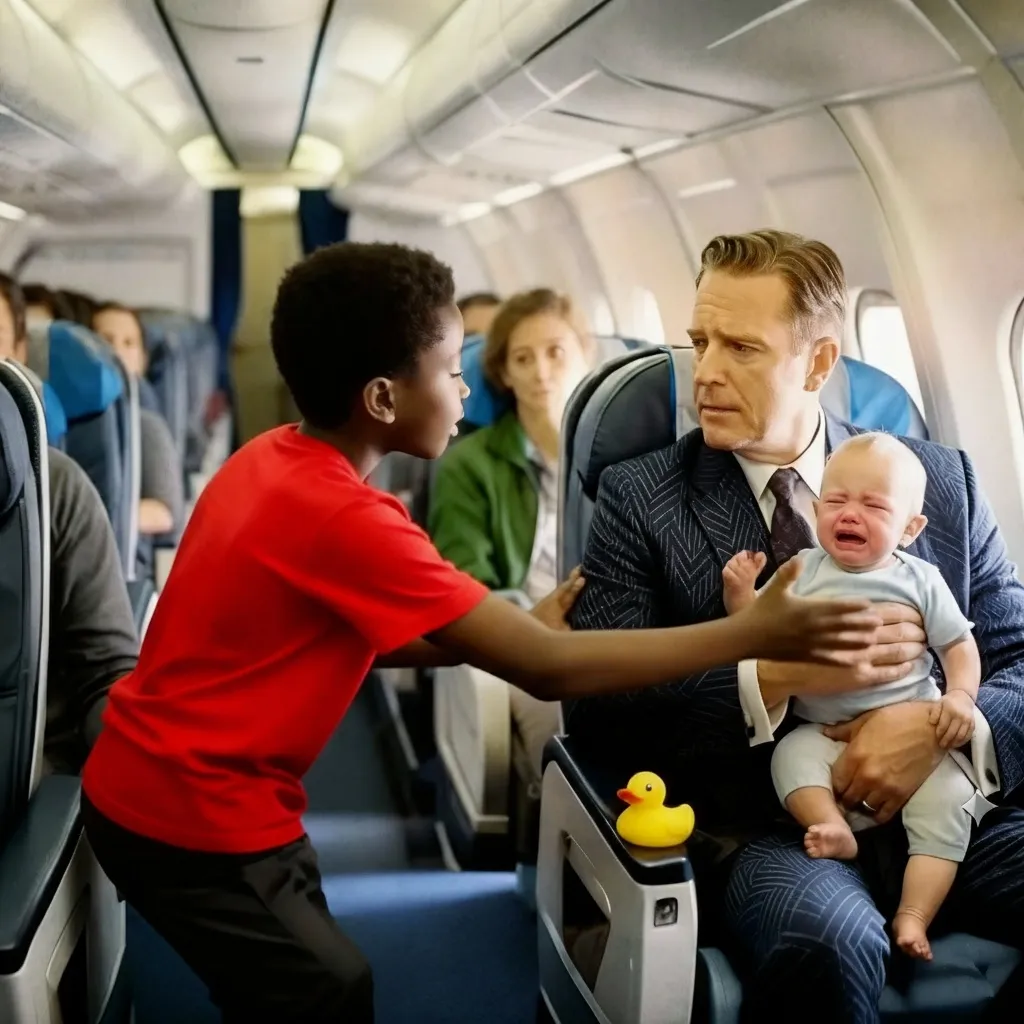
Richard Whitaker was trapped in a gilded cage at 35,000 feet. Seated in 2A, the billionaire could feel the heat of embarrassment and exhaustion spreading across his face. In his arms, his six-month-old daughter, Emma, was screaming with a raw, relentless intensity that seemed to vibrate through the very frame of the transatlantic aircraft. For three solid hours, this tiny human had produced a wall of sound that no amount of wealth, influence, or sheer desperation could breach. Every passenger onboard, from the front row to the very last seat in economy, was a captive audience to this performance of infant misery. Richard, a man who commanded boardrooms and made markets move, had been utterly defeated. He had tried every trick he could think of.
He had paced the narrow aisles, bouncing her until his arms ached. He had offered her the bottle his wife had prepared, only to have it rejected with a violent push from her tiny, flailing hands. He had changed her diaper multiple times in the claustrophobic airplane bathroom, an ordeal that left him sweating and disheveled. As a last resort, he had even pressed his own expensive, noise-canceling headphones over her small ears, piping in classical music in a futile hope it would soothe her. The result was always the same: a piercing wail that shredded the calm of the first-class cabin.
The other passengers in the premium seats were no longer hiding their annoyance. Their looks had sharpened from mild sympathy to open hostility. The flight attendants, with their professionally painted-on smiles, had run out of suggestions. One had diplomatically offered, “Sometimes babies just need to cry it out.” Another had brought him a small speaker playing ocean sounds. Nothing made a difference. The tension peaked when the pilot’s smooth voice came over the intercom, making a subtle announcement about ensuring all passengers have a comfortable journey. Richard didn’t need a translation; he knew the message was for him. He was at his absolute lowest, drowning in a sea of helplessness, when the unthinkable occurred.
A teenager emerged from the economy section and walked purposefully toward his seat. The boy was Black, maybe sixteen years old, his clothes worn but immaculately clean. The backpack slung over his shoulder had a strip of duct tape reinforcing one of the straps. Without waiting for an invitation or even introducing himself, the young man gently reached toward the screaming infant. “May I?” he asked. His voice was quiet, yet it cut through Emma’s wails with a strange clarity.
Richard was so thoroughly broken, so desperate for any sliver of relief, that he didn’t question the strangeness of the situation. Why would a stranger, let alone a teenager, offer to help? In that moment, he didn’t care. He simply gave a weary, defeated nod. The instant the boy’s hands made contact with Emma, a miracle unfolded right there in seat 2A.
The screaming stopped.
A complete, profound silence fell over the airplane cabin. It was so sudden and absolute that two hundred passengers seemed to collectively hold their breath, waiting to see if this impossible quiet would hold. The teenager cradled Emma with a natural, unshakable confidence that seemed impossible for his age. He held her in a specific way, one hand firmly supporting her head and neck while the other applied gentle, rhythmic pressure to certain points along her tiny spine. All the while, he hummed a soft, melodic tune that Richard had never heard before.
Emma’s eyes, which had been squeezed shut in distress for hours, slowly fluttered open. They focused on the boy’s face. For the first time since the plane had taken off from New York, her expression was not one of agony, but of calm, peaceful recognition. “How did you…?” Richard whispered, staring in awe at this mysterious youth who had accomplished in seconds what an army of highly-paid nannies and pediatric specialists could not.
The boy offered a gentle, knowing smile. “My baby sister had colic. Took me months to figure out what actually worked.”
As his own heart began to slow its frantic pace, Richard finally looked around the cabin. The landscape of faces had transformed. The hostile glares were gone, replaced by universal expressions of amazement and profound gratitude. But what truly made Richard’s breath catch in his throat was what he noticed about the young man himself. The boy’s patched backpack was covered in embroidered patches from mathematics competitions. A notebook peeked from a side pocket, its pages filled not with notes from school, but with dense, complex equations. There was an intelligence in his eyes, a deep, perceptive light that seemed to belong to someone much, much older. “Who are you?” Richard asked, his voice filled with a wonder he hadn’t felt in years…
The teenager met his gaze directly, his maturity startling. “My name is Noah Simon. I’m sixteen years old, I’m from Southside Chicago, and I’m on my way to London to compete in the International Mathematics Competition Championship.” In that single moment, Richard felt his entire worldview shift. The person who had saved his sanity and restored his daughter’s comfort wasn’t a trained professional or a peer from his own wealthy circles. He was a brilliant kid from one of the most challenging neighborhoods in America. And as Noah continued to hold a now-contentedly gurgling Emma, Richard had no idea that this chance encounter was about to unravel a story of raw determination, immense sacrifice, and a quiet genius that would fundamentally alter the course of both their lives. Neither of them could have known that the events about to unfold would challenge every single assumption Richard held about worth, intelligence, and what it truly means to extend a hand to someone in need.
Richard Whitaker, at forty-two, was the founder and CEO of Whittaker Technologies, a company valued at over eight billion dollars that specialized in the cutting-edge fields of artificial intelligence and machine learning. This trip to London was for a series of critical board meetings that would determine the success or failure of his company’s ambitious expansion into European markets. He was a man who usually traveled alone, treating flights as mobile offices, conducting business from 35,000 feet with a focused intensity. But this trip was different. His wife, Sarah, was back home, recovering from an unexpected emergency surgery. “I can reschedule the London meetings,” Richard had told her as she lay in her hospital bed. Her reply had been firm, leaving no room for argument. “Absolutely not. This deal is too important for the company. Take Emma with you. How hard can it be to manage a baby for a five-day business trip?”
Famous last words. He had hired the best nanny agency in the city to provide a traveling caregiver, but at the very last minute, the nanny had called in sick with a severe case of food poisoning. With zero time to find a replacement, Richard found himself boarding a plane to London armed with a briefcase full of contracts, a head full of financial projections, a six-month-old baby, and absolutely no practical childcare experience whatsoever. For the first blissful hour of the flight, Emma had been an angel. She slept peacefully in the first-class bassinet while Richard reviewed documents, and he began to think his wife had been right. How hard could it possibly be? Then Emma woke up, and his confidence evaporated into thin air, replaced by the panicked realization that he was in over his head.
He tried feeding her the bottle Sarah had meticulously prepared, but Emma rejected it violently, pushing it away with her tiny hands and crying even harder, her face turning a shade of furious red. He attempted a diaper change in the airplane bathroom, a claustrophobic and awkward struggle that left him flustered and sweating, but the screaming continued unabated. He tried walking the aisles, bouncing her gently as he’d seen Sarah do a thousand times, but Emma’s cries only grew louder, more desperate, more piercing. The flight attendants offered their suggestions with professional smiles that were becoming increasingly strained, unable to hide their growing concern about the massive disruption to the other paying passengers. “Sometimes babies just need to cry it out,” one suggested diplomatically. “Have you tried playing some white noise?” another offered, bringing him a small speaker that emitted the sound of crashing waves. Nothing worked. Emma screamed with a power that seemed impossible for such a small body.
As the hours dragged on, Richard became hyper-aware of the hostile atmosphere solidifying around him in the first-class cabin. In seat 1A, the elderly businessman Harold Morrison, a man Richard recognized from various charity galas, was making increasingly loud, theatrical sighs and checking his watch with dramatic flair every few minutes. “This is exactly why children shouldn’t be allowed in first class,” Morrison muttered to his wife, his voice just loud enough to carry to Richard’s ears. In seat 3B, the prominent socialite Victoria Sterling was typing aggressively on her phone, likely live-blogging her displeasure to her entire social circle. “Some people have no consideration for others,” she said pointedly to her assistant. “If you can’t control your child, you simply shouldn’t bring them on a plane.” Richard felt his face burn with a mixture of deep embarrassment and simmering anger. These were people from his own world, wealthy, influential individuals who he felt should understand that sometimes circumstances beyond your control create impossible situations. But their judgment felt particularly harsh and personal because Richard was failing at something he had always assumed was a basic, natural instinct of parenthood. He was a man who could navigate billion-dollar deals and lead teams of hundreds of brilliant employees, yet he was completely incapable of deciphering the needs of his own six-month-old daughter. The most painful part was watching the clear distress on Emma’s face and feeling utterly, completely helpless to fix it. Every wail seemed to express not just physical discomfort, but a deeper, more complex need that he, her own father, did not understand how to meet.
As the flight progressed, his panic began to extend beyond the immediate humiliation. He had five days of crucial, make-or-break business meetings in London. He could not possibly walk into those boardrooms, filled with potential investors and partners, with a screaming baby in his arms. His company’s entire European expansion, a deal he had worked on for over a year, could collapse entirely if he couldn’t figure out how to properly care for Emma during this trip.
What Richard didn’t know, what he couldn’t have known, was that three rows behind him, crammed into a seat in the economy section, sixteen-year-old Noah Simon had been listening to Emma’s cries with a growing sense of concern and a dawning recognition. Noah was traveling to London entirely alone. His backpack contained his few precious possessions and a plane ticket that had been purchased with money his entire community had painstakingly raised through bake sales, car washes, and small, sacrificial donations from neighbors who could barely afford to give. The International Mathematics Competition Championship represented his one and only chance to earn a full scholarship to MIT, an opportunity that could change not just the trajectory of his own life, but the future of his entire family….
Noah came from South Side Chicago, where he lived with his mother, Lisa, his grandmother, Rosa, and his three younger siblings in a cramped two-bedroom apartment. His mother worked double shifts as a nurse’s aide to keep food on the table, while his grandmother watched the children during the day. Two years earlier, Noah’s youngest sister, Maya, had been born with severe colic that kept her crying for hours on end, day and night. The family couldn’t afford to take Maya to expensive specialists or purchase fancy treatments, so Noah had taken it upon himself to find a solution. He spent months at the local library and on the computers at his community center, researching colic remedies, studying infant massage techniques, and experimenting through patient trial and error to find what could soothe his sister. He discovered a particular combination of gentle pressure points, specific holding positions, and calming humming that could, within minutes, settle Maya’s frantic crying. “Noah’s got magic hands,” his grandmother would often say, her voice brimming with pride. “That boy can calm any baby, I tell you.”
As Noah listened to Emma’s specific, distressed screams echoing through the airplane cabin, he recognized the same distinct pitch and rhythm that his sister Maya had exhibited. He could hear the particular signature of a baby experiencing painful digestive discomfort combined with sensory overstimulation. In his bones, Noah knew he could help. But he also knew, with a weary certainty born of experience, that a Black teenager from the inner city approaching a wealthy white businessman in first class was an action almost guaranteed to be met with suspicion, hostility, or outright rejection. In his sixteen years, Noah had faced enough discrimination and prejudice to understand that many people would instinctively see him as a threat or a nuisance, rather than a helper, no matter how pure his intentions or proven his abilities.
For two full hours, Noah wrestled with the decision internally. He pulled out his well-worn mathematics textbooks and tried to force his mind to focus on preparing for the competition that represented his entire future, but Emma’s increasingly desperate, heart-wrenching cries made it impossible to concentrate on theorems and equations. Finally, his compassion for the suffering baby and the overwhelmed father overrode his very rational fear of rejection. Noah closed his textbook with a quiet sigh, stood up, and began walking toward the front of the plane, ignoring the curious and questioning stares from the passengers he passed.
A flight attendant stationed at the divider curtain between economy and first class looked at him with polite but firm suspicion. “Can I help you with something?” she asked, her body language clearly prepared to redirect him back to his proper section.
“The baby in first class,” Noah said, his voice quiet but steady. “I think I might be able to help.”
The flight attendant’s expression was openly skeptical. “Are you traveling with family in first class?”
“No, ma’am,” Noah replied, maintaining a respectful tone. “But I have a lot of experience with colicky babies, and I recognize the type of crying. Sometimes there are specific techniques that can help.”
The flight attendant glanced back toward the first-class cabin, where Emma’s screams were reaching a new, fever-pitch intensity, then back at Noah’s earnest, sincere face. She was clearly weighing the protocol breach against the potential for peace. “Let me ask the father,” she said diplomatically.
But before she could even take a step, Richard Whitaker himself appeared in the aisle, holding the screaming Emma and looking completely and utterly overwhelmed, his usual executive composure in tatters. “I heard someone say they might be able to help?” Richard asked desperately, his voice ragged with exhaustion.
Noah took a deep, steadying breath, knowing this single moment would determine whether he would be accepted as a compassionate helper or immediately dismissed as an inappropriate intruder. “Sir, my name is Noah Simon. I know I’m just a kid, but I have a baby sister who had really bad colic, and I learned some specific techniques that helped her. I think your daughter might be experiencing similar discomfort. It sounds familiar.”
Richard looked at Noah, truly looked at him, for the first time. He saw a sharp intelligence in the young man’s eyes, a quiet confidence in his posture, and, most importantly, a genuine, unfeigned concern for Emma’s well-being. Richard was exhausted enough and desperate enough to seriously consider help from any source, from anywhere. “What kind of techniques?” Richard asked, having to raise his voice to be heard over Emma’s crying…
“Gentle pressure on specific points along her spine, combined with a particular holding position that can help relieve gas and digestive pressure,” Noah explained, his tone surprisingly professional. “Also, sometimes babies get overstimulated by too much bouncing and movement. What they really need is calm, steady pressure instead.”
Richard’s gaze swept around the first-class cabin, taking in the scene. Every single passenger was watching this unusual interaction with intense, unabashed interest. Some wore expressions of deep skepticism about accepting baby care advice from a teenager from economy, while others looked on with a flicker of hope that someone, anyone, might finally bring peace to this tortured flight. Right there, in the aisle, Richard made a decision that would ultimately change everything. “Please,” he said, extending the screaming Emma toward Noah. “If you think you can help her, I’m willing to try anything. Absolutely anything.”
What happened next seemed to defy all logic and conventional medical understanding. The moment Noah’s experienced, confident hands made contact with Emma, her piercing cries began to diminish in volume and intensity. Noah held her in a specific, cradling position that Richard had never seen before, one hand firmly supporting her head and neck while the other applied a gentle, rhythmic pressure along the length of her tiny spine. “Babies with colic often have trapped gas and digestive discomfort,” Noah explained quietly as he worked with a focused calm. “This position helps release the pressure while the back massage stimulates their digestive system to start moving properly.” Before their eyes, Emma’s screaming reduced to soft, hitching whimpers, then to quiet hiccups, and then, miraculously, to complete and utter silence.
The entire first-class cabin watched, utterly captivated, as Noah began to hum that same soft, melodic tune, a lullaby that seemed to hypnotize the baby into a state of deep calm. Emma’s eyes, which had been squeezed shut in agony for hours, slowly opened and focused with rapt attention on Noah’s face. “Where did you learn that song?” Richard asked, completely mesmerized by the magical transformation unfolding in his daughter.
“My grandmother taught it to me,” Noah replied, never breaking the rhythm of his gentle back massage. “She said it was a lullaby her own mother sang to her when she was a baby back in Georgia. Sometimes, I think these old songs carry a special kind of comfort in them, you know?”
Richard could only watch, stunned, as Emma began to relax completely in Noah’s capable arms. Her tiny fists, which had been clenched into tight balls of distress for so long, slowly uncurled. Her breathing became deep, regular, and peaceful. For the first time in over three hours, she looked serene, comfortable, and happy. The elderly businessman in seat 1A, Harold Morrison, who had been complaining so vocally about the disruption, now watched Noah with unconcealed admiration. “Remarkable,” Morrison said to his wife, his voice filled with awe. “Absolutely remarkable.” Victoria Sterling put down her phone and simply stared at Noah, her expression a mixture of sheer surprise and newfound respect. “I’ve never seen anything like that,” she whispered, almost to herself. The flight attendants gathered discreetly nearby, shaking their heads in shared amazement at the sudden, welcome transformation in the cabin’s atmosphere.
“How long will she stay calm like this?” Richard asked Noah, his voice brimming with a hope he hadn’t felt in hours.
“If she’s experiencing what I think she is, she should sleep peacefully for the rest of the flight,” Noah replied with a quiet confidence that was far beyond his years. “The pressure on her digestive system has been relieved, and she’s no longer overstimulated. She’s just tired now.”
True to Noah’s prediction, Emma’s eyes began to flutter closed as she settled into a deep, peaceful sleep, her body going limp with relief. As Noah carefully, expertly transferred the sleeping baby back into Richard’s arms, maintaining that same supportive position throughout the exchange, Richard found himself studying this remarkable teenager with entirely new eyes.
“Noah, you mentioned you’re traveling to London for a mathematics competition?” Richard asked quietly, not wanting to risk waking the peacefully sleeping Emma.
“Yes, sir. The International Mathematics Competition Championship. It’s a global competition for high school students, and the top finishers receive full scholarships to universities like MIT, Stanford, and Cambridge.”
Richard was genuinely impressed. “That’s incredibly competitive. You must be exceptionally gifted in mathematics.”
Noah shrugged with a becoming modesty. “I just love solving problems, sir. Whether they’re complex mathematical equations or figuring out how to help a crying baby, to me, they’re both just puzzles that need the right approach and a little patience.”
“Tell me about your background,” Richard said, settling more comfortably into his spacious seat with Emma sleeping soundly in his arms. “How does a sixteen-year-old from Chicago become qualified for an international mathematics competition of that caliber?”..
Noah’s eyes lit up with passion as he began to share his story, though he remained standing politely in the aisle, unsure if he was welcome to sit in the empty first-class seat beside Richard. “I’ve always been good with numbers, but my school in Southside Chicago doesn’t exactly have a strong math program. Most of my learning has been self-directed, using books from the public library and free online resources.” Richard gestured for Noah to finally sit down in the plush seat beside him, genuinely interested in hearing more. “My math teacher, Mrs. Rodriguez, noticed I had an ability back in eighth grade and started giving me extra, more challenging problems to solve. When I finished the entire high school mathematics curriculum in about six months, she helped me find and enroll in some online college courses.”
“How did you manage to qualify for the London competition?” Richard asked, intrigued.
“I won the Chicago Regional Competition first, then the Illinois State Championship, and then the National Qualifying Rounds,” Noah explained matter-of-factly, as if this were a normal sequence of events. “Each level definitely gets harder, but I’ve always been able to see patterns and connections in mathematical problems that other people seem to miss.”
Richard was beginning to understand that he wasn’t just conversing with a bright teenager; he was speaking with a genuine mathematical prodigy, a young man whose intellectual gifts were every bit as remarkable as his almost magical ability to calm a crying infant.
“How is your trip to London being funded?” Richard asked, though from Noah’s appearance and demeanor, he suspected he already knew the answer.
Noah’s expression became more serious, more weighted. “My community raised the money for my plane ticket and for a place to stay. The barbershop on my block, the whole church congregation, neighbors who can barely afford their own bills… they all contributed something because they believe in my potential. They believe I can do this.”
Richard felt a profound shift occur within his own understanding. This boy wasn’t just naturally talented; he was carrying the collective hopes and dreams of an entire community on his young shoulders, a community that had invested in his success despite facing significant financial struggles of their own. It was a weight of expectation Richard could barely fathom.
“What happens if you win the competition?” Richard asked.
“A full scholarship to MIT, with additional funding for living expenses and books,” Noah replied, his voice filled with a quiet, fierce determination. “It would mean I could actually study mathematics and computer science at the highest level possible and then, eventually, come back to my community to create better educational programs and opportunities for other kids like me.”
In that moment, Richard realized he was witnessing something truly extraordinary. It wasn’t just the raw mathematical genius, impressive as that was. It was the depth of character, the clear sense of purpose, and the visionary thinking that, if given the right opportunities, could genuinely change the world. But he also recognized the immense, solitary pressure Noah was under. This one competition would determine whether he could leap forward to pursue his dreams or return to Chicago with the heavy knowledge that his community’s collective investment and sacrifice had not paid off.
As Emma continued to sleep peacefully in his arms, her chest rising and falling in a steady rhythm, Richard found himself making a decision that surprised even him. “Noah, I have a proposition for you,” Richard said, his sharp executive mind already rapidly formulating a concrete plan.
Noah looked both curious and naturally cautious. “What kind of proposition, sir?”
“I’m going to be in London for five days of crucial business meetings, and as you’ve just witnessed, I am completely and totally unprepared to care for Emma while trying to conduct complex international business negotiations.” Richard paused, watching Noah’s reaction carefully. “I would like to hire you officially as Emma’s temporary caregiver during my London trip. I’ll pay you five hundred dollars per day, provide you with a hotel room adjoining my own suite, and ensure you have private transportation to and from your mathematics competition and all your related events.”
Noah stared at Richard, his jaw slightly agape in pure shock. “Five hundred dollars a day, sir? That’s… that’s more money than my mother makes in an entire week working double shifts.”
“It’s the standard daily rate for a professional, experienced nanny here in London,” Richard replied calmly. “And frankly, you’ve already proven you’re significantly more skilled with Emma than any professional I could possibly hire through an agency. You have a genuine gift.”
Noah’s mind raced, trying to process the sheer scale and implications of Richard’s offer. The money would be immediately life-changing for his family; it could pay bills, relieve pressure, maybe even mean his mother could work fewer shifts. But he was also acutely concerned about maintaining his razor-sharp focus on the competition that represented his entire future. “Mr. Whitaker, I’m truly honored by your offer, I am,” Noah began, choosing his words with care. “But I need to be completely, one hundred percent prepared for this mathematics competition. My entire future, and everything my community has invested in me, depends entirely on my performance there.”
Richard smiled, a genuine, appreciative smile, recognizing the maturity and clear priorities Noah was demonstrating. “I understand completely, Noah. The competition absolutely comes first, no question about it. I would only need your help with Emma during my specific business meetings and in the evenings. You would have complete freedom and uninterrupted time to study, prepare, and focus during your free time, I promise you that.” Richard then leaned forward slightly, his expression becoming more serious, more intent. “Noah, in the past three hours, you’ve shown me something that I haven’t encountered very often in my entire business career. You’re someone who can solve seemingly impossible problems that others can’t, who remains incredibly calm under extreme pressure, and who acts with genuine compassion rather than self-interest. That is a rare combination.”…
“What do you mean, sir?” Noah asked, slightly taken aback by the intensity of the compliment.
“You could have easily stayed in your economy seat, put on your headphones, and ignored a crying baby who was not your responsibility,” Richard stated plainly. “Instead, you made a conscious decision to risk personal rejection and potential embarrassment to help a complete stranger. That kind of inherent character and courage is even rarer, in my experience, than raw mathematical genius.”
Noah felt completely overwhelmed by the unexpected and dramatic turn his trip to London was taking. What had started as a straightforward, if high-stakes, scholarship competition was rapidly evolving into something much larger, more complex, and life-altering. “Can I… can I have some time to think about it?” Noah asked, needing space to process everything.
“Of course,” Richard replied without hesitation. “But before you decide, I should mention one more thing.”
“What’s that?”
Richard’s expression became even more serious. “My company, Whittaker Technologies, operates a private foundation specifically dedicated to providing full scholarships, mentorship, and career pathways to exceptionally gifted students from underserved communities. This is separate from your competition. Regardless of how you perform in the championship, I would like to discuss how we might be able to support your educational goals through that foundation.”
Noah felt his heart begin to race, pounding against his ribs like a drum. He realized that this chance encounter on an airplane might be swinging open doors to opportunities he had never even dared to imagine before. But along with the dizzying excitement, he also felt the heavy weight of uncertainty. Was Richard’s offer genuine, disinterested help, or was there something more complicated lurking beneath the surface? How would accepting what felt like charity from a billionaire affect his own hard-won sense of self-reliance and pride? These questions swirled in his mind as the airplane began its gradual descent toward London.
As the plane touched down smoothly at London Heathrow Airport, Noah realized with sudden clarity that the mathematics competition he had traveled so far to enter might not, in fact, be the most important test he would face during his time in England. The real test, he suspected, would be navigating the complex, unfamiliar world of extreme wealth, privilege, and sudden opportunity that Richard Whittaker represented, all while trying to stay true to the core values, identity, and community that had shaped him into the person he was. But as Noah looked over at baby Emma, still sleeping peacefully in her father’s arms, he knew with certainty that this moment, this encounter, had already irrevocably changed his life in ways he was only just beginning to understand.
As the seatbelt sign chimed off and passengers began gathering their belongings and standing up, Noah made a decision that would alter the entire course of his future. “Mr. Whittaker,” Noah said, his voice quiet but firm amidst the cabin noise. “I accept your offer. I’ll help care for Emma during your business meetings.”
A palpable wave of relief washed over Richard. The immediate, crushing problem of navigating high-stakes negotiations while simultaneously managing a baby had been solved. But more than that, he felt a genuine thrill at the prospect of getting to know this remarkable young man better. “Excellent,” Richard replied, carefully adjusting the sleeping Emma in his arms. “I have a car already waiting to take us into the city. We can discuss all the specific details of our arrangement during the drive.”
As they walked together through the bustling, modern terminal of Heathrow—a billionaire CEO, a peacefully sleeping infant, and a teenager from Chicago’s South Side—Noah couldn’t help but notice the curious, lingering stares they attracted from other passengers. He was so used to being invisible, to blending into the background in most settings. But walking alongside someone as visibly powerful as Richard Whittaker made him suddenly, intensely visible in a way that felt both exhilarating and strangely overwhelming.
The car waiting for them just outside the terminal was unlike any vehicle Noah had ever seen in person. It was a long, sleek, black Mercedes sedan with a driver in a full uniform standing patiently beside it. The interior was a sanctuary of quiet luxury, with deep leather seats and polished wood trim that felt more like a high-end office than a mode of transport. “The International Mathematics Competition begins tomorrow with the official opening ceremony,” Noah said as they settled into the spacious back seat. “The actual competition itself takes place over three consecutive days, with different rounds designed to test various mathematical skills and our ability to think under pressure.”..
Richard listened intently as Noah explained the competition’s format, increasingly impressed by the young man’s thorough preparation, his strategic understanding of the event, and his clear-eyed focus. “What would you say are your strongest mathematical areas?” Richard asked.
“Number theory and combinatorial mathematics,” Noah replied without a hint of arrogance. “But I also think I excel at creative problem-solving, especially under time pressure, which is obviously crucial for this type of timed competition.”
As the car navigated through London’s busy, historic streets, Richard found himself studying Noah with a growing sense of respect. This wasn’t just a mathematically gifted kid; this was a young man with exceptional analytical abilities, a surprising degree of emotional intelligence, and the kind of quiet, determined grit that Richard recognized from his own unlikely rise in the cutthroat world of business.
When they finally arrived at the five-star Langham Hotel in the heart of central London, Noah felt as though he had physically stepped into a different universe. The hotel lobby was more opulent and elegant than any building he had ever entered in his life. There were vast expanses of gleaming marble floor, enormous, glittering crystal chandeliers hanging from high ceilings, and sumptuous furniture that probably cost more than his family’s entire annual rent. “Mr. Whittaker, welcome back to The Langham,” the hotel manager said, approaching them with a warm, professional enthusiasm. “Your usual suite is prepared for you, and we’ve also made the adjoining room ready, exactly as you requested.”
As they rode the silent, polished elevator up to the top floors, Noah tried and failed to fully process the surreal reality of his current situation. Less than twelve hours ago, he had been an anonymous student sitting in an economy-class seat, quietly worrying about how he would afford even basic meals during his stay in one of the world’s most expensive cities. Now, he was checking into a legendary luxury hotel as the personal guest of one of America’s most successful and influential businessmen.
Richard’s suite was larger than Noah’s family’s entire apartment back home. It featured floor-to-ceiling windows that offered a spectacular, panoramic view of the London skyline, a full kitchen with stainless steel appliances, a separate dining area with a table for eight, and multiple bedrooms. “Your room is right through that connecting door,” Richard said, gesturing toward a polished wooden door. “You’ll have complete privacy, your own large bathroom, and access to twenty-four-hour room service for anything you might need.”
Noah opened the door to his temporary room and felt truly overwhelmed by its sheer elegance and size. The bed was a massive king-sized four-poster, larger than any bed he had ever seen. The bathroom was a marvel of marble and chrome, with a deep soaking tub and fixtures that looked like real gold. The window offered a stunning, picture-postcard view of Hyde Park spread out below. “Mr. Whittaker, this is… this is incredible,” Noah managed to say, his voice hushed. “But I have to ask you, why are you being so incredibly generous with me? You barely know anything about me.”
Richard was at the kitchen counter, carefully preparing a bottle of formula for Emma, who was beginning to stir from her long nap. “Noah, throughout my business career, I’ve learned to recognize truly exceptional people very, very quickly. What you did on that airplane wasn’t just about knowing how to care for a baby. It demonstrated a unique problem-solving ability, a high degree of emotional intelligence, and the courage to take action when everyone else was just standing by and watching.” Richard paused, testing the temperature of the milk against his wrist in a practiced motion. “But more than that, if I’m being completely honest, you remind me of myself when I was your age.”
Noah felt genuinely surprised by this personal revelation. “You didn’t grow up wealthy, Mr. Whittaker?”
Richard smiled slightly as Emma eagerly accepted the bottle he offered her. “My father worked on the assembly line in a car factory in Detroit, and my mother cleaned office buildings at night to help make ends meet for our family. I managed to earn a competitive scholarship to study business at the University of Michigan, and I built my company, every single part of it, completely from nothing. No family money, no connections.”
This new information fundamentally shifted Noah’s entire perception of Richard. He had made the easy assumption, like most people would, that all billionaires were born into privilege and comfort. But here was living, breathing proof that exceptional success could indeed be forged from humble, difficult beginnings through sheer will and intelligence…
“The crucial difference, though,” Richard continued, his tone thoughtful, “is that I was fortunate enough to have a few key mentors along my path. People who saw some potential in me and who believed in me enough to open specific doors that I never could have opened on my own. They saw something and they invested in it.” He looked directly at Noah. “I want to be that kind of mentor for you, Noah. I believe in what I see.”
The next morning, Noah woke up in the unbelievably comfortable king-sized bed, feeling a potent mixture of excitement and deep nervousness about the competition that was now upon him. Richard had already arranged for a full breakfast to be delivered to both of their rooms, and he had also provided Noah with a printed, detailed schedule showing his business meeting times and Emma’s anticipated care needs. “I have back-to-back meetings scheduled from ten AM until four PM today,” Richard explained as they shared a quick breakfast in the suite’s dining area. “According to her usual routine, Emma typically takes a long nap from about one o’clock until three. So you’ll have at least two solid hours of completely uninterrupted freedom during that time to focus entirely on your competition preparation.”
Noah deeply appreciated Richard’s clear understanding and respect for his priorities, but he was also discovering, to his own slight surprise, that the actual act of caring for Emma felt natural, enjoyable, and even relaxing, rather than feeling like a burdensome job.
The opening ceremony for the International Mathematics Competition was held in the grand, hallowed halls of the Royal Institution in London, a historic building where many of the world’s most groundbreaking scientific discoveries had first been announced to the public. Walking into the main auditorium, Noah felt his heart begin to race with a mixture of intimidation and pure exhilaration. He was surrounded by hundreds of other teenage mathematical prodigies who had arrived from all corners of the globe. These were the brightest, most accomplished young minds from sixty different countries, each one representing the absolute pinnacle of mathematical achievement within their respective regions.
“Welcome, all of you, to the Forty-Seventh Annual International Mathematics Competition Championship,” announced Dr. Margaret Thompson, the competition’s director, from the podium. “Each of you in this room represents the future of mathematical research and technological innovation. Over the course of the next three days, you will face a series of challenges specifically designed to test not only your computational skills and speed, but also your innate creativity, your logical reasoning, and, most importantly, your ability to solve complex problems that have no obvious, pre-existing solutions.”
Noah scanned the crowded auditorium and felt both daunted and intensely motivated. Some of his competitors were dressed in expensive, tailored suits and carried high-end, programmable calculators, clearly representing well-funded private academies and wealthy families. Others, like Noah himself, wore simple, clean clothes and carried basic, unassuming supplies, representing communities and public schools that had likely sacrificed a great deal to send them here. But Noah had already learned something profoundly important during his airplane encounter with Richard Whittaker: ultimate success in any field was rarely determined by your starting background or the resources immediately available to you. It was determined by your ability to see solutions and solve problems that others simply could not.
The first official round of the competition consisted of individual problem-solving, where each participant worked entirely alone to solve a booklet of increasingly complex and intricate mathematical puzzles. Noah opened his test booklet, took a deep, centering breath, and felt his initial nervousness transform into a surge of confidence as he read through the first problem. It was a complex question deeply rooted in number theory, one of his very strongest and most favorite areas of mathematics. More importantly, he could immediately visualize the underlying patterns