“And he confirmed what I already knew. You see, it’s a funny thing. I was never legally declared dead.”
“There was no death certificate, no court ruling. There was only, let’s say, a verbal agreement. A family arrangement.”
She raised her eyes and looked directly at Anisa. Cold poison shimmered in her gaze. “And since I never legally died, my marriage to David was never dissolved.”
“It was and remains valid. All these years.” Kira paused, letting Anisa fully grasp the meaning of what had been said.
“Which means,” she pronounced the next words slowly, with relish, “that your marriage to him, that whole wedding of yours, the photographs, the stamps in your passport—it’s a fiction. Legally void. You are not his wife, Anisa.”
“You are his mistress. A long-term live-in lover. Nothing more.”
She smiled her most charming and most cruel smile. Anisa felt an icy cold seize her from within. A mistress.
That’s what she had been all this time, without even knowing it. A woman living on borrowed time. “I see you don’t believe me,” Kira said, noticing the expression on her face.
“You think I’m bluffing?” She reached into her expensive leather bag and pulled out a document folded in four. She tossed it carelessly onto the desk in front of Anisa.
“Here. To dispel your doubts. The original.”
Anisa took the document with a trembling hand. It was on thick, official paper, slightly yellowed with age. She unfolded it.
It was a marriage certificate. It bore the names—Malinin, David Andreevich and Dobrynina, Kira Igorevna. The registration date—fifteen years ago.
All the seals, all the signatures, were in place. The document was genuine, beyond any doubt. And it was legally stronger than her own certificate, which had now turned into a useless piece of paper.
Anisa stared at the marriage certificate lying on her desk. This yellowed sheet of paper wasn’t just a document. It was a weapon.
And Kira had just fired it straight into her heart. Everything her life had been built on for the past years—her status, her family, her self-perception—had all turned out to be a fake. Kira watched her reaction with obvious pleasure.
She saw the color drain from Anisa’s face, saw her fingers grip the armrests in a death hold. “Well, do you understand now?” Kira said, rising. She neatly took the certificate from the desk, folded it, and put it back in her bag.
“I’d start packing my things if I were you. Both here at work and at home. Nothing here belongs to you anymore.”
She turned and walked to the exit, her heels tapping out a clear, victorious rhythm on the parquet. Right at the door, she stopped and, without turning around, threw over her shoulder: “Oh, and one more thing.”
“David sends his regards. He’s very sorry about what happened. But family is family.”
The door closed behind her, leaving Anisa alone in the deafening silence. She sat motionless for several minutes, staring at the spot on the desk where the document that had destroyed her life had just lain. The shock was so profound she couldn’t even think.
But then the icy stupor began to recede, and in its place came anger. Not hysterical, but cold and clear. She would not let herself be destroyed. She would fight.
The first thing she needed was a lawyer. And not just any lawyer, but the best family law specialist in the city. Anisa opened her laptop and started searching.
The name Semyon Arkadievich Roitman came up on all the forums. Expensive, cynical, but brilliant. Exactly what she needed.
She called and, to her surprise, managed to get an appointment for that same day. Apparently, the name of the sewing factory director still carried some weight. Roitman’s office was in an old building in the city center and looked more like a library than an office.
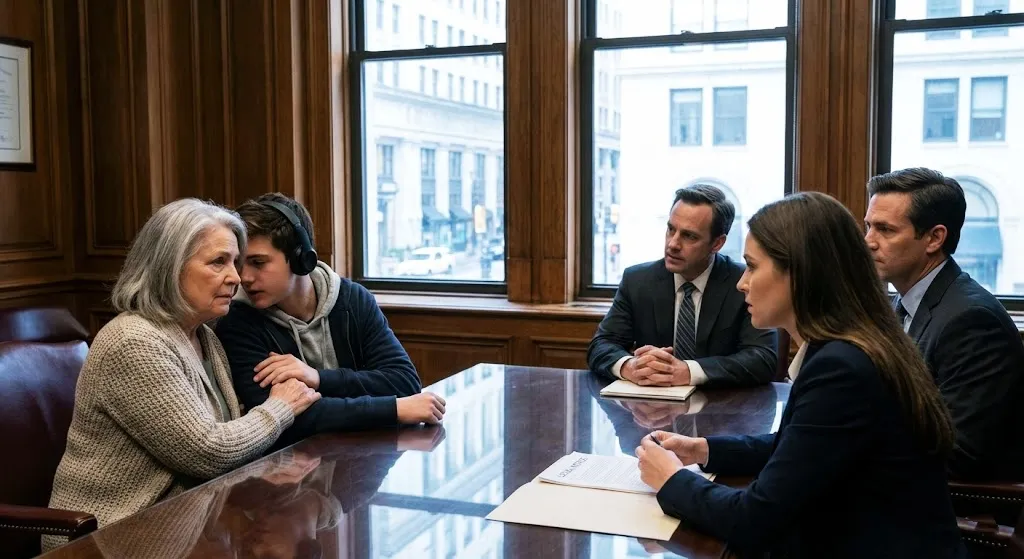
The walls were lined with shelves of leather-bound books. Roitman himself, a short, portly man in his sixties with intelligent, tired eyes, listened to her attentively. He didn’t interrupt, only occasionally making notes in a notebook.
Anisa told him everything. From the very beginning. About the grave, about David’s lie regarding the clinic, about the receipt, the glove, the public scandal, and finally, about Kira’s morning visit and her marriage certificate.
She spoke evenly, without tears, stating only the facts. When she finished, Roitman leaned back in his massive leather chair and was silent for a long time, tapping his pen on the desk. “Yes, Anisa Nikolaevna,” he said at last, sighing heavily.
“Your situation is a legal nightmare. It couldn’t be worse.” “But they committed a crime!” Anisa exclaimed. “They faked a death! That’s fraud!”
“Undoubtedly,” the lawyer nodded. “Article 159 of the Criminal Code. Fraud committed by a group of persons by prior conspiracy.”
“Sounds beautiful. But try to prove it.” “I have David’s testimony! He told me everything himself!”
“He told you in your kitchen,” Roitman gently corrected her. “Without witnesses, without a recording. And now, as I understand it, he’s on her side.”
“And what will he say in court? He’ll say you misunderstood everything. That you, as a deceived and abandoned woman, are simply trying to take revenge. And Kira Igorevna will present it as solely his, David’s, initiative. He, supposedly, decided her illness was incurable and hurried to arrange his personal life. And she, the poor victim, spent 5 years in a private sanatorium, unaware her husband was a bigamist.”
“And who in this situation will look like the monster in the eyes of the judge and our entire pious town?” The lawyer’s words were merciless, but true. Anisa understood that.
“So, my marriage… it’s really invalid.” “With a 99% probability, the court will recognize it as void,” Roitman confirmed. “The law is on the side of the first marriage, if it wasn’t dissolved.”
“And it wasn’t. At best, you’ll be recognized as a spouse in good faith, meaning one who didn’t know and couldn’t have known about the impediments to the marriage. But in practice, it changes nothing.”
“You are not the wife. And you never were.” “And what threatens David? Bigamy?” “We don’t have a criminal article for bigamy,” the lawyer spread his hands. “At most—administrative liability. A fine.”
“And public condemnation. But the main problem for you isn’t even that. If your marriage is declared invalid, you could get a label in this town—a ‘homewrecker.’ A woman who entered into a marriage with a married man.”
“And no one will care whether you knew or not. For our provincial public, that’s tantamount to social death.” Anisa closed her eyes.
The cage they were driving her into had slammed shut. She was trapped. Without money, without status, with a trampled reputation.
“What should I do?” she asked quietly. “Fight,” Roitman said unexpectedly firmly. “Fight for what can be defended.”
“For property.” That thought gave Anisa strength. “Yes.”
They had taken everything from her. But there was the house. The apartment.
The place she considered her own, that she had furnished, where she had lived for several years. She wouldn’t give it up without a fight. “The apartment we lived in… It was bought after David and I got married. I invested money in it, did renovations. My name is on the ownership documents, I remember us signing them. Doesn’t that give me any rights?”
For the first time during the entire conversation, a flicker of interest passed over Roitman’s face. “Now we’re talking constructively. Your name is in the purchase agreement and the certificate of ownership?”
“Yes. I’m sure of it.” “That changes things.”
“If you are listed as an owner, then you have a share. And they can’t just evict you. It will be a long and complicated process of property division.”
“That gives us time and room to maneuver.” He picked up the phone. “Hello, Lenochka. Connect me with the Bureau of Technical Inventory. Yes, with the head of the registration department. Tell him it’s Roitman calling. Urgently.”
While he waited to be connected, Anisa felt the first spark of hope in days. There it was.
Her lifeline. Her name on a document. Something that couldn’t be disputed.
“Viktor Sergeevich, good day,” the lawyer spoke into the phone. His tone became businesslike and authoritative. “Semyon Roitman here… I need operational information on one property. Yes, completely confidential. The address.”
Anisa dictated her address to him. Roitman wrote it down and read it into the phone. “I need to know everything about the owners of this apartment. The history of title transfers, current status. Yes, right now. I’ll hold.”
He fell silent, listening to the response on the other end. Anisa held her breath. She watched the lawyer’s face, trying to guess from his expression what he was hearing.
At first, his face was calm. Then he frowned. His eyebrows drew together.
He picked up a pen and started writing something down quickly. “When was the purchase?” he said into the phone, and Anisa’s heart plummeted. “Repeat the date of the property right registration, please.”
He wrote down the date. Then something else. “I understand, Viktor Sergeevich… Thank you for the promptness. I owe you one.”
He slowly placed the receiver back on the cradle. Looked at his notes. Then raised a heavy, sympathetic gaze to Anisa. The kind of look doctors have when delivering a bad diagnosis.
“Anisa Nikolaevna,” he said very quietly. “I have very bad news for you.” “What is it?” she whispered.
“This apartment… it is indeed registered to two owners. To you and your… to David Andreevich.” “But not to you.”
“What do you mean, not to me?” Anisa didn’t understand. Roitman took a deep breath. “The apartment was acquired and registered as joint property to Malinin, David Andreevich, and… Dobrynina, Kira Igorevna.”
“Two months before they supposedly divorced, and two years before your wedding to David.” Anisa stared at him dumbly, unable to comprehend what she had heard. “That can’t be, I signed the documents.”
“Most likely, you signed a spouse’s consent for a transaction that David was conducting after your wedding, perhaps selling or buying something else. And your consent was a formality. But your name was never entered into the title documents for this apartment.”
“You have been living in an apartment that is half-owned by her. Kira is not just his legal wife. She is the legal co-owner of your home.”
“She can evict you from there by a court order at any moment.” Anisa left the lawyer’s office and stepped out onto the street, but she felt neither the fresh air nor the cold autumn wind. She moved through a viscous, airless space.
Roitman’s words, “she is the legal co-owner of your home,” echoed in her head like a funeral bell. She had been living in someone else’s house. Sleeping in someone else’s bed.
She wasn’t just a mistress; she was an impostor who had illegally occupied someone else’s territory. And now she would be thrown out of there like a homeless dog. The hope that had briefly flared in her was extinguished.
Kira had thought of everything. Every step. She hadn’t left Anisa a single chance, not a single loophole.
She had locked her in a cage of lies and legal facts and was now slowly, with relish, tightening the bars. But simply taking Anisa’s husband, money, and home wasn’t enough for Kira. She wanted complete, total annihilation.
She wanted to trample Anisa into the mud, mix her name with disgrace, turn her into a town pariah. And for this purpose, she had the most powerful weapon in their small, provincial town—public opinion. The campaign for Anisa Malinina’s social liquidation began the very next day.
And it was conducted with the skill of an experienced commander. The main mouthpieces were Kira herself and her mother, Regina Dobrynina. They chose the two most effective platforms for spreading rumors—the local market and the church parish.
Places where information, seasoned with righteous anger and tears, spread like wildfire. Kira played the role of the tragic heroine. She appeared in the most crowded places—the best bakery, the pharmacy, the post office—always impeccably dressed, with a sad but courageous smile on her face.
She didn’t shout or make accusations. She told her story in a quiet, breaking voice, just loud enough for those standing in line to hear. The story of a miraculous recovery from a severe, mysterious illness that had cut her off from the world for five years.
The story of her long-awaited, happy return home. And of the terrible blow that awaited her on the threshold—in her house, in her bedroom, next to her husband, lived another woman. Her account was a masterpiece of manipulation.
She never once called Anisa by name. She said “that woman,” “the usurper,” “the one who took advantage of my husband’s grief.” It was much more effective.
She created the image of a faceless, predatory usurper, and the rich imagination of the townspeople filled in the rest. If Kira was the chief playwright, her mother, Regina, was the heavy artillery. She didn’t mince words…