Harper Quinn leaned her shoulder against the heavy glass service door of Drake Holdings, the industrial cleaning cart before her letting out a soft, rhythmic groan as its wheels transitioned onto the marble floor. It was just past midnight. The towering financial cathedral, which pulsed with frantic energy during daylight hours, now echoed with a profound,cavernous silence. Under the harsh, unforgiving glare of the white security lights, Harper moved like a ghost in transit—clad in a gray uniform and rubber gloves, her blonde hair tucked severely under a worn-out baseball cap.
She was twenty-eight years old, though her eyes held a weariness that suggested a soul far older. It was the specific kind of exhaustion that comes from seeing too much of the world’s rougher edges too young. Raised in a fading industrial town where the smoke stacks had long since stopped smoking, Harper had once harbored dreams of becoming a lawyer.
She had imagined herself in a courtroom, arguing cases, speaking truth to power, and setting things right. But life had pivoted sharply when her mother’s back was broken in a factory accident. The insurance company had denied the claim, citing a technicality buried deep within the fine print of a policy no one had properly explained. Harper’s life veered off course that day. She dropped out of community college to care for her brother, her dreams of law exchanged for the immediate necessity of survival.
What followed was a string of odd jobs—waitressing in diners, stocking shelves at big-box stores, scrubbing floors. At nineteen, she married a man who promised to take care of her. By twenty-three, she was divorced, alone, and raising her daughter, Eva, who was now four. Her ex-husband had vanished into the ether, leaving behind nothing but a trail of debt and a final, fading bruise on her cheek.
Now, Harper cleaned. She didn’t complain. She spoke rarely and asked for nothing. Her singular focus was maintaining this job long enough to pay the rent, buy groceries, and scrape together enough for Eva’s preschool tuition the following year.
She avoided eye contact as a rule. She remained invisible because invisible people didn’t get into trouble. Yet, despite her calculated blending into the background, Harper noticed everything.
She noticed the way the junior analysts threw their expensive coats over chairs with the carelessness of royalty. She saw how the third-floor receptionist always frantically checked her lipstick whenever the VP of Strategy walked past. She knew that the printers on the twenty-sixth floor were temperamental and always jammed when it rained.
And she noticed the corner office on the top floor—behind double glass doors—where papers were always left exposed when the rest of the world had gone home. That office belonged to Mason Drake, the enigmatic CEO of Drake Holdings. She had never seen him up close, knowing him only as a blur between elevator doors or a face on a magazine cover.
Self-made billionaire, tech finance prodigy, the man who spun nothing into an empire. To Harper, however, he was simply another door to wipe down, another floor to polish. That night, as she pushed her cart into his office, the city lights stretched out behind the massive glass wall like a river of molten gold.
The room was a study in clinical perfection: leather, glass, and silence. But as she wiped the mahogany surface, her hand froze mid-swipe. A contract sat open on the CEO’s desk.
It consisted of three clipped pages. On the final sheet, her eye was drawn to a line printed in a gray so faint it was nearly invisible, italicized and smaller than the surrounding text. It read like a clause she had seen once before, in another lifetime.
The text mentioned “equity reassignment” and “contingent operational control.” The specific vocabulary meant little in her world, but the rhythm of the sentence—the hollow, predatory legalese of it—echoed with a painful familiarity. It was nearly identical to the clause buried in the insurance papers her mother had signed years ago. The clause that ensured they received nothing: no treatment, no payout, absolute ruin.
Her chest tightened, a physical squeeze of anxiety. She leaned closer, tracing the air above the words without daring to touch the paper. Her mother had signed something just like this, and it had destroyed them.
Harper straightened up slowly, the sharp smell of antiseptic clinging to her gloves. She glanced over her shoulder, paranoia prickling her skin, but the office was empty.
“This is wrong,” she whispered to the empty room, her voice barely audible over the soft, continuous hum of the HVAC system. Without making a sound, she wiped the desk clean around the papers, killed the lights, and pushed her cart out of the room. She retreated back into the silence, back into invisibility. But something inside her had shifted.
As she rode the service elevator down, Harper stared at her reflection in the mirrored panel. Her heart hammered against her ribs—not entirely from fear, but from a dormant pulse she hadn’t felt in years. It was a knowing. A moral certainty that would not let her sleep, not that night, not the next, until she made a choice between her safety and the truth.
From the street, Drake Holdings appeared as a monument to perfection, a thirty-seven-story tower of blue-tinted glass and brushed steel piercing the midnight clouds.
Inside, however, the reality was different. Mason Drake, thirty-eight, sat leaned forward in the leather chair of his corner office. His temples pounded with the dull, rhythmic ache of stress layered over days of exhaustion. The world saw the billionaire CEO, the boy genius who turned a coding project in a trailer park into one of the largest financial software empires on the East Coast. No one saw what it cost him to remain there.
He tapped his pen rhythmically against the mahogany desk, eyes skimming the pages of the contract spread out before him. The numbers blurred and the words twisted; his vision only seemed to sharpen now during spikes of adrenaline.
Ten years ago, he had made a mistake. Just one. He had signed a contract that looked harmless, routine even, until it nearly destroyed everything he had built. Fine print buried in legal jargon, designed to strip him of voting control. He had caught it with mere seconds to spare, preventing his ousting before the company hit its fifth year. Since that day, he never signed anything without reading every single line himself.
But tonight, after sixteen hours of back-to-back meetings, pitch decks, interviews, and three missed meals, Mason wasn’t sure he could trust his own eyes.
“Mr. Drake, they’re waiting on your signature,” his assistant had whispered earlier, placing the thick file on his desk. Luxembourg Capital. Their biggest potential partner yet. A $500 million strategic merger. Everyone was already celebrating.
The champagne was chilling. The lawyers had pre-cleared it. All formalities, they said. Just sign.
But Mason couldn’t. He was wired differently. Mistrust wasn’t paranoia to him; it was a survival mechanism. He reached for the bottle of water beside him and took a sip. Two blue sleeping pills lay untouched next to the coaster. He considered taking one, the temptation heavy, then decided against it. Sleep was not an option. Not yet.
He ran a hand through his hair. A faint scar curved above his right temple, faded now, but permanent. It was the only physical remnant of the night he had collapsed from exhaustion eight years ago, cracking his head on the edge of a porcelain sink. The business magazines never featured that part of the story.
His fingers hovered over the pen. A signature. That was all they needed. But something caught his attention—a flicker in the corner of his vision. No, not in the room, but on the page.
Near the bottom margin, in a font smaller than standard, was a clause. His breath caught in his throat. He blinked hard, trying to clear the blur. It looked… off. The language concerned “operational equity,” “reassignment of strategic voting,” and “temporary custodianship of digital infrastructure.”
He leaned in, his pulse quickening. Something about the phrasing pulled at a long-buried memory. The contract from ten years ago had used similar syntax—slick, buried, almost poetic in the way it masked theft as corporate strategy.
But he couldn’t trust his instincts alone tonight. His hand reached for the intercom to call legal, but the office door opened. He looked up sharply, defensive.
Harper Quinn stood there, a mop in one hand, her cart parked just outside the threshold. Her eyes met his, startled.
“I thought you went home,” Mason said, his voice low and raspy.
She hesitated, then stepped just inside the room. “I left something.”
He watched her for a moment. This woman in a faded uniform, hair tucked under a cap, a face that looked far too tired for her age. She didn’t flinch under his gaze, which was rare.
“Be quick,” he muttered, turning his attention back to the page.
But Harper didn’t move. In that breathless silence, as the city lights flickered across the glass wall behind him, the contract remained unsigned, suspended in the space between trust and danger, instinct and fatigue. Neither of them knew yet that what she was about to say would alter the trajectory of both their lives.
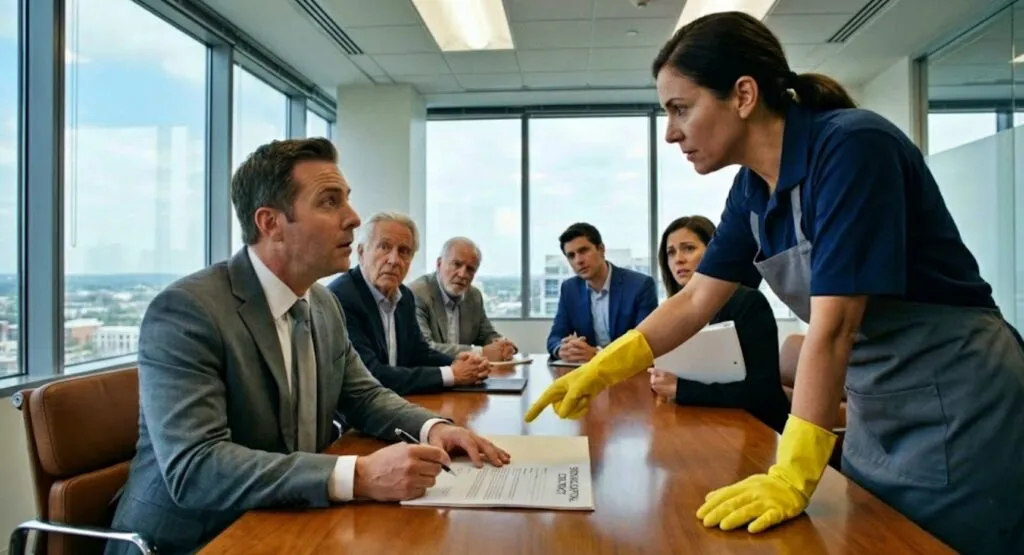
Harper stood just inside the doorway, the low hum of the fluorescent lights mixing with the thick tension in the room. Her hands gripped the handle of her cleaning cart so tightly her knuckles turned white.
Mason didn’t look up again. His pen hovered over the contract. “Whatever it is,” he muttered, “make it quick. I am in the middle of something.”
She hesitated. Her voice, when it finally came, was barely louder than a whisper. “I… I know I shouldn’t say anything. I clean. That is all I do here.”
She took a breath. “But that paper. The wording. Near the bottom. Something’s wrong.”
Mason’s eyes flicked up, cold and irritated. Harper took a step forward, forcing herself to continue despite the fear constriction her throat.
“I don’t know much about corporate stuff, but that sentence… Section 28… I think I saw one just like it when I was seventeen.”
He blinked, confused. “What?”
She pointed a gloved finger toward the document, careful not to touch it. “My mother. She signed an insurance form that had a clause just like that, hidden down low. It looked harmless. Legal. Like paperwork everyone signs. But it gave them the power to deny her everything. Medical care, disability… we lost our house. She could never walk again.”
Silence settled in the room, heavy as ash. Mason slowly put down the pen.
She swallowed, her voice shaking now. “Maybe I am wrong. Maybe it is not the same. I just… I couldn’t walk away and pretend I didn’t see it.”
She turned to go, terrified and embarrassed, ready to face a reprimand or, worse, termination.
“Wait.” Mason’s voice stopped her.
He picked up the contract and scanned to the section she had mentioned. His pulse began to hammer. He saw it now. The phrasing was too slick, too vague. A temporary delegation of strategic oversight paired with digitally automated custodial proxy rights.
He pressed a button on his phone. “Get Langston. And my lawyer. Now. Conference call, priority.”
Harper stood frozen near her cart, uncertain whether to flee or stay.
Within minutes, two voices echoed through the speakerphone. Mason read the clause aloud. The silence that followed from the other end was telling.
His lawyer’s voice dropped an octave. “Sir, this clause effectively hands partial control of your digital assets and voting rights to the counterparty for an undefined transitional period. It could be interpreted as a strategic merger handover.”
Langston added quickly, panic edging his voice, “This was not in the original version.”
Mason’s jaw clenched until it hurt. “And yet everyone said it was a formality.”
He looked back at Harper. She was still standing there, shoulders hunched as if she expected to be yelled at.
“You can go,” he said, his voice quieter now. “Thank you.”
She nodded once, face flushed, and pushed the cart out, not daring to look back.
Mason stared at the document for a long time after she left. Then he picked up his pen again—not to sign, but to strike a thick red line through the entire page. He leaned back in his chair, exhaling slowly. A half-billion-dollar mistake had just been stopped by a woman no one in the building would have spoken to twice. Not because she was an executive, not because she was a lawyer, but because once, her life had been torn apart by a sentence just like this, and she had remembered.
Mason waited until Harper’s shift ended before approaching her. She was pulling on her jacket in the supply closet, ready to head home, when she turned and saw him standing at the door. In his tailored suit, he looked completely out of place under the humming fluorescent light of the utility room.
“I want to talk,” he said.
Harper paused, her hands still on the zipper of her jacket. “Is everything all right?”
“Yes. Because of you.” He stepped closer, holding out a thick envelope. “This is a bonus. A very generous one. And I have a proposal. A permanent position in our compliance team. Entry-level, but a real salary, benefits, a future.”
Harper looked at the envelope, then at Mason. “I appreciate the offer, sir, but I cannot accept it.”
He frowned, genuinely confused. “Why not?”
“I just want to keep my job. The one I already have. I need to keep things steady for my daughter. I’m not looking for a promotion or attention. I just want to be left alone to do my work.”
Mason’s tone sharpened slightly. “You saved a half-billion-dollar deal. Are you trying to be some kind of humble martyr now? Come on, everybody wants money.”
She looked at him calmly, her gaze steady. “That is just it, Mr. Drake. I do not have enough money to pretend to be someone I am not.”
Silence fell between them. Mason’s jaw tensed. He had heard every excuse, every manipulation in the book during his career, but Harper’s refusal had no edge. No performance. She meant it. He felt something unsettling move through him—shame. Shame for assuming she was just another angle-taker, just more camouflage in a world full of masks.
Before he could speak again, his phone buzzed. A message from legal: Rumors about the unsigned Luxem deal have leaked. Internal review suggests possible data breach.
The next day, Harper was called into HR.
Two supervisors waited with stiff expressions, a printed document already open on the table. “We received concerns about your presence in Mr. Drake’s office the night the Luxem contract was withheld.”
Harper froze. “I was cleaning. That is all.”
They slid a badge log across the desk. “You re-entered after hours. Unscheduled.”
Harper’s chest tightened. “I only went back to wipe down the coffee table. I noticed something odd, and I thought it might be important.”
“You accessed sensitive documents.”
“I did not touch anything! I just saw.”
“We have to place you on temporary leave while we investigate.”
She stopped breathing for a second. Leave meant unpaid. No income. No way to pay Eva’s preschool next month.
“I have done nothing wrong,” she whispered, but they were already printing the suspension form.
A sharp knock at the door interrupted them. Mason walked in, his expression unreadable.
“That won’t be necessary.”
The supervisor stood awkwardly. “Mr. Drake…”
“She stays,” he said firmly. “You are questioning the wrong person. She did not breach the company’s trust. She protected it. She saved it.”
He turned to Harper. “You can go back to work now.”
Harper blinked, disoriented. “Why are you doing this?”
“Because you are the only person in this building who told the truth without anything to gain.” He turned back to the supervisors, his voice hard. “And the person you should be questioning is yourselves.”
The sun was low when Harper’s phone buzzed with a message from Eva’s preschool: Early closure today due to plumbing issue. Please pick up Eva as soon as possible.
Harper’s heart sank. She still had two more floors to clean.
Thirty minutes later, a tiny girl in a faded pink dress tiptoed into the marble lobby of Drake Holdings. Her curly blonde hair bounced with every step. In her arms, she clutched a battered sketchbook and a box of crayons. No one noticed her. The receptionist was on a call; security barely glanced. She quietly sat on one of the sleek black couches and began to draw, her legs swinging above the floor.
From the executive elevator, Mason Drake stepped out, rubbing his temple after another brutal board meeting. His tie hung loose, and he barely registered the figure in the lobby until he caught a flicker of color. Pink.
A little girl. Alone.
He slowed his steps, approaching quietly. “Hey there.”
The girl looked up with wide, curious eyes.
“Hi. Are you lost?”
She shook her head and returned to her drawing. “I’m waiting for Mommy. She cleans the shiny floors. She said to sit still and draw.”
He glanced at the sketchbook. There, in bold crayon strokes, was a figure of a woman holding a long stick—no, a mop—but it was drawn like a sword. The woman’s hair was tucked into a hat, and she wore a red cape.
“Who’s this?” he asked gently.
“My Mommy. She’s a superhero.”
Mason’s throat tightened. Just then, Harper came rushing into the lobby, breathless.
“Eva!”
The little girl jumped up, running into her arms. “I’m so sorry,” Harper said quickly, catching Mason’s eye, panic in her stance. “Her preschool closed early. I didn’t have anyone to watch her. She just needed to sit quietly for ten minutes.”
Mason shook his head. “No apology needed.”
Eva looked up at him. “You’re Mr. Boss, right?”
He smiled. “Something like that.”
She said, “You’re grumpy. But smart.”
Harper gasped, mortified. “Eva!”
Mason laughed for the first time in days. A real laugh. “It’s okay,” he said. “I have been called worse.”
Eva held out the sketchbook. “Wanna see?”
He sat down beside her on the couch, accepting the book with a quiet reverence. Page after page showed Harper in different versions: holding a mop like a sword, pushing a cleaning cart like a tank, standing in front of a building with stars behind her.
“She fights dirt and mean people,” Eva explained proudly.
Harper looked away, embarrassed. But Mason’s gaze never left the pages.
“This is beautiful,” Mason beamed.
“Do you have a Mom?” Eva asked.
He nodded slowly. “I did. A long time ago.”
“What did she do?”
“She… she was a cleaner too.”
Eva tilted her head. “Did she have a magic mop?”
He laughed softly. “She had something stronger. Dignity.” He looked up at Harper. “She raised me on night shifts and cold coffee. She taught me that being tired doesn’t mean you give up. And that doing things right, even when no one sees, is the kind of power money cannot buy.”
Eva leaned into him, completely comfortable now. “I think you’re nice. For a boss.”
Mason’s voice caught. “Thank you, Eva.”
As Harper gathered her daughter’s crayons, she caught Mason staring at the drawing of the mop-sword. He noticed and looked up.
“May I keep this page?”
Harper hesitated, then nodded.
That night, Mason slipped the drawing into his briefcase, nestled between financial reports and contract drafts. It was the only thing in that case that had never been altered, negotiated, or signed. It was simply real.
The neighborhood park had transformed into a small street fair. Strings of lights glowed softly above booths offering caramel apples, face painting, and secondhand books. Children ran through the grass with balloons, while music from a small local band drifted in the air.
Harper stood at the edge, holding Eva’s hand tightly. She had hesitated when Mason invited them, unsure if it was kindness or obligation, but Eva had begged, and something in Mason’s voice had sounded honest.
He met them near the popcorn stand, dressed down in jeans and a navy sweater, hair tousled by the breeze. When he saw Eva in her favorite pink hoodie, he smiled in a way Harper had never seen before—unguarded, like someone remembering who he used to be.
Eva wasted no time dragging Mason toward the mini petting zoo. Harper followed slowly, watching them laugh as a goat tried to nibble Mason’s sleeve.
Later, the three of them sat on a bench eating ice cream. The sun dipped low, painting the sky in dusty orange.
Eva turned to Mason and asked, “Are you my Mom’s boss?”
Mason paused, then shook his head. “No. I’m her student.”
“Student?” Eva squinted at him. “You’re too tall to be a student.”
He laughed. “You’d be surprised how much I still have to learn. She taught me something school never could.”
Harper’s eyes widened. Suddenly, her phone buzzed. She opened her email and froze.
Subject: Scholarship Approval – Eva Quinn. A full academic scholarship has been awarded for Eva Quinn beginning fall term, funded by an anonymous donor.
Her throat tightened. She looked at Mason, who was gently helping Eva wipe ice cream off her chin.
“Was it you?” she asked quietly, not accusing, just searching.
He looked at her with soft eyes and a small, knowing smile. “She deserves a chance to learn. And to become someone good. Like her mother.”
Harper felt tears rising, unexpected and sharp. She looked away quickly, blinking against the sting.
They stayed at the fair until the lights turned gold and the crowd thinned. Harper carried a tired Eva in her arms as they walked back to Mason’s car.
On the drive home, the car was quiet. Eva slept in the back seat, her little fingers still clutching a balloon string. Mason broke the silence.
“Do you ever get tired, Harper? Of always doing the right thing when no one else seems to care?”
She looked out the window. “I do. All the time.”
He nodded slowly. “Then why keep doing it?”
She turned to him, voice steady but soft. “Because if I am not the last kind person my daughter sees, then maybe she will not believe kindness exists at all.”
Mason did not reply right away, but his knuckles tightened slightly on the steering wheel.
They pulled up in front of Harper’s apartment, a modest walk-up building with peeling paint but flower pots on the windowsills.
“I can take her in,” Harper said, reaching for the back door.
“I’ll carry her,” Mason offered, already stepping out.
Inside the apartment, he carefully laid Eva onto the couch. Harper pulled a blanket over her. For a long moment, they stood together in the quiet hum of a home—books on the shelf, crayon drawings on the fridge, a world he had never known.
“I used to be afraid,” Mason said suddenly, breaking the silence. Harper looked at him. “After the deal I almost signed ten years ago, I trusted someone I shouldn’t have. Lost almost everything. Since then, I stopped sleeping. I check every word, every comma. I became the man who does not let people close because I was convinced the next one would cost me everything.”
She sat down across from him. “I was nineteen. He said he loved me. Three months after Eva was born, he vanished. Left us with debt, bills, and no clue where he went. I stopped believing in people. I started surviving.”
They both sat in the quiet. No promises, no confessions. Just two people scarred by trust, learning how to breathe again.
When Mason finally stood to leave, Harper walked him to the door. He paused, then turned to her.
“You were never invisible, you know.”
Harper smiled faintly.
“I was just quiet. And brave,” he added.
She nodded once, then softly, “Good night, Mason.”
He looked like he wanted to say something more, but instead he just said, “Good night, Harper.”
Outside, the wind carried the last echo of the fair’s music. Inside, something fragile and new began to grow.
It started with a whisper on the trading floor. Drake Holdings delayed the signing. Within hours, the market responded. By 3:00 PM, the company’s stock had dropped eleven percent. News outlets quoted anonymous insiders suggesting CEO Mason Drake had failed to close a pivotal deal in time. Screens flashed red across offices; headlines pulsed on phones.
$500 Million Deal Collapse. Internal Hesitation Blamed.
Behind it all, a name stayed hidden: Victor Lang, a senior shareholder with a polished smile and a quiet ambition. He had been working with Luxem Capital from the shadows, leaking just enough misinformation to trigger a panic. The plan was elegant: force Mason out, let Luxem swoop in.
At 5:00 PM, a board meeting was called. Mason sat at the head of the long glass table, face expressionless. The room buzzed with tension.
“We needed your signature last week,” one board member snapped. “Why the hesitation?”
Mason looked up. “Because there was a trap. And someone here helped lay it.”
Whispers broke out. Victor sat three seats away, arms crossed, looking unbothered.
But it wasn’t just Mason who was under fire. At 6:42 PM, Harper Quinn received an envelope tucked inside her locker. Inside was a single sheet of paper.
“Shut up if you want your daughter to see tomorrow.”
There was no signature. No return address. But the message was clear. Harper froze. Her breathing became shallow, her legs buckled, and she gripped the metal locker for support. Eva.
She ran to her supervisor’s office, a resignation letter half-scribbled in trembling pen. But when she reached the lobby doors, she saw a figure waiting outside her apartment building in the rain. Soaked, unshaven, eyes bloodshot. Mason.
“I know,” he said softly, holding up a phone. “Your building’s security forwarded me the footage. You got a threat.”
She stared at him, silent, torn between fear and fury. “I can’t let this touch my daughter,” Harper said.
“I understand,” he replied. “But I can’t do this alone.”
Silence. Raindrops pattered between them.
“I need the only person I can trust.” It wasn’t a plea; it was a truth.
Harper nodded once. “Give me an hour.”
She came back soaked, hair plastered to her forehead, a laptop clutched under one arm. They sat side by side in the company’s small IT archive room—dusty, dim, forgotten by most. But Harper remembered. Two months ago, she had overheard a systems tech mention the company’s old backup logs weren’t fully migrated. One server still held version histories of internal memos.
She booted it up. “It’s slow,” she warned.
Mason nodded. Files crawled open. Time-stamped PDFs. Edited memos. Harper traced the changes, contracts edited and re-uploaded under Victor Lang’s credentials. She highlighted three entries, matching the exact line that had almost cost Mason the company.
“Victor changed the file,” she whispered. “Twice.”
Mason exhaled. “Enough to prove tampering?”
She clicked print.
The next morning, the board convened again. Victor entered with his usual calm, expecting chaos, expecting Mason’s resignation. But instead, Mason stood tall, a thick file in hand.
“I have something you all need to see,” he said. He laid the printed logs on the table. “Victor Lang manipulated internal documents. Here is the trail.”
Gasps filled the room. Victor stood, scoffing. “This is absurd.”
But Mason cut him off. “We verified the backup server’s logs. These edits happened under your login. On your machine. You tried to force my hand, then punish me for not playing along.”
The board members turned to Victor with narrowed eyes. By 11:00 AM, Victor Lang was escorted out of the building under security guard supervision.
That evening, Harper sat at her desk quietly. No applause, no parade. But an email popped up from Mason’s office.
Subject: Thank you. Message: Some people talk. Some act. You saved more than a company.
She smiled faintly. Not long after, as she tucked Eva into bed, her daughter mumbled, “Mommy, were you brave today?”
Harper kissed her forehead. “Not brave. Just not invisible anymore.”
The boardroom had never been this quiet. The walls of glass shimmered under the morning light, but all eyes were locked on one man—Mason Drake, standing at the head of the table.
“I know most of you expected today to be about numbers,” Mason began, his voice steady. “Quarterly gains, market projections, analyst expectations.”
He paused. “But instead, I want to talk about someone who saved this company. Not with a spreadsheet, not with a degree, but with courage.”
Behind him, a screen lit up with a photo of Harper in her uniform—dusty cap, cleaning cart beside her, mid-step—caught in the act of doing something no one ever noticed.
Mason turned back to the room. “She is not just a cleaning lady. She’s the reason this company still exists.”
There were murmurs, surprised glances. A few executives shifted in their seats.
“She caught a clause in a $500 million deal that none of us did. She risked her job, her safety, and she never asked for anything in return.”
He glanced to the side of the room, where Harper stood quietly in a black blazer borrowed from a neighbor, her hands clasped.
“She reminded me what integrity looks like. What truth sounds like when it walks into a room nobody sees.”
There was silence. Then, slow applause began to build. Rising. Genuine.
Later that week, Harper received a formal offer letter: Assistant Contract Risk Analyst, reporting directly to CEO. Not a promotion made for show, but one earned in full.
“I don’t have the qualifications,” Harper had whispered when Mason handed it to her.
He smiled. “You have something better.”
One year later, the ballroom was warm with light. Banners that read Truth Above All – Annual Scholarship Ceremonyhung from the high ceiling. Harper stood behind the podium, clutching a folded paper. Mason watched from the front row next to Eva, now five, wearing a pink dress that twirled when she shifted in her seat.
Harper cleared her throat. “I never went to college,” she said softly. “But I know this. Honesty saved $500 million. And more importantly, it taught my daughter that doing the right thing isn’t about who you are, but what you choose.”
Applause followed, gentle and respectful.
At the edge of the stage, Eva broke free from her chair and ran toward her mother, the hem of her pink dress fluttering like a ribbon in the wind. Mason stood to stop her, but then smiled and crouched.
As Eva reached him, she paused to fix her untied sneaker. Mason knelt. His fingers worked the laces slowly, carefully, like he had done it a hundred times before.
Harper watched from the stage, her eyes stinging. Not just from pride, but from something she had not dared to imagine: a man kneeling, not in apology, not in power, but in care. A picture she never thought could belong to her world.
When Mason stood, he held Eva’s hand and walked her to the steps where Harper waited. No kiss, no grand gesture. Just a glance. One that said, I see you.
As the room continued to applaud for the next scholarship recipient, Harper leaned toward him and whispered, “You didn’t have to tie her shoe.”
Mason’s reply was quiet, almost lost beneath the clapping. “I wanted to.”
Later, as they stepped outside into the cool air, Harper looked back at the building glowing with light and names and titles. Then at her daughter, spinning in circles on the grass. Then at the man beside her.
Maybe this was not a fairy tale. Not a rescue. Not a miracle. But it was something better.
Real.
In a world that tried so hard to pretend.