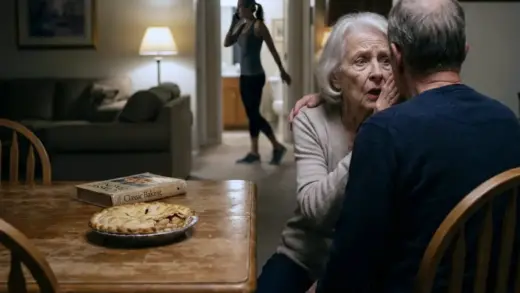
“You’re so strong, Kwame,” Kamisi would whisper, pressed against him in his mother’s condo. “Amaria doesn’t appreciate you. To her, you’re just a worker. But I see who you really are.” Kwame, beaten down by debt and insecurity, drank it in. “You really think so?” She nodded. “I know so. I’m her sister. I see the way she treats you.”
The plan was born in Nadira’s mind; she was always sharper and more ruthless than she let on. One evening, while Kwame sat at her kitchen table looking like a beaten man, she said, “What if Amaria just… wasn’t here anymore?” Kwame looked up, startled. “Ma, what are you saying?” She leaned in. “An accident, Kwame. A car malfunction. It happens to people every day. No one would ever know. The house would be yours. The insurance policy is yours. Kamisi loves you. I’d finally have the daughter-in-law I want. Everyone wins.”
“Have you lost your mind?” he asked. “No,” she countered, “you’ve lost yours, living with a woman who looks down on you while you drown in debt.” Kamisi added her own incentive. “When Amaria is gone, I’ll be the only heir to my parents’ estate. When their time comes, everything goes to us. We’ll be truly wealthy, Kwame. For real.” Kwame resisted at first. Then he listened. Then he went silent. The plan matured slowly. The mother designed the scheme; Kamisi provided the motivation. Finally, Kwame agreed to execute it.
On the eve of that fateful morning, they discussed the final details over the phone. Kamisi called from a café, her voice sounding excited, almost giddy. “Tomorrow! Tomorrow morning! I’ll do it!” Kwame replied, “I love you.” “I love you too,” she answered.
He got up at six in the morning while I was still asleep, slipping out of bed. He went down to the garage and popped the hood of my silver Toyota Camry, the car I loved for its reliability. He grabbed his tools. He knew exactly what to do. His hands were steady, his breathing even. He didn’t let himself think about the horrific reality of what he was doing; he just turned his brain off and worked. Within minutes, the vehicle was compromised. He wiped his hands with a rag, closed the hood, and checked for any stray marks. He went back to the bedroom, lay down next to me, and matched his breathing to mine. The car sat in the garage, quiet and obedient, with a hidden, fatal flaw waiting to manifest at the first sign of heavy traffic.
Kwame lay in the dark, pretending to sleep, waiting for me to wake up, get ready for work, get behind the wheel, and drive away to a destination I would never reach. The alarm on the nightstand went off at 7:30. I reached for it through my sleep, eyes still closed, finding the button by habit. Kwame lay beside me with his back turned, breathing so steadily that I decided not to wake him. Lately, he’d been sleeping poorly, complaining of headaches and stress at the shop, so I tried not to disturb him.
I showered and dressed. Outside, a gray December sky hung low over Atlanta. The weather report had predicted a warm front, so I pulled a light trench coat from the closet instead of my heavy winter jacket. I swallowed some tea, grabbed my bag, checked for my keys and wallet, and slipped out of the house, closing the door softly. I was about thirty feet from the car when I patted my pockets and stopped. My phone. I’d left it in the pocket of my heavy jacket the night before and hadn’t moved it when I switched coats. “Darn it,” I muttered, turning back toward the house.
I opened the front door quietly, still not wanting to wake Kwame. The foyer was dim, but a sliver of light spilled from the living room. From there, I heard my husband’s voice, low but clear, possessing a tone I had never heard before. I froze at the threshold, not yet understanding why my stomach had just dropped.
“Baby, it’s done,” Kwame was saying into the phone, his voice thick with triumph. “I took care of the car this morning while she was sleeping. It’s clean. Nobody’s going to find a thing. The first time she has to hit the brakes hard, that’s it.” There was a pause. From the speaker, a woman’s laugh drifted out—a familiar laugh that made my heart stop. It was Kamisi.
“I’ll see you at your sister’s funeral,” Kwame continued. “Your mother’s plan was brilliant. We’re going to be living large soon. Half for us, half for her, just like we agreed. You’ll take your sister’s place, just like you wanted. I get the house and the insurance, and Ma finally gets the daughter-in-law she actually likes.” He laughed—a triumphant, expectant sound I would never forget. “My mother is a genius, I’m telling you. She calculated everything—how to sabotage the car, how to set up the alibi. She even said she’d swear I was at her place all morning if anyone asks. She thought of every detail.”
The world stopped. I stood in the foyer of my own home, listening to my husband discuss my funeral with my own sister, praising his mother—the sweet Nadira who called me “daughter”—for a brilliant murder plot. I started shaking. My hands, my legs, my entire body was gripped by a tremor I couldn’t control. My first impulse was to scream, to burst into the room and throw the accusations in his face, to strike him. But something stopped me. Maybe it was a survival instinct, or the sudden realization that a scream wouldn’t change anything; it would only give them time to prepare, to hide the evidence.
I took a deep breath. Then another. The shaking stopped, and my mind began to work with a cold, sharp clarity I’d never felt before. I reached for the coat rack. My heavy jacket was right there. My phone was in the pocket. I pulled it out silently and slipped back out the front door. I walked around the corner of the garage, out of view of the windows, and leaned against the cold brick wall. I stared up at the gray sky and just breathed for a few minutes. Then, I pulled out my work planner. In the back, I had the number for a premium towing service I’d used a year ago. My voice barely trembled as I gave the dispatcher my address and the make of the car. “We’ll be there in thirty minutes,” the dispatcher said.
For those thirty minutes, I stood behind the neighbor’s hedge, watching my own home. There were no thoughts, just a deafening silence inside me and a strange, almost inhuman calmness. The tow truck arrived at 8:45. By then, another car had parked at the house—Kamisi’s old, battered sedan. They weren’t even hiding anymore. Why would they? The wife was supposed to be dead on the side of the highway by now.
“That Silver Toyota,” I told the driver, pointing to the garage. “I need it delivered to this address in Midtown. I’ll ride in the cab with you.” The driver, a stoic man in his fifties, didn’t ask questions. He was paid to tow, not to be curious. As the car was being winched onto the bed, I looked up at the second-story windows. A shadow moved behind the curtain. Kwame and Kamisi were in the master bedroom, which faced the backyard. They didn’t see the tow truck in the driveway. They didn’t see the car leaving without its engine running.
A plan was forming in my mind. Going to the police now would be useless; it would be my word against his. No proof, just an overheard conversation. But if someone got behind the wheel of that car and had an accident, there would be an investigation. Experts would find the sabotage. Who should get the car? The answer was obvious: the woman who thought of it all. “Your mother’s plan was brilliant,” Kwame’s words echoed. Nadira, the sweet old lady, the cold-blooded architect of my murder. Let her fall into her own trap.
The tow truck pulled up around the corner from Nadira’s condo at 9:45. I asked the driver to drop the car and wait. I would drive the last fifty feet to the entrance myself. He shrugged and complied. I sat in the driver’s seat. I knew the car was compromised, but I only had to go fifty feet at five miles per hour. I managed it, stopping the car against the curb by the front door using the emergency brake. I paid the driver and went up to the third floor.
Nadira opened the door almost immediately, wearing a floral robe and holding a cup of herbal tea. Seeing her daughter-in-law, she broke into her usual smile. “Amaria, honey, what a surprise! Come in, sugar, I just put the kettle on.”
“Thank you, Nadira, but I can only stay a second,” I said, my voice steady. “Kwame asked me to drop the car off for you. Mine is stuck at the shop, and he said he needed his truck for something urgent. I’m just going to take an Uber to the office. Here are the keys. He said it’s a surprise gift for you.” I held out the keychain.
Nadira froze. The smile slowly slid off her face. She looked at me—alive, healthy, smiling—and she couldn’t process it. “Thank you, baby,” Nadira managed to choke out, her fingers trembling as she took the keys. “How… how sweet.”
“Well, I’ve got to run. Have a wonderful day, Nadira.” I went downstairs, walked out of the building, caught a cab, and gave my office address. In the back seat, I finally let myself break, sobbing silently into my palms.
Nadira stood in her doorway, clutching the keys so hard they dug into her skin. Something had gone wrong. She needed to call Kwame immediately. She rushed to her phone and dialed. One ring, two, three. “The subscriber you are trying to reach is not available.” She tried again. Same result. The third time, the call was declined. She didn’t know that at that moment, her son was lying on the sofa with Kamisi, celebrating their upcoming freedom. A bottle of expensive champagne was nearly empty, and his phone was on silent, buried under a cushion. “To our new life,” Kamisi whispered, kissing his neck. “To freedom,” Kwame replied.
Panic rose with every passing minute. Nadira paced her condo. Why was the daughter-in-law alive? Why wasn’t her son answering? She had to get to him. She looked out the window. Her own car had been sitting in the lot for three weeks with a blown radiator. She pulled up the ride-share app on her phone. “Wait time: 25 minutes.” High demand. She stared at the screen, her heart racing. She didn’t have twenty-five minutes. She needed answers now.
She looked at the keys in her hand. Amaria’s car was right there in the lot. The girl had just driven it here, so it was obviously working. Nadira threw on her coat, grabbed her purse, and ran out. She had no idea how a car worked mechanically. She’d spent her life as a passenger; first her husband drove her, then her son. She had a car. She had keys. What else did she need? She started the engine and pulled out of the complex.
For the first few minutes, everything seemed fine. Nadira drove cautiously, as was her habit, doing twenty-five miles per hour through the side streets. Then she turned onto Peachtree Street and accelerated to forty. The car responded, the engine was smooth, and she began to calm down. Maybe it was okay. Maybe Kwame would just call back and explain everything. She didn’t know that under the hood, the braking system was failing with every press of the pedal. The fluid that allowed the car to stop was leaking away, drop by drop. As long as she was in the neighborhood and braking gently, there was enough left. But with every pump, the safety margin evaporated.
At a major intersection, Nadira slowed down for a pedestrian. The pedal went slightly deeper than usual, but the car stopped, and she didn’t think much of it. Then there was another light, then a turn, and each time the pedal sank further. Her son’s house was fifteen minutes away. Nadira picked up speed as she hit a main thoroughfare, the speedometer climbing to fifty. Only one thought hammered in her brain: Why is she alive? Why is she alive?
Up ahead, about two hundred yards away, was a busy intersection with four lanes of traffic in each direction. The light was green. Nadira tapped the gas, hoping to make it through. The green flashed and turned yellow. She instinctively hit the brake. The pedal hit the floor with no resistance, like stepping into a void. She pumped it again, slamming her foot down with force. Nothing. The car didn’t slow down.
The light turned red. Time stretched out strangely, the way it does in moments of mortal peril. Nadira saw a massive blue delivery truck entering the intersection from the left, and she knew she wasn’t going to make it. She jerked the wheel to the right, trying to avoid the collision, but she was going too fast. Her hands were sweating, her fingers slipped from the leather, and in that final heartbeat, she finally understood. The car. Amaria’s car. The very one she had arrived in. Her own plan. Her own trap.
She screamed, and then the scream was cut short. The truck slammed into the driver’s side door with terrifying force. The impact spun the car and threw it against a concrete light pole. The airbags deployed, filling the cabin with white dust, but it was too late. By the time the ambulance arrived, sirens wailing through the crowd of onlookers, Nadira Vance was dead.
Police cars swarmed the scene, blue and red lights slicing through the gray afternoon. Curious bystanders crowded behind the yellow tape. Officers took statements, questioning the truck driver, a pale man in a uniform who kept repeating, “I had the green. She just blew through it. I couldn’t do anything.”
A forensic investigator was called in. A fatal accident required a thorough check. A thin man in glasses popped the mangled hood, shone a flashlight into the engine bay, and straightened up a few minutes later with a grim expression. The system had been tampered with—cleanly, deliberately. It wasn’t wear and tear. He called over the lead detective, showed him the find, and the detective let out a long whistle. The investigation began.