Tariq stayed silent, looking at his younger daughter as if he didn’t recognize her. The memory hit him, but he didn’t flinch. “You wanted to kill your sister because of a math contest?” he asked finally, his voice heavy. “To kill her. Not to argue, not to get even—to end her life. Do you understand what that means?”
“I understand that I would have finally had a normal life, my own life, without the constant comparison to the perfect big sister.”
“Are you sick?” Imani whispered. “Are you sick, Kamisi?”
“I’m not sick, Mama. I’m just tired. Tired of being second. Tired of being worse. Tired of being nobody.”
Tariq stood up. Imani looked at him in fear. “Tariq, wait.”
“Imani, let’s go.” He took his wife’s hand and led her toward the door. At the exit, he stopped and turned. “You are no longer my daughter,” he said flatly, without anger, just stating a fact. “I had two daughters. Now, I have one.”
Kamisi jumped up, her chair clattering to the floor. “Dad! Dad, wait!” But he was already gone, leading his weeping wife away. The door slammed shut, and Kamisi was left alone. She stood in the center of the room, and for the first time, a look of genuine fear crossed her face. “Dad!” she screamed at the closed door. “Mama, come back! You can’t… you can’t do this!” No one came back.
A week later, a lawyer processed the changes to the Thorne Family Trust. Kamisi was completely disinherited. Every asset, every share of the company, and all properties were left to me. “Are you certain?” the lawyer asked, an older man with silver hair. “She is your daughter. Perhaps a minimal trust for her basic needs?”
“I am certain,” Tariq replied. “I have one daughter.”
They didn’t hire a defense attorney for Kamisi either. She was assigned a public defender, a young man fresh out of law school. He tried his best, but against the forensic evidence, the text messages, and Kwame’s full confession, he stood no chance.
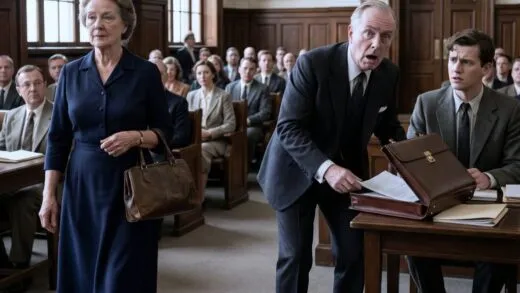
The trial took place in March, as the Georgia sun was starting to warm the pavement and the peach blossoms were beginning to bloom. The courtroom was packed. The case had drawn intense media coverage in Atlanta; journalists swarmed the entrance. Two people sat at the defense table: Kwame, hollowed out by months in jail, and Kamisi. She still tried to look defiant, but something in her had broken. She searched the room for her parents and found them. Tariq and Imani were sitting in the front row next to me, and they didn’t look at their younger daughter once.
The sentencing took nearly an hour. Kwame Vance was found guilty of attempted murder and manslaughter. He was sentenced to thirteen years in state prison. Kamisi Thorne was found guilty of conspiracy to commit murder. She was sentenced to ten years. As the bailiffs led her away, Kamisi turned. Our eyes met—sister to sister, separated now by far more than four years of age.
“You’ll pay for this!” Kamisi hissed. “You hear me? I’ll get out and you’ll pay!”
I didn’t answer. I had nothing to say to the person who ceased to be my sister the moment she agreed to a murder. Imani watched her youngest daughter being led away, tears streaming down her face. Tariq sat motionless, staring straight ahead. I took my mother’s hand and squeezed it.
“Mama, let’s go.”
“I… I can’t, Amaria. She’s my baby. She was my baby. I carried her for nine months. How could she? How could I not see it?”
“No one could, Mama. No one.”
We walked out of the courthouse through a gauntlet of camera flashes and shouting reporters. Tariq shielded his wife and me, led us to the car, and sat behind the wheel for a long time without starting the engine. He just gripped the wheel with both hands. “I lost her,” he said finally. “I lost her a long time ago. I just didn’t want to admit it.”
“She lost herself, Dad,” I said softly. “This isn’t on us, right?”
He turned, and the pain in his eyes was visible. “Maybe if I’d praised you less in front of her… if I’d given her more attention…”
“Dad, stop. You aren’t to blame. Mama isn’t to blame. I’m not to blame. She is. She made a choice, not us.”
Tariq nodded, but I could see he didn’t quite believe me. He would carry that guilt for the rest of his life.
A month after the trial, as the April sun was truly warming the city, I stood on the platform at Peachtree Station with a small suitcase. The house my parents had bought was sold. I had resigned from the company. My father understood without a word. He just held me tight and wouldn’t let go for a long time.
“Are you sure you won’t stay?” my mother asked, dabbing her eyes. “We’re right here. We can support you.”
“I have to go, Mama. There’s too much here. Every street, every building is a reminder. I need to start over where nobody knows me.”
Tariq stood silent, looking at his eldest daughter—his only daughter. “Call,” he said finally. “Every day. And if you need anything—money, help, anything—I’m always here.”
I hugged him, buried my face in his shoulder, just like when I was a little girl. “Thank you, Dad. For everything.”
“You don’t have to thank me. I’m your father.”
The boarding call was announced. I kissed my mother, hugged my father one last time, and boarded the train. At the door, I turned and waved. My parents stood on the platform, holding onto each other. My mother was crying. My father kept his hand on her shoulder and watched me until the train began to move.
As Atlanta slowly faded behind the window, I watched the city where I was born, where I’d gone to school and university, where I’d gotten married. The city where I had been betrayed by those closest to me: my husband, my sister, and the mother-in-law who had played the role of a loving mother for years. I watched the passing landscape—the greening woods of Georgia, the small towns, the lone pines along the tracks—and felt a strange lightness, as if I’d dropped a weight I’d been carrying for years without noticing. Behind me lay the pain, the betrayal, the death. But behind me also lay all the anchors that had held me in place: the obligations, the relationships, the illusions.
I had won, if you could call it a victory. The conspirators were punished. The architect had died in her own trap. But at what cost? I had lost a husband, a sister, and my faith in people, my belief that those closest to you are incapable of betrayal.
Outside the window, a sign for a distant station flashed by. The train swayed on the rails and picked up speed. I leaned back into my seat and closed my eyes. For the first time in my life, I wasn’t thinking about what I had to do, or what was expected of me. I was thinking about what I wanted. I was alive. I had survived. And that was enough to start over.