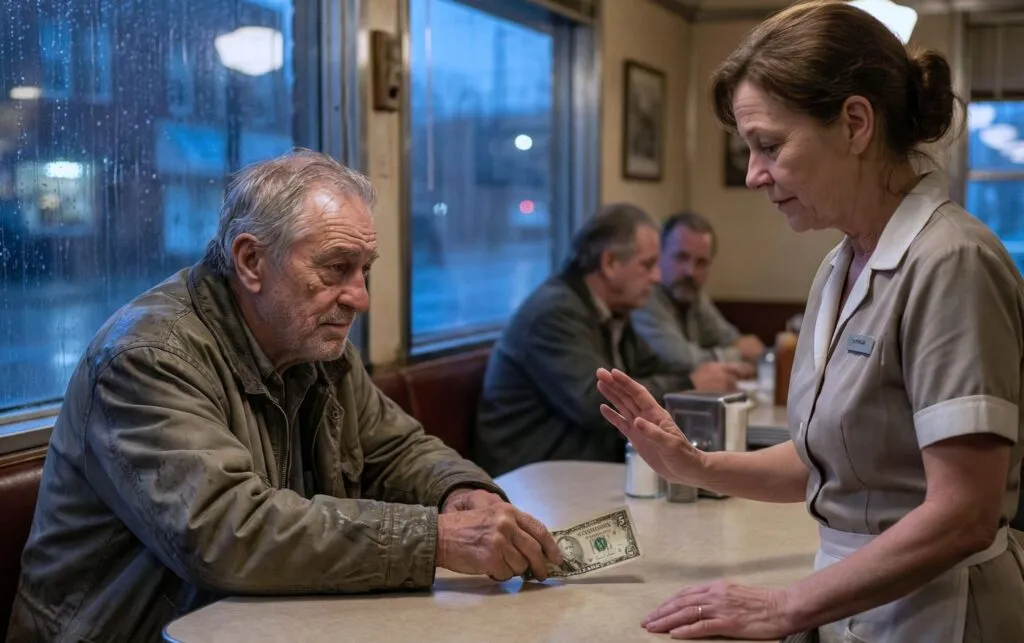
The crumpled five-dollar bill slid across the Formica table, coming to rest like a silent dare. Outside, the autumn rain hammered relentlessly against the plate-glass windows of the diner, blurring the city lights into smears of neon and gray. Naomi Brooks, nearing the end of a grueling double shift, looked down at the solitary figure seated in booth six.
He was an older man, wrapped in the scent of damp wool and cold nights. His trembling hands clutched a chipped mug as if it were the only anchor keeping him tethered to the world.
To the casual observer, and certainly to the diner’s impatient manager who had already attempted to eject him, he was just another vagrant seeking shelter from the storm. But Naomi paused, catching a glimpse of something profound in his weary eyes. Disregarding the manager’s earlier irritation, she had stepped in, offering the stranger a bowl of hot soup, fresh bread, and a warm seat near the radiator, all put on her own personal tab.
She had no way of knowing that the man hunched over the steam was Henry Calloway, a billionaire recluse masquerading as a beggar to see if any spark of humanity survived outside his boardrooms.
When Henry finished his meal, he rose with a slow, deliberate stiffness and placed the single five-dollar bill on the table. For a man of his stature, it was microscopic, but he knew that for a waitress in this part of town, it mattered. For Naomi, that five dollars represented bus fare home to relieve the babysitter. It was a fraction of her overdue rent. It was cough medicine for her young daughter waiting at home.
The air in the diner seemed to stagnate as she reached out, picked up the bill, and gently pressed it back into his calloused palm. Her voice was soft but firm when she spoke.
“I can’t take this,” she said, offering him a tired but genuine smile. “In my space, guests don’t pay for kindness.”
The sentence struck Henry with more force than any corporate merger or stock market crash ever had. He had spent his entire life insulated by wealth, surrounded by the shark-like greed of associates and, painfully, his own children, Marcus and Elena. They were already circling his estate like vultures waiting for a carcass.
Yet here, in a worn-down diner smelling of grease and rain, stripped of his status and designer suits, Henry found the one thing his billions had never been able to purchase: dignity given freely.
In that fleeting moment, with only a five-dollar bill passing between their hands, the destiny of a massive financial empire shifted course. When Henry Calloway stepped back out into the biting rain, the bill still warm in his hand, a fundamental fracture had occurred within him. For decades, he had commanded respect from the tops of glass towers, feared by competitors and obeyed without question by subordinates.
However, his world had recently shrunk to the size of a medical file. Only a week prior, a specialist with a steady, sympathetic voice had delivered the verdict that no amount of negotiation could alter: stage four cancer. The timeline was measured in months, perhaps weeks, not years.
The ticking clock had ceased to be a metaphor. When Henry broke the news to his children, their reactions solidified a suspicion he had long tried to suppress. Marcus had immediately inquired about the voting rights of the controlling shares.
Elena had been more subtle, but her primary concern was the insulation of the family trusts from inheritance tax. Neither of them had asked how much pain he was in, nor how much time they had left to spend as a family. In that sterile living room, Henry realized with terrifying clarity that his legacy would not be honored by love, but devoured by avarice.
Sleep became a stranger to him that night. Instead, a plan began to form in the darkness, one that was dangerous, simple, and absolute. If his own blood could not be trusted to steward his life’s work, perhaps he could find character elsewhere.
Henry decided to test the world in the harsh way the world tests the impoverished. He shed his identity, dressed in rags, and ventured into the establishments where his name usually opened every door. The results were devastatingly consistent.
Luxury hotels, where he held VIP status, turned him away without so much as eye contact. High-end restaurants, places where he had spent thousands on single meals, escorted him out as if his poverty were a contagious disease. Security guards physically shoved him into the wet streets while well-dressed patrons averted their gaze.
In every polished sanctuary built by capital, humanity evaporated the moment a person couldn’t pay the price of admission. By his fifth rejection, Henry felt a heavy despair settling in his chest. It wasn’t the cruelty that hurt, but the cold predictability of it all.
Then he found the diner. Inside that flickering, humble establishment, nobody knew he was a titan of industry. Yet, Naomi Brooks truly saw him.
She didn’t assess his net worth or ask what he could do for her. She didn’t recoil at his odor or his tattered clothing. She didn’t perform her charity for an audience. She simply acted, quietly and instinctively, at a cost to herself.
As Henry sat in the back of his limousine, watching the city blur past, her words replayed in his mind. “Guests don’t pay for kindness.” The sentiment roared louder than any keynote speech he had ever delivered.