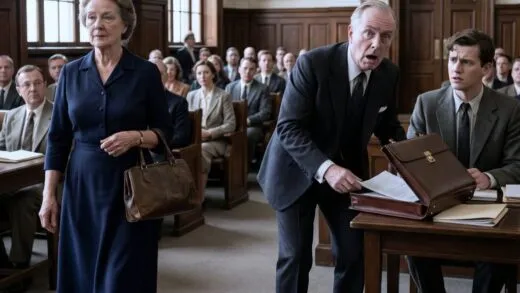
My father nervously cleared his throat, breaking the heavy silence.
“I genuinely didn’t realize what we were doing was a federal crime,” he stammered, addressing the deputy. “I swear to God, I didn’t.”
“You didn’t want to realize it,” I corrected him softly. “There is a massive legal and moral difference between the two.”
Chad opened his mouth and mumbled a defensive retort, but the sharply dressed man standing beside him—who I quickly realized was a public defender Chad had managed to secure—firmly placed a hand on my brother’s shoulder, instantly silencing him. The uniformed deputy then took control of the meeting, clinically explaining the immediate procedural steps. He outlined the scheduling of official sworn statements, the imposition of temporary legal restrictions preventing both my father and Chad from stepping foot on the property, the scope of the forthcoming county investigation, and the overwhelming likelihood of severe criminal charges.
My father’s weathered face went entirely translucent at the mention of the word charges. He slowly turned his watery eyes toward me.
“Maria, I never meant for it to come to this,” he rasped.
“I know,” I said, holding his gaze. “But your actions brought every single one of us here.”
I turned my back on him because there was absolutely nothing left to articulate. For the first time in days, I walked purposefully up the wooden steps toward the front door and gently placed my bare hand against the painted surface. The wood felt cool beneath my fingertips, comforting and deeply familiar in a way that made my throat tighten with emotion. I did not turn the handle or step inside, not yet. But I stood there just long enough to feel a vital piece of my soul returning—a profound sense of home. It was not because the physical structure was finally secure, but because the truth had finally been dragged into the light.
When the uncomfortable assembly dispersed later that morning—after the deputy drove away, the respective attorneys departed, and the nosy neighbors who had been lingering near their front windows finally retreated—I remained standing alone in the front yard. Long after the taillights of my father’s truck disappeared around the corner, I stayed there. The morning air was crisp and completely still, carrying that distinct, heavy quiet a neighborhood adopts immediately after a violent storm has passed.
Emily and her husband had respectfully excused themselves to finalize their legal paperwork downtown. I stood solitary on the small patch of green grass I used to meticulously mow every Sunday morning, allowing the profound silence to settle around my shoulders like a heavy woolen blanket. I honestly did not know whether I wanted to wrap myself tightly inside it or violently shake it off.
Eventually, I walked up the steps and pushed the front door open. I moved slowly, stepping over the threshold with extreme caution. It felt exactly like wandering through a vivid memory that no longer entirely belonged to me. The layout of the living room felt disorienting; Emily had naturally rearranged the furniture, draped soft, unfamiliar blankets over the armchairs, and hung framed photographs of her own smiling family on the drywall.
But peering beneath those superficial, cosmetic changes, I could still clearly trace the undeniable shadow of my own history. I saw the distinct, shallow dent in the hardwood floorboard near the fireplace where I had accidentally dropped a heavy steel toolbox three years prior. I noticed the faint, jagged scratch on the hallway doorframe from the afternoon I had stubbornly wrestled my oak dresser inside without asking for help. I could even see the faint, rectangular outline of lighter paint on the living room wall where my framed military medals had proudly hung. Physical homes inevitably change hands, but the bones of the architecture always remember.
I walked silently through the property, moving meticulously from room to room. I was not doing it to violently stake my claim or reclaim the territory in that specific moment. I simply needed to physically remind myself that I had not lost absolutely everything. The chaotic mess was now safely resting in the capable hands of the legal system, the seasoned attorneys, the county prosecutors, and the VA investigators. For the first time since this waking nightmare had commenced in Okinawa, I trusted that rigid bureaucratic process far more than I trusted anything my own father could ever say or do.
The final room I entered was the master bedroom. Emily had installed sheer white curtains that fluttered beautifully in the soft breeze slipping through the cracked windowpane. The mattress was a different size, the color scheme was alien, and the subtle scent of lavender detergent was unfamiliar. But the structural bones of the sanctuary were identically mine.
As I slowly ran my fingertips along the painted wooden windowsill, I felt a familiar, rough texture. It was the small, uneven ridge where I had carefully carved my own initials into the wood on the exact day I originally closed on the property. I had entirely forgotten it was there. The tactile sensation of those tiny, raised bumps of the letters hit my chest like a soft, devastating punch to the heart.
I stood there by the window for a very long time before finally turning to leave. I had no desire to intrude on Emily’s life any more than was absolutely necessary—she and her husband were still technically occupying the space, after all—but I desperately needed to feel the grounding pulse of the house one last time before stepping back into the uncertainty of the outside world.
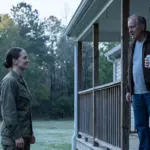
When I finally walked out the front door and locked it behind me, I noticed a solitary figure waiting patiently at the bottom of the porch stairs.
It was my father.
He was standing beside the dented fender of his pickup truck, both hands shoved deeply into the pockets of his worn jacket. His shoulders were severely hunched, carrying the ruined posture of a man who had finally realized the crushing weight he was bearing was entirely of his own making. For a long, suspended moment, neither of us uttered a single word. It was the most profound, deafening silence we had shared in over a decade.
Finally, he cleared his throat.
“Can we talk?” he asked.
I slowly descended the wooden stairs, deliberately keeping a careful, measured distance between us.
“We have been talking, Dad,” I replied.
“No,” he said quietly, his gaze dropping to the pavement. “Not like this.”
Something buried deep within the timbre of his voice—a spark of genuine humility, perhaps, or simply the utter exhaustion of a man who had completely run out of convenient lies—made me pause my retreat. I offered a single, curt nod.
Standing there in the harsh daylight, he looked significantly older than I remembered. He had not merely aged in the gradual way that passing time weathers a person; he had aged in the violent, sudden way that crushing regret physically breaks a man down. His eyes were deeply bloodshot, and his lower lip trembled slightly when he finally forced himself to speak the unvarnished truth.
“I honestly thought I was helping him,” my father confessed, his voice thick with unshed tears. “I genuinely thought that if I didn’t step in and handle it, he was going to lose absolutely everything.”
“You didn’t step in,” I said, my voice remarkably steady. “You stepped directly over me.”
He bowed his head, accepting the verbal blow.
“I know,” he admitted. “And I absolutely do not expect you to ever forgive me. I just desperately need you to understand my mindset. I was so incredibly scared.”
“Scared of what?” I pressed.
“Of losing him,” my father whispered, the confession tearing from his throat. “He is a complete disaster, Maria. He always has been. But he is… he is all I have left around here.”
He swallowed hard, fighting for composure.
“And I didn’t want to lose you either,” he continued. “But I just kept choosing wrong.”
I did not soften my stance, nor did I offer him immediate absolution. But I remained standing there, and I listened.
“Your mother was always the strong one,” he said, his voice drifting into a painful nostalgia. “You inherited all of that from her. After she passed away, I honestly didn’t know how to hold the pieces of this family together. Chad always needed me more… or at the very least, he made it feel like he did. You were always perfectly fine. You were always the resilient one who survived no matter what. I thought… I convinced myself that you wouldn’t break.”
“I didn’t break,” I told him, ensuring the absolute certainty of my survival resonated in my words. “But you managed to break something inside of me.”
His bloodshot eyes finally spilled over.
“I know,” he wept quietly.
“And you broke something fundamental inside of yourself, too,” I added without malice. “You just haven’t realized it yet.”