I reached into the dark canvas bag resting at my feet and pulled out two thick, neatly stapled copies of the documents I had meticulously assembled the night before. I held them out toward her.
“Here,” I said gently. “These files are for your attorney. They clearly outline and document absolutely everything I told you yesterday afternoon.”
Emily tentatively took the thick stack of papers, her trembling fingers brushing lightly against mine. She stared at the bold legal print on the top page.
“This is going to get incredibly messy, isn’t it?” she asked softly.
“Yes,” I confirmed without hesitation. “But messy does not necessarily mean hopeless.”
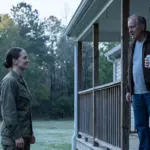
Before she could process the weight of that statement, the heavy front door swung aggressively open on its hinges. My father stepped out onto the porch, bringing the cold reality of the situation right along with him. His facial expression was the exact same one he used to weaponize against me when he scolded me as a teenager: tight, furiously rigid, and profoundly impatient.
“Maria!” he barked loudly. “What exactly are you doing here?”
“Talking,” I replied, my tone devoid of any emotion.
He aggressively pointed a thick finger at me as though I were a common trespasser vandalizing his personal property.
“Not without my explicit permission, you aren’t,” he demanded.
I stood up slowly from the wooden step, turning my body to face him fully.
“Your permission,” I repeated, letting a cold laugh escape my chest. “That is incredibly interesting, Dad, considering absolutely none of this belongs to you.”
“It doesn’t belong to you either!” he shouted back, his voice echoing off the neighboring houses. Beside me, Emily visibly flinched at his sudden volume.
“It never once belonged to you,” I stated, stepping closer to the railing so he could hear the absolute finality in my voice. “You arrogantly acted like you could make catastrophic decisions about my life simply because you held a temporary piece of paper and a legal signature. A Power of Attorney is not a transfer of ownership, Dad. It is a profound responsibility. And you disgustingly abused it.”
“I did exactly what I had to do!” he yelled, his voice trembling violently with misplaced anger. “Your brother was in serious danger. He had very dangerous individuals looking for him.”
“Dangerous people are always looking for him,” I shot back, refusing to let him control the narrative. “That is absolutely not a valid excuse to steal my future to pay his illicit debts.”
“It wasn’t stealing!” he barked, his face twisting into an ugly, defensive mask. “You constantly judge him. You walk around with this arrogant air, thinking you are fundamentally better than him simply because you wear a Marine uniform. You think you are entirely self-sufficient, that you don’t even need this family.”
“And I didn’t need you?” I asked, my voice dropping to a low, trembling register as years of suppressed exhaustion finally breached the surface. “I have dedicated thirteen years of my life to serving this country. I sacrificed my youth, missed countless holidays, and willingly walked into environments you cannot even fathom. And through every single deployment, I faithfully sent money home. I kept this family financially afloat more times than either of you possess the basic decency to admit. Tell me, Dad, at what exact moment did I become the child who did not matter?”
He visibly hesitated. His mouth opened, but no sound emerged. In that agonizing split second of profound silence, a veil lifted, and I finally saw the tragic, unvarnished truth. He had not orchestrated this theft out of pure, calculated malice. He had not intended to destroy me. He had done it out of a pathetic, deeply rooted weakness. He acted out of a twisted, enabling version of love that had mutated into a toxic obligation. He was paralyzed by the overwhelming fear of losing the broken son he had never once stopped trying to rescue. But pure intentions do not magically repair a shattered foundation. And love—genuine, unconditional parental love—never justifies a knife in the back.
Behind my father, the rusty spring of the screen door creaked loudly, shattering the fragile quiet of the morning. Chad casually stepped out onto the porch. He was vigorously rubbing sleep from his bloodshot eyes, appearing as though he were merely waking up from an inconvenient mid-morning nap rather than stepping into the catastrophic consequences of his own reckless actions.
“Is this still about the house?” Chad mumbled, offering a wide, lazy yawn.
I looked at him. I really looked at him, stripping away the familial bond and observing the man beneath. I saw an individual who had never once been told the word no. I saw a man who had never been forced to face accountability, never been required to earn his keep, and never been expected to stand entirely on his own two feet. He had grown so profoundly comfortable extracting resources from everyone around him simply because taking was always infinitely easier than building.
“Yes,” I answered, keeping my gaze locked onto his. “It is still very much about the house.”
Chad let out a highly dramatic sigh, leaning his weight casually against the wooden frame of the door.
“Jesus, sis, just relax,” he whined, waving his hand as if swatting away a minor nuisance. “It’s not like you are dead. You make plenty of money. You can easily rebuild. It’s really not the end of the world.”
“No,” I agreed softly. “It’s not the end of my world. But it might very well be the end of yours.”
His careless expression immediately hardened, his features twisting into an ugly scowl.
“Is that a threat?” he demanded.
“No,” I replied with chilling sincerity. “It’s a mathematical prediction.”
Before Chad could escalate the argument, the low rumble of a vehicle engine caught my attention. A pristine, silver sedan slowly crawled down the residential street, easing to a stop directly in front of the manicured lawn. The driver side window smoothly rolled down.
“Is everything all right over there?” a booming voice called out.
It was Mr. Halpern, the neighborhood veteran who had lived exactly two doors down ever since I originally purchased the property. He was the quintessential retired Navy sailor—a meticulous man who mowed his front lawn in perfectly measured diagonal stripes and routinely flagged down the local mail carrier to enthusiastically discuss the latest military base news. He squinted through the morning fog, recognized me standing on the damp grass, and immediately put his vehicle in park. He stepped out onto the pavement, his posture rigid and alert.
“Staff Sergeant Lawson,” Mr. Halpern greeted me with a firm nod. “I didn’t know you were scheduled to be home.”
“I just got back, sir,” I replied respectfully.
He carefully scanned the tense tableau spread across the front yard. He took in my father’s flushed, panicked face, Chad’s defensive slouch, and Emily’s tear-stained cheeks. His gray eyebrows furrowed deeply.
“Is there something going on here?” Mr. Halpern asked, his tone shifting from neighborly curiosity to protective authority.
My father stiffened, puffing out his chest in a futile attempt to project control.
“It is just a private family matter, Halpern,” my father insisted.
“Actually,” I interjected smoothly, “it is absolutely not.”
Mr. Halpern simply crossed his arms over his chest and waited patiently, possessing the quiet, unshakeable endurance of an old sailor weathering a storm. I did not raise my voice, nor did I embellish the details. I explained, in the most clinical and precise terms possible, exactly what had transpired during my deployment. I outlined the rushed sale, the blatant misuse of the military power of attorney, and the calculated fraud orchestrated with the buyer. I stated nothing but the verified facts. When I finally finished my brief summary, Mr. Halpern let out a long, low whistle.
“Well, that is certainly not good,” the old sailor noted.
“No,” I agreed. “It is not.”
“Have you called the county sheriff yet?” he asked directly.