“It’s Yvonne. Mom wants to make peace. Don’t be stubborn.”
No “I’m sorry.” No “That was wrong.” Just “Don’t be stubborn.” Like my boundaries were an attitude problem.
I didn’t reply.
The third attempt was the one that made my blood run cold. Daisy’s kid-phone buzzed at breakfast. She glanced at the screen and slid it toward me without a word.
“Grandma” flashed at the top. My mom had found Daisy’s number. I stared at it like it was a snake in my kitchen.
Daisy watched me, jaw tight. “I didn’t give it to her,” she said quickly. “I swear.”
“I know,” I said, and I meant it. Daisy isn’t sneaky. She’s honest in that blunt kid way that makes you want to apologize to every adult who ever misread you.
I let it go to voicemail. My mom’s voice chirped through the speaker like she was calling about a bake sale.
“Hi, Daisy. It’s Grandma. Tell your mom to call me back. I miss you. I have something special for you.”
Something special. My mother’s favorite bait.
Daisy’s face twisted. “I don’t want something special.”
I felt rage rise up, and then I did what I’ve learned to do. I put it in a box and kept it from spilling onto my child.
“Okay,” I said calmly. “We’re going to handle this.”
I didn’t call my mom. I didn’t open the door to a conversation she could turn into a weapon. I called Daisy’s school and asked them to update her file.
No contact with extended family without my written permission. Period.
It wasn’t dramatic. It was adult. It was the kind of boundary you build with paperwork.
That same week, I got another call. This one from a cousin I still trusted. The kind of relative who doesn’t love drama but also doesn’t lie.
“Just so you know,” she said carefully, “Your mom’s been telling people she always supported you. She’s saying the family is very proud.”
I let out one short laugh. Not because it was funny, but because the audacity was almost impressive.
“And Philip,” my cousin added, hesitating. “He’s been mentioning you in meetings. Like you’re connected.”
Connected. My brother Philip wasn’t reaching out because he missed me. He was reaching out because my name was now useful.
A week later, the fourth attempt arrived in the most “My Mother” way possible. A polite email. Not to me. To the event organizer of a business awards night I was scheduled to attend.
The organizer forwarded it to my assistant with a simple question: “Is this legitimate family?”
My assistant brought it to me with that careful professional face people wear when they’re trying not to pry. The email was from my mom.
She wrote: “I am Erica’s mother. Our family will be attending to support her. Please ensure we are seated appropriately.”
Appropriately. Like love comes with assigned seating. I stared at the screen, feeling that old familiar tightness in my chest.
And then I understood exactly what was happening. My family wasn’t coming to celebrate me. They were coming to be photographed near me.
They were coming to cash in on the story they’d rewritten. Proud parents, supportive siblings, loving grandparents—a family that never disowned anyone.
The only problem was, I had receipts.
I opened a folder on my computer titled “Proof”—because yes, I’m a single mom, and yes, I’m petty in a responsible way—and I pulled up the screenshot of my mother’s group chat message. Then I forwarded it to the event organizer with one calm note.
“Thank you for checking. This person disowned me in writing. They are not authorized VIP/family section guests. Please notify security if they approach the stage or my daughter.”
No rant, no essay. Just facts. Because facts are harder to gaslight.
That night after Daisy went to bed, I sat at my kitchen table and stared at the blank space where my mother’s love used to be. I didn’t cry. I didn’t spiral. I didn’t even feel surprised.
I felt steady. At the time, I thought the worst thing had already happened. I didn’t know yet that the next time my family showed up, it would end with them wishing they’d never said my name.
The night of the event, Daisy stood in front of the mirror, twisting her hair, trying to decide whether she looked fancy enough for a room full of people in blazers. She was eleven now, still my kid, still stubborn, just tall enough to see over the lies.
“Do I look okay?” she asked.
“You look perfect,” I said, smoothing her collar.
We arrived early. The venue was all high ceilings and flattering lights, the kind of place where people pretend they’ve never ugly-cried in a car. Cameras by the entrance, a step-and-repeat backdrop, tiny glasses of expensive liquids that taste like regret.
Daisy squeezed my hand. “Why are there so many people?”
“Because grown-ups like to clap for each other,” I said. “It’s basically a pep rally, but with blazers.”
She giggled, and for a second, my chest loosened. Because no matter what happened, Daisy and I were together. We always had been.
This was a public event. Anyone with a ticket could come in, which meant my family could show up. But they weren’t getting anywhere near us this time.
So when Daisy and I sat near the front, my name printed in the program, I felt steady. Then the air changed.
You know that feeling when a room shifts before you see why? Like your spine gets an alert? I felt it. Daisy felt it too.
Her hand tightened around mine. “Mom,” she whispered.
I turned my head just enough. There they were. My mom. My dad. Yvonne.
Philip and Mallory filed into the back rows under the lights, the way you seat people who arrived late and expected VIP anyway.
My mother was dressed like she’d planned a photo. Pearls. Cream. Respectable.
From head to toe, from the back of the room, it didn’t look respectable. It looked desperate. She spotted me and lifted her chin like she was about to reclaim territory.
Then she stood up and started moving down the aisle. Of course she did.
Daisy’s voice went thin. “Is she coming here?”
“She’s trying,” I murmured.
And that’s when my mom tried to walk toward the stage. Not at a run. Not making a full scene yet. Just a steady march toward the front rows, the cameras, the family section she believed she deserved.
An event staff member stepped into her path with a polite smile and a spine made of steel. “Ma’am,” she said gently. “Your seats are in the back.”
My mom’s mouth tightened. “I’m her mother.”
The staff member didn’t blink. “Your seats are still in the back.”
My mom tried to step around her. The staff member moved with her, like a living boundary.
I didn’t move. I didn’t rescue her pride. She’d spent years burying mine.
My mom argued for one more beat, long enough for heads to turn, then finally backed down and walked stiffly back to her row. Yvonne’s smile vanished. Phillip leaned in, whispering fast.
My dad stared forward like he didn’t want to be recorded having a conscience. The program continued. Speeches. Awards. Applause.
Then my name was called. Daisy looked up at me like I was about to jump off a cliff.
“Go,” she whispered.
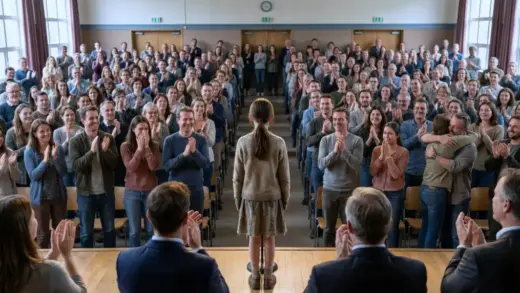
I walked to the stage, took the microphone, and looked out at the room. I saw cameras. I saw a livestream screen off to the side. I saw a sea of faces.
And in the back, I saw my family sitting where they belonged, far enough away that they couldn’t pretend we were close.
I took a breath. I’d planned not to mention them. I wanted to win without speaking their names. But then I remembered Daisy’s voice at our kitchen table: “What does lowly mean?”
And I realized something. If I stayed silent, the shame would stay ours. So I made a choice.
“I’m a single mom,” I said. “And I built this without a safety net.”
A few people nodded. The room got quieter.
“My daughter and I started in a small apartment with a kitchen table that doubled as a desk and a dinner table. There were nights I wanted to quit, but I couldn’t. Because I had someone watching me learn what ‘worthy’ looks like.”
I paused, just long enough for the room to lean in.
“Three years ago, my mother wrote in our family chat: ‘All my children brought this family respect except Erica. She chose to be a lowly single mom. I no longer see her as my daughter.'”
The room went still in that stunned, public way. Not gossip-still. Truth-still.
I kept my tone calm. Not angry. Not theatrical. Just factual. Like reading something that should never have been written.