The rain fell in a soft, unyielding drizzle, transforming the pavement outside the small coffee shop near the bus station into a shimmering mirror of gray and gold. Inside the café, the rich aroma of freshly ground beans and warm, buttery pastries hung heavy in the air, a comforting barrier against the biting chill of the early morning.
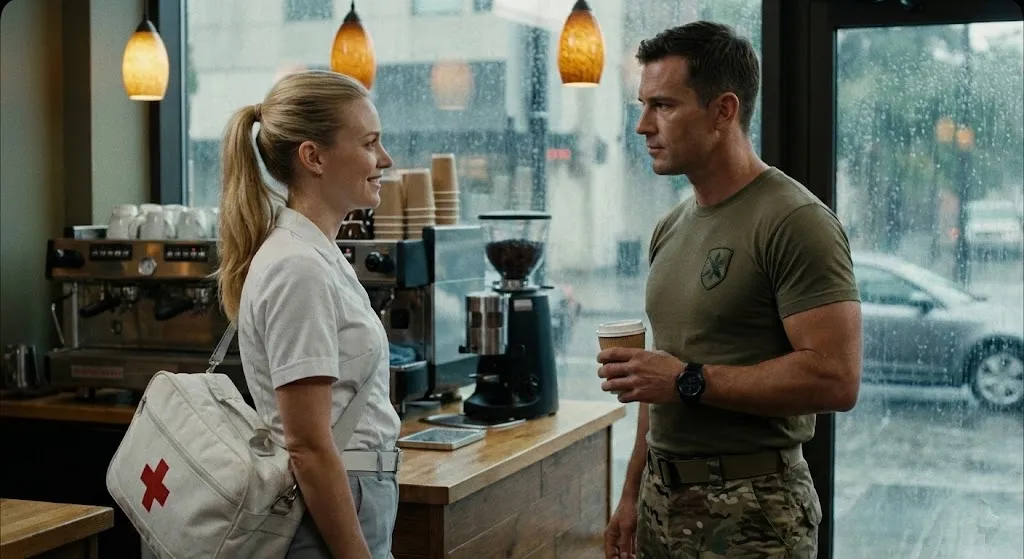
Rachel Carter, twenty-four, pushed through the glass door, shivering slightly as she shook the dampness from her worn nursing student uniform. Her blonde hair was pulled back into a practical, low ponytail, though a few stray strands had escaped to cling to her wet cheeks. The grueling overnight shift at the hospital had painted dark, violet shadows beneath her bright blue eyes, yet her stride remained steady and driven by purpose.
She desperately needed coffee, something hot to fortify her before she headed home to relieve the babysitter and see her little brother. She joined the queue, casting a brief, tired glance at the man standing directly behind her. He was an imposing figure, tall and broad-shouldered, yet his posture was curled inward, hunched as if the invisible weight of the entire world had been crushing him down for far too long.
His military jacket was faded to a dull olive and deeply creased, the patches on the sleeves worn to the point of being barely legible. He wore a day’s worth of dark stubble, and his eyes darted nervously around the bustling room before finally settling, softening as they landed on the elderly man in front of him. When the older gentleman trembled and struggled to reach a pastry on the high display, the soldier moved instantly; he stepped forward, retrieved the item gently, and handed it over with a faint, fleeting smile.
The older man nodded his gratitude and shuffled off to find a seat. Rachel turned her attention back to the counter, but her gaze lingered just long enough to catch the moment Eli pulled his wallet from his pocket. He thumbed through the contents slowly, revealing only three crumpled dollar bills and a handful of loose coins.
It was enough for a simple coffee, she realized, but certainly not much more. She stepped up to the register to place her own order. “One small, dark roast, please,” she said.
She paused for a heartbeat, then glanced back at the man behind her. “And his coffee is on me.” The barista hesitated, looking between them with mild confusion, before nodding and keying in the order. Eli looked up sharply, genuine surprise washing over his face.
His eyes met hers, revealing a shade of gray-blue that reminded her of the ocean right before a storm breaks. For a suspended moment, they simply looked at one another while the rain tapped a gentle, rhythmic code against the windowpane. “You don’t have to do that,” he said quietly, his voice raspy from disuse but surprisingly steady.
Rachel offered him a smile that was warm, despite her exhaustion. “I know,” she replied softy. “But I want to.”
He hesitated, shifting his weight uncomfortably. “I’ll pay you back.” She shook her head immediately, dismissing the notion.
“Just pass it on,” she said. Eli’s lips parted as if to speak, but no words came; his throat seemed to tighten, choking off his voice. It was just a simple cup of coffee, a gesture worth maybe five dollars.
But there was something about the way she had said it—as if being kind was the most natural, elemental thing in the world—that struck him deeper than he had expected. She took her drink and walked toward the exit, the little bell above the door chiming softly in her wake. Her figure quickly faded into the silver mist beyond the glass, leaving him standing there.
Eli stepped up to the counter, still processing the interaction. “What kind of person does that?” he muttered, largely to himself. The barista handed him the hot cup and offered a shrug. “The kind the world needs more of.”
He wrapped his hands around the cup, letting its heat seep into his frozen fingers. Outside, the rain continued to descend in thin, silent ribbons. For the first time in weeks, perhaps even months, he felt something stir within him that wasn’t just numbness.
It wasn’t just the caffeine or the warmth of the cup. It was the look in her eyes, and the sudden, foreign feeling that maybe, just maybe, the world hadn’t completely given up on him yet. Across town, Rachel unlocked the door to her apartment with practiced quietness, careful not to wake her little brother.
The hallway carried the faint, stale scent of old paint mixed with something burnt drifting from a neighbor’s kitchen. Their unit was located on the third floor of a deteriorating brick building where the elevator hadn’t functioned in years. Inside, the space was cramped, with two small bedrooms that barely fit the essentials, yet it was spotless and maintained with obvious love.
Scattered across the living room floor were Lego pieces, a half-constructed robot from an online tutorial, and a notebook dense with sketches and lines of code. This was Luke’s world. Rachel kicked off her shoes, padded silently into the kitchen in her socks, and set her coffee down on the counter.
The fluorescent bulb overhead buzzed with a weak, flickering light. “Rache?” a sleepy voice called out. Luke appeared at the end of the hallway, rubbing his eyes with the back of his hand.
His brown hair was a mess of bedhead, and he was clutching his tablet tightly against his chest. “You’re home,” he said, sounding relieved. “I’m always coming back, buddy,” she whispered, pulling him into a hug.
“Go back to bed,” she urged him gently. “Big school day tomorrow.” He looked up at her hopefully. “Did you get my raspberry yogurt?” Rachel hesitated, a pang of guilt hitting her, then forced a smile.
“Tomorrow, I promise,” she said. She watched him shuffle back to his room, the guilt gnawing at her stomach; her shifts barely covered the rent, their groceries, and the expensive secondhand textbooks she needed for nursing school. There were weeks when she had to stretch a few ramen packets to last three days.
And still, she smiled, for Luke’s sake, and for the memory of their parents. Their mother had died when Rachel was sixteen, taken by a cancer that went undiagnosed for too long. Their father, Sergeant Carter, had fallen in Afghanistan less than a year later.
He had died a hero, or so the officials said. The medals he won were tucked away in a drawer Rachel could never bring herself to open. She had been seventeen then, left with no one but an eight-month-old Luke and a terrifying stack of bills.
Now, at twenty-four, she was halfway through her nursing program. She worked grueling nights at the hospital handling administrative tasks, picked up weekend shifts at a diner, and occasionally helped elderly neighbors with their groceries for extra cash. Every single hour of her day was accounted for, and every dollar was spoken for before she even earned it.
She collapsed onto the worn couch, her eyes fluttering shut for just a moment of respite. Across the city, Eli sat on the edge of a lumpy mattress in a budget motel that smelled aggressively of bleach and dust. The flickering neon light from the sign outside painted his room in pulsing, pale blue intervals.
On the cheap table before him lay a manila envelope, opened, with its contents fanned out. There were adoption papers, hospital records, and a birth certificate bearing his name, Eli Monroe, but the line for “Mother” was blank.
His thumb traced the faded logo in the corner of a document: St. Margaret’s Women’s Health Clinic. His hands trembled uncontrollably. He had spent eight years in a hell where days blurred into dirt, smoke, and silence, captured during a covert mission gone wrong and presumed dead by the world.
He had clawed his way back to life, found his way out, and now that he was here, he didn’t know where he belonged. Family? He had none. Friends? He had kept everyone at a safe distance.
Home? He had never truly had one. And then, just days ago, he had received this file from the VA. “We thought you’d want to know,” the caseworker had said.
“There may be someone looking for you,” they had told him, but there was no name, no letter, no hand reaching out to claim him. Eli stood up, running a hand through his short-cropped hair. The nightmares still came for him—the gun smoke, the screams, the metallic taste of fear—every time he closed his eyes.
And yet, despite the darkness in his mind, he had not forgotten the girl in the cafe, Rachel. She had given him coffee. Not out of pity.
Not because she knew his name, his tragic history, or his pain. She did it just because. Two lives were unfolding in two different corners of the same city.
One was building a future from the ruins of the past. The other was lost in the shadows of war, trying to find a name, any name, that might make him feel real again. And though they had met only once, that morning had shifted something in the atmosphere.
Because in a world where most people looked away, she had looked right at him. And she had smiled. The night was slow at St. Mary’s Hospital, possessed of the kind of eerie quiet that felt too good to last.
Rachel sat behind the front desk, hunched over a pile of paperwork, her eyes heavy from back-to-back shifts. Her scrub top was wrinkled, and a loose strand of blonde hair kept falling stubbornly into her eyes. She pushed it back and took a sip of lukewarm coffee from a chipped mug that read “World’s Sleepiest Nurse.”
The front door buzzed, breaking the silence. She glanced up. A man stumbled in, appearing to be in his mid-forties, reeking of alcohol and slurring his words as he approached.
He leaned heavily on the counter, his eyes glassy and unfocused. “Hey, pretty girl, you got a phone?” he mumbled. “Maybe I can call… my heart, cause it just stopped when I saw you.” Rachel forced a polite, professional smile.
“Sir, this is a hospital,” she said firmly. “Do you need medical attention?” He leaned in closer, his voice dropping to a low, greasy tone. “Only thing I need is your number, sweetheart.” Rachel stood up, backing away slightly.
“I’m going to call security if you don’t leave right now,” she warned. The man reached over the counter, his hand brushing against her wrist. Then, out of nowhere, he let her go.
A voice spoke from behind him—low, firm, and immediately sobering. Rachel’s eyes darted to the entrance. Eli stood there, half-obscured in shadow, wearing the same worn army jacket.
He crossed the floor in three calm, steady steps. The drunk man turned to him, looking confused. Eli didn’t raise his fists.
He simply stared, quiet and unblinking. And there was something in that gaze that made the man take a step back, and then another. Muttering to himself, the intruder turned and staggered out the door.
Rachel stood frozen behind the desk. “Are you okay?” Eli asked gently. She nodded, still stunned by the sudden escalation and resolution.
“You… what are you doing here?” she asked. “I had a VA appointment,” he said. “Missed it. Wandered in here.”
“Heard yelling,” he added simply. Rachel let out a shaky breath she hadn’t realized she was holding. “Thank you.”
Eli shrugged, looking uncomfortable with the praise. “You bought me coffee. I owed you.”
Later that night, they sat outside the hospital on a cold metal bench, beneath the hum of a flickering street lamp. Rachel had brought two vending machine sodas, and they shared a comfortable silence. “You didn’t have to step in like that,” she said eventually.
“You looked tired,” Eli replied. “And scared.” She chuckled dryly. “That obvious?”
“Only to someone who knows the look,” he said. Rachel took a sip of her soda, staring at the pavement. “My dad was in the military. Deployed twice.”
“Didn’t come back the second time,” she said softly. Eli looked over at her, his face unreadable in the dim light. “I was ten,” she continued, her voice distant.
“He was my hero. I thought if I held my breath long enough, he’d walk through the door.” Eli remained quiet for a long moment, respecting the weight of her words.
“What was his name?” he asked finally. “Michael Carter,” she answered. “He wrote letters home every week. He said the hardest part wasn’t the danger, it was missing birthdays and first days of school.”
Eli nodded slowly, his hands clenched tightly in his lap. Rachel noticed the tension in his knuckles. “You served too, didn’t you?” He didn’t answer right away.
His voice, when it finally came, was hoarse with suppressed emotion. “Eight years. Lost track of how many places. Of how many people.”
Rachel’s eyes softened as she looked at him. “Is that why you’re here alone?” “I’m not good at being around people,” Eli admitted, looking down. “I keep waiting for the floor to drop out.”
“Well,” Rachel said, bumping his shoulder gently with hers, “it hasn’t. Not tonight.” Eli looked at her then, really looked at her.
There was something in her face, something unguarded and kind, that made his chest ache with a familiar longing. She smiled. “For what it’s worth, I think my dad would have liked you.”
Eli blinked quickly and turned away, but not before she saw the single tear he wiped away with the back of his hand. That night, two people, each carrying invisible scars, shared more than just a bench and a soda. They shared understanding.
And for Eli, whose world had felt like a series of disconnected shadows for so long, Rachel’s voice was the first real warmth he had known in years. Days later, Rachel stood at her stove, stirring a pot of noodles as steam curled into the air. The rich scent of garlic and herbs filled the small apartment.
The walls were decorated with drawings—some crayon sketches from Luke, others detailed anatomy diagrams from Rachel’s nursing classes. A small dining table was set with mismatched plates, and a flickering candle added a soft, inviting glow to the cozy space. “Smells amazing,” Eli said from the doorway, rubbing his hands together.
He had hesitated before accepting the invitation, but Rachel’s voice on the phone had made it feel like less of a favor and more of a welcome. Rachel turned with a bright smile. “It’s just spaghetti, nothing fancy.”
“After weeks of gas station snacks and ramen, this might be the best meal of my life,” he joked softly. Luke came running into the kitchen, clutching a toy robot in one hand. “Eli, you came!”
Eli bent down, a genuine smile breaking across his face. “I wouldn’t miss it, buddy.” “You can sit next to me,” Luke said, grabbing his arm and guiding him to the chair like an old friend.
Rachel watched them, her heart warming at how natural the scene felt. They sat down, and for the first few minutes, the only sound was the clinking of forks and the soft hum of conversation. Eli ate slowly, savoring each bite; he hadn’t realized how long it had been since he’d had a home-cooked meal.
More than that, he hadn’t realized how much he missed the feeling of belonging, the easy rhythm of dinnertime, the way Luke’s voice filled the room with laughter, and the quiet joy in Rachel’s eyes as she watched her brother smile. “I fixed the light switch,” Rachel mentioned, nodding toward the hallway. “Well, tried to.”
“It keeps sparking,” she admitted. “I can take a look at it later,” Eli offered between bites. “You know wiring?” she asked, surprised.
He shrugged. “Eight years in the Marines, you learn to fix what breaks.” True to his word, after dinner, Eli grabbed a flashlight and knelt beside the faulty switch.
With a few expert adjustments and some careful tightening, the flickering stopped completely. Rachel stood beside him, arms crossed, impressed. “You didn’t have to do that.”
“I wanted to,” Eli said simply. Later, while Rachel washed the dishes, Eli found Luke’s jacket hanging by the door. It had a nasty tear in the seam and was dusty from playground scuffles.
He took it to the sink, carefully rinsed the dust away, and stitched the seam with a spare sewing kit he always carried in his duffle bag. When Rachel turned and saw him, she paused, watching in silence. “You fixed his coat?”
Eli nodded, holding it up to inspect his work. “It looked cold.” Rachel looked at him for a long moment, her expression tender. “You’re kind.”
Eli looked down, uncomfortable. “I’m not used to anyone thinking that.” “Well, maybe you should be,” she said.
Luke interrupted them, running in with a piece of paper and a big grin. “I made this for you, Eli.” He held up a drawing of the three of them—Rachel, Luke, and Eli—under a big blue sky with the words “Dinner Friends Forever” scrawled across the top.
Eli took the paper slowly, handling it as if it were something incredibly fragile. “Thanks, Luke,” he whispered. “I’m gonna keep this.”
That night, when Eli finally left the apartment, Rachel stood at the door and watched him walk down the hall. “Thank you for coming,” she said. Eli turned back.
“Thank you for dinner,” he replied. “And the… warmth.” He hesitated before adding, “This was the first meal I’ve had where no one asked what I do. They just… let me be.”
Rachel smiled softly. “You don’t have to be anything here. Just be.” He nodded, then reached into his coat pocket and pulled out a small wooden bead on a string.
“From my first tour,” he explained. “I keep it for luck. For some reason, I think you and Luke should have it now.” Rachel took it, visibly moved.
“Then… We’ll keep it safe,” she promised. As Eli disappeared into the night, Rachel looked down at the bead in her palm. She didn’t know what would come next, but she knew that man wasn’t just passing through.
He had touched their little world with quiet gestures and genuine care, not for attention, not for reward, but because that was simply who he was. And for the first time in a long while, Eli walked away not feeling like a soldier, but like a person someone might actually want to keep.
Later that night, Eli sat alone on the edge of his motel bed, the letter clutched in his hand, the seal already broken. The crisp paper trembled slightly as he re-read the words for the fifth time. “Mr. Eli Monroe, we write on behalf of our client, Ms. Margo Welling…”
“Our client, currently under palliative care, has recently identified you as her biological son, based on a confidential adoption tracing investigation and confirmed DNA match. She expresses a final wish to speak with you.” The name Welling struck him like a ghost from a world he knew only from the news.
It sounded like legacy, like suits and glass towers, everything he had never been part of. And now, someone claiming to be his mother wanted to see him, after decades of absence, after years of war, after he had built himself from rubble and silence. He folded the letter carefully, placed it back in the envelope, and stared at the ceiling.
The room was dim, lit only by the orange glow of the parking lot light sneaking through the curtain. He hadn’t slept properly since it arrived. The next day, he found himself standing outside Rachel’s apartment again.
She opened the door, surprised to see him so soon. “Eli?” “I need to talk,” he said. Within minutes, they were sitting at the tiny kitchen table, mugs of tea steaming between them.
He slid the envelope across the table. “This came three days ago.” Rachel read silently, her eyes scanning the formal legal language. When she finished, she looked up, her eyebrows furrowed.
“Margot Welling,” she whispered. “She’s that Welling?” Eli nodded. “Yeah, the energy giant, global foundations, one of the richest women in the country.”
“And she’s your mother?” Rachel asked, stunned. “So the letter says,” Eli replied heavily. “Apparently, I was adopted. My parents never told me.”
“And now this… this woman says she wants to meet me.” Rachel leaned forward, her voice gentle. “Do you want to?”
Eli hesitated. “I don’t know. It doesn’t make sense. If she really cared, why now?”
“Why not when I was a scared kid being moved from base to base? Why not when I came home broken?” His voice cracked slightly under the strain. Rachel reached out, her fingers brushing his knuckles.
“You don’t have to forgive her,” she said. “But maybe, maybe you deserve the truth. Closure. Not for her. For you.”
Eli stared at her hand—warm, steady, anchoring him. “I’m afraid,” he admitted. “Of what?”
“That if I go, I’ll get angry. Or worse, I won’t feel anything. What kind of son feels nothing when meeting the woman who gave him away?”
Rachel pulled back, looking him squarely in the eyes. “The kind who survived,” she said firmly. “You are not defined by what they did or didn’t do for you. But you do deserve to stop wondering. Even if it’s just once.”
Eli exhaled slowly, the crushing weight in his chest shifting slightly. “I think I need a few days.” Rachel nodded. “Take them.”
“And whatever you decide, I’ll be here.” He stood up, lingering in the doorway for a moment. “Thanks, Rachel. For always seeing me.”
She smiled softly. “Just don’t vanish without saying goodbye.” But that, unfortunately, was exactly what he did.
For the next few days, Rachel heard absolutely nothing. No calls. No texts. She went to the coffee shop, waited at the bus stop, and even walked past the hospital bench where he often sat in silence.
He was gone. One morning, she found a note slipped under her door, written in the familiar, neat handwriting she’d come to recognize. “I needed to go. You were right. I deserve to know.”
“But I didn’t want you to see me if I broke. I’ll come back. If I still know how.” Rachel held the note against her chest, her heart heavy but strangely proud.
Eli wasn’t running away. He was walking into something painful, maybe for the first time on his own terms. Whatever lay on the other side of that truth, he’d face it. And if he made it back, she’d be there, waiting, just like she said.
The smell of grilled cheese filled the kitchen as Rachel sliced apples for Luke’s plate. The little boy sat at the table, humming happily as he scribbled in his notebook—lines of code she did not understand but always encouraged. The television in the corner murmured softly with the evening news.
Rachel was only half-listening, her thoughts drifting constantly to Eli and the days since he had disappeared. It had been almost a week. No messages. No sign.
Just the echo of that note he had left her. She had tried to be patient; after all, he had gone to confront something monumental, his own past. But the silence still hurt.
Then Luke’s voice broke her thoughts. “Rachel, look.” She turned just as the anchorwoman’s voice sharpened with urgency. “In breaking news tonight, Welling Energy, one of the nation’s leading renewable energy conglomerates, has officially confirmed the return of a long-lost heir.”
“Eli Monroe, a former Marine presumed missing in action eight years ago, has been verified through legal and genetic documentation as the sole biological son of CEO Margo Welling.” The screen flashed with high-definition photos. There was Eli, clean-shaven and dressed in a sharp charcoal gray suit, standing beside an older woman in a hospital bed.
She looked frail, her hand resting over his. He looked composed, though something flickered behind his eyes—pain? Regret? Rachel dropped the knife onto the cutting board with a clatter.
Luke looked up. “That’s Eli.” She could not speak. Her throat had closed entirely.
She felt the sting before the tears came, not just from surprise, but from the crushing weight of realization. He had never told her. Never prepared her for this scale. He had just… gone.
She sat down slowly, her hands trembling. “He said nothing,” she murmured, mostly to herself. “Not one word.”
Luke looked concerned. “Are you okay?” Rachel nodded mechanically, trying to smile for him. “Yeah, baby. Just… surprised.”
But inside, her heart cracked. Was she just a temporary refuge? A soft place to land before he returned to his real world of wealth, legacy, and perfectly manicured press conferences? After tucking Luke into bed, she slipped on her jacket and walked out into the night.
The streets were quiet, damp from an earlier drizzle. She followed instinct more than memory, her feet leading her to the bench outside the hospital where Eli used to sit in the quiet hours, watching people come and go, never speaking. The bench was empty, but something rested on it—a folded piece of paper with her name on it.
Hands shaking, Rachel opened it. “Rachel. I watched you carry the world on your shoulders with a grace I’ve never known. You gave me coffee. You gave me shelter.“
“You gave me laughter at dinner and silence when I needed it. You gave me home. But I needed to walk into my past to see if I could live in my future.“
“I didn’t know how to explain that, so I disappeared. I am sorry. I just needed time to believe I deserved it.“
There was no signature. None was needed. Rachel sat down, holding the letter against her chest.
She felt foolish, hurt, and betrayed, but also something deeper. She had seen something in Eli long before the world had a headline for him. She had loved the man in a thrift store jacket, not the heir in a tailored suit.
The pain was real, but so was the memory of the night he fixed her broken outlet or made Luke laugh with a silly face. That man was not just a lie. He was a part of Eli, too.
Maybe she had not lost him. Maybe he was just figuring out who he really was. Still, as the wind picked up around her, Rachel whispered into the night, “You should have told me.”
She folded the note carefully and stood. The bench behind her stayed empty. But somewhere in her heart, a quiet hope remained. Maybe, just maybe, he would come back, and this time with the truth.
The conference room inside the Welling Energy Headquarters was a cathedral of glass and light. Media crews hustled to adjust cameras, lights, and microphones, their voices blending into a rising wave of anticipation. Every major outlet was there; the return of the heir had become national news.
At the front stood a long table draped in white linen, behind which sat lawyers, board members, and executives in dark suits. But only one chair remained empty: the one at the center. Then the doors opened, and Eli Monroe walked in.
He was dressed in a simple navy suit, his posture upright but not stiff, as though every step was both a challenge and a triumph. Whispers rippled across the room as he approached the microphone, skipping the assigned seat entirely. He cleared his throat.
The cameras clicked and whirred in a frenzy. “Good morning,” Eli began, his voice calm but resonant. “I know most of you are here expecting statements about fortune, succession, and what this means for the Welling Energy Empire.”
He paused, his eyes scanning the crowd. Behind the reporters stood a few unfamiliar faces, but in the back row, standing quietly near the exit, was Rachel. She wore a pale blue blouse and jeans, her blonde hair loose around her shoulders, her eyes locked on his.
Eli smiled faintly. “But I’m not here to talk about fortune,” he continued. “I’m here because, not too long ago, I was just another man in a faded uniform. I had no name that mattered, no legacy I believed in, no family I knew.”
“I was tired, angry, lost.” The room hushed. “And then someone bought me a coffee.”
The room blinked, confused by the shift in narrative. “She did not know my name, she did not ask for one, she just paid for a stranger’s drink and told him to pass it on. That moment didn’t just warm me, it shook something awake.”
“I had not been seen as a person in a long time, but she saw me.” He glanced directly toward Rachel. “Her name is Rachel Carter.”
The camera lights turned instantly, locating her in the back. She froze, eyes wide. Eli stepped down from the stage and walked toward her, past a wave of stunned executives and whispering reporters.
A handheld mic was passed to him. He took it, stopping a few feet from where she stood. Rachel’s face was flushed, unsure whether to run or stay.
“I came here today,” he said, his voice softer now, “because I realized this company, this name, this money—it means nothing unless I know who I am without it.” He took another step closer. “You reminded me that I was still human. That I could laugh, that I could fix a broken outlet and be thanked like I mattered. That maybe I did.”
The cameras flashed again. “I found my blood,” he said, eyes locking with hers, “but you, you found me.” A murmur spread through the room—not gossip, not scandal, just awe.
Rachel stepped forward, trembling. “You disappeared,” she whispered. “I did,” he replied, “because I was scared that if I stayed, I’d lose you the moment you saw the truth.”
“But the truth is, you saw me before I even knew who I was.” Reporters scrambled to catch every word, but Eli turned to them one last time. “She gave me coffee. I want to give the world better because of her.”
Then, without waiting for another question, Eli took Rachel’s hand and walked with her out of the spotlight. Behind them, the crowd did not cheer, but it was as if the air had changed. Something real had been said, something human, in a world of headlines and stock prices. And in that quiet exit, hand in hand, a new kind of legacy began.
One year later, the doors to the Carter Community Wellness Center opened with the gentle chime of a brass bell above the frame. The building, though modest, radiated warmth with its cream-colored walls and flower boxes beneath the windows. A sign near the entrance read “In Honor of James Carter,” carved in wood and painted by hand.
Inside, Rachel stood by the reception desk in a soft green blouse and white sneakers, handing out flyers to new patients. The center, funded entirely by the Monroe-Welling Foundation, offered free care for low-income families, walk-in clinics for veterans, and mental health support for trauma survivors. Every room had sunlight and stories.
Every nurse on staff had once dreamed of helping and now had the means to do so. At the heart of it all stood Rachel. Eli, meanwhile, had become something of a myth: the heir who refused the empire, the Marine who traded mansions for missions.
He quietly gave away nearly eighty percent of his inherited wealth, directing it to build shelters, schools, and transitional homes for veterans and their families. He refused board seats, titles, or applause. “I don’t want control,” he told one journalist. “I want change.”
And change came. That fall, on a wide plot of land just beyond the edge of town, construction crews laid the final bricks of a neighborhood called Anchor Grove. It was a place where no veteran would sleep on the street again, designed with open kitchens, wide porches, and gardens between every house.
Rachel and Luke were invited for the ribbon-cutting, but as they arrived, Eli pulled her aside toward one of the porches, where a single swing hung gently in the breeze. “I wanted you to see this one first,” he said. She turned to him, eyes filled with pride.
“You did all this.” “No,” he replied firmly. “We did.”
A breeze lifted her hair as he reached into his coat pocket. But instead of a ring box, he pulled out a small paper cup, identical to the one from the coffee shop long ago. Inside, nestled at the bottom, was a velvet pouch.
Rachel laughed, tears already forming in her eyes. “You kept the cup?” “I kept everything,” Eli said, dropping to one knee under the porch’s shade.
“You gave me coffee, Rachel. But more than that, you gave me a place to belong. You gave me peace. You gave me home.”
He opened the pouch to reveal a simple gold band. “I’d like to give you forever.” She nodded, her voice caught in her throat.
“Yes. Always yes.” From behind them, Luke whispered loudly, “You better kiss her, man. I need this ending for my video.”
Eli stood, scooped Rachel into his arms, and kissed her as the sun dipped low behind the houses they had helped build. Later that night, Luke uploaded a short clip. It was simple: a porch swing, a paper cup, a kiss, and a quiet title across the screen: From Caffeine to Commitment.
Within hours, the video spread across the internet. Not because it was flashy, but because it was real. One cup of coffee. One small act of kindness.
And now, one home. One family. One future. Rebuilt, together.