Michael Barrett sat on the weathered slats of a park bench, the rough wood pressing against the fine wool of his navy suit. He felt none of the disparity. This bench was his sanctuary, a solitary island where he could retreat from the world he had so carefully constructed. He had just come from Laurel Grove Cemetery, leaving behind a bouquet of fresh white roses against a polished headstone that bore his daughter’s name.
Eleven years had passed, yet the sight of her name carved into cold marble still made his chest ache with a hollow, resonant throb he could never quite articulate. In the years since, Michael had built an empire: towering glass developments, high-end hotels, and a real estate portfolio that had cemented his status as a titan in Savannah’s commercial landscape. But the more wealth he amassed, the more cavernous the silence inside him became.
His penthouse condominium was a masterpiece of modern design, looking like a curated spread from an architectural magazine with its floor-to-ceiling windows, abstract art, and gleaming stone countertops. Yet, every evening when he returned, it felt less like a home and more like a high-end storage container for one man’s profound isolation. He took a sip from a paper cup of coffee, grimacing slightly; the heat had long since faded, leaving only a bitter, lukewarm memory.
Across the expanse of the park, two children raced beneath the sprawling limbs of the ancient oaks, their voices sharp and bright with joy. Michael’s gaze drifted, almost against his will, to a small figure hovering at the periphery of the playground. She was tiny, perhaps five years old, with a mane of blonde hair that formed a tangled halo around her face.
She was dressed in a faded yellow frock with a hemline that grazed her knees in an uneven, erratic line. Her shoes were mismatched—one white, one lavender—and she clutched a stuffed rabbit by the ear, its fur matted from years of fierce affection. She was looking straight at him. Michael glanced over his shoulder, convinced she must be staring at someone else.
But when he turned back, her eyes were still fixed on him, bright and unblinking. She began to walk toward him with a deliberate certainty that seemed at odds with her small stature. Stopping directly in front of his bench, she tilted her head to the side.
“Are you sad too, mister?”
Her question, so direct and unfiltered, stole the breath from his lungs for a moment. He blinked, caught off guard. “Why would you think that?” he asked softly.
She shrugged, a gesture of careless innocence. “Cause you’re sitting alone like me.”
Something inside him shifted, a subtle but distinct realignment of his emotional defenses. He searched for a polished, easy answer—the kind he used in boardrooms—but found he had none. “Why are you alone?”
Her expression turned solemn, her small brow furrowing. “It’s my birthday today. Mommy’s sick, but she’ll still smile if you come to my party.”
Michael stared at her. “Your party?”
She nodded vigorously, the stuffed rabbit swinging like a pendulum from her grip. “I saved candies from school. I can share if you come.”
He looked down at her, this tiny stranger offering an impossible invitation. He had stood before city councils, stared down hostile board members, and won multi-million dollar negotiations without breaking a sweat. But he had absolutely no defense against this small, steady voice.
“I don’t think I should intrude,” he said carefully, beginning to rise from the bench.
Her small hand shot out and tugged at his sleeve with surprising firmness. “Please.”
The word lingered in the humid air between them, heavy with expectation. Michael studied her face, the open earnestness in her eyes, the quiet urgency that underpinned her request. He hadn’t celebrated a birthday in years. The last one he had attended was in a sterile hospital room, his daughter too weak to blow out the candles, though they had pretended anyway.
“All right,” he said slowly, surrendering to the pull. “Lead the way, birthday girl.”
Her entire face lit up, resembling a sudden flare of sunlight piercing through heavy storm clouds. She slipped her hand into his without a second of hesitation. Her fingers were small and cool, but her grip was sure. They began walking.
The paved, manicured paths of Forsyth Park eventually gave way to narrower sidewalks lined with weathered homes and corner stores where painted signs had faded under the relentless Southern sun. Spanish moss swayed gently overhead, brushing the low branches like ghostly fingers.
“You live far?” Michael asked.
“Not far. Over Mrs. Bennett’s store,” she said matter-of-factly. “She’s nice. Gives me apple slices sometimes.”
“Mrs. Bennett sounds kind.”
“She is, but she’s busy today.”
They turned down a quieter street where the heavy, sweet perfume of magnolia blossoms hung in the air. The houses here leaned a little, their shutters crooked, the paint peeling in intricate maps of neglect. Michael noticed the girl skipping lightly to avoid the cracks in the pavement.
“What’s your name?” he asked.
“Lily.” She looked up at him, her eyes dancing. “What’s yours?”
“Michael.”
“Michael,” she repeated slowly, testing the weight of the name on her tongue. “I like it. Sounds like someone who brings candles.”
He smiled faintly, a genuine expression he hadn’t worn in some time. “Candles?”
“For birthday wishes.”
He was quiet for a moment. “I see.”
At the corner, she pointed to a narrow building with green shutters and a creaky wooden stairwell clinging to the side. A hand-painted sign above the shop read Bennett’s Market. The scent of ripe peaches drifted out through the propped-open door, sweet and earthy. They climbed the steps together. The hallway upstairs was dim, illuminated only by a thin strip of daylight seeping under a warped window at the far end.
Lily led him to a door marked 2B, the paint chipped down to the bare wood in spots. She knocked twice, then pushed it open without waiting. The apartment was compact but immaculately tidy, the furniture worn but clearly cared for.
A beige couch faced a window that looked out over the street. The light inside was softer here, filtered through sheer, inexpensive curtains. On that couch sat a woman, pale but smiling faintly as Lily bounded inside.
“Mommy! I brought someone.”
The woman, Clara May Harper, shifted to sit up, bracing herself with one arm. Her hair was pulled into a loose braid, stray strands slipping free to frame her face. She wore a simple cotton blouse, and though her posture betrayed a deep, structural fatigue, her eyes were warm.
“Hello?” Michael said, pausing just inside the doorway, feeling suddenly oversized in the intimate space. “I hope I’m not intruding.”
Clara glanced from Lily to him, a flicker of genuine surprise passing over her face. “You came with her?”
“Yes. She… invited me to her party.”
Clara’s smile deepened just a fraction. “Did she now?”
Lily was already busy at a small table near the window, spreading out two mismatched napkins and a paper plate containing a scattering of wrapped candies. “Sit here, Michael. You can have the red one. It’s cherry.”
Michael crossed the room, his polished dress shoes sounding aggressively loud against the old wood floor. He lowered himself onto a chair that wobbled slightly under his weight. Clara watched him, her gaze steady but curious.
“It’s not much of a party,” she said softly, her tone almost apologetic.
“It’s honest,” he replied, meeting her eyes. “And that’s more than I can say for most parties I attend.”
Something unreadable flickered in her eyes. Outside, a church bell began to toll the hour, a deep resonance that vibrated through the floorboards. Inside, Lily began singing, soft and slightly off-key, but with all the sincerity in the world.
“Happy birthday to me…”
Her voice faltered as she glanced at the plate. “No cake, no candle, just candy.” She hesitated, then smiled again, lifting her chin with a resilience that broke Michael’s heart. “Now I’ll blow out the air,” she announced, and leaned forward to breathe gently over the plate.
Michael felt something break open in his chest. He reached into his coat pocket, pulled out a matchbook from a hotel he had once stayed in, and struck a single match. He lit the tip of a toothpick he found in his pocket and placed it upright in the center of the plate, wedging it between the candies.
Lily’s eyes widened into saucers. “It’s a real candle.”
“Make your wish,” he said quietly.
She did, closing her eyes tight before blowing out the tiny, flickering flame. Clara looked on, her hand resting lightly against her collarbone, her lips curved in a smile that seemed to hold both gratitude and something else—a quiet, wary hope.
Michael didn’t know it yet, but he would return. This little party with three candies and one makeshift candle would be the beginning of everything.
Michael had intended to stay no more than a few minutes—a polite visit, a polite exit. That was how people like him kept boundaries; they insulated themselves with courtesy. But after Lily’s breathy wish over the tiny flame, he found himself still sitting at the small, wobbly table, sipping weak tea Clara had poured into mismatched mugs. It was the kind of tea that had probably been steeped twice already to stretch the budget, but it was offered with the care of someone who didn’t take hospitality lightly.
Clara sat across from him, her hands wrapped around her cup as if for warmth. She studied him in the quiet moments between Lily’s chatter, her gaze curious but reserved.
“So,” Clara began, her voice soft but steady. “What do you do, Michael?”
He hesitated. He had been asked this question thousands of times at charity galas and boardroom dinners. The answer was rehearsed, polished, a shield of status. Yet here, in this little apartment above Bennett’s Market, it suddenly felt like the wrong kind of truth.
“I’m in real estate,” he said simply.
Clara raised an eyebrow, a flicker of interest—or was it caution?—passing over her face. “That’s a wide field.”
“I develop properties. Commercial, residential.” He stopped himself before adding luxury and high-rise, words that would have landed heavily in a place like this.
Lily climbed into her mother’s lap, the rabbit still dangling from her hand. “Michael builds castles,” she declared.
Michael managed a small, self-deprecating laugh. “Not quite castles.”
Clara’s lips curved in a faint smile. “To a child, maybe.” Then her gaze turned thoughtful. “I suppose you don’t work much around this part of town.”
The comment was light, but he caught the thread of tension beneath it. She was testing him.
“Not yet,” he replied, careful.
Her eyes stayed on him for a beat longer before she looked down at Lily. “Sweetheart, why don’t you show Michael your drawing?”
Lily scampered away and returned with a crumpled sheet of paper covered in bright, enthusiastic scribbles. There was a sun, a crooked house, and three stick figures holding hands. Michael recognized himself in the tall figure in the middle, though he had only met her an hour ago.
“That’s you,” Lily said proudly, tapping the paper. “You came to the party.”
Something tightened in his chest. “It’s beautiful,” he told her.
As they talked, Michael became aware of a faint rhythmic hum coming from near the couch—an oxygen concentrator tucked discreetly away. Clara noticed his glance.
“It’s just a precaution,” she said quickly, a defensive edge to her voice. “My lungs need a little help sometimes.”
He didn’t press, but the sound stayed in his ears long after Lily went back to her crayons. When he finally stood to leave, Clara rose with him, holding the edge of the table for balance.
“Thank you for humoring her,” she said quietly. “Not many people would have followed a little girl home from the park.”
Michael looked at her, trying to read what sat beneath her polite tone. “It was my privilege.”
She smiled faintly but didn’t step closer. “Good night, Michael.”
He nodded, offering a small wave to Lily, who waved back without looking up from her coloring. Then he stepped out into the cool evening. The streets were quieter now. He walked slowly, his mind replaying Clara’s cautious eyes, the way she guarded her words like someone who had been forced to grow comfortable with disappointment.
He had known women who wore diamonds like armor, who navigated conversations like chess matches. Clara’s armor was invisible, woven into her every breath, but it was just as impenetrable.
As he reached the corner, a voice called from behind him. “Evening, sir.”
Michael turned to see a woman in her late sixties locking up the market below the apartment. She had salt-and-pepper hair pulled back into a severe bun and wore a store apron dusted with flour.
“You must be Mrs. Bennett,” he guessed.
She eyed him with polite curiosity. “I am, and you’re the gentleman Lily dragged up the stairs.”
Michael chuckled, feeling strangely guilty. “Guilty as charged.”
Mrs. Bennett leaned on her oversized key ring, studying him as if weighing his soul. “Clara doesn’t get many visitors. She’s proud, but it’s been hard on her.”
Michael didn’t answer, unsure how much he should say.
Mrs. Bennett tilted her head slightly. “I don’t know who you are or what you do, but just know—folks around here notice when someone takes an interest. Sometimes that’s good, sometimes not so much.”
Her meaning was clear enough: Don’t mess with them.
“I understand,” he said simply.
She nodded once, seemingly satisfied, and headed inside.
That night, in his penthouse high above the river, Michael poured himself a drink and stood by the glass wall. The city lights shimmered across the water, elegant and distant. Yet he kept seeing Lily’s mismatched shoes, her mother’s pale but steady gaze, and hearing the hum of that oxygen machine.
His phone buzzed. David Martinez flashed on the screen. Michael let it ring out.
The next morning, David cornered him in the Barrett-Martinez conference room.
“You missed my call. We’ve got the East Wharf redevelopment on the agenda this week. Big opportunity.”
Michael flipped open his leather-bound planner, avoiding David’s eyes. “We’ll talk about it later.”
David smirked, but his eyes were serious. “I know that look. You’ve been wandering into the wrong neighborhoods again, haven’t you? Michael, we have investors waiting. This isn’t just about us; it’s about the company we built.”
Michael’s voice stayed even. “Maybe I’m starting to think about what happens to the people in those neighborhoods.”
David gave a short, dismissive laugh, clapping him on the shoulder. “Sentiment is fine for weekends, my friend, but it doesn’t pay the payroll.”
Michael said nothing, but as David walked away, his thoughts were already drifting back to Apartment 2B, above Bennett’s Market.
By late afternoon, he found himself back in Forsyth Park, coffee in hand. It wasn’t planned. At least, that’s what he told himself. But when he saw Lily again, this time spinning in the grass with her stuffed rabbit, she spotted him instantly and came running.
“Michael!” she called, breathless. “Mommy’s making soup. You should come.”
He hesitated, feeling the tug of two worlds: one polished and calculated, the other unpredictable and unguarded. And somehow, for reasons he wasn’t ready to name, the second one was starting to feel like the only one that mattered.
The smell of simmering soup greeted Michael before he even reached the top of the narrow wooden stairs. It was a warm, savory scent, cut through with the faint sweetness of onions and carrots. Lily had insisted on running ahead, calling through the open door before he could catch up.
“Mommy, he came!”
Clara appeared in the doorway, one hand braced against the frame, the other holding a wooden spoon. She was dressed simply in a soft gray cardigan, her hair pulled back loosely, but there was a faint flush in her cheeks that made her look almost startled.
“You didn’t have to,” she said, her voice even but guarded.
“Apparently I did,” Michael replied, glancing toward the kitchen where Lily was already setting the table with mismatched bowls. “She gave me a direct order.”
That coaxed a smile from her, brief but real. “Come in then.”
The apartment was just as he remembered: small but clean, touched everywhere with Lily’s presence. Crayon drawings pinned to the fridge, a stack of children’s books on the coffee table, a tiny tea set arranged on the windowsill as though someone had just stepped away mid-play.
Michael took a seat at the little table while Clara ladled soup into bowls.
“It smells wonderful,” he offered.
“It’s nothing fancy,” she said without looking at him. “Chicken, a few vegetables, whatever Mrs. Bennett had left at the store.”
Lily hopped into her chair, legs swinging. “It’s my favorite,” she announced. “Mommy makes the best soup in the world.”
Clara set a bowl in front of Michael and finally met his eyes. “Careful, she might be biased.”
They began eating, the quiet punctuated only by the clink of spoons and Lily’s occasional hums of satisfaction. Michael found himself studying Clara in these small silences—the way she rested her elbow lightly on the table, the faint crease between her brows when she was thinking, the way she hid her fatigue behind easy smiles for her daughter.
“Have you lived here long?” he asked.
“A few years,” she replied. “It’s affordable and close to Mrs. Bennett.”
“She’s been a good friend?”
Clara nodded. “More than a friend. She’s the kind of person who shows up. Those are rare.” Her gaze lingered on him just a fraction longer than necessary.
Michael set down his spoon. “I’d like to be one of those people, if you’ll let me.”
Her expression softened, but only slightly. “You don’t know me, Michael, and I don’t know you. Showing up… it’s not always what people think it is.”
He leaned forward a little. “Then tell me what it is.”
She didn’t answer right away. Instead, she glanced at Lily, who was balancing a cracker on the edge of her bowl. “It’s doing it without expecting something back, and sticking around when it’s not easy.”
There it was, her quiet challenge.
Michael was about to reply when there was a knock at the door. Clara rose, moving with a slight hesitation, and opened it to reveal Mrs. Bennett holding a grocery bag.
“Brought over some fresh bread,” the older woman said warmly, then glanced at Michael with a knowing look. “You’re staying for supper, I see.”
Clara’s cheeks colored faintly. “He’s just visiting.”
Mrs. Bennett stepped inside, placing the bread on the counter. “Visiting can turn into something more if it’s the right kind of visit,” she said with a smile before turning to Lily. “And happy birthday again, Sugarplum.”
Lily beamed. “We had a candle last time. Michael made it.”
Mrs. Bennett’s eyes flicked between them, her smile softening into something quieter. “That’s sweet.” She lingered a moment, then left as quickly as she’d come, closing the door behind her.
Michael caught the way Clara watched the door for a moment longer, as though bracing for questions she wasn’t ready to answer.
“People around here look out for each other,” she said, almost to herself.
“I’ve noticed,” he replied.
After supper, Lily darted to her room to fetch a board game, leaving Michael and Clara alone in the quiet kitchen. The lamplight was warm, casting a golden glow that softened the lines of her face.
“You’re different from most people who pass through this neighborhood,” she said, turning to him.
“How so?”
“You don’t seem like you’re here for a project, or charity, or because you’re curious about the ‘other side’ of town.” Her voice wasn’t accusing, just deliberate.
“I’m here because a little girl told me her mother would smile if I came to her party,” he said. “And she was right.”
Her breath caught, just barely. She looked away, busying herself with stacking the bowls. “Don’t make promises you can’t keep, Michael.”
“Maybe I don’t intend to break this one.”
For a moment, the only sound was the hum of the oxygen machine. Then Lily came bounding back, plopping the game on the table. “Play with us!” she demanded.
And so they played, three mismatched lives woven together for an hour over laughter and pretend competition. Michael found himself laughing more than he had in months. Clara’s smile grew easier, more unguarded as the game went on, though it never lost that trace of watchfulness.
When the game ended, it was nearly dark. Michael stood, lingering at the door. “Thank you for dinner,” he said.
Clara nodded, her hand resting lightly on the frame. “Thank you for coming.”
Lily ran over to hug him, her tiny arms wrapping around his waist. “Come back soon,” she whispered.
He promised nothing, but as he walked down the creaking stairs into the cool Savannah night, he already knew he would. In the quiet, he began to sense the truth: this wasn’t just about a birthday anymore. This was the start of something that could change everything—if he was willing to let it.
The late winter sky over Savannah was already turning the color of polished pewter when Michael left his office. The day had been a blur of phone calls, budgets, and yet another tense exchange with David about the East Wharf redevelopment. David saw numbers, property lines, and demolition schedules. Michael kept seeing Lily’s drawing taped to the fridge in Apartment 2B.
He told himself he was just going to the market for fresh bread. But somehow, he found himself climbing the narrow staircase again, the faint hum of Bennett’s Market downstairs fading with each step.
When Clara opened the door, surprise flickered in her eyes, followed by something more complicated.
“Twice in one week,” she said.
“Couldn’t stay away,” he replied lightly, but there was truth in it.
Lily came bounding into the room, wearing a paper crown fashioned from construction paper and glitter glue. “We’re having a party!” she announced.
Michael glanced at Clara, who gave a small shrug. “She decided Wednesday needed to be a party. No arguing with her once she’s got an idea in her head.”
The living room was lit with two table lamps and a string of mismatched holiday lights draped across the curtain rod. The effect was warm, almost magical in its own imperfect way. On the coffee table sat a plate of crackers, apple slices, and two cookies shaped like stars.
Michael bent down to Lily’s height. “What’s the occasion?”
She grinned. “Because you came.”
Clara was watching him now, the faintest smile tugging at her lips. “Careful, she’s going to start planning these every time you walk through the door.”
“I could get used to that,” Michael said.
They sat together at the little table, Lily happily narrating her party agenda. There would be snacks, a performance of her favorite song, and—she looked at Michael with wide eyes—”Real candles again.”
Michael reached for the matchbook in his coat pocket, the one he’d been carrying since the park. “I think that can be arranged.”
As he lit the stub of a birthday candle stuck into a tea biscuit, Lily’s face glowed in the flicker. She leaned in, made a wish, and blew it out with all the ceremony of a royal decree. Michael felt the same tug in his chest as he had the first time. But this time, Clara’s gaze stayed on him longer. And there, in the quiet between Lily’s giggles, Michael felt the weight of it.
After Lily darted off to her room to find her toy microphone, Clara poured them both tea and sat across from him.
“She’s happy when you’re here,” she said slowly.
“I’m happy when I’m here,” he admitted.
“That’s not nothing.” Her tone was soft, but there was a caution threaded through it. “But you should know… her father hasn’t been in the picture for a long time. She’s quick to get attached to people who show her kindness.”
Michael met her eyes. “I’m not planning on disappearing, Clara.”
Her lips curved in a faint, almost sad smile. “People say that all the time. Until they do.”
Before he could respond, Lily came back, holding a pink plastic microphone. “Time for the show!”
She climbed onto the couch and began to sing in a small, wobbly voice. Michael and Clara sat side by side, watching her. And for a moment, the room felt like it belonged to the three of them.
Then the phone rang.
Clara glanced at the screen, her expression tightening. She stepped into the kitchen to answer, her voice dropping low. Michael tried not to listen, but he caught fragments.
“I’ve told you, not possible right now… I’ll see what I can do.”
When she returned, her smile was forced. “Sorry about that. Just a bill I’ve been trying to sort out.”
“Anything I can help with?” Michael asked gently.
She shook her head quickly. “I can handle it.” The shift in her tone was subtle, but it left a faint chill between them. She was retreating, just a little.
Lily finished her song with a dramatic bow. “Did you like it?”
“It was perfect,” Michael said, clapping softly.
Clara’s eyes softened again, but the guard was still there. He felt the urge to tell her everything—about how the East Wharf project could threaten buildings like hers, about how he was already wrestling with David to slow it down. But the timing wasn’t right.
Instead, he stood to leave, promising Lily he’d return soon. Outside, the evening air felt heavier. He walked slowly toward the corner, his mind replaying her warning: People say that all the time. Until they do.
Back at his car, his phone buzzed with a message from David. Need you on East Wharf tomorrow. Investors getting antsy.
Michael stared at the screen. For the first time in years, the deal on the table didn’t feel like the win he used to chase. It felt like a threat. And somewhere inside him, a decision was starting to form. One that could put him in direct conflict with the very life he’d built. But for now, he just knew this: he’d light a candle for Lily again. And again. As long as she wanted him to.
Savannah’s streets glistened under a fine mist, the kind that didn’t quite count as rain but clung to the skin anyway. The air carried that familiar scent of damp brick and magnolia, faint even in winter. Michael slowed his car as he approached Bennett’s Market, headlights sweeping across the faded sign. The upstairs windows glowed warm against the gray evening.
He hadn’t planned to come tonight, not really. But after another grinding day in the office, the thought of returning to his empty penthouse felt unbearable. And so, here he was again, climbing the same creaky stairs, feeling the now-familiar anticipation and uncertainty that came with every visit.
Clara opened the door before he could knock. She was wearing a pale blue sweater and had her hair loose over her shoulders tonight. There was something softer about her in that moment, until she noticed his expression.
“You look tired,” she said quietly.
“It’s been a day,” he admitted.
“Come in. Lily’s finishing her drawing.”
The apartment smelled of cinnamon and chamomile. Lily was perched at the small table, crayons scattered around her like confetti. She looked up and grinned. “Michael! I’m drawing us at my next birthday party. We’re going to have a real cake this time.”
Michael smiled at her enthusiasm, but caught Clara’s glance—quick, subtle, the kind that said Don’t promise her too much.
Lily went back to her coloring, humming to herself. Clara motioned toward the couch, and they sat. She poured him tea from a chipped pot, sliding the cup toward him without meeting his eyes.
“You’re here a lot lately,” she said after a pause. “Do you mind?”
Her lips pressed together. “I don’t mind. I just… people don’t usually make a habit of sticking around here unless they have to.”
“I want to,” he said simply.
She looked at him then, studying his face like she was trying to find the cracks. “Why?”
Michael hesitated. He could tell her about Lily’s unmatched ability to draw light into a room, or about how her smile—Clara’s smile—had begun to feel like something he needed. But the truth was deeper, harder to say out loud.
“Because this feels real,” he said at last. “More real than most of my life.”
Clara’s breath caught just slightly. She turned toward the window, watching the drizzle trace lines down the glass. “Real doesn’t always mean safe, Michael.”
He leaned forward. “I’m not here for safe.”
Before she could respond, the lights flickered. Once, twice, and then went out completely. The apartment sank into a soft, muted darkness. Lily squealed from the table, half-delighted, half-startled.
“It’s dark,” Clara sighed, standing carefully. “Transformer must be out again. Happens every few weeks.”
Michael reached into his coat and pulled out a small, tactical flashlight. “I’ve got it.”
The beam cut across the room, bouncing off the walls. Lily clapped her hands. “It’s like a campfire! Can we have a tea party by flashlight?”
Clara laughed quietly, shaking her head. “She won’t let this be just a blackout.”
Michael glanced at Clara, then crouched beside Lily’s toy box. “Do you have your tea set handy?”
Minutes later, they were sitting cross-legged on the floor, the flashlight angled upward to throw a warm glow across their faces. Lily poured invisible tea into tiny pink cups, passing them with ceremony.
“Tonight,” she declared, “we are having royal tea.”
“Royal tea,” Michael repeated with mock solemnity. “And who am I in this royal court?”
“You’re the knight who brings the light,” she said without hesitation.
Clara’s gaze lingered on him, her expression unreadable in the flickering light. They sipped imaginary tea and nibbled on shortbread cookies Clara had set out from a tin in the cupboard. At one point, Lily leaned into her mother’s side, yawning but still smiling.
“This is the best blackout ever,” she whispered.
When Lily finally drifted off to sleep on the couch, her paper crown still tilted on her head, Michael helped Clara tuck a blanket around her. They stood in the soft hush, the flashlight now dimming.
“She’s everything,” Clara murmured, looking down at her daughter. “And I want to protect her from everything. Even from disappointment.”
Michael’s voice was quiet. “Are you worried I’m a disappointment?”
“I don’t know yet,” she said honestly. “But I know what happens when people walk away. And I can’t let her get used to someone being here if they won’t stay.”
He stepped a little closer. “Clara, I’m not looking for a reason to leave.”
Her eyes met his in the faint light. “And I’m not looking for someone to save us.”
The words hung there between them, not as a rejection, but as a boundary—one he understood.
“Still,” he said, “what if I’m just looking for a reason to keep coming back?”
Her gaze softened, just for a moment. “Then maybe… we’ll see.”
The flashlight flickered one last time and went out completely, leaving only the glow from the streetlamp through the rain-streaked window. Michael didn’t move right away. Neither did she. Somewhere in that quiet, Michael knew this blackout was more than an inconvenience. It was a moment. One that had shifted something between them. And maybe, just maybe, it had shifted something in him too.
The next morning, Michael stood at the window of his penthouse, coffee cooling in his hand. Savannah stretched out below him, rooftops slick from last night’s rain, the river moving in slow, deliberate swells. The blackout at Clara’s place lingered in his mind—not just the tea party, or Lily calling him the “knight who brings the light,” but Clara’s voice in the dim glow: I’m not looking for someone to save us.
He wasn’t sure what unsettled him more: that she’d said it, or that part of him wanted to prove her wrong.
By mid-morning, he was in the Barrett-Martinez boardroom, sunlight spilling across the long table. David was already there, flipping through a glossy presentation.
“East Wharf,” he said without looking up. “We finalize this week. Demolition permits are lined up. Investor dinner’s on Friday. We’re moving.”
Michael set his coffee down and took the seat across from him. “I’ve been thinking. Maybe we’re moving too fast.”
David’s eyes narrowed slightly. “Too fast? We’ve been working on this for nine months.”
“Exactly. Which is why we should make sure we know the full impact before we start tearing down people’s homes.”
David leaned back, smirking. “Ah, so this is about your little field trip downtown.”
Michael didn’t rise to the bait. “It’s about doing the right thing. You’ve seen the tenant lists. These aren’t just buildings. They’re people’s lives.”
David shook his head, closing the folder. “You’re getting sentimental. That’s not what built Barrett-Martinez. Investors want results, not a morality play.”
Michael looked out the window, jaw tight. “Maybe they can have both.”
David’s smirk faded, but before he could reply, Michael’s phone buzzed. A text from an unfamiliar number: Clara Harper. Power’s still out. Bennett’s said you might have a generator.
Michael read it twice before slipping the phone into his pocket. “We’ll talk later,” he told David, and left the room without waiting for a reply.
By late afternoon, he was back at Bennett’s Market with a small, portable generator in the trunk. Mrs. Bennett was at the counter, bagging apples for a customer. She looked up as he came in, her gaze sharpening.
“You’re here for Clara,” she said. Not quite a question.
“She texted me.”
Mrs. Bennett’s eyes softened slightly. “She’s too proud to ask for much. So if she did, she probably needs it.” She handed him a paper bag. “Take this too. Bread, fruit, a jar of my preserves. Tell her it’s from me.”
Upstairs, Clara opened the door with a look of both relief and hesitation. “You didn’t have to—”
“I wanted to,” Michael cut in gently. He held up the bag and nodded toward the hallway. “Where should I set it up?”
In the kitchen, he unpacked the bag on the counter while Clara cleared a space near the back door for the generator.
“You didn’t have to bring all this,” she said quietly.
“Mrs. Bennett insisted,” he replied with a faint smile.
Clara busied herself at the sink, rinsing an apple, but her movements were slow. Michael noticed the shadows under her eyes, the faint stiffness in her posture.
“You’re not feeling well,” he said softly.
“I’m fine,” she answered too quickly.
“Clara…”
She stopped, setting the apple down. For a moment, she looked as though she might argue, but instead she exhaled. “It’s just a flare-up. Happens when I overdo it.”
Michael remembered the gentle hum of the oxygen machine, the way she’d braced herself against the doorway the first time they met. “Is there anything I can do?”
She shook her head. “You’ve already done too much.”
“Too much?”
Her eyes lifted to his. “You keep showing up. And part of me wants you to, but another part knows that people don’t usually keep doing that. Not when it gets inconvenient.”
Michael stepped closer, his voice low. “Then let me prove I’m not ‘most people’.”
For a heartbeat, neither of them moved. Then Lily burst into the kitchen, clutching a hand-drawn map. “Michael! I made a treasure hunt. You have to find the cookies Mommy hid.”
Clara’s lips curved into a reluctant smile. “Go on then. Can’t keep a royal knight from his quest.”
They spent the next half-hour following Lily’s paper clues—under the couch cushion, inside the coat closet, behind a stack of coloring books—until they ended up in the pantry, where a tin of sugar cookies sat on the top shelf. When Michael lifted Lily so she could grab it, her giggles filled the small space. Clara stood in the doorway, watching them with a softness in her expression she didn’t try to hide this time.
Later, after cookies and tea, Michael checked the generator one last time. The low hum filled the kitchen, steady and reassuring.
“This should get you through until the power’s back,” he said.
“Thank you,” Clara said simply.
He started to leave, but she touched his sleeve. “Michael… you don’t have to keep proving anything. But if you do, I’ll notice.”
The words stayed with him all the way down the stairs, out into the cooling night. He knew the fight with David over East Wharf was far from over. And he knew this: Clara was becoming more than just someone he wanted to help. She was becoming someone he didn’t want to lose.
Sunday morning sunlight filtered through the Spanish moss in Forsyth Park, scattering patterns across the worn brick walkways. The bells from a nearby church rang out, slow and deliberate, calling the faithful to service. Michael wasn’t a regular churchgoer, not since his daughter’s funeral, but today he found himself walking toward the white-columned steps of a modest brick church on the East Side.
He hadn’t planned to be here. But when Mrs. Bennett mentioned Clara sometimes brought Lily to service, he’d felt an odd pull. Not obligation—curiosity. Maybe even the need to see them in a place where they belonged, and he didn’t.
Inside, the air was warm with the scent of old wood and candle wax. A low murmur of voices filled the sanctuary, soft enough to feel reverent. Michael paused near the back pew, scanning the congregation until he spotted Lily—paper crown still somehow making an appearance—swinging her legs beside Clara. Clara’s hair caught the light from the stained-glass window, loose waves brushing her shoulders.
When she noticed him, her brows lifted in surprise. But then, almost imperceptibly, her lips curved in a small smile. She patted the seat beside her.
He slipped into the pew, murmuring a quiet “Morning.”
“You’re full of surprises,” she said softly.
“I could say the same.”
Lily leaned forward, whispering loudly, “Michael’s here!” as though the whole row needed to know.
Before Clara could respond, the service began. Reverend Carter, a tall man with a voice that seemed to reach every corner of the room without strain, stepped to the pulpit. His sermon wasn’t fire and brimstone. It was steady, warm, a reminder of things people knew but often forgot.
“Sometimes,” the Reverend said, “the light you bring to others will never make headlines. No one will hand you an award for it. But it matters. It changes the air in a room. It changes hearts. And sometimes, it changes the person bringing the light most of all.”
Michael felt the words land somewhere deep, uncomfortably close to the thoughts he’d been having since the night of the blackout tea party. His eyes drifted to Clara. She was listening intently, her hand resting lightly on Lily’s back. She glanced his way, just for a second, and he wondered if she’d heard it the same way he had.
After the service, Mrs. Bennett intercepted him near the doors. “You found your way here, I see.”
“I did.”
She gave him a look that was equal parts approval and warning. “That woman and her girl, they’ve had a hard road. Be sure you’re not just passing through.”
“I’m not,” he said, and realized he meant it.
Outside, the congregation spilled onto the steps, trading greetings and weekend plans. Lily tugged Michael’s hand. “There’s cookies in the fellowship hall. Come on!”
He followed her inside, where folding tables were laden with homemade treats and mismatched mugs of coffee. Clara joined them, balancing two cups of lemonade.
“You seem to be blending in just fine,” she said.
“Don’t let it fool you,” he replied. “I’m terrible at small talk.”
Her eyes softened. “Then you’re in luck. This isn’t small talk.”
Before he could ask what she meant, a man in a dark sports coat approached. He was tall, with sharp features and the kind of confidence that suggested he rarely heard the word “no.”
“Clara,” the man greeted warmly. “Didn’t see you last week.”
“I wasn’t feeling well,” she said evenly. “This is Michael. He’s a friend.”
The man extended a hand. “Paul Evans. I work with the neighborhood committee.” His handshake was firm, measuring. “We’ve been hearing rumors about East Wharf. You wouldn’t happen to know anything about that, would you?”
Michael felt Clara’s eyes on him. “I’ve heard some talk,” he said carefully.
Paul’s gaze sharpened. “Talk is one thing. Watching families get pushed out is another. We need allies who aren’t just here to smile and vanish.”
The challenge was clear. Michael nodded once. “I understand.”
Paul held his stare for a beat longer, then looked to Clara. “We’ll talk at the meeting Tuesday?”
“Maybe,” she said.
When Paul moved away, Clara glanced at Michael. “He’s passionate,” she said lightly, though her tone carried something else—something that made Michael think she was testing him again.
“I’ve noticed passion is common around here,” he replied.
They lingered over cookies with Lily, who seemed oblivious to the quiet tension that had settled between them. But as they walked back toward the market later, Clara slowed her pace.
“You didn’t have to come today,” she said.
“I wanted to.”
She studied him for a long moment. “Michael, you keep saying that. But you have a life far from here. Friends, business partners, a world that doesn’t look anything like mine. People don’t usually cross that gap for long.”
He stopped walking. “Maybe I’m not looking for ‘long’. Maybe I’m looking for ‘good’. The kind of good that’s worth showing up for, no matter the distance.”
For the first time, she didn’t look away. “And what if you find out it’s not enough?”
“Then I’ll keep showing up until it is.”
She let out a quiet breath, almost a laugh. “You sound like a man who’s already decided.”
“Maybe I have.”
Lily, walking a few steps ahead, turned and grinned. “Hurry up! Mrs. Bennett’s making pie!”
Clara smiled faintly, but Michael caught the flicker of something else in her eyes. Hope, maybe, or fear. He couldn’t tell which. As they reached the market steps, he realized the central conflict wasn’t about East Wharf or even about crossing the gap between his world and hers. It was about convincing Clara—and maybe himself—that some lights were worth keeping lit, no matter the cost.
The Saturday afternoon sun washed the Savannah square in a soft, honeyed light, the kind that made even the worn brick sidewalks look like something out of a painting. Children chased each other between the benches, while couples strolled under the shade of the moss-covered oaks.
Michael had been invited—or rather, gently coaxed—by Mrs. Bennett to attend the neighborhood picnic. “Community matters, Mr. Barrett,” she’d told him when she caught him leaving the market two days earlier. “If you plan to keep showing up for ‘them’, best you understand what ‘them’ means.”
Now, standing in the middle of the square, he realized she’d been right. Folding tables were piled high with potluck dishes, the air heavy with the scent of barbecued chicken and fresh cornbread. Conversations overlapped in a warm, noisy hum.
Michael spotted Clara near one of the tables, her hair caught up in a loose braid, a light summer dress brushing her calves. She was arranging slices of watermelon while Lily tugged on her skirt, pointing toward the lemonade stand. Clara looked up and saw him. The briefest flicker of surprise crossed her face before she smiled.
“You came,” she said when he reached her.
“I told you,” he replied. “I’m starting to like it here.”
“Careful,” she said lightly. “You might get roped into running the pie contest next year.”
Lily slipped her hand into his. “Come on, Michael! We’re making lemonade for everyone.”
He let her lead him to the stand where Mrs. Bennett was directing a small army of kids. “There’s the tall one I told you about,” she said with a grin. “Put him to work.”
So Michael found himself pouring cups of lemonade, chatting with residents whose names he was hearing for the first time. They asked where he lived, what he did, how he knew Clara. He kept his answers simple, deflecting the curious ones with a smile.
After an hour, he finally made his way back to Clara, who was sitting on a picnic blanket beneath one of the oaks. Lily was curled beside her, coloring in a workbook.
“You’re a natural,” Clara said, gesturing toward the lemonade stand.
“Don’t tell David,” Michael replied dryly. “He might decide to rebrand me as a public relations asset.”
She tilted her head, studying him. “Is David the one I met at church?”
“No, that was Paul. David’s my business partner. He doesn’t share my newfound appreciation for this neighborhood.”
Her smile faded slightly. “Because of East Wharf?”
Michael’s throat tightened. “You’ve heard?”
“Everyone’s heard,” she said quietly. “Word travels fast here. People are scared, Michael. They don’t know where they’ll go if those buildings come down.”
He sank onto the blanket beside her. “It’s not decided yet.”
“But you’re part of the decision,” she pressed.
“Yes.” His gaze held hers. “And I’m not going to let it happen the way they think it will.”
She studied his face as though searching for the truth in it. “That’s a big promise.”
“I know.”
Before she could respond, Reverend Carter strolled over, holding a plate of peach cobbler. “Barrett,” he said warmly. “Glad you made it. You and I need to talk.”
Clara glanced between them. “I’ll take Lily for ice cream,” she offered, rising with her daughter’s hand in hers. “You two talk.”
When she was out of earshot, Reverend Carter lowered himself onto the edge of the blanket.
“I’ve been hearing things, son. People say you’re part of the team that’s going to push us out.”
“I’m part of the team,” Michael admitted. “But I’m also the one who can slow it down. Or stop it.”
The Reverend studied him for a long moment. “That’s not the kind of fight men in your position usually pick.”
“Maybe it’s time they did,” Michael said quietly.
A small smile tugged at the Reverend’s lips. “If you mean that, then you’re going to need allies here. Real ones. And allies don’t just show up when it’s easy.”
“I understand.”
When Clara returned, Lily had a dribble of ice cream on her chin and a fresh smile. She dropped onto the blanket and leaned against Michael’s side without hesitation. Clara sat across from him, her gaze softer now, though still guarded.
“You passed the cobbler test,” she said.
“What’s that?”
“If Reverend Carter brings you cobbler instead of questions, it means he thinks you’re worth listening to.”
Michael chuckled, but the weight of the conversation still hung between them. He glanced toward the tables where neighbors laughed and shared food, where children darted between the adults with sticky hands and happy faces. He felt the warmth of Lily’s small frame leaning into him, and across from him, Clara’s eyes—steady, searching—on his.
It struck him then that he didn’t just want to protect this place for her sake. He wanted to be a part of it. And that realization was both exhilarating and terrifying.
As the afternoon light deepened into gold, Clara rose to help Mrs. Bennett pack up the leftover food. Michael stayed with Lily, watching her draw a picture of the day. She handed it to him proudly. A tree, a picnic blanket, three stick figures: one tall, one with long hair, one small with a crown.
“Who’s that?” he asked, pointing to the tall figure.
“You,” she said matter-of-factly. “This is us. At the picnic. Like a family.”
The words settled in his chest with surprising force. And as the laughter and clatter of the picnic swirled around them, Michael knew the central conflict wasn’t just the fate of East Wharf anymore. It was whether he could truly belong in the life that picture promised.
The first autumn chill had crept into Savannah overnight, the kind that hinted at shorter days and early twilights. Michael stood outside Bennett’s Market with a bag of groceries balanced in one arm. He could hear Lily’s laughter from upstairs, a high, clear sound that cut through the slow rumble of passing cars.
When Clara opened the door, she looked momentarily surprised to see him holding more than his usual coffee or bread.
“You didn’t have to do that,” she said, stepping aside.
“I know,” he replied. “But I wanted to.”
The apartment smelled faintly of rosemary and something baking. On the counter, a small chicken roasted in the oven, its skin turning a perfect golden brown. Lily sat at the kitchen table with a glue stick and a pile of colored paper, making what looked like a garland of paper leaves.
“What’s all this?” Michael asked, setting the groceries down.
“Mommy says we have to decorate for fall,” Lily announced. “Even if it’s just us.”
Clara smiled faintly. “Traditions matter,” she said.
Michael glanced around the room. She’d placed small pumpkins on the windowsill, a bowl of pinecones on the coffee table. Simple touches, but they warmed the space.
“It looks beautiful,” he said.
“Thank you.” She busied herself at the oven, basting the chicken. “Would you like to stay for dinner?”
He hesitated for a beat. “I’d like that.”
As they moved around the kitchen, there was an ease to their movements now—him rinsing vegetables while she chopped, Lily occasionally interrupting with requests for help with her paper leaves. But beneath it, Michael sensed a quiet undercurrent. Clara seemed more thoughtful tonight, her smiles a touch slower to appear.
Halfway through slicing carrots, she finally said, “I’ve been thinking about what you told me at the picnic. About East Wharf.”
Michael set down the knife. “And?”
She glanced at him. “And I want to believe you. I really do. But this neighborhood has seen a lot of promises that never turned into anything real.”
“I’m not ‘them’,” he said quietly.
“I know,” she said, her eyes steady on his. “But if this goes wrong, it’s not just a project. It’s homes. It’s families. It’s us.” The weight in her voice was unmistakable.
Michael nodded slowly. “I understand. And I meant what I said. I’m not going to let them bulldoze this place without a fight.”
For a moment, she just looked at him as though measuring the truth in his words. Then she turned back to the carrots. “Dinner will be ready in twenty minutes.”
At the table, Lily chattered happily about school, about how she’d been chosen to help hand out paintbrushes in art class, about a squirrel she’d seen chase a blue jay that morning. Michael listened, watching Clara across the table. She was relaxed in these moments, her hand occasionally brushing Lily’s hair, her laughter soft but unguarded.
After dinner, Clara gathered the dishes while Michael helped Lily hang her paper garland across the window. She stepped back to admire it, tilting her head.
“It’s perfect,” she said.
“It’s crooked,” Michael teased gently.
“It’s perfectly crooked,” Lily corrected, grinning.
They moved to the couch with mugs of tea, Lily curled between them. She soon drifted off, her head resting against Michael’s arm. The warmth of her small weight against him, the soft rhythm of her breathing—it settled into him in a way he hadn’t felt in years.
Clara reached over, easing the mug from his hand. “Careful,” she whispered. “She’ll be out for the night soon.”
Michael looked at her, their faces close in the dim lamplight. “You do everything for her,” he said quietly.
“She’s all I have,” Clara replied. Then, after a pause, “Which is why I have to be careful about who I let close to her.”
His voice was low. “I understand.”
“I’m not saying this to push you away,” she continued. “I just need you to know that if you’re here, you’re really here. Not halfway. Not until something else feels more important.”
“I’m here,” he said, and meant it.
They sat in silence for a moment, the hum of the refrigerator filling the space between them. Outside, a car passed slowly down the street, its headlights sweeping briefly across the wall. Clara’s gaze lingered on him as though she wanted to say something more, but instead she reached for the blanket draped over the couch and pulled it gently around Lily’s shoulders.
Michael stayed a little longer, until the clock on the wall edged toward ten. As he stood to leave, Clara followed him to the door.
“Thank you for dinner,” he said.
“Thank you for helping with the garland,” she replied, a hint of a smile at the corner of her lips. Then, softer: “Michael… if you ever feel like you can’t keep that promise about East Wharf, please tell me. I’d rather hear it from you than from someone else.”
“You won’t have to hear it from anyone,” he said, “because I’m keeping it.”
For a moment, they just stood there, the quiet thick with things unspoken. Then Clara nodded once, opening the door.
The cool night air met him as he stepped outside. He glanced back at the upstairs window as he reached his car. Through the sheer curtain, he saw the glow of the living room lamp, the faint outline of Clara moving to check on Lily. And in that moment, he knew he wasn’t just trying to save a neighborhood anymore. He was trying to protect the place where he finally felt he belonged.
The morning broke gray and cool over Savannah, a faint mist curling around the edges of the riverfront. Michael sat at the long boardroom table, his fingers tapping lightly against the polished wood as David ran through his presentation. The East Wharf project plans glowed from the projection screen, digital renderings of sleek glass towers rising where modest brick buildings now stood.
“And once demolition begins,” David was saying, “we’re looking at a fourteen-month turnaround. Investors are excited. This is exactly the kind of high-yield project Barrett-Martinez built its name on.”
Michael didn’t answer immediately. His mind flashed with the image of Lily’s paper-leaf garland in Clara’s window, of neighbors at the picnic swapping plates of peach cobbler, of Mrs. Bennett’s quiet warning: Be sure you’re not just passing through.
Finally, he spoke. “We need to slow down.”
David blinked, caught off guard. “Slow down? Michael, we’re already in motion. Permits, financing, timelines—everything’s lined up. This is our biggest deal of the year.”
“And it’ll still be there in three months,” Michael said. “We need to reassess the human impact before we make decisions we can’t undo.”
David leaned forward, his voice tightening. “You’re letting your weekend strolls through that neighborhood cloud your judgment.”
Michael’s jaw tightened. “I’m letting my conscience inform it.”
David’s eyes narrowed. “Conscience doesn’t pay dividends.”
Michael didn’t flinch. “Sometimes it keeps you from losing more than money.”
The silence between them stretched, taut as a wire. David finally leaned back in his chair, smirking faintly. “Fine. But I’ll tell you this: you drag your feet too long, someone else will step in and take the whole thing out from under us. Do you want to explain to the board why we lost the contract?”
Michael stood, gathering his notes. “I’d rather explain that than explain why we evicted fifty families.”
By late afternoon, he found himself climbing the familiar stairs to 2B. Clara opened the door, her expression softening when she saw him.
“You’re here early,” she said.
“I needed to see you,” he admitted.
Lily was on the floor in the living room, building a small fort out of couch cushions. “Michael! Come help me make the roof!”
He dropped his briefcase and crouched beside her, stacking cushions into place. Clara watched from the kitchen doorway, a hint of amusement in her eyes.
“You look… serious,” she said when he joined her by the counter.
“It’s been a day,” he replied. “A fight with David about East Wharf.”
Her brow furrowed. “What happened?”
“I told him we’re moving too fast. That we need to think about the people who’ll be displaced.”
“And he didn’t take that well,” she guessed.
“Not even a little.”
Clara studied him for a moment. “You’re risking a lot for people you barely know.”
“I’m not doing it just for them,” he said quietly.
Something flickered in her eyes, but she didn’t press. Instead, she ladled soup into bowls and set them on the table. Lily came running, sliding into her chair with the energy of someone twice her size.
Halfway through dinner, Clara paused, her spoon hovering over her bowl. “Michael… there’s something I should tell you.”
He set his spoon down. “What is it?”
She glanced at Lily, then back at him. “My doctor called yesterday. They’ve been monitoring my blood work. My bone marrow isn’t producing enough healthy cells. It’s aplastic anemia, and it’s getting worse.”
The words hit him like a physical blow. He stared at her, the hum of the refrigerator suddenly deafening. “Is it… treatable?”
Her voice was steady, but her hands betrayed her, curling slightly on the table. “It can be. But I’ll need more aggressive treatment soon.”
Lily looked between them, sensing the shift. “Mommy?”
Clara reached over to smooth her daughter’s hair. “It’s fine, sweetheart. Just talking about grown-up things.”
Michael felt a rush of conflicting emotions—concern, frustration, and a fierce, terrifying urge to protect them both. “Clara,” he said softly. “You don’t have to go through this alone.”
She met his gaze. “I’ve been doing it alone for a long time.”
“Not anymore,” he said.
For a moment, they just looked at each other, the quiet between them thick with unspoken things. Then Lily broke it by announcing, “The fort’s falling down!”
Michael helped her rebuild it after dinner, though his thoughts kept drifting back to Clara’s words. When it was time for him to leave, she walked him to the door.
“Michael,” she said quietly. “You don’t have to keep proving yourself to me.”
“Maybe I’m not,” he replied. “Maybe I’m trying to prove something to myself.”
Her eyes softened, but there was still a wall there—one she wasn’t ready to take down yet. “Good night.”
Out on the street, the air felt cooler, sharper. Michael looked up at the light glowing in their window, the paper leaf garland still hanging there. He knew then that the fight over East Wharf had shifted into something far more personal. It wasn’t just about stopping a development project. It was about holding on to the fragile, imperfect, irreplaceable world inside that apartment. And he wasn’t going to let it be taken away.
The cold air of late autumn swept down the Savannah streets, carrying with it the scent of rain on brick. Michael stood outside the hospital’s automatic doors, the fluorescent lights spilling out onto the damp sidewalk. He had driven Clara here himself an hour ago, after she called and said simply, I can’t catch my breath.
Inside, the waiting area hummed with low voices and the occasional squeak of rubber soles on tile. Lily sat beside him, her small hand clutching his, her paper crown crumpled in her lap. Every few minutes, she would glance at the doors to the treatment area, hoping to see her mother come through.
A nurse finally approached. “She’s stable. We’re running some more tests. It may be a little while before the doctor can speak with you.”
Michael nodded, relief tempered by the gnawing worry in his chest.
Lily leaned into him, her voice a whisper. “Is Mommy going to be okay?”
“Yes,” he said, his voice low and steady. “She’s strong. And she’s not alone.”
When they were finally allowed back, Clara was propped up in a hospital bed, a thin blanket tucked neatly around her. Her skin was pale, but her eyes lit up at the sight of Lily.
“Hey, birthday girl,” she teased softly, even though it wasn’t her birthday.
Lily climbed carefully onto the edge of the bed, hugging her. “I was scared,” she admitted.
“I know,” Clara murmured, smoothing her daughter’s hair. “But I’m okay. Just tired.”
Michael stood at the foot of the bed, his hands in his pockets. “The doctor will be in soon,” he said. “We’ll know more then.”
Clara met his eyes for a brief moment—long enough for him to see both gratitude and the quiet fear she wasn’t voicing.
Dr. Clark entered a few minutes later, holding a chart. “Clara, we’ve reviewed your tests. Your counts are critically low. We can’t rely on transfusions forever. We need to consider a bone marrow transplant.”
Michael felt the air shift. Clara’s hand tightened around Lily’s.
“That’s… a big step,” she said softly.
Dr. Clark nodded. “It is. And the first hurdle is finding a donor. The registry can take months.”
Michael didn’t think. “Test me,” he said immediately.
Clara’s head snapped toward him. “Michael—”
“I’m serious,” he cut in, his gaze steady. “Test me.”
Dr. Clark glanced between them, then nodded. “We can do a preliminary swab today. It’s a long shot, but it’s worth checking.”
While the nurse prepared the kit, Clara lowered her voice. “You don’t have to do this. It’s invasive. It’s painful.”
“I know,” he said quietly. “That’s why I want to.”
She looked at him for a long moment, her lips pressed together as if she were holding back something she couldn’t quite say.
The swab was quick, and the nurse left with it to send to the lab. Lily had curled against her mother, her breathing slow and steady, exhaustion finally catching up to her.
When Michael stepped into the hallway a little later, David was there, of all people, leaning against the wall in his tailored coat.
“You missed the investor dinner,” David said, his voice clipped.
Michael exhaled sharply. “Clara’s in the hospital.”
David’s brow furrowed. But it wasn’t sympathy that followed; it was calculation. “And what does that have to do with East Wharf?”
“Everything,” Michael said. “I’m pulling our company out of it.”
“Your what?”
“I’m not displacing those families. And I’m sure as hell not letting her lose her home.”
David’s expression hardened. “You do this, you’re burning bridges you can’t rebuild. We have a responsibility to this firm, Michael. To the people we employ.”
“And we have a responsibility to be decent human beings,” Michael replied. “If the firm can’t survive that, maybe it shouldn’t exist.”
He walked away before David could respond.
Back in the room, Clara was resting, Lily asleep in the chair beside the bed. The steady rhythm of the heart monitor filled the quiet. Michael pulled a chair close and sat beside her. Her eyes opened just enough to find his.
“What happened out there?” she asked softly.
“I ended something that needed ending,” he said. “For you. For Lily. For all of them.”
She blinked slowly, as though processing the weight of that. “Michael… that’s not small.”
“Neither are you,” he said, his voice low but certain.
Her lips curved into the faintest smile before sleep claimed her again. Michael sat there long after, the hum of the machines and the quiet breath of the two people he most wanted to protect anchoring him in place. Somewhere deep inside, the decision he’d made tonight settled like stone—immovable, irreversible. And for the first time in years, he didn’t doubt it.
The rain came in steady whispers against the hospital window, a gray veil over Savannah. Michael sat in the corner of Clara’s room, one leg crossed over the other, watching her sleep. Lily was curled up in the armchair beside him, a soft blanket tucked under her chin. The room was warm, but the air between them felt fragile, like a moment that could shatter if touched too roughly.
A quiet knock broke the stillness. Dr. Clark stepped in, her expression gentle but purposeful.
“We have the preliminary results,” she said. “Michael, against the odds, you’re a potential match. The markers line up.”
The words landed like a quiet bell ringing in his chest—relief, surprise, and a deep sense of inevitability all at once.
“What’s the next step?”
Dr. Clark glanced at Clara, still sleeping, and lowered her voice. “We need to do high-resolution typing to be 100% sure, but this is very promising. If confirmed, we’d start the protocol immediately.”
“I’ll do it,” Michael said without hesitation.
“We’ll need your formal consent. And Michael…” The doctor’s gaze softened. “Donating marrow isn’t like giving blood. It’s a surgical procedure. There’s recovery time, pain…”
He took a breath, feeling a flicker of very human fear in his gut—not of the decision, but of the physical reality of it. He pushed it aside. “I understand. I’m ready.”
As Dr. Clark left to arrange the paperwork, Michael glanced at Lily. She had stirred at the sound of their voices, blinking sleepily.
“You’re helping Mommy, aren’t you?” she asked.
“I’m going to try,” he said softly.
Her small smile carried more trust than he knew how to hold.
When Clara woke later, she found him sitting beside her bed. “You look like you’ve been thinking too much,” she murmured.
“I’ve been thinking just enough,” he replied. “The doctor says the markers match. I can do the transplant.”
Her eyes widened, the surprise clear even through her fatigue. “Michael.”
“I’m doing it,” he said firmly.
She shook her head, a faint crease between her brows. “You don’t understand. It’s dangerous. You’re healthy. Why would you risk that?”
He hesitated only long enough to find the truest words. “Because you and Lily matter to me. Because you’re worth more than any deal or any building I could ever sign my name to.”
She looked at him for a long moment, as if searching for cracks in his resolve. “I can’t owe you something like that,” she whispered.
“You wouldn’t owe me,” he said. “You’d just be here. That’s all I want.”
Her eyes shimmered, but she looked away quickly, swallowing hard. “You make everything so complicated,” she murmured.
“Or maybe I make it simple,” he countered.
By evening, the hospital felt quieter, the rain still soft against the windows. Michael stepped into the hallway to take a call. David again.
“You’re out of your mind,” David snapped. “You’re pulling out of East Wharf, and now I hear you’re about to play donor in some grand gesture.”
Michael’s voice was calm, but there was steel underneath. “This isn’t a gesture. This is a choice. And I’m not asking your permission.”
“You’re burning this company down for sentiment,” David shot back.
“Maybe I’m building something better,” Michael said, then ended the call.
When he returned to the room, Clara was awake, Lily curled against her side. The lamplight threw a warm halo over them both.
“You’re sure about this?” Clara asked quietly, almost as if testing him one last time.
“I’ve never been sure about anything,” he said.
For the first time, she didn’t argue. She just nodded, her gaze softening in a way that made the tightness in his chest ease.
The next morning, the hospital began preparations for the transplant process. There was a flurry of nurses, forms, and whispered instructions. Michael felt a tremor in his hands as he changed into the hospital gown—a reminder that he was just a man, flesh and blood, about to do something difficult. But when he looked in the mirror, the emptiness that had haunted him for years was gone.
As they wheeled Clara toward the prep area, she caught his hand. “Michael… no matter what happens, thank you.”
He squeezed her hand gently. “We’re not talking like that. We’re talking about what’s next. And what’s next is you getting better.”
She didn’t let go until they had to separate. Standing outside the treatment room, Michael watched as the doors closed behind her. He thought of the first time he saw Lily in the park, of the toothpick candle, of the paper crown and the garland of leaves. All those small, quiet moments had led here. And in his bones, he knew this wasn’t just about saving her life. It was about making a promise he intended to keep—one she could believe in, long after today was over.
The weeks after the transplant blurred into a rhythm of slow mornings, cautious steps, and the hum of machines. Clara’s hospital room, once a place of anxiety, began to feel like a fragile sanctuary. Outside, winter had crept into Savannah, frosting the edges of windows in the early mornings, while inside, the air carried the steady scent of antiseptic and fresh linens.
Michael came every day, walking a little slower himself as his body recovered from the donation. Sometimes he brought coffee for the nurses, sometimes books for Clara, and always some small surprise for Lily—a paper crown from a craft store, a puzzle, a little ceramic bird he found in a shop near the square.
Today, he arrived to find Clara sitting up in bed, her hair pulled back loosely, her color returning little by little. Lily sat cross-legged at the foot of the bed, drawing another picture on hospital stationery.
“You’re early,” Clara said, her smile faint but genuine.
“I didn’t sleep much,” he admitted. “Figured I might as well be here instead of staring at my ceiling.”
Lily grinned without looking up. “We were talking about my birthday party. Mommy says maybe we can have one at the park again.”
Michael leaned against the windowsill, looking at Clara. “I’ll bring the cake this time. And real candles.”
Her gaze softened, but she shook her head slightly. “Don’t make promises until we’re sure. I don’t want her disappointed.”
“I’m not promising lightly,” he said quietly.
The room fell into a comfortable quiet, broken only by the scratch of Lily’s crayon. Michael watched her work, then glanced at Clara again. She was studying him, her eyes thoughtful in a way that made him feel exposed.
“You’ve given up a lot for this,” she said softly. He knew she meant more than just the transplant.
“Maybe. But I’ve gained more than I’ve lost.”
She tilted her head. “You’ve lost East Wharf.”
“I walked away from East Wharf,” he corrected. “There’s a difference.”
Her lips curved faintly. “And David?”
“He’ll survive,” Michael said with a wry smile. “He just won’t be sending me Christmas cards.”
She looked at him for a long moment, her eyes searching. “I don’t know how to thank you.”
“Don’t,” he said simply. “Just get well. That’s all the thanks I need.”
The door opened and Mrs. Bennett stepped in, holding a bag that smelled faintly of cinnamon. “Brought you both some of my sweet rolls,” she announced, then shot a pointed look at Michael. “And you? How are you holding up after all that?”
Michael smiled faintly. “Better than I thought I would.”
Mrs. Bennett’s eyes softened. “You’ve done a good thing, son. But good things aren’t always easy to live with. Don’t forget to take care of yourself, too.”
“I’ll remember,” he said.
She stayed only a few minutes, fussing over Clara and giving Lily a small bag of cookies. When she left, the room felt quieter again, though not heavy. More like the quiet of a pause between chapters.
Michael sat down beside the bed. “So. I’ve been thinking.”
“That sounds dangerous,” Clara teased lightly.
“I think when you’re ready, we should celebrate. Not just the transplant. Everything. You. Lily. The fact that we all made it through this.”
Her brows lifted slightly. “Celebrate how?”
“A picnic at the park. The same spot where I met Lily. We’ll bring food. Cake. Maybe invite a few neighbors. No speeches. No fuss. Just… being together.”
She looked at him for a long moment, as though weighing the idea. Then she nodded. “If I’m strong enough, we’ll do it.”
“You will be,” he said, his voice quiet but certain.
That night, after Lily had gone home with Mrs. Bennett, the room was still except for the rhythmic beep of the monitor. Clara leaned back against her pillows, watching the dark outside the window.
“You’ve changed,” she said suddenly.
Michael glanced at her. “How so?”
“When I first met you, you looked like someone who’d forgotten what it felt like to be needed. Now…” She trailed off, searching for the words. “Now, you look like you’ve remembered.”
He didn’t answer right away. “Maybe I just needed the right reason.”
Their eyes met in the dim light, and for a moment the air between them held something unspoken—something that had been building since that first improbable birthday invitation.
“You know,” Clara said softly, “I never expected you to keep coming back.”
“Neither did I,” he admitted. “But now… I can’t imagine not.”
She smiled faintly, her eyes glistening just a little. “You’re making it harder for me to keep my guard up.”
“Good,” he said.
The monitor beeped softly in the background, the rain still whispering against the window. And somewhere deep in Michael’s chest, a quiet certainty took root. Whatever came next, he wasn’t going anywhere.
Winter sunlight spilled across the rooftops of Savannah, the kind of soft light that made even the worn brick buildings glow. Michael stood in the empty conference room of Barrett-Martinez, his hands resting on the back of a chair as he looked out over the city. He could see the distant cranes at the East Wharf site, poised to begin work. But they wouldn’t. Not if he had anything to say about it.
The door opened behind him. David stepped in, a file tucked under his arm, his tone already sharp.
“We need to talk. Now.”
Michael turned slowly. “I thought we already did.”
“You walked out,” David shot back. “And while you were busy playing hero in the hospital, our investors have been getting restless. You’re about to cost us millions.”
Michael’s jaw tightened. “I’ve made my decision. We’re halting the East Wharf redevelopment.”
David let out a short, incredulous laugh. “You’re halting it? Michael, that project is the cornerstone of our year. You can’t just—”
“I can,” Michael interrupted, his voice even but firm. “And I am. We’re shifting the budget to renovate the existing buildings and keep the tenants in place.”
David stared at him, almost stunned. “You’ve lost it.”
“No,” Michael said quietly. “I’ve finally found it.”
David stepped closer, lowering his voice. “You’re letting one woman and her kid dictate the future of this company?”
Michael’s eyes didn’t waver. “I’m letting my conscience dictate it. If that’s a problem for you, maybe it’s time you rethink your place here.”
The silence between them was sharp enough to cut. Finally, David dropped the file on the table and left without another word. Michael exhaled slowly, feeling the weight of the choice settle on his shoulders. It was risky. It was messy. But it was right.
That evening, he climbed the narrow stairs to 2B. The hallway smelled faintly of cinnamon—Mrs. Bennett’s doing, no doubt. Clara opened the door, her face framed by the glow of the lamp inside. She looked stronger than she had in weeks, though still a little pale.
“You look like a man who’s had a day,” she said softly.
“More like a week,” he admitted. “Come in.”
Lily was on the floor, surrounded by crayons and construction paper. She looked up and grinned. “Michael! We’re making signs for my birthday party.”
He crouched beside her. “Signs?”
She nodded proudly. “One says ‘Welcome to the Park’. And one says ‘Don’t Eat the Cake Before We Sing’.”
Michael laughed. “Smart thinking.”
Clara watched them from the couch, her expression softening. “She’s been talking about the park all week,” she said.
Michael glanced at Clara, then sat beside her. “I wanted to tell you… I ended East Wharf today.”
Her brows lifted. “You what?”
“I’m not tearing down those buildings. We’re going to renovate them instead. Keep the people who live there in their homes.”
For a moment, she just stared at him, as if trying to decide if he was serious. “Michael… that’s huge.”
“It felt bigger than huge,” he admitted. “But it was the right thing to do.”
Her gaze held his. “You’ve risked a lot for this.”
“I’ve risked more for less,” he said. “At least this matters.”
Something in her expression shifted, like a door unlocking. “I don’t know what to say.”
“Don’t say anything,” he murmured. “Just know I meant it when I told you I’m not going anywhere.”
The quiet between them was warm this time, not weighted with hesitation. Lily’s singing voice drifted up from the floor, filling the space with small, happy notes.
Later, while Lily was busy arranging her paper signs in a careful row, Clara leaned closer. “You’ve changed things for a lot of people, Michael. Not just me and Lily. That matters more than you realize.”
He held her gaze, the truth of it settling deep. “It matters because it’s you.”
For a moment, neither of them moved. Then she reached over and lightly rested her hand on his. It wasn’t much, but it was more than he’d dared hope for weeks ago.
That night, as he left, he glanced back at the upstairs window. Lily’s garland still hung there, the paper leaves shifting gently in the winter air. And just behind it, Clara stood, watching him go. Not with the guarded caution he’d seen before, but with something softer—something that looked a lot like trust. And for Michael, that was enough to know he was exactly where he was supposed to be.
Forsyth Park was alive with the colors of spring—soft green grass, magnolia blossoms drifting in the breeze, sunlight spilling over the brick paths like a blessing. The fountain sprayed its familiar arc into the air, scattering light in small rainbows.
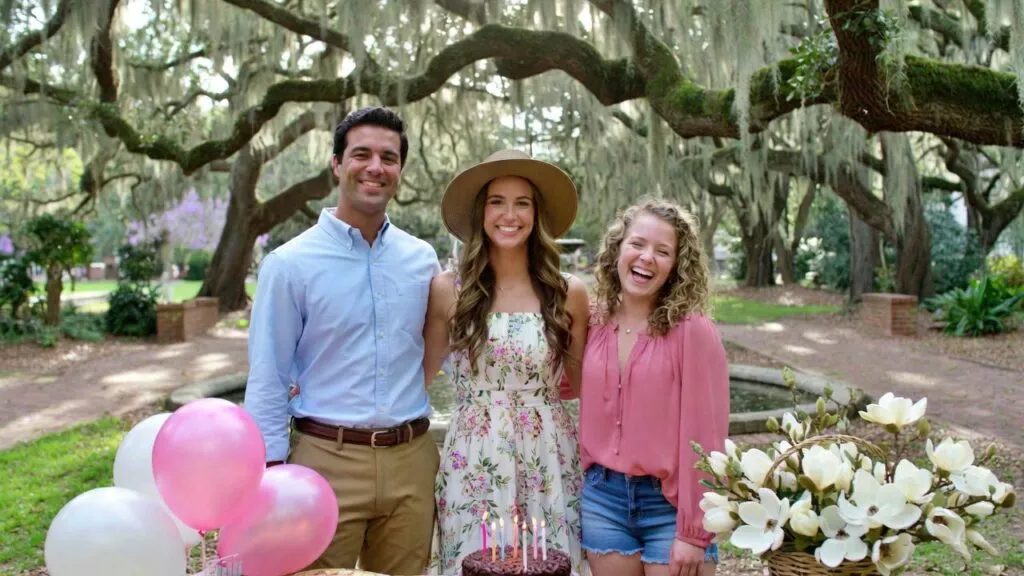
In the center of the lawn, a long picnic table was covered in a checkered cloth and ringed with folding chairs. Balloons bobbed gently in the breeze, tied to the corners. Michael stood off to the side for a moment, just taking it in. The air was filled with the hum of neighbors greeting one another, children chasing each other through the shade of the oaks, the scent of fried chicken and cornbread mixing with the sweetness of a chocolate cake in the center of the table.
It wasn’t just Lily’s birthday party. It was a celebration of something bigger, something they had all managed to protect.
He spotted Mrs. Bennett near the food table, her hands on her hips as she directed a couple of volunteers setting out lemonade. She caught his eye, smiled, and tipped her head toward the path. Michael followed her gaze.
Clara was walking toward him. She was wearing a simple cream dress, her hair loose around her shoulders. The months since the transplant had given her color again—soft roses in her cheeks, light in her eyes. Lily skipped ahead of her, paper crown already crooked, her hand clutching a small wrapped gift she insisted on giving later.
When Clara reached him, she paused just close enough that the sunlight caught the faint smile on her lips. “So,” she said softly. “You did it.”
“What’s that?” he asked, pretending not to know.
“You kept every promise.”
Michael let out a quiet laugh. “I told you I don’t make them lightly.”
Before she could answer, Lily came bounding back. “Michael! Come see the cake!”
She tugged his hand, pulling him toward the table. It was a simple chocolate cake with white frosting, but in the center stood a row of bright candles—seven this year. Michael reached into his pocket and pulled out the same matchbook he’d carried since the day they met.
Lily’s eyes widened. “You still have it.”
“Of course I do,” he said. “Some things are worth keeping.”
The crowd gathered as Michael lit the candles. Clara stood just behind Lily, her hand resting lightly on her daughter’s shoulder.
“Make your wish,” Michael said.
Lily squeezed her eyes shut, her lips moving silently, and then blew the candles out in one determined breath. Cheers rose from the crowd—the sound seemed to ripple outward, warm and unguarded.
As the cake was being cut, Paul from the neighborhood committee came over, a plate in hand. “Barrett,” he said. “I have to admit, I wasn’t sure about you. But you’ve done right by us. East Wharf’s still standing. Tenants are still in their homes. And people here don’t forget things like that.”
Michael shook his hand. “It wasn’t just me.” He glanced toward Clara and Lily. “I had the right reasons.”
Later, as the party thinned and the golden light of late afternoon spread across the park, Clara found him leaning against one of the oak trees.
“I’ve been thinking,” she began.
“That sounds dangerous,” he teased, borrowing her line from weeks ago.
She smiled. “Dangerous, maybe. But true.” She stepped closer. “You’ve done more than keep your promises, Michael. You’ve given us something I didn’t think we’d ever have again.”
“What’s that?”
“A future.”
He felt something shift inside him at the weight of her words. “It’s yours. Always.”
She was quiet for a moment, studying his face. “And what about you? You’ve spent all these months giving to us. What do you want?”
His eyes held hers. “I want to stay. With you. With her. Whatever that looks like.”
Her lips curved slowly into a smile—not the cautious kind she’d worn in those early days, but the open, certain kind that said the walls had finally come down.
“Then stay.”
The sun dipped lower, the park bathed in amber. Lily came running, her paper crown now just a strip of gold construction paper in her hand. She pressed it against Michael’s chest.
“You’re the knight who brings the light,” she said, as if it were the most obvious truth in the world.
Michael knelt so they were eye-level. “And you’re the little girl who taught me how.”
Clara stood beside them, the breeze catching the loose strands of her hair. And in that moment, with the lanterns beginning to glow along the edges of the park and the laughter of neighbors drifting through the trees, Michael realized the most beautiful love story wasn’t one he had found. It was one he had built, slowly, deliberately, with every choice to show up, to stay, to keep the light burning.
And as Clara’s hand found his, warm and steady in the cooling air, he knew this was only the beginning.