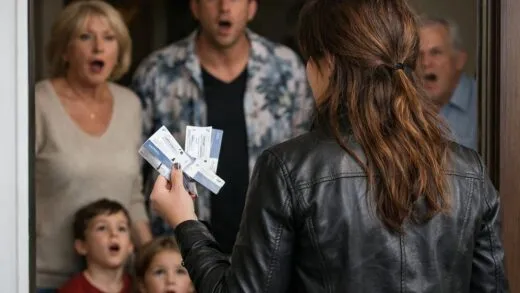
Meanwhile, the loan I had pulled my name from for my mother’s SUV finally processed. I got a notice from the bank confirming I was no longer attached to the liability.
Two days later, my cousin Chloe posted a story of my mother at the dealership. She was red-faced, arguing with a salesman while her luxury SUV sat behind her with a bright “REPO” sticker in the window.
The caption just said: “ROUGH WEEK FOR THE PARKERS.” I should have felt bad. I didn’t.
Around the same time, Lighthouse Living asked if I’d be open to a short-term consulting contract. They wanted me to help them implement the inventory systems and reporting structures I had designed in my head long before my parents ever let me put my name on anything.
I didn’t give them any of Parker & Co.’s secrets or client lists. I didn’t have to. The real value was in how I thought. The processes I built. Those were mine.
Within a month of working with them just a few hours a week, I watched from the sidelines as their online reviews skyrocketed. More shoppers in Texas started mentioning Lighthouse instead of Parker.
The thing my parents were most afraid of—losing status—was happening in slow motion.
The final straw, at least for them, came on a Sunday night. I was cleaning up after dinner when a notification popped up on my laptop from an old company Zoom account I still had access to.
The meeting title was “FAMILY MEETING.” Against my better judgment, I clicked join with the camera off.
Faces popped up one by one. My parents sat in their living room. Jason was in what looked like a cramped apartment. Monica held a glass of wine. They started talking over each other immediately.
My father blamed my mother for pushing too hard on the Hawaii trip. He claimed that if she had just gone to the wedding, none of this would have happened.
My mother started crying, insisting she was the real victim, that I had “stolen” her company. Jason shouted that they always bailed out my mistakes, but the one time he needed help, suddenly everyone was teaching him a lesson.
Not one of them, in that entire forty-minute call, said the word “sorry.” Not one of them said, “We hurt Lauren.”
I watched them claw at each other, each one trying to find a way to make this my fault while also begging for a solution only I could provide.
When my mother finally said, “She’ll come around, she always does, she’s soft,” something in me settled permanently.
No, I thought. Not anymore.
I closed the laptop. Outside, Seattle rain tapped against the windows. Inside, Danny wrapped an arm around my shoulders on the couch. We quietly watched a movie while my family’s world continued to crumble without me holding it up.
The thing about revenge, at least the kind I never planned on taking, is that it doesn’t arrive as one big explosion. It shows up in a hundred smaller ways, day after day.
It happens until even the people who swore they were untouchable start to realize the ground under them is gone.
A month after that family Zoom call, Parker & Co. closed its first store. Officially, the statement said it was a “strategic consolidation” in Arizona. Unofficially, I knew exactly what it was.
That location in Scottsdale had always been one of our more fragile ones. Without the safety nets I used to pull, without the quiet deals I used to make with vendors and landlords, they couldn’t keep up.
Photos started popping up online: a handwritten closing sign in the window, half-empty shelves, and a comment under the local news article that made my stomach flip.
“Didn’t their own daughter get married and they all went to Hawaii instead?” someone wrote. “Looks like karma.”
I hadn’t told that story publicly. But people talk. Employees talk. Nothing stays hidden when you treat everyone around you like they’re disposable.
The Yelp and Google reviews began to shift, slow at first, then in a wave. Mixed in with the usual complaints about shipping delays and paint colors were sharper critiques.
“Love their products, but can’t support a business that treats their own family like that.”
“Heard the owners ditched their daughter’s wedding for a vacation. Gross.”
My parents had always cared more about image than numbers. Watching that image crack was probably worse for them than any balance sheet.
Around that time, I received a call from a number tied to an old Houston bank. I almost let it go to voicemail, but curiosity won out. The woman on the line introduced herself as an officer managing several older trusts.
“Ms. Parker,” she said. “We’ve been trying to reach you about an account in the name of Eleanor Hayes.”
My grandmother. My mom’s mother. The only person on that side of the family who ever sat through my school plays and actually asked how I was doing instead of how my grades were. My chest tightened.
The officer explained that before she died, my grandmother had set up a trust—one my parents had never mentioned. It had a condition baked into it.
The principal wouldn’t be released until I had been financially independent from Parker & Co. for at least two consecutive years, with documented proof of income from work unrelated to the family business.
“According to the records,” the woman said, “you’ve met that condition. Your freelance income, your work with Lighthouse Living, and the sale of your shares all qualify. Your grandmother structured it this way so no one in your family could touch the funds except you.”
She paused. “She also left a note attached. Would you like me to read it?”
I sat at my kitchen table, fingers tight around my mug, and listened as she read my grandmother’s handwriting out loud. Ellie’s voice came back to me in every line.
She wrote about watching my mother become obsessed with status, about seeing me carry more and more of the load while getting less and less respect.
“If they ever choose themselves over you,” the note said, “I want you to have a way out that they can’t control. Use this to build a life that has nothing to do with their pride. Don’t look back unless it’s to be proud of how far you walked.”
By the time the banker finished, my eyes were wet. This was not money I took from my parents. This was money someone gave me precisely so I would never have to ask my parents for anything again.
Within a few months, that trust, combined with my own savings and the consulting income, became the down payment on a small Craftsman house in Portland, Oregon.
Danny and I signed the papers on a sunny afternoon, our names side-by-side, no Parkers anywhere in sight.
While we were walking through our new, empty living room, planning where to put a couch, my phone buzzed with a text from an old co-worker.
“They’re selling the Florida house,” it said, “and Jason’s working part-time at that coffee place on 3rd to make his car payments.”
Later, I heard my parents had to move out of their big Houston house into something smaller. They had quietly lost their seats on the local business boards they loved to brag about.
Invitations dried up. People stopped treating them like royalty and started treating them like what they really were: aging business owners who’d burned too many bridges, including the one to their own daughter.
I didn’t feel triumphant. It wasn’t fireworks. It was more like finally exhaling after holding my breath for way too long. They were living in the world they’d created without me propping it up. I was, for the first time, living in one I chose.
I wish I could say there was one perfect moment where everything tied up neatly, where I stood on a metaphorical mountaintop and declared myself healed. Real life doesn’t work like that. It came in quieter ways.
It was the first Saturday morning in Portland when I woke up to sunlight instead of my phone buzzing with some crisis my parents had created.
Danny was already in the kitchen, burning pancakes just a little, playing some old playlist from when we first started dating.