And beside the left front wheel, half-hidden by the shelf’s wooden frame, was a small electronic keypad. Four digits. A tiny LED light glowing red.
I stared at it. My pulse hammered in my ears. Cassandra had built a lock, a code. I thought of the receipts. The $100,000 payment to J. Morrison Construction. The basement renovation that had never been permitted, never inspected, never recorded anywhere but in Stephen’s files.
This was what that money had bought. Not a studio. A prison.
I wiped my palms on my jeans and entered the first code that came to mind: 1992. Cassandra’s birth year. The LED blinked red. Incorrect.
I tried 1997. Felicia’s birth year. Red again.
2006. The year Margaret died. Red.
I sat back on my heels, staring at the keypad. What number would Cassandra use? What number mattered enough to her to lock her sister away behind it?
And then I knew. 2016. The year Felicia disappeared.
I entered the digits slowly. The LED turned green. A soft click sounded from inside the bookshelf, and the metal pins released.
The shelf rolled forward an inch, smooth as silk. I grabbed the edge and pulled. It slid aside easily, revealing a narrow gap in the wall behind it. And there, set into the drywall, was a steel door. Gray, industrial, with a deadbolt lock mounted on the outside.
The lock was open.
I stood there, my hand hovering over the doorknob, unable to move. My chest felt tight. My vision blurred at the edges.
From the other side of the door, I heard it: a soft, shallow breath. Someone was in there.
I leaned closer, pressing my ear against the cold metal. The breathing was faint, careful, as if whoever was inside was trying not to make a sound.
“Felicia,” I whispered.
The breathing stopped. Five seconds of silence. Then a sound so quiet I almost missed it. A sharp intake of breath, a sob caught halfway in a throat.
And then a voice, weak, hoarse, trembling.
“Dad?”
My knees buckled. I braced myself against the doorframe, my hand shaking as I gripped the handle.
“Felicia,” my voice cracked. “Baby, is that you?”
A sob broke through the door, small, broken, full of eight years of pain.
“Dad. You came. I knew… I knew you would.”
I reached for the deadbolt, ready to throw it open, but then I heard it. Footsteps. Upstairs. Slow, deliberate. Moving toward the staircase.
Cassandra was awake.
I froze, my hand still on the lock. If I opened this door now, if Cassandra came down and found me here, she would lie. She would twist the story. She would call the police and say I’d broken into her studio, that I was delusional, that I was dangerous.
And I couldn’t risk that. Not when I was this close.
I pressed my forehead against the door. “Felicia,” I whispered urgently. “I’m going to get help. I’m calling the police right now. I’m going to get you out of here. I promise.”
“Please,” her voice was barely audible. “Please don’t leave me alone again.”
“I won’t,” I said, tears streaming down my face. “I’m not leaving. I’m just going upstairs to call. You hear me? I’m getting you out tonight.”
She didn’t answer. Just cried.
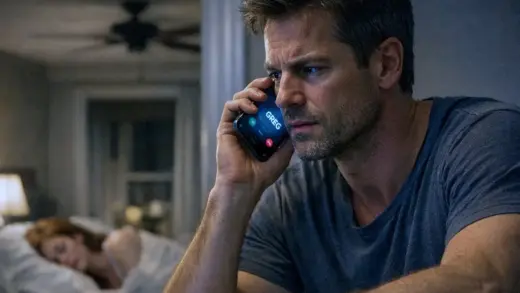
I pulled out my phone with shaking hands and dialed 9-1-1. The operator answered on the second ring.
“9-1-1, what’s your emergency?”
“My name is Christopher Hayes. I’m at 2847 Ashford Lane, Minneapolis. My daughter… she’s been held in my basement for eight years. She’s alive. I need officers here immediately.”
“Sir, can you confirm your address?”
“2847 Ashford Lane. Please, she’s locked in a room. I can hear her. She’s alive.”
“Officers are on the way, sir. Stay on the line with me.”
I nodded, even though she couldn’t see me. My hand was still pressed against the steel door. On the other side, Felicia had gone quiet again.
“Felicia,” I whispered.
“I’m here,” she said softly.
“Help is coming. Okay?”
I closed my eyes and leaned my weight against the door, my palm flat against the cold metal, as if I could reach through it and touch her.
“Dad,” she said after a moment.
“Yeah, baby?”
“You found me.”
My chest tightened. I couldn’t speak. I just nodded, tears running down my face, my hand pressed to the door like a lifeline.
I was still standing in the basement, one hand pressed against the steel door, when I heard the doorbell ring upstairs. My first thought was, The police can’t be here this fast. My second thought was, Cassandra is awake.
But when I raced up the stairs and looked through the peephole, I saw Derek Hamilton standing on the porch, his face pale and haunted. I yanked the door open.
“Derek, what are you doing here?”
He looked past me into the house, his eyes darting left and right. He was thin, thinner than I remembered, and his hands shook as he clutched a worn messenger bag.
“I heard you went to see a lawyer,” he said, his voice low and urgent. “I heard you’ve been asking questions. Mr. Hayes, I need to tell you everything before the police get here. Please.”
I heard it then, the faint wail of sirens in the distance getting closer. Derek heard it too.
“I’ve got maybe ten minutes,” he said. “Maybe less. Please, let me explain.”
I pulled him inside and shut the door. Derek collapsed into the armchair in the living room, his whole body trembling. I stood over him, my fists clenched, every instinct telling me to throw him out. But I didn’t. I needed to hear this.
“Eight years ago,” Derek began, his voice shaking, “I made the worst mistake of my life. Cassandra asked me to help her with something. She said it was just a prank, a way to teach Felicia a lesson about humility. I was stupid enough to believe her.”
“What did you do?” I asked, my voice cold.
Derek looked up at me, his eyes red-rimmed. “I owed $45,000. Gambling debts. Cassandra knew about it. She said if I helped her, she’d pay it all off.”
I said nothing, just waited.
“The plan was to stage a fake car accident,” Derek continued. “To scare Felicia, make her think she’d hit someone. Cassandra said it would only last one night, that we’d tell her the truth the next morning. But we never did.”
He pulled a USB drive from his bag and set it on the coffee table between us. “It’s all on here. The recordings, the messages, the bank transfers. Cassandra admitting the accident was fake. My confession. Everything.”
I stared at the drive. My hands were shaking. “Tell me what happened that night,” I said.
Derek took a shaky breath. “I rented an old Honda Civic, bought a mannequin and fake blood from a costume shop. Cassandra had already set everything up. She’d been texting Felicia from a burner phone pretending to be a friend, asking her to meet up on Oakwood Avenue. It’s a back road, no cameras, no traffic.”
I felt sick.
“Felicia drove out there around midnight,” Derek said. “I put the mannequin in the road. She hit it. She panicked. Cassandra showed up a minute later and told her she’d killed someone, told her his name was Thomas Whitmore.”
“I showed up after that, pretending to be an off-duty cop. I took her statement, made her think she was going to prison. And then…”
“And then?” I asked, my voice barely a whisper.
“Then Cassandra brought her here. Told her she’d help her hide until things blew over. But things never blew over. Because there was no Thomas Whitmore. There was no investigation. It was all fake.”
Derek’s voice broke. “The next day, Cassandra told me the plan had changed. She said Felicia was too talented to let go, that her designs could make us both rich. She promised it would only be a few months.”
“It’s been eight years,” I said.
“I know.” Derek buried his face in his hands. “I know.”
He told me the rest. How Cassandra had paid his debt in small installments—$500 here, $1,000 there—never all at once, always keeping him dependent. How she’d threatened him: “If you say anything, you’ll go to prison too.” How she’d isolated him, cut him off from his family.
“She made me believe we were protecting Felicia,” Derek said, his voice hollow. “That if the truth came out, Felicia would go to prison for killing that man. It sounds insane now, but back then, I believed her.”
Three years ago, Derek had started to doubt. He’d looked up the name Thomas Whitmore and found nothing. He’d seen Felicia once through a crack in the basement door—thin, hollow-eyed, her hair long and matted—and the guilt had nearly destroyed him. So he’d started recording, secretly: Cassandra’s admissions, her threats, her plans. He’d saved it all on the USB drive and hidden it in a storage locker across town.
“Last week,” Derek said, “I saw Cassandra at a cafe. She was laughing with a client, acting like everything was normal. And I realized she’s never going to stop. She’s going to keep Felicia down there forever unless someone stops her.”
The sirens were louder now. Close. Derek stood.
“I’m turning myself in tonight. I’ll tell the police everything. I deserve whatever sentence I get. But please, Mr. Hayes, save Felicia. Don’t let my cowardice ruin her life any more than it already has.”
I looked at him, this thin, broken man who’d helped lock my daughter away for eight years, and I didn’t know what to feel. Rage. Pity. Disgust.
But I took the USB drive. “You’re doing the right thing now,” I said quietly. “That counts for something.”
Derek shook his head. “It doesn’t make up for eight years.”
Through the window, I saw the red and blue lights of a police cruiser pulling up to the curb. Derek saw them too. He took a deep breath and walked toward the door.
“Tell Felicia,” he said without turning around, “that I’m sorry.”
Twenty minutes after Derek walked out my front door and into a police car, Detective Linda Bennett stood in my basement, staring at the steel door behind the bookshelf.
“Mr. Hayes,” she said quietly. “I need you to prepare yourself for what we’re about to find in there.”
I nodded, but I wasn’t listening. I was already prepared. I’d been preparing for eight years.
Detective Bennett was in her mid-forties with sharp eyes and a calm, steady voice. Officer Ryan Torres stood beside her, younger, early thirties, with a hand resting on his radio. Two more officers flanked the entrance to the studio, their faces grim.
I’d led them down here as soon as they arrived, showed them the bookshelf, the keypad, the steel door. Then Cassandra had woken up. She came flying down the stairs in her pajamas, her hair wild, her eyes wide with panic.
“Dad? What’s going on? Why are the police here?”
Detective Bennett turned to face her. “Ms. Hayes, we have a warrant to search this property based on credible evidence of unlawful imprisonment.”
Cassandra’s face drained of color. “That’s ridiculous. There’s nothing down here except my studio.”
“Then you won’t mind if we take a look,” Officer Torres said.
Cassandra’s jaw tightened. “I want a lawyer.”
“That is your right,” Detective Bennett said. “But we’re going in now.”
Officer Torres approached the keypad. I’d already told them the code: 2016. He entered it slowly. The LED turned green. The bookshelf slid open with a soft click. Behind it, the steel door stood slightly ajar; I’d unlocked it earlier when I’d spoken to Felicia through the metal.
Detective Bennett pulled on a pair of gloves and pushed the door open. The smell hit us first. Damp. Stale. Disinfectant mixed with the unmistakable scent of a space that had been lived in but never aired out.
Detective Bennett shone her flashlight into the room. It was about fifteen by twelve feet. On the left side, a narrow twin bed with a thin blanket and a single pillow. On the right, a small desk, a desk lamp, paper, and pencils scattered across the surface. In the corner, a portable toilet, a tiny sink, and a basic plumbing setup.
The walls were completely covered with drawings. Hundreds of them. Taped, pinned, layered over one another. Landscapes, birds, trees, and faces. One face over and over: my face.
And on the bed, curled up against the wall with one arm shielding her eyes from the sudden light, was a woman. Thin, too thin. Her brown hair was long and tangled, cascading over her shoulders. Her skin was pale, almost translucent.
But I knew her. God help me, I knew her.
Detective Bennett stepped inside first. “Hello?” she said gently. “My name is Detective Bennett. You’re safe now. We’re here to help you.”
The woman lowered her arm, slowly blinking against the light. Her eyes scanned the doorway, the officers, the strangers. And then they landed on me.
I stepped forward, my legs shaking. It was Felicia. Eight years had changed her. She’d been nineteen the last time I saw her—healthy, bright-eyed, full of life. Now she was twenty-seven. She weighed maybe ninety-five pounds. Her cheekbones jutted out sharply. Her eyes were sunken, ringed with shadows.
But it was her. My daughter.
“Dad,” she whispered.
I couldn’t speak. I just ran to her, dropped to my knees beside the bed, and wrapped my arms around her. She felt so small, so fragile.
“Felicia,” I choked out. “Oh God, Felicia. I’m so sorry. I’m so sorry.”
She clung to me, her whole body trembling. “You came,” she whispered, her voice breaking. “I knew you would. I kept drawing you, and I knew. I knew someday you’d find me.”
I held her tighter, sobbing into her shoulder. I couldn’t stop. I couldn’t breathe. All I could do was hold on.
Behind me, Detective Bennett turned away discreetly, wiping her eyes. Out in the hallway, Cassandra stood frozen, her face white as paper, her mouth open but no sound coming out.
The paramedics arrived ten minutes later with a stretcher. Felicia was too weak to walk; her legs had atrophied from years of limited movement. Her hands shook when she tried to stand.
Detective Bennett knelt beside her. “Felicia, we need to take you to the hospital. Is that okay?”
Felicia nodded, but her eyes never left me. “Dad, don’t leave me.”
I gripped her hand. “I’m not going anywhere. I’ll be right there with you. Every step.”
The paramedics lifted her gently onto the stretcher and carried her out of the room. As we passed through the studio, Felicia’s gaze shifted to Cassandra.
Cassandra stood against the wall, her arms wrapped around herself, her face streaked with tears. Felicia stared at her for a long moment. Then, in a voice so quiet I almost didn’t hear it, she said, “Why, Cassie? Why did you do this?”
Cassandra didn’t answer. She just looked at the floor and sobbed.
Officer Torres stepped forward, pulling out a pair of handcuffs. “Cassandra Hayes, you’re under arrest for unlawful imprisonment, kidnapping, and conspiracy. You have the right to remain silent.”
Cassandra didn’t resist. She let them cuff her, let them lead her up the stairs. She didn’t say a word.
I followed Felicia to the ambulance. The paramedics loaded her in, and I climbed in beside her. As the doors closed, I looked back at the house—the house I’d lived in for ten years, never knowing my daughter was locked in a room beneath my feet.
Felicia squeezed my hand. “Dad.”
I looked down at her. Her eyes were hollow, haunted, but they were still hers.
“You found me,” she whispered.
I nodded, tears streaming down my face. “I did.”
“Did you ever stop looking?”
The question hit me like a punch to the gut. The truth was, I had. I’d stopped years ago. I’d given up hope. I’d let her go.
But I couldn’t tell her that. Not now.
“Never,” I lied. “I never stopped.”
She closed her eyes and smiled just a little, squeezing my hand again. The ambulance pulled away from the curb, lights flashing, siren silent. I held my daughter’s hand and thought, I found her. But will she ever forgive me for taking eight years to do it?
At the hospital, beneath the harsh, fluorescent lights of the examination room, Felicia told us about the night that changed everything. Detective Bennett sat beside me, taking notes, while a nurse monitored Felicia’s vitals. My daughter’s voice was soft, hesitant, as if speaking the truth aloud might make the nightmare real all over again.
The room smelled like disinfectant and sterile gauze. Machines beeped softly. An IV drip fed fluids into Felicia’s arm. The doctor had already given us the preliminary diagnosis: severe malnutrition, acute vitamin D deficiency, muscle atrophy. She’d need weeks, maybe months, of monitored recovery.
But right now, she needed to talk. I held her hand.
Detective Bennett leaned forward, her recorder running. “Felicia,” she said gently, “I know this is hard, but we need to understand what happened eight years ago. Can you tell me about that night?”
Felicia took a shaky breath. “It was March 15th, 2016. I was nineteen. I got a voice message around 11:45 PM,” Felicia said, her eyes fixed on the ceiling. “It was from Sophie Morgan. At least, I thought it was Sophie. She was my best friend back then.”
“The message said, ‘Felicia, I need help. Meet me at Riverside Park. It’s urgent.’”
I glanced at Detective Bennett. She scribbled something in her notebook.
“I didn’t think twice,” Felicia continued. “Sophie sounded scared, so I grabbed my keys and drove out. I had a white Toyota Corolla. I took Oakwood Avenue. It’s a shortcut to the park. The street was dark—no streetlights, no traffic.”
Her voice dropped to a whisper. “And then I saw him.”
“Saw who?” Detective Bennett asked.
“A man. He ran out into the road. I slammed on the brakes, but I heard this… this sound. A thud. I got out of the car and…” Her voice cracked. “There was a man lying on the pavement. Blood everywhere. I panicked. I was about to call 9-1-1 when Cassandra showed up.”
I froze. “Cassandra was there?”
Felicia nodded, tears streaming down my face. “She came out of nowhere. She said, ‘Felicia, oh my God, what did you do?’ I told her I didn’t see him, that he just appeared. I said I had to call for help, but she stopped me.”
“What did she say?” Detective Bennett asked.
“She said if I called the police, I’d go to prison. She said it was vehicular manslaughter. That I could get twenty years.” Felicia’s hands trembled. “She checked the man. She said he was dead. She said there was nothing we could do. She told me to go home and let her handle it.”
I felt sick.
“And you believed her?”
“I was in shock, Dad. I couldn’t think. I just… I trusted her.”
“The next morning,” Felicia said, “Cassandra showed me a news article. It was on some website I’d never heard of. It said there’d been a fatal hit-and-run on Oakwood Avenue. There was a photo of the victim. His name was Thomas Whitmore. Forty-two years old. Civil engineer. He had a wife and two kids.”
Her voice broke. “I thought I’d killed a father.”
I squeezed her hand. “You didn’t kill anyone, Felicia.”
“I know that now,” she whispered. “But for eight years, I believed I did.”
Detective Bennett leaned forward. “What happened after you saw the article?”
“Cassandra said I needed to hide. Just for a little while until she could figure things out. And then Derek showed up.”
“Derek Hamilton,” Felicia nodded. “He was wearing a police uniform. He said he was there to take my statement. He asked me all these questions: what time I was driving, whether I’d been drinking. I told him I hadn’t. But he said a toxicology report would determine that. He said I was facing fifteen to twenty-five years in prison.”
She looked at me, her eyes hollow. “I was so scared, Dad. I didn’t know what to do. Cassandra said she’d find me a lawyer. She said I just needed to stay in the basement for a few days until things blew over.”
“But it wasn’t a few days,” I said quietly.
“No,” Felicia whispered. “It was eight years.”
Detective Bennett set down her pen. “Felicia, I need to check something. Can you give me a few minutes?”
She stepped out into the hallway and made a call. I could hear her voice through the door, low and urgent. Five minutes later, she came back in. Her face was unreadable.
“Felicia,” she said. “I just ran a search for Thomas Whitmore. Forty-two years old, civil engineer, Minneapolis area, 2016.”
Felicia tensed.
“There’s no record of a death by that name in Minneapolis in 2016. So I expanded the search to Wisconsin and Iowa.” She paused. “I found a Thomas Whitmore. Forty-two years old. Civil engineer. Lives in Madison, Wisconsin.”
Felicia stared at her. “Lives?”
“He’s alive, Felicia. He’s never been to Minneapolis, and he’s never been in a car accident.”
The room went silent. The only sound was the beeping of the machines. Detective Bennett pulled out her phone.
“I’m going to call him right now. I want you to hear this.”
She dialed the number and put the call on speaker. The phone rang three times. Then a groggy male voice answered.
“Hello?”
“Mr. Whitmore? This is Detective Linda Bennett with the Minneapolis Police Department. I need to ask you about an incident in 2016.”
“In 2016?” The man sounded confused. “I’m sorry, Detective. I don’t know what you’re talking about.”
“Were you involved in a traffic accident on Oakwood Avenue in Minneapolis on March 15th, 2016?”
“A traffic accident? Ma’am, I’ve never even been to Minneapolis. I’ve lived in Madison my whole life.”
“Can you confirm that you’re alive and well, Mr. Whitmore?”
The man laughed, nervous, bewildered. “As far as I know, yeah. Detective, what’s this about?”