Felicia’s hand flew to her mouth. A sob tore out of her throat. “He’s alive. He was never… He never died.”
I pulled her into my arms. “It was all a lie, baby. All of it.”
Detective Bennett ended the call. “Felicia, you didn’t kill anyone. There was no victim. Your sister staged the entire thing.”
Felicia buried her face in my shoulder and wept. “Eight years,” she choked out. “She let me think I was a murderer for eight years.”
The next day, after Felicia had been admitted for observation and had finally fallen into a deep, exhausted sleep, Detective Bennett called me down to the station.
“We’ve been digging into the evidence, Mr. Hayes,” she said over the phone. “And we found something else. Something that proves this wasn’t a spur-of-the-moment decision.”
I drove to the Minneapolis Police Department, a four-story building downtown, and followed her to a conference room on the second floor. The table was covered with files, photographs, and documents. Officer Torres was there, along with a bespectacled man in his fifties who introduced himself as Dr. Alan Pierce, a forensic document examiner.
“We’ve been tracing Felicia’s car,” Detective Bennett said without preamble. “The 2012 Toyota Corolla. White. Minnesota plates. And what we found… It’s chilling.”
She spread three documents across the table. Dr. Pierce leaned forward, pointing to the first page.
“This is the vehicle registration for a 2012 Toyota Corolla, license plate ABC4729. Registered owner: Felicia Hayes.”
He slid the second document forward. “This is a bill of sale dated March 28, 2016. Thirteen days after the staged accident. The car was sold to Iowa Auto Exchange in Des Moines for $3,500 cash.”
“And here,” he tapped the bottom of the page, “is the seller’s signature. Felicia Hayes.”
I stared at the signature. It looked like Felicia’s handwriting. The looping F, the slant of the H.
Dr. Pierce placed a third document beside the bill of sale—a photocopy of Felicia’s driver’s license and an old lease agreement she’d signed in college.
“This is Felicia’s real signature,” he said. “Now look closely.”
He pulled out a magnifying glass and handed it to me. I leaned over the bill of sale, squinting through the lens. At first, I saw nothing. But then I noticed it: tiny hesitations in the ink. Micro-tremors where the pen had paused, lifted, repositioned. The strokes weren’t fluid. They were copied.
“This signature is a forgery,” Dr. Pierce said. “A good one. But under magnification, you can see the stopping points—places where the forger checked the original and then continued. This was not written by Felicia Hayes.”
I set the magnifying glass down, my hands shaking. “Cassandra.”
Detective Bennett nodded. “We contacted Iowa Auto Exchange. They confirmed that a woman in her mid-twenties sold the car. Cash transaction. They still had security footage from 2016.”
She clicked a button on the laptop in front of her. A grainy video filled the screen. A woman walked into the dealership. She wore a baseball cap pulled low, oversized sunglasses, and a medical mask. The timestamp read March 28, 2016, 2:47 PM.
I couldn’t see her face, but I recognized her build, her walk, the way she carried herself. It was Cassandra. She signed the paperwork, accepted a stack of cash, and left. The whole transaction took eight minutes.
Officer Torres spoke up. “We also checked with the DMV. Felicia never reported the car stolen.”
“You never reported it missing, either,” Bennett added.
I shook my head slowly. “Because Cassandra told me Felicia had taken the car and left. She said Felicia was going to California. To start over.”
“And you believed her,” Detective Bennett said quietly.
“I did.” My voice was hollow. “I thought Felicia had run away.”
Dr. Pierce cleared his throat. “Mr. Hayes, there’s one more thing. We found a partial fingerprint on the bill of sale, underneath the forged signature. It’s Cassandra’s. She tried to wipe it clean, but she missed a spot.”
I stared at the document. “She planned this. Before the accident even happened, she knew she was going to get rid of the car.”
“That’s what we believe,” Detective Bennett said. “Selling the car this quickly—within two weeks—suggests she wanted to eliminate any evidence that Felicia was still in the area. This wasn’t impulsive, Mr. Hayes. This was premeditated.”
I sank into the chair, my legs suddenly too weak to hold me.
“She knew exactly what she was doing. She staged the accident, locked Felicia in the basement, sold her car, and made it look like Felicia had run away.”
“Yes,” Detective Bennett said.
I thought back to those first few weeks after Felicia disappeared. Cassandra had seemed so worried. She’d cried. She’d helped me file the missing persons report. She’d called Felicia’s friends, asking if anyone had heard from her. All lies.
“She told me Felicia just needed space,” I said, my voice breaking. “She said Felicia would call when she was ready. And I believed her. For eight years, I believed her.”
Detective Bennett sat down across from me. “Mr. Hayes, Cassandra is your daughter. You trusted her. That’s not blindness. That’s love. And she exploited it.”
I looked up at her. “What kind of person does this to their own sister?”
She didn’t answer. Because there was no answer that made sense.
That weekend, Riley called me with a name: Marcus Grant, an audio forensic specialist.
“Mr. Hayes,” she said over the phone, “I think I know how Cassandra convinced everyone that Felicia was still in touch after she disappeared. And you’re not going to believe it.”
I met them Monday afternoon at Riley’s office, Digital Arts Studio, a sleek glass building in downtown Minneapolis. The conference room was small, lined with monitors and audio equipment. Riley sat across from me, her laptop open. Beside her was a man in his mid-thirties with sandy hair and sharp, analytical eyes.
“Mr. Hayes, this is Marcus Grant,” Riley said. “He used to work for the FBI as an audio forensic analyst.”
Marcus shook my hand firmly. “Ms. Summers brought me some voice messages she received years ago—messages she believed were from Felicia Hayes. She asked me to analyze them. What I found is deeply concerning.”
He opened a folder on the laptop and clicked the first file. A voice filled the room. Soft, familiar, achingly real.
“Riley, it’s me. I’m okay. I just need some time away. Don’t worry about me. I’ll call when I’m ready. Love you.”
I froze. “That’s Felicia.”
Riley’s eyes were red-rimmed. “That’s what I thought too.”
Marcus played a second message. “Riley, I’m still doing fine. I’m somewhere new, starting over. Don’t try to find me, okay? I need this space. Take care.”
Then a third, this one sent to my phone in August 2017. “Dad, I love you. I’m safe. I just need to figure things out on my own. I’ll come home someday. I hope you understand.”
My throat tightened. I’d listened to that message dozens of times. I’d clung to it. It had been my proof that Felicia was alive, that she was okay, that she’d chosen to leave.
“How is this not her?” I whispered.
Marcus leaned forward. “Because it’s not a person, Mr. Hayes. Watch this.”
He replayed the first message, this time displaying a waveform on the screen—a jagged line of peaks and valleys representing the sound. Red markers dotted the waveform at irregular intervals.
“These red points indicate artificial synthesis,” Marcus said. “This voice was created using AI voice cloning technology.”
I stared at the screen. “AI? In 2016?”
“Yes,” Marcus said. “Voice cloning technology was emerging around 2015 and 2016. It wasn’t as sophisticated as it is now, but it was good enough to fool people who knew the voice well, especially over a phone or voicemail where audio quality is already compressed.”
He pulled up another window. “To clone a voice, you need about five to ten minutes of clean audio samples. The software analyzes the pitch, tone, cadence, and speech patterns, then generates new speech that sounds identical to the original speaker.”
Riley spoke up. “I found old videos on Cassandra’s laptop. Family gatherings, birthday parties. Cassandra had hours of Felicia’s voice on file.”
Marcus clicked through to a comparison screen. On one side was the waveform of the voicemail. On the other was a waveform from an old video of Felicia speaking at a family dinner.
“The pitch and tone match almost perfectly,” Marcus said. “But look here.”
He zoomed in on a segment of the voicemail. “See these micro-pauses? They’re slightly longer than natural human speech. Fractions of a second, but consistent. And here,” he pointed to another section, “the breathing doesn’t align with the words. A real person inhales and exhales at predictable points. This doesn’t.”
He played the voicemail again, this time highlighting the glitches. I heard it now: tiny, almost imperceptible stutters. A breath that came half a beat too late. A word that sounded just slightly too smooth.
“To the average listener, it sounds real,” Marcus said. “But under analysis, it’s clearly synthetic.”
I sank back in my chair, my head spinning. “You’re telling me that every message I thought was from my daughter was fake?”
“I analyzed five messages sent over three years,” Marcus said. “All of them show signs of AI generation.”
Riley wiped her eyes. “I believed her, Mr. Hayes. Every time I got a message from Felicia, I thought she was okay. I stopped searching because I thought that’s what she wanted.”
I looked at Marcus. “What kind of skill does it take to do this?”
“In 2016, basic technical knowledge. There were a few apps and online services that offered voice cloning. Anyone with access to audio samples and a laptop could do it.” He paused. “But the level of deception here—sending messages over three years, timing them strategically, making sure they sounded natural—that takes planning. Whoever did this knew exactly what they were doing.”
I thought back. Cassandra had always been good with technology. She’d majored in computer science her first year of college before switching to jewelry design. She’d helped me set up my phone. She’d fixed Riley’s laptop once when it crashed.
“She had the skills,” I said quietly. “And she had the motive.”
Riley leaned forward. “Mr. Hayes, there’s something else. I went through Cassandra’s email archives. Detective Bennett gave me access as part of the investigation. I found receipts for a voice synthesis service called VoiceForge. She subscribed in April 2016.”
“One month after Felicia disappeared,” Marcus nodded. “VoiceForge was one of the early platforms. It’s been shut down since then, but in 2016, it was one of the most accessible tools for voice cloning.”
I stared at the screen, at the red markers scattered across the audio file like tiny wounds. Marcus played the message one more time, highlighting the micro-errors in the waveform—pauses that lasted a fraction of a second longer than they should, breaths that didn’t align with the words.
“This isn’t your daughter, Mr. Hayes,” he said gently. “This is a machine.”
For three years, I’d listened to these messages and felt relief. Relief that Felicia was alive. Relief that she was okay. Relief that she’d chosen to leave. I’d stopped searching because I thought it was what she wanted.
But all along, it was Cassandra sitting in her studio, uploading audio files, pressing send, watching me believe the lie.
Tuesday morning, Detective Bennett called.
“We found the contractor who built that room, Mr. Hayes,” she said. Her voice was tight with barely contained anger. “His name is Jake Morrison from Des Moines, Iowa. He flew in this morning to cooperate with the investigation. Do you want to hear what he has to say?”
An hour later, I sat behind a one-way mirror at the police station, watching a middle-aged man with rough hands and a guilty conscience fidget in the interrogation room. Officer Torres stood beside me, arms crossed.
“That’s him,” he said quietly. “Jake Morrison, the $100,000 contractor.”
I stared through the glass. Jake Morrison looked to be in his early fifties: graying hair, weathered face, a faded flannel shirt, his hands wrapped around a Styrofoam cup of coffee, knuckles white.
Detective Bennett sat across from him, a recorder between them on the table. “Mr. Morrison,” she said, “thank you for coming in voluntarily. Can you tell me about the work you did for Cassandra Hayes in 2016?”
Jake nodded slowly. “Yes, ma’am. I’ve… I’ve been carrying this guilt for eight years.”
“It was March of 2016,” Jake began, his voice rough. “I got a message through Craigslist. Someone was looking for a contractor from out of state—specifically not from Minnesota. The job was… unusual.”
“Unusual how?” Detective Bennett asked.
“She wanted a hidden room built in a basement. Soundproofed, with a lock on the outside.” He swallowed hard. “She said it was a wine cellar, a special one. She said she needed privacy and strict temperature control. She was very specific about the lock. Said her father was elderly and sometimes wandered, and she needed to keep him safe from the valuables inside.”
I felt my stomach turn.
“She offered $15,000. Cash. No paperwork. No permits. I was supposed to work only when the homeowner was out of town. She said he traveled a lot for work—pilots, she said—and she wanted it to be a surprise.”
Detective Bennett leaned forward. “And you didn’t find any of that suspicious?”
Jake’s face crumpled. “Of course I did. But my wife… she was sick. Stage 4 cancer. The medical bills were burying us. $15,000, cash, no taxes. I didn’t ask questions I should have asked.”
He set the coffee cup down, his hands shaking. “I told myself it was just a rich person’s weird hobby. A fancy wine cellar. That’s what I wanted to believe.”
“Walk me through the construction,” Detective Bennett said.
Jake took a breath. “It took three weeks. The homeowner, Mr. Hayes, was in Europe on a long flight rotation. Cassandra gave me access to the house. I built a false drywall wall to create a hidden space behind it. About fifteen by twelve feet. I did the math. One hundred and eighty square feet.”
The same measurements Officer Torres had confirmed when we found Felicia.
“I installed a steel door with a deadbolt lock that could only be opened from the outside,” Jake continued. “I set up a basic ventilation system tied into the house’s HVAC so it wouldn’t be noticed. I installed a portable toilet, a small sink—plumbing that connected to the main lines. Soundproofing foam on the walls and ceiling. She wanted it completely silent.”
“And you still thought it was a wine cellar?” Detective Bennett’s voice was cold.
Jake looked down. “No. By the end, I knew it wasn’t. But I’d already taken the money. My wife was dying. And I… I convinced myself it wasn’t my business.”
“When did you realize what you’d built?” Detective Bennett asked.
“2020,” Jake said quietly. “I saw a news article about a missing girl, Felicia Hayes, Minneapolis. I recognized the last name. I started wondering if… but I had no proof. And I was terrified. Terrified that if I said something, I’d be arrested as an accomplice.”
He looked up at Detective Bennett, his eyes red. “Last week, I saw it on CNN. They found her. Alive. In a basement room. And I knew. I knew it was the room I built.”
“So you called us.”
“Yes, ma’am. I couldn’t live with it anymore.”
There was a long silence. Then Detective Bennett stood. “Wait here.”
She stepped out of the room and gestured to me through the glass. “Mr. Hayes, do you want to speak with him?”
I didn’t know if I did, but I nodded. When I walked into the interrogation room, Jake Morrison looked up at me, and his face went pale.
“Mr. Hayes,” he said, his voice breaking. “I’m so sorry. If I’d known…”
I sat down across from him. My hands were shaking. I wanted to scream at him. I wanted to ask him how he could build a prison for a human being and walk away. But when I looked at him, all I saw was another person Cassandra had used.
“You built the room that held my daughter for eight years,” I said quietly.
Jake’s eyes filled with tears. “I know. And I’ll regret it for the rest of my life. I should have asked more questions. I should have reported it. But I was desperate, and I… I failed.”
“Your wife,” I said. “Is she…?”
“She passed. Six months after I finished the job.” His voice was hollow. “The medical bills bankrupted us anyway. All that money, and it didn’t save her. It just made me a monster.”
I didn’t know what to say. Part of me hated him. Part of me understood.
“Mr. Morrison,” Detective Bennett said from the doorway. “You’ll be charged as an accessory. However, your cooperation will be taken into account.”
Jake nodded. “I’ll take whatever sentence I deserve.”
I stood to leave. At the door, I turned back.
“If you’d asked one more question,” I said. “Just one. My daughter might have been free seven years and eleven months sooner.”
Two days later, Detective Bennett called and asked me to meet her at a quiet coffee shop a few blocks from my house.
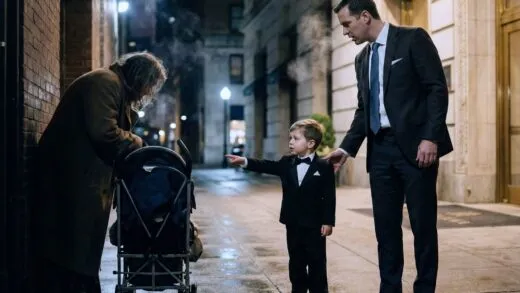
“Someone came into the station this morning,” she said over the phone. “His name is Eddie. He says he witnessed the staged accident eight years ago on Oakwood Avenue. Mr. Hayes, I think you need to hear this.”
I arrived at the Corner Cafe twenty minutes later. Detective Bennett was sitting in a booth at the back, a file folder and a cup of coffee in front of her. She looked tired.
“Eddie came in voluntarily this morning,” she said as I slid into the seat across from her. “He’s been unhoused for the past decade, but he’s been sober for three months now. He said it was time to tell the truth.”
“So who is Eddie?” I asked.
“He’s about fifty. Homeless back in 2016. He used to sleep in an abandoned building near Oakwood Avenue.” She opened the folder and pulled out a handwritten statement. “He saw the whole thing. The staged accident, the mannequin, everything. But he never reported it.”
“Why not?”
She slid the folder toward me. “Let me tell you what he said.”
Detective Bennett leaned back and began. “Eddie was sleeping in an old warehouse about 150 feet from Oakwood Avenue on the night of March 15th, 2016. Around 12:15 in the morning, he woke up because he heard a car engine.”
I listened, my hands folded on the table.
“He looked out a broken window and saw a gray Honda Civic parked on the side of the road. Lights off. A man got out. Eddie described him as mid-thirties, average build. The man opened the trunk and pulled something out. Eddie said it looked like a person at first, but it moved weird. Stiff, like a doll.”
My chest tightened.
“The man dragged it into the middle of the road and laid it down. Then he poured something red on the pavement around it. Eddie said it looked like blood, but he could tell it wasn’t real—too thick, too bright. A woman stood nearby watching. She didn’t help. Just watched.”
“Cassandra,” I said quietly.
Detective Bennett nodded. “Eddie didn’t know her name at the time, but his description matches. About five minutes later, a white Toyota Corolla came down the road. It braked hard. The driver got out—a young woman, early twenties. She looked terrified. The woman who’d been watching ran over to her, and they talked for a few minutes. Then the man picked up the mannequin, put it back in the trunk of the Honda, and drove away.”
I stared at her. “He saw the whole setup.”
“Yes. He knew it was fake. He watched them stage it from start to finish.”
“So why didn’t he come forward?”
Detective Bennett sighed. “He was homeless, Mr. Hayes. An alcoholic. He had no ID, no address, no credibility. He said he figured no one would believe him—a drunk homeless guy over two people who looked clean-cut and wealthy. He thought maybe they were filming a movie or doing some kind of prank. He told himself it wasn’t his business.”