The pre-dawn air was biting, a sharp reminder that summer had long since faded. Under the small, tattered awning that had served as her sanctuary for the past few weeks, Emily woke with a shiver. At five years old, she had already mastered the grim routines of street survival. The sky was still an inky black, offering no warmth, as she pulled her thin, threadbare blanket tighter around her shoulders.
With fingers stiff from the cold, she adjusted her faded dress. It hung loosely on her frame, a size too big for her malnourished body. She tried to smooth down her matted brown hair, brushing the bangs out of her eyes before turning her attention to her most prized possession: a worn backpack, the final gift she had ever received from her mother. Inside lay her treasures—pencil stubs scavenged from sidewalks, crumpled sheets of paper rescued from trash bins, and fragments of discarded notebooks that still held a few clean lines.
A low growl from her stomach broke the early morning silence. Emily reached into her pocket and retrieved a small wax paper packet containing half a bread roll, a remnant from the previous night. The baker down the street sometimes took pity on her, leaving unsold goods near the back door. She ate with deliberate slowness, savoring every crumb. Life on the pavement had taught her the hard lesson of rationing; one never knew when the next meal would come.
For eight lonely months, this had been Emily’s reality. Before the solitude, there had been the two of them—her and her mother—begging at the busy city intersections. Emily closed her eyes and summoned the memory of her mother’s gentle smile, a beacon of warmth even on days when passersby ignored them. She remembered how they would huddle together for warmth, sharing whatever meager food they had gathered.
“We are rich in other ways, Emily,” her mother would whisper when hunger pangs kept them awake. But then came the hacking cough, followed by the burning fever. One tragic night, they had fallen asleep curled together under the overpass, and by morning, her mother simply didn’t wake up. Strangers passed by until a man in uniform finally called for help, but the ambulance arrived too late. In the chaos that followed, Emily slipped away, and nobody came looking for her.
The only inheritance she had left was her education. Even without a roof over their heads, her mother had been adamant about learning. “Reading is like having wings,” she used to say, tracing letters in the dust by the light of a flickering candle. “With wings, you can fly far away from here.” Emily never knew how her mother had become so learned, but she clung to those lessons desperately.
After her mother passed, Emily continued her studies as a way to keep the memory alive. The dumpsters behind libraries and schools became her goldmines. She salvaged books with torn covers, used workbooks, and old magazines. Under the yellow glow of streetlights, she practiced until letters formed words, and words wove into sentences, unlocking worlds far brighter than her own.
Packing her meager belongings, Emily began her daily pilgrimage. She navigated the city with the instinct of a stray cat, knowing which alleys offered shortcuts and which corners to avoid. She knew where the safe trash bins were and which pedestrians would look through her rather than at her. Fifteen minutes later, she arrived at her destination: St. Thomas School.
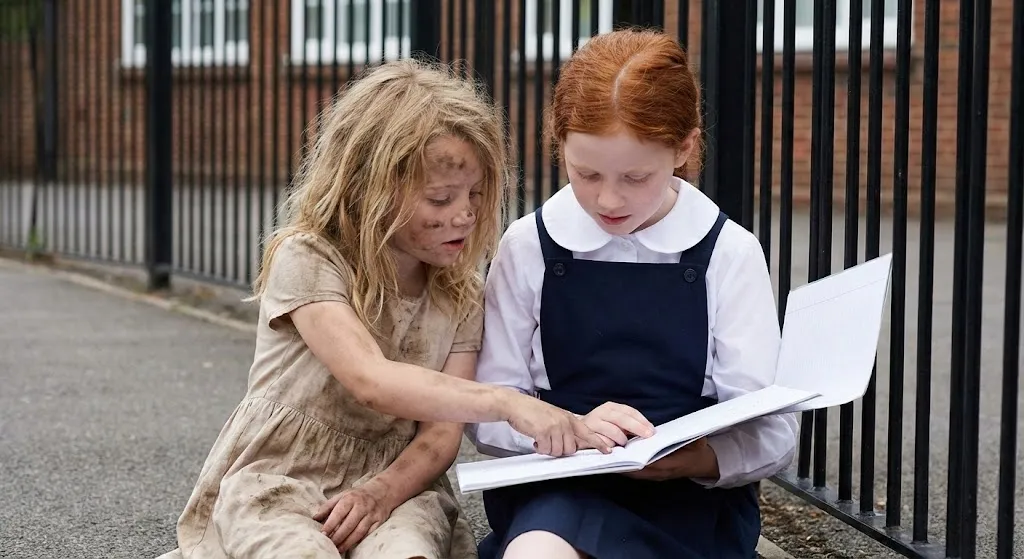
The prestigious institution sat behind an imposing iron fence. Emily slipped into her usual observation post, a secluded nook behind a large oak tree that offered a clear view of the main gate while keeping her hidden. She sat cross-legged and waited, just as she had done every morning for months.
Soon, the parade of wealth began. Sleek, polished luxury cars pulled up to the curb, a stark contrast to the crowded city buses Emily sometimes rode to escape the rain. Children emerged in immaculate uniforms—crisp white shirts, navy blue skirts or trousers, and shoes that gleamed without a single scuff. They carried backpacks featuring cartoon characters Emily recognized from discarded comic books.
She watched with a hunger that had nothing to do with food. She observed parents bending down to kiss their children goodbye, friends running to greet one another, the air filling with laughter and chatter about topics she could only guess at. Some children grumbled about waking up early or unfinished homework, and Emily felt a pang of confusion. How could anyone complain about something so magical?
“I forgot to do my math homework,” she heard a boy say, panic in his voice. “Today we have art class!” a girl with bouncing braids squealed nearby. Then, the sharp, authoritative ring of the bell cut through the air. The children formed neat lines and filed into the building, leaving the courtyard silent and empty.
Emily crept closer, her small hands gripping the cold iron bars of the fence. She couldn’t see into the classrooms, but her imagination filled in the blanks. She pictured sitting at a real desk with her name on it, opening a notebook that didn’t smell of refuse, raising her hand to ask a question. She visualized maps on the walls, shelves groaning with books, and a kind teacher explaining the mysteries of the universe.
“I would learn so fast,” she whispered to the empty air. “I know I could.”…