The thick, humid heat of an Atlanta summer clung to Zalika’s skin the instant she stepped out of the Uber. It was a physical weight, pressing down on her shoulders, but she barely minded. She had spent the last two weeks in a tiny, dusty town deep in the Alabama sticks, nursing her mother through a critical illness.
The air there had been still and suffocating in a different way—filled with the scent of rubbing alcohol and worry. Now that her mother was finally stable, Zalika was returning to her life. Every muscle in her body ached for the climate-controlled comfort of her luxury penthouse.
More importantly, she ached for the embrace of her husband, Kwesi. She missed his scent; she missed the way he would (she hoped) rub her back and tell her everything was handled.
She dragged her modest carry-on through the lobby of The Sovereign. It was one of the most prestigious addresses in Buckhead, standing tall right in the beating heart of Atlanta’s wealth. The marble floors clicked rhythmically under her heels.
A weary smile touched her lips when the elevator chimed, announcing her arrival on the thirtieth floor. She was exhausted down to her bones, but the relief of being home was a balm to her spirit. The hallway was cool, silent, and smelled faintly of lemon polish and expensive potpourri.
Zalika arrived at door 30A, the entrance to their sanctuary. She dug around in her purse, her fingers brushing against loose receipts and gum wrappers before finding the plastic key fob. She tapped the card against the digital reader mounted on the door frame.
Beep, beep. A harsh red light flashed. Access denied.
Zalika frowned, confusion knitting her brow. She tried again, pressing the plastic firmer against the sensor. Beep, beep. Red light again.
“That’s strange,” she murmured to herself, tapping the card against her palm. “Maybe it got demagnetized in my bag near my phone.”
She pressed the doorbell twice, the sound echoing faintly within. A moment of silence stretched out, heavy and awkward. Then, she heard the muffled sound of footsteps approaching. They were followed by the soft, metallic click of the deadbolt turning from the inside.
The heavy door swung open. There stood Kwesi, her husband. But he wasn’t the Kwesi she knew. The man looking down at her had eyes as cold as flint.
He was wearing a silk robe she didn’t recognize—something flashy and new—and there, stark against the skin of his neck, was a fresh smudge of bright red lipstick.
“Ah, you’re back already,” Kwesi said. It wasn’t a greeting; it was an accusation.
Zalika’s heart seemed to skip a beat, then hammer painfully against her ribs. “Kwesi? Why… why isn’t my key working?” she asked, her voice trembling slightly.
“Because I changed the locks,” Kwesi replied smoothly, his body blocking the entrance.
From deep inside the apartment, the crystal-clear laughter of a woman rang out. “Babe, who is it? If it’s a solicitor, tell them to kick rocks!”
A young woman, breathtakingly beautiful and significantly younger than Zalika, appeared over Kwesi’s shoulder. Zalika recognized her instantly. It was Inaya, a local Instagram model who was gaining clout in the city—a woman who had always made Zalika’s stomach turn with her ostentatious displays online.
Inaya was wearing Zalika’s silk robe. It was the very same robe Zalika had gifted herself for their wedding anniversary just last year. Inaya’s eyes swept over Zalika from top to bottom, judging her simple travel clothes, her fatigue-lined face, and her scuffed suitcase.
“Oh,” Inaya said, a mocking smirk curling her lips. “It’s not a solicitor. Turns out it’s the ex-wife.”
“Ex-wife? Kwesi, what is this?” Zalika whispered, feeling a stinging burn prick her eyes. “Who is she? Why is she in our house? Why is she wearing my clothes?”
Kwesi sighed, rolling his eyes as if Zalika were a trivial nuisance, like a fly he couldn’t swat away. “Listen, Zalika, this is over. Better we talk downstairs. Don’t make a scene here.”
He didn’t even give her a chance to step across the threshold to breathe the air of her own home. He stepped out into the hallway, pulling the door shut behind him, leaving Inaya smiling smugly on the other side.
Kwesi didn’t speak a single word while they rode down in the elevator. Zalika stood petrified, staring at the numbers descending on the panel. Her brain wasn’t capable of processing the trauma that had just unfolded.
The smell of Inaya’s perfume—an expensive, cloying scent that wasn’t to Zalika’s taste at all—lingered faintly on Kwesi’s robe, invading her personal space.
The elevator chimed, opening into the busy lobby. It was evening rush hour, and the space was buzzing with activity. A few other residents glanced at them with curiosity, noting Kwesi’s attire and Zalika’s distress.
Kwesi walked quickly toward a secluded corner of the lobby, near a large floor-to-ceiling window overlooking the traffic on Peachtree Road. Zalika followed him like a robot, her movements stiff and unnatural.
“Kwesi, explain this to me,” Zalika demanded, though her voice was barely audible over the hum of the lobby.
“What is there to explain?” Kwesi said coldly, crossing his arms. “Is it not clear? No? You and I are done. Finished. Just like that.”
“After ten years?” Zalika’s voice rose an octave. “After I took care of your mother? After her stroke last year? After building with you from ground zero?”
Kwesi let out a cynical, dry laugh. “Building with me from ground zero? Don’t be ridiculous, Zalika. I am successful thanks to my hard work. You… you’re just a burden. Especially after you spent so much time taking care of your mama in that country town.”
He leaned in, his face twisted with disdain. “You forgot your duties as a wife.”
“My duties?”
“Yes. Look at you.” Kwesi pointed at Zalika with disgust, gesturing at her travel-worn appearance. “Disheveled. Unkempt. I am a major developer in this city. I need a partner on my level, not a housewife like you.”
Zalika’s jaw dropped. The man standing in front of her seemed like a complete stranger, a monster wearing her husband’s face. “Inaya? So it’s been going on this whole time?”
“Yeah, we’ve been together a year,” Kwesi said without a shred of guilt. “And she understands me much better.”
Suddenly, a building security guard approached, pushing a small, tattered duffel bag on a luggage cart. It was the same cheap bag Zalika had used when they first moved to Atlanta years ago, long before they had money.
Kwesi took the bag and threw it at Zalika’s feet. The zipper burst slightly, and the contents spilled out a little—just some old clothes and a wallet.
“Those are your things. The rest I threw out,” Kwesi said casually. He then tossed a thick brown envelope onto the bag. “Those are the divorce papers. I’ve already signed them. Inside is the settlement.”
He straightened his robe. “All the assets—this penthouse, the cars, the company—everything is in my name. You came into this marriage with nothing. You leave with nothing.”
The tears finally escaped Zalika’s eyes, hot and fast. This wasn’t just humiliation; it was annihilation. “You… you can’t do this.”
“Oh, I can, and I already have.” Kwesi looked at her with eyes as cold as ice. “Sign those papers. If you behave yourself and don’t claim marital assets, maybe I’ll be generous and give you cash for a Greyhound bus ticket back to your little town in Alabama.”
Some people in the lobby started to whisper, their eyes darting toward the scene. Zalika felt naked, exposed in her misery.
“Get out,” Kwesi hissed.
“But this is my home, too!”
“Not anymore!” Kwesi shouted, his voice echoing off the marble walls. “Security!”
Two security guards approached rapidly. They looked uncomfortable, shifting their weight, but they were clearly on the side of Kwesi, the owner of the penthouse.
“I’m sorry, ma’am. Please don’t make a scene,” one of them said, gently but firmly grabbing Zalika’s arm.
Zalika was dragged toward the revolving doors by force. She looked back, staring at Kwesi with desperation. “Kwesi, please!”
Kwesi just looked at her blankly, then turned around and walked toward the elevator without a backward glance. Up above, near the mezzanine railing, Zalika could just make out Inaya’s silhouette, watching her victory unfold.
The heavy glass door of the lobby hissed shut behind Zalika, severing her from the life of the last ten years. She was thrown onto the busy sidewalk under the Atlanta sky, which was starting to bruise with the colors of twilight. She had nothing but a duffel bag of old clothes and the divorce papers that insulted her very existence.
Night fell quickly in Atlanta. The streetlights began to flicker on, buzzing overhead, but for Zalika, the whole world seemed to have plunged into darkness. She walked aimlessly, her feet dragging on the concrete.
The sound of honking horns from the heavy traffic on Peachtree sounded like roaring beasts in her ears. She had nowhere to go. Her mother in Alabama was still in fragile recovery; she couldn’t add the crushing weight of this news to her mother’s burden.
Her feet carried her instinctively to Centennial Olympic Park. She sat on one of the empty benches, staring blankly at the illuminated skyline. Her stomach growled loudly, a painful reminder that she hadn’t eaten since morning.
Ironically, all around her, the restaurant patios were coming alive. The rich, smoky aroma of barbecue ribs, fried catfish, and sweet waffle cones floated in the heavy air, making her stomach ache even more. People laughed as they walked by. Young Black couples walked hand-in-hand, full of hope. Zalika felt like a ghost—invisible, non-existent.
She opened the old wallet Kwesi had thrown at her. Inside was about ten dollars in cash. It wasn’t even enough for a night in a cheap motel on the outskirts of the city.
She pulled out her phone; the battery indicator showed a critical five percent. She rushed to open the mobile banking app for their joint account, her fingers trembling.
Balance: $0.00.
Kwesi had cleaned her out. He had drained every dollar they had together, which also included the personal savings Zalika had brought into the marriage. A cold, heavy despair wrapped around her shoulders like a wet blanket. It was over. She was truly at rock bottom. She would be homeless tonight.
Tears fell silently onto her lap. She looked down at the contents of her wallet again. Behind the empty card slot was a faded photo, a picture of her father. Her father, Tendai Okafor, a simple tobacco farmer and merchant who had died ten years ago, just before Zalika married Kwesi.
And behind that photo was something else.
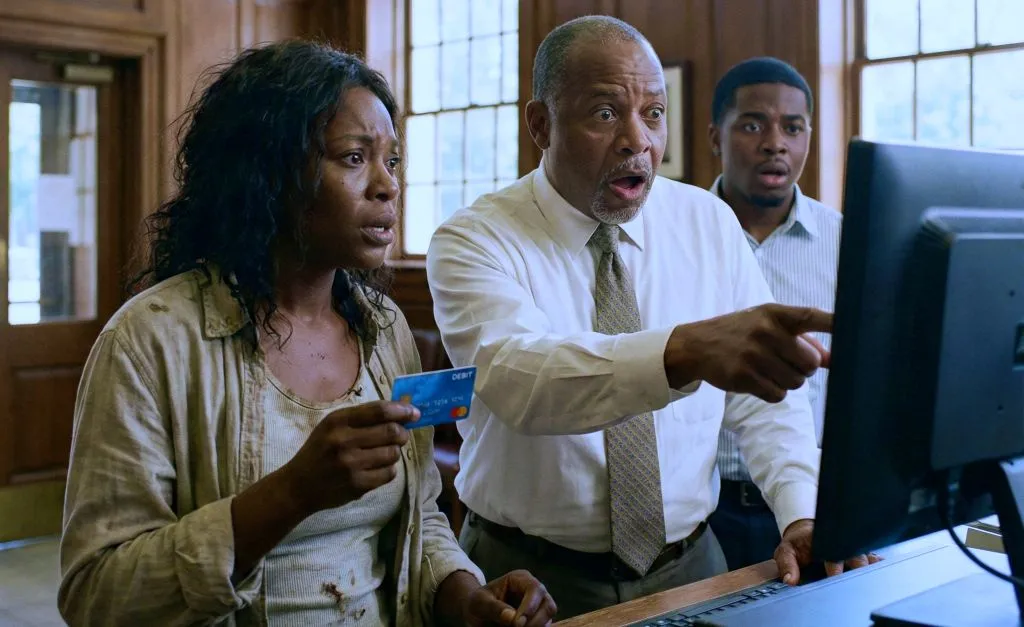
Zalika’s trembling fingers pulled it out. It was a faded blue debit card, the plastic already peeling at the edges. The logo was barely legible: Heritage Trust of the South, a small, old regional bank.
Zalika was stunned. Memory washed over her. She remembered now that her father gave her this card when she was seventeen, back when she was moving out for the first time to go to college at Spelman.
“Keep this, my baby girl,” her father had said back then, his tone loving but serious. His voice was soft, but firm. “This is an account Papa created for you. Never use it unless it is absolutely necessary. Don’t mix it with money for your expenses. Imagine it doesn’t exist.”
“How much is in it, Papa?” she had asked curiously.
Her father had just smiled mysteriously. “Enough to be an anchor. If you ever feel like your ship is going to sink, use this. But as long as you can sail, don’t touch this anchor.”