Zalika had never used it. She had forgotten about it completely. She got busy with college, then she met Kwesi, then she became busy building her husband’s empire. She always thought the account would have, at most, a few hundred dollars—the remainder of some allowance that wasn’t used.
But tonight… tonight, her ship wasn’t just going to sink. Her ship had been blown to pieces.
She held the card tight. The ten dollars in her wallet wasn’t enough for anything, but maybe, just maybe, the rest of her father’s money would be enough to buy a bus ticket back to Alabama. A small hope, as thin as a thread, began to light up in her tight chest.
Zalika didn’t sleep all night. She took shelter under the awning of a closed shop, hugging her duffel bag tight against her chest, waiting for morning to come. She was dirty, hungry, and terrified, but the faded card felt warm in her hand.
At eight o’clock in the morning, she was already standing in front of the branch of Heritage Trust of the South on a side street in downtown Atlanta. The place was exactly as she remembered from her childhood visits: an old stone building that seemed anchored in the past, far removed from the impression of the modern glass-and-steel banks where Kwesi kept his money.
Inside, the atmosphere was hushed. There were only two tellers and a customer service desk. The smell of old paper and dust dominated the room. Zalika took a number. She was the only customer.
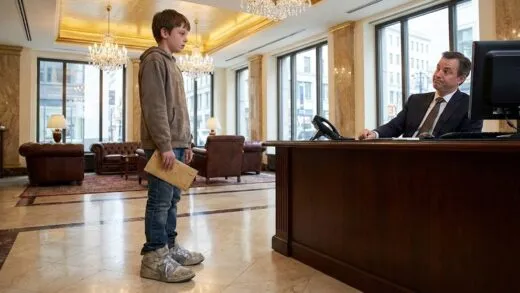
She was called to the customer service desk, manned by a young man in a crisp white shirt. His name tag read Kofi.
“Good morning, ma’am. How can I help you?” Kofi was polite, though his eyes betrayed a bit of confusion seeing Zalika’s somewhat disheveled appearance.
“Good morning.” Zalika’s voice was hoarse from disuse. “I want to check the balance, but the card is very old. I’ve also forgotten the PIN.”
Zalika handed over the faded blue card. Kofi took it, turning the plastic over in his hands and frowning.
“Wow, ma’am, this card is ancient. This is our old logo. Can it still be used?”
“I don’t know,” Zalika asked anxiously. “Can you check?”
“I’ll check, ma’am.” Kofi took Zalika’s ID, matching the name—Zalika Okafor. He started typing on his computer.
The system seemed agonizingly slow. Kofi typed, clicked, and then frowned again. “Hmm, that’s strange,” he murmured.
“What’s wrong?” Zalika’s heart beat wildly.
“The data isn’t coming up directly. Ma’am, our legacy system is sometimes a little slow. It seems this account is in an inactive or dormant state. How long has it been since there were transactions?”
“Maybe ten years,” Zalika replied hesitantly. “Or twenty.”
Kofi’s eyes went wide. “Twenty years. One moment, ma’am. I’m going to try accessing the manual server.”
His fingers danced over the keyboard again. His computer screen flickered, showing rows of green code that Zalika didn’t understand. Silence stretched in the room. Only the sound of the keyboard and the noisy air conditioning could be heard.
Zalika bit her lip. It’s over, she thought. Surely the account has been closed, the money lost to fees.
Kofi scratched his head. “How odd. The balance isn’t reading, ma’am, but there is a sort of flag—an alert on this account. A high-level alert.”
“Alert? Does that mean I have debt?” Zalika panicked.
“No, no, not debt. I’ve never seen a code like this. One moment, ma’am.”
Kofi typed a series of commands. The computer seemed to think for a moment. Then, on Kofi’s screen, something appeared.
Kofi’s face, which was relaxed before, suddenly changed. He went pale. His eyes opened wide, glued to the monitor.
“Mr. Kofi?” Zalika called out.
Kofi didn’t answer. He seemed frozen. He re-read what was on the screen. His mouth opened slightly, and he swallowed hard.
Suddenly, he stood up from his chair so fast that it flew backward, making a loud screech against the floor. “Mr. Zuberi! Mr. Director!”
Kofi’s voice was shrill, breaking the silence of the small bank. He didn’t care about Zalika anymore. His eyes were still glued with horror to the screen.
A middle-aged Black man with a stern look—Mr. Zuberi, the branch manager—stepped out of his glass-walled office. “What is it, Kofi? Don’t shout like that. There are customers,” Mr. Zuberi scolded, his tone flat.
“I’m sorry, sir, but… but you have to see this.” Kofi pointed at the screen with a trembling hand. “Account in the name of Zalika Okafor. Inheritance from her father, Tendai Okafor.”
Mr. Zuberi sighed, annoyed at being interrupted, and walked toward Kofi’s desk, preparing to lecture his young employee on decorum. He glanced at the screen casually, and then he froze.
His professional, rigid face crumbled in an instant. His expression changed from annoyance to confusion, and then to a deathly pallor. He looked at the screen, then looked at Zalika, and then back at the screen.
“Ma’am? Mrs. Zalika Okafor?” Mr. Zuberi asked. His voice, previously firm, was now trembling.
“Yes, sir,” Zalika whispered, scared. “What’s wrong? Was my father a criminal?”
“Kofi,” Mr. Zuberi ordered sharply. “Close your window quickly. Put up the ‘Closed’ sign. Take Mrs. Zalika to my office right now. Don’t let anyone see this screen.”
The order was so urgent and full of panic that Zalika jumped. Kofi, stuttering, immediately put up the closed sign and turned off his monitor.
“Come with me, ma’am,” Kofi said, now treating Zalika with immense respect, almost with fear.
In Mr. Zuberi’s cramped office, the door was locked instantly. Mr. Zuberi paced from one side to the other for a moment before finally sitting in his chair. His hands shook slightly as he turned on his desk computer.
“Excuse me, ma’am, you caught us by surprise,” Mr. Zuberi said, wiping sweat from his forehead.
“Actually, what is happening, sir? Did my father leave a huge debt?” Zalika asked. Her voice was on the verge of breaking into tears.
“Debt?” Mr. Zuberi let out a nervous chuckle. “No, ma’am. Far from it.”
He turned his computer monitor towards Zalika. Kofi, who was standing in the corner of the room, pointed at the screen, holding his breath. “Ma’am, look at this quickly.”
The screen didn’t show a balance in dollars. The screen showed an ownership structure diagram.
“Ma’am,” Mr. Zuberi said, his voice low with astonishment. “This account is not a normal savings account. This is a master account, connected to a limited liability company—a corporation.”
Zalika frowned. “Corporation? LLC?”
“Correct. It is called Okafor Legacy Holdings, LLC. This company was founded by your father, Tendai Okafor, in 1998 and was left inactive exactly twenty years ago.”
“But my father was just a tobacco salesman.”
“That is what he wanted people to know, ma’am,” Mr. Zuberi interrupted gently. “Your father, it seems, wasn’t just a salesman. He was a land broker, and a genius one at that.”
Mr. Zuberi clicked on a tab on the screen. The title read: List of Assets, Okafor Legacy Holdings, LLC. Mr. Zuberi continued reading the contents aloud. “It is the legal owner of 2,000 acres of prime pecan groves and farmland in South Georgia, all under this deed. The sole ownership was transferred completely to you as the heir with a special clause.”
“What clause?” Zalika whispered.
“This company activates automatically and all its assets become accessible to the heir only if… if the heir accesses this master account in a desperate situation, or if the balance of their personal account is zero.”
Zalika’s jaw dropped. Her father had predicted this. She looked at the row of numbers on the screen. They weren’t savings figures, but figures of land acreage and estimated value.
She didn’t faint. She didn’t scream. Zalika simply sat up straight. The hunger, the exhaustion, and the humiliation she had felt for the last twenty-four hours evaporated. They were replaced by something else—something cold, sharp, and very strong.
She remembered Kwesi’s mocking face. She remembered Inaya’s victory smile.
“Mr. Zuberi,” Zalika said. Her voice was calm and cold, surprising even herself.
“Yes, ma’am?”
“How do I activate this company right now?”
Mr. Zuberi looked at Zalika with concern. The reaction of the woman in front of him was totally unexpected. She wasn’t crying. She wasn’t screaming with joy. Her eyes, still puffy from yesterday’s tears, had hardened into steel. She stared at the computer screen with a cold, terrifying focus.
“Mr. Zuberi,” Zalika repeated, her voice steady. “What do I need to activate this?”
Mr. Zuberi stuttered. “Technically, it is already active, ma’am. As soon as you accessed this account with a null personal balance, the clause was fulfilled. Our legal team managing the trust… well, they are already waiting for your instructions.”
“Kofi,” Mr. Zuberi signaled.
The young employee promptly poured a glass of water and placed it in front of Zalika. Zalika didn’t drink it.
“My father, Tendai Okafor. What else do you know about him?”
Mr. Zuberi opened a drawer, pulling out a thick, dusty folder. “Your father was a priority client, long before the term ‘private banking’ existed for folks like us. He left this—a letter and legal documents. He said, ‘This can only be opened by my daughter or by us if she has accessed the account.'”
Mr. Zuberi handed over a yellowed envelope. Zalika’s hands trembled as she opened it. Inside was a sheet of paper written neatly by hand.
To my baby girl, Zalika,
If you are reading this, it means there are two possibilities. First, Papa is no longer here, and you are ready to start your own life. Second, life hasn’t gone according to your plans.
Papa was a salesman, it’s true, but Papa also knew that this world isn’t always fair to good Black women like you. I saw how they treated your mother.
Papa kept a small anchor for you, not to spoil you, but to ensure you have options when you feel cornered. Papa designed the ‘desperate clause’ on purpose. I know you are smart, but your heart is too soft. I was afraid. If you had wealth, you would attract the wrong man. And if you didn’t have wealth, you would be oppressed by the wrong man.
Papa failed in one thing. I hope you never need to read this letter. But if you read it, remember Papa’s message: Don’t cry. Don’t get revenge with tears. Build your own kingdom, my child. Make them regret it.
The anchor has been dropped. Now sail, baby girl.
Love, Papa.
The tears she had been holding back finally fell. They weren’t tears of sadness anymore, but of understanding. Her father, the simple salesman, had seen the future. He had seen Kwesi decades before Kwesi existed.
Zalika wiped her tears with the back of her hand. She looked up at Mr. Zuberi.
“I need three things,” she said.
“What things, ma’am?”
“First, cash. I don’t have a dime.”
“Of course. Kofi, prepare a cash withdrawal from the operating account,” Mr. Zuberi said.
“Second,” Zalika continued, “I need a place to stay temporarily. A secure hotel, far from The Sovereign apartments.”
“That can be arranged. We have corporate rates with secure hotels.”
“Third, and this is the most important,” Zalika leaned forward, her eyes blazing. “I need all the financial data of Okafor Legacy Holdings, LLC, and I need a recommendation for the best business restructuring consultant. Not from around here. I want someone from the Midtown Financial District, someone who doesn’t know Kwesi.”
Mr. Zuberi was stunned for a moment, impressed by the composure of the woman who, thirty minutes ago, looked like a homeless person.
“I know a name,” Mr. Zuberi said slowly. “They nickname him ‘The Cleaner.’ Very expensive, very cold. His name is Sekou.”
“Good,” Zalika said. “Give me the money, book me the hotel, and organize my meeting with Sekou.”
Zalika didn’t stay at the hotel Mr. Zuberi booked. That was her first step: not being predictable. After taking a considerable amount of cash—enough to make her dizzy if it had been yesterday—she bought a new phone, a new number, and several sets of simple but clean clothes at a nearby mall. Then she booked a room at the St. Regis, one of the most luxurious hotels in Atlanta, under a fake name.
For twenty-four hours, she locked herself in the room. She ordered room service, ate her first decent meal, took a hot bath, and slept. She let her brain process the destruction and rebirth in a single day.
The next morning, she didn’t call Sekou. She knew someone like Sekou wouldn’t be impressed with a phone call. Zalika went straight to the financial district in Midtown.