And at the bottom of the pile, a handwritten note from Richard.
“My dearest Marsha, I know you sacrificed everything to build a life with me, but your talents were never wasted. They were just sleeping, waiting for the day you would need them again. You are the strongest, most brilliant woman I have ever known. Do not let anyone—not even our son—convince you otherwise. All my love, Richard.”
The tears came then, hot and overwhelming. Richard had known. He had always known who I really was, what I had given up for love, and he had protected that secret, keeping it safe until I was ready to reclaim it.
I had been Judge Margaret Stone for fifteen years before I became Mrs. Stone. I had presided over complex civil cases, corporate litigation, and criminal trials that made headlines. I had earned a reputation as the “Iron Judge”—brilliant, incorruptible, and feared by lawyers who came unprepared to my courtroom.
But when I met Richard at a charity gala in 2003, something shifted. He was recently widowed, struggling to raise twelve-year-old Trevor alone. He didn’t know who I was professionally; to him, I was just Marsha, the woman who made him laugh for the first time since his wife’s death.
For the first time in my career, I had found something more important than the law. A man who loved me for who I was, not what I had achieved. A broken family that needed healing. A chance to be someone’s wife, maybe even someone’s mother.
So I had made a choice. I took early retirement, citing burnout, and quietly stepped away from the legal world that had defined me for so long. I became Mrs. Richard Stone, stepmother to a grieving boy who resented my presence but desperately needed stability.
Twenty years of PTA meetings and school plays and family dinners. Twenty years of being the woman behind the successful man, supporting Richard’s career while mine became a footnote in legal journals. I had told myself it was worth it. That love was worth any sacrifice.
But as I sat in that study, surrounded by the evidence of who I used to be, I realized something had been burning inside me all day. Not just anger at Trevor’s accusations, but something fiercer. Something that remembered what it felt like to command a courtroom, to make lawyers twice my age scramble for precedents they couldn’t find.
I pulled out my laptop. Richard had insisted I learn to use it, though I had mostly stuck to email and online shopping, and did something I hadn’t done in twenty years. I researched case law. Inheritance disputes. Undue influence. Burden of proof.
My fingers moved across the keyboard with muscle memory I didn’t know I still possessed, navigating legal databases like I had never left. The law had changed in some ways over the past two decades, but the fundamentals remained the same.
And Trevor’s case? It was weaker than tissue paper. Pierce was relying on emotional manipulation and circumstantial evidence. He had no proof of coercion, no documentation of diminished capacity, no witnesses to any actual wrongdoing. What he had was a grieving son’s resentment and a jury’s potential sympathy for a young man who felt cheated out of his inheritance.
But sympathy doesn’t win cases. Evidence does. And I was beginning to remember exactly how to find it.
I spent the rest of the night in that study, reading through Richard’s papers with eyes that hadn’t seen them in twenty years—not as a wife, but as a lawyer. The will was ironclad, witnessed, and notarized properly. Richard’s medical records showed no signs of dementia or cognitive decline.
His financial advisor had detailed notes about their discussions regarding the inheritance, including Richard’s specific concerns about Trevor’s spending habits and lack of responsibility.
More importantly, I found Richard’s private journal from his final months. Page after page of entries expressing his love for me, his gratitude for our life together, and his growing disappointment in Trevor’s behavior.
The last entry, dated just a week before his death, made me catch my breath.
“Marsha doesn’t know I’ve seen her old courtroom photos, hidden in that box in the closet. She thinks she gave up everything for me, but she has no idea how proud I am of what she accomplished. If anything happens to me, I know Trevor will try to hurt her. He has never forgiven her for taking his mother’s place in my heart. But my Marsha is stronger than she knows. She has forgotten what she is capable of, but I haven’t. She is going to surprise everyone.”
I closed the journal and looked around the study with new eyes. This wasn’t just Richard’s space. It had been mine too, long before I had ever met him.
And tomorrow, when I walked back into that courtroom, I wouldn’t be walking in as “just a housewife.” I would be walking in as Judge Margaret Stone.
Trevor thought he could intimidate me with his expensive lawyer and his accusations. He thought I was nothing more than the woman who had cooked his dinner and washed his clothes for twenty years. He was about to learn how wrong he had been about everything.
The second day in court arrived with a crispness that matched my newfound resolve. I dressed carefully that morning, choosing the same navy dress from the day before. But this time, I carried myself differently. My spine was straighter, my steps more measured. I was still playing the role of the grieving housewife, but underneath, something had awakened.
Trevor and Pierce were already at their table when I arrived, deep in conversation over stacks of papers. Pierce looked confident, almost bored, like a man who had already won. Trevor wore that same smirk, occasionally glancing my way as if I were an amusing sideshow.
Judge Hamilton entered promptly at nine o’clock, and I noticed something I had missed yesterday: the way he carried himself, the careful precision of his movements. He reminded me of the young attorneys who used to appear in my courtroom—the ones who had studied every case precedent and still trembled when they stood to speak.
“Mr. Pierce,” Judge Hamilton said, “you may call your first witness.”
“Thank you, Your Honor. I would like to call Mrs. Elizabeth Chen to the stand.”
My stomach clenched as my neighbor took the oath. Mrs. Chen had lived next door for eight years, always polite but distant. I had helped her with groceries after her hip surgery, brought her soup when she had the flu. But as she settled into the witness chair, she wouldn’t meet my eyes.
Pierce approached her with the practiced ease of a predator who had cornered his prey.
“Mrs. Chen, how well did you know the deceased, Richard Stone?”
“Pretty well. He was a good neighbor. A very kind man.”
“And his relationship with his son, Trevor?”
Mrs. Chen shifted uncomfortably. “Well, I didn’t see Trevor visit very often in the last few years.”
“Did Mrs. Stone ever discuss this with you?”
“Sometimes,” her voice was barely above a whisper. “She seemed frustrated by it.”
Pierce nodded encouragingly. “Can you tell the court about a specific conversation you had with Mrs. Stone regarding the inheritance?”
My heart hammered against my ribs. I knew what was coming.
“It was about two months before Richard died. I found her crying on her front porch. She was upset about his diagnosis, the cancer, you know. And she said…” Mrs. Chen paused, glancing at me with what looked like guilt. “She said she was scared of what would happen to her when he was gone. That she had given up everything for him, and Trevor would probably try to take it all away from her.”
The courtroom was dead silent. Pierce let the words hang in the air like smoke.
“Did she mention the will specifically?”
“She said Richard had promised to take care of her, but she was worried Trevor wouldn’t honor that promise.”
Pierce smiled. “No further questions.”
Judge Hamilton looked at me. “Mrs. Stone, do you wish to cross-examine the witness?”
I stood slowly, my legs steadier than they had been yesterday. Something was stirring in my chest. Not panic, but calculation.
“Yes, Your Honor.”
I approached Mrs. Chen, noting how she flinched slightly. Poor woman. She had no idea she was about to become my first piece of evidence that things weren’t what they seemed.
“Mrs. Chen, you testified that I was crying on my porch when we had this conversation. Can you tell the court why I was crying?”
She blinked, clearly not expecting this question. “Because… because Richard was dying?”
“Specifically, what had I just learned that day?” Pierce started to object, but Judge Hamilton waved him off. “I will allow it.”
Mrs. Chen looked confused. “The doctor had told you both that morning that the treatments weren’t working. That he had maybe six weeks left.”
“Six weeks,” I repeated, letting the words settle. “Mrs. Chen, in your opinion, was I crying because my husband was dying, or because I was worried about money?”
“Because he was dying,” she said immediately, then looked stricken as she realized what she had admitted.
“And when I mentioned being scared of what would happen when he was gone, did I say I was scared of being poor? Or did I say I was scared of being alone?”
Mrs. Chen’s voice was barely audible. “You said you were scared of being alone. That you didn’t know how to live without him.”
I nodded. “Thank you, Mrs. Chen. No further questions.”
As she left the witness stand, I caught Judge Hamilton watching me with renewed interest. There had been something in my questioning—a precision, a control—that didn’t match the image of a helpless housewife.
Pierce called two more witnesses: Richard’s banker, who testified about the large sums of money Richard had moved around in his final months, and a former colleague who claimed Richard had seemed “confused” during their last conversation. But with each witness, I grew more confident.
The banker admitted under my cross-examination that Richard had been reorganizing his finances to make them easier for me to manage after his death—a thoughtful gesture, not evidence of manipulation. The colleague conceded that Richard’s confusion was actually frustration with his former law firm’s handling of a client’s case.
By the lunch break, I could see doubt creeping into Pierce’s expression. Trevor, however, remained smugly confident.
“You are doing better than expected,” Judge Hamilton said quietly as we prepared to recess. “But I have to ask, Mrs. Stone… what is your full legal name?”
The question hit me like electricity.
“I am sorry, Your Honor?”
“For the court records. Your full legal name.”
My mouth went dry. This was it. The moment I had been both dreading and anticipating.
“Margaret Stone, Your Honor. But I go by Marsha.”
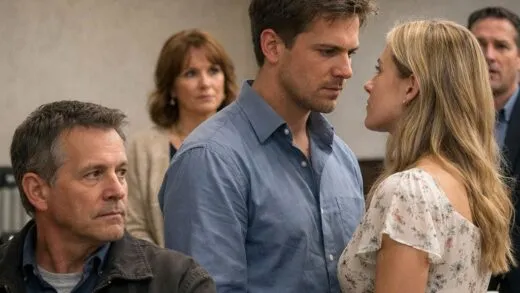
Judge Hamilton’s pen froze over his notepad. His eyes snapped up to mine, and I saw the exact moment recognition dawned.
“Margaret Stone,” he repeated slowly. “As in… Judge Margaret Stone?”
The courtroom went deadly silent. Trevor’s head whipped around to stare at me. Pierce’s confident expression cracked like thin ice.
“I was Judge Margaret Stone,” I said quietly. “I retired twenty years ago.”
Trevor shot to his feet. “What? That is impossible. You are just…”
“A housewife?” I finished for him. “Yes, I heard you yesterday.”
Pierce was frantically whispering to Trevor, both of them looking like they had seen a ghost. Judge Hamilton was staring at me with something approaching awe.
“Your Honor,” Pierce said, his voice strained. “This is the first we are hearing of any legal background. We request time to…”
“To what?” Judge Hamilton’s voice was sharp. “To research the woman you have been calling an uneducated gold digger? Mr. Pierce, did you not investigate the background of the opposing party?”