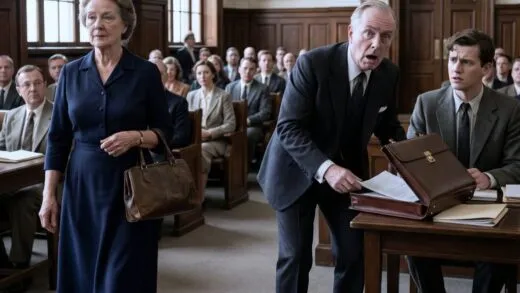
Pierce’s face had gone pale. “We… we conducted standard background checks, Your Honor. There was no indication of any legal career.”
“Because I took my husband’s name and retired from public life,” I said simply. “But my bar membership is still active. I have kept up with continuing education requirements. I am, in fact, qualified to represent myself in this matter.”
The weight of what was happening began to settle over the courtroom. Trevor looked like he was about to be sick. Pierce was shuffling through papers as if he could find some magic solution to the disaster unfolding before him.
But Judge Hamilton was looking at me with the kind of respect I hadn’t seen in twenty years.
“Judge Stone,” he said formally. “I had the honor of appearing before your court several times as a young attorney. You were… formidable.”
A small smile tugged at my lips. “I tried to be fair, Your Honor.”
“You were both fair and brilliant.” He turned to Pierce. “Mr. Pierce, I suggest you use the lunch recess to reconsider your strategy. Court will reconvene at two o’clock.”
As the courtroom emptied, I remained seated, feeling the transformation that was taking place inside me. The mask I had worn for twenty years was beginning to slip, and underneath, Judge Margaret Stone was waking up.
Trevor approached my table, his face twisted with rage and confusion. “This is impossible. You can’t be a judge. Judges don’t just become housewives.”
I looked up at him, really looked at him, for the first time in years. Not as his stepmother, not as the woman who had tried so hard to earn his love, but as the judge who had spent fifteen years sizing up liars and manipulators.
“Some of us,” I said quietly, “chose love over power, Trevor. But that doesn’t mean we forgot how to fight when we need to.”
His mouth opened and closed like a fish gasping for air. Behind him, Pierce was making frantic phone calls, probably trying to figure out how badly they had just miscalculated.
As I gathered my things to leave for lunch, I felt lighter than I had in months. The grief was still there; I would always miss Richard. But underneath it was something I thought was gone forever. The thrill of the hunt. The satisfaction of watching a weak case crumble under scrutiny.
Judge Margaret Stone was back, and she was ready for war.
The afternoon session felt different from the moment I walked back into that courtroom. Word had spread during the lunch break. I could see it in the way people looked at me, in the hushed conversations that stopped when I passed. The local legal community was small, and apparently, the return of Judge Margaret Stone was big news.
Trevor sat slumped in his chair like a deflated balloon. Pierce kept glancing at me with the expression of a man who had just realized he had brought a knife to a gunfight.
But it was Judge Hamilton’s demeanor that had changed most dramatically. Where yesterday he had looked at me with polite sympathy, now there was something approaching deference in his eyes.
“Before we proceed,” Judge Hamilton said once court was in session, “I want to address what was revealed this morning. Mrs. Stone, I need to ask, are you planning to continue representing yourself or will you be seeking counsel?”
I stood, and for the first time in twenty years, I felt the full weight of my professional authority settle around my shoulders like a familiar coat.
“I will continue representing myself, Your Honor. I believe I am adequately qualified.”
A ripple of quiet laughter went through the courtroom. Judge Hamilton’s lips twitched. “I think that is safe to say. Mr. Pierce, do you wish to continue with your case as planned?”
Pierce looked like he wanted to disappear into the floor, but he nodded. “Yes, Your Honor. I would like to call Trevor Stone to the stand.”
This would be interesting. I had watched Trevor lie to his father, to teachers, to girlfriends, and to himself for twenty years, but he had never been cross-examined by someone who had spent fifteen years spotting deception from the bench.
Trevor took the oath with all the swagger he could muster, but I could see the nervousness in the way he kept glancing at me. Pierce led him through his testimony carefully: the distant relationship with his father, the sudden marriage to a much younger woman, the isolation he claimed to have experienced.
“In your opinion,” Pierce asked, “did Mrs. Stone deliberately interfere with your relationship with your father?”
“Absolutely,” Trevor said, his confidence returning as he warmed to his favorite subject: himself. “She was always there, always hovering, making it clear I wasn’t welcome in my own father’s house.”
“Can you give the court a specific example?”
Trevor’s eyes lit up. “Last Christmas, I came to visit for three days, and she made sure every minute was scheduled with her activities. Shopping, dinner parties with her friends, holiday movies she wanted to watch. When I tried to have a private conversation with my dad, she would always interrupt with something that supposedly couldn’t wait.”
Pierce nodded sympathetically. “How did this make you feel?”
“Like she was deliberately keeping me from my father. Like she was afraid of what he might say if we were alone together.”
It was a compelling story, delivered with just the right amount of wounded emotion. If I had still been the grieving housewife from yesterday morning, it might have devastated me. But I wasn’t her anymore.
“Mr. Pierce,” Judge Hamilton said. “Your witness.”
I stood and approached Trevor with measured steps. He tried to maintain his confident expression, but I could see the first cracks forming.
“Trevor,” I said, my voice carrying the authority I had forgotten I possessed. “You testified that you came to visit your father last Christmas for three days. Is that correct?”
“Yes.”
“And before that visit, when was the last time you had seen your father?”
Trevor shifted in his seat. “I don’t remember exactly.”
“Let me help refresh your memory.” I pulled out a document from the folder I had compiled the night before. “According to your father’s calendar, which he kept meticulously, your last visit before Christmas was fourteen months earlier. Does that sound accurate?”
“Maybe. We talked on the phone.”
“How often?”
Another shift. “Regularly.”
“Trevor, I am going to show you your father’s phone records, which are part of his estate documents.” I handed him a paper. “Can you tell the court how many times you called your father in the six months before his death?”
He stared at the paper, his face flushing. “I… these might not be complete.”
“They are complete, Trevor. The answer is three times. Three calls in six months, each lasting less than ten minutes. Does that match your definition of ‘regularly’?”
Pierce was on his feet. “Objection, Your Honor. Mrs. Stone is testifying rather than questioning.”
“Sustained,” Judge Hamilton said, but there was no disapproval in his voice. “Please rephrase, Mrs. Stone.”
I smiled slightly. It had been twenty years, but the rhythm of courtroom combat was coming back to me like riding a bicycle.
“Trevor, based on these phone records, would you say you were in close, regular contact with your father?”
“We had a complicated relationship,” he said defensively.
“Indeed. Now, you testified that I scheduled activities to prevent you from having private conversations with your father. Do you recall what those activities were?”
“Shopping, dinner parties, movies…”
“Specifically, Trevor, what shopping?”
He looked confused. “I don’t remember.”
“The shopping was for your father’s medications, which required a special trip to a pharmacy thirty miles away because they were the only ones who could compound his pain medicine properly. The ‘dinner parties’ were actually one dinner party—a surprise celebration for your father’s seventieth birthday, which you had forgotten about until I reminded you. And the movies were films from the 1940s that your father loved but could barely hear without the volume turned up extremely loud. Were you aware that your father had severe hearing loss in his final months?”
Trevor’s mouth opened and closed. “I… no.”
“So when you interpreted my presence during your conversations as ‘interference,’ is it possible I was actually helping your father hear what you were saying?”
The courtroom was completely silent now. I could see the jurors—yes, we had somehow ended up with a jury trial, Pierce’s mistake—leaning forward with interest.
“And Trevor,” I continued, my voice softening just slightly. “You mentioned being made to feel unwelcome in your father’s house. When you arrived for that Christmas visit, where did you sleep?”
“In my old room.”
“The room I had spent three weeks preparing for your visit. The one where I had hung your high school baseball trophies and put out fresh flowers and your favorite snacks.”
His face was bright red now. “You? I… I don’t remember.”
“Let me ask you directly, Trevor. In all the years I was married to your father, did I ever—even once—ask you not to visit? Did I ever tell you that you weren’t welcome?”
“No.”
“Did I ever refuse to cook your favorite meals when you came home?”
“No.”
“Did I ever fail to include you in family photographs, holiday celebrations, or important events?”
“No.” His voice was barely audible.
“Trevor, is it possible that your feelings about our relationship had more to do with your grief over your mother’s death than with anything I actually did or didn’t do?”