Leo Blake held his father’s hand tightly as they exited the grand ballroom of the Blackstone Hotel.
The building glowed behind them, golden lights spilling across the sidewalk. Men in suits laughed loudly near the valet. Women in glittering gowns snapped photos under crystal chandeliers. The smell of champagne and expensive perfume still lingered in Leo’s nose.
His father, Brian Blake, didn’t pause. He was already on the phone, one hand in his coat pocket, the other guiding Leo down the marble steps.
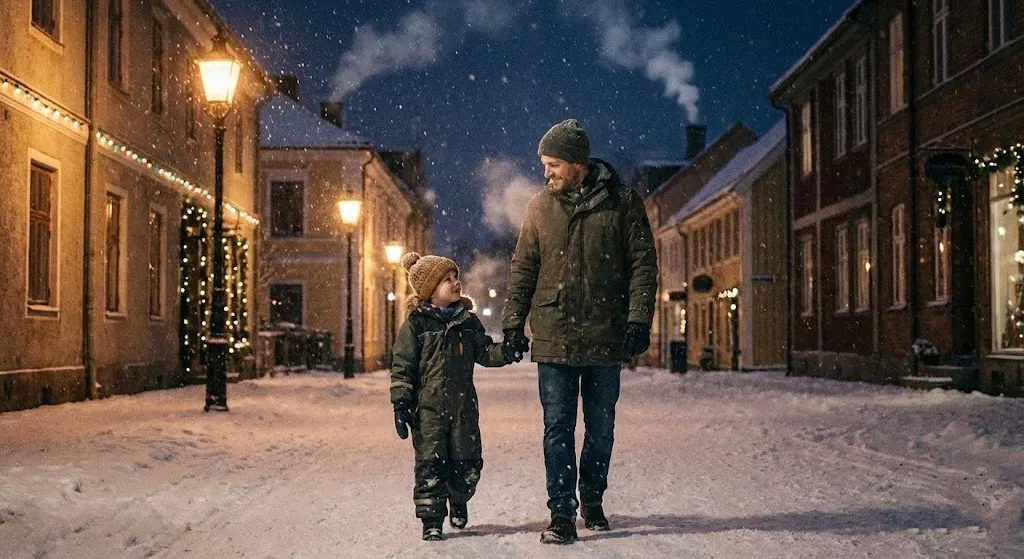
“Yes, we can close by Monday,” Brian said into his Bluetooth earpiece. “Have the documents at my office first thing.”
Leo looked up at him but didn’t say anything. In his small hand, he clutched a worn little plush lion—something that didn’t belong in this polished world, something that used to live in a different house, with a different voice that read stories and sang lullabies.
They turned onto a side street that had lost its lights. It was quieter, colder. Puddles reflected dim signs from a closed coffee shop. Leo walked slower; something tugged at him. Then he heard it. A soft voice, almost drowned by wind.
You are my sunshine, my only sunshine.
He stopped. Just ahead, near the edge of a shuttered storefront, a woman sat hunched over a worn stroller. Her blonde hair was tied back loosely, strands falling across her cheek. Her coat was too big, fraying at the sleeves, and her hands were pale, moving carefully over something inside the stroller.
Leo blinked. It was not a baby. A small, old teddy bear lay wrapped in a faded blanket. The woman was shielding it from the wind, murmuring softly as though it were alive.
Brian caught the change in pace. He glanced sideways, quickly, and then turned his eyes away. His grip on Leo’s hand tightened.
“Don’t stare, Leo,” he said, his voice sharp. “Keep walking.”
Leo resisted slightly but let himself be pulled forward. Brian didn’t look back. In his mind, he categorized the woman immediately: young, unkempt, mentally unstable, likely intoxicated. Another social problem someone else would deal with. Not his concern. He had given his check to the charity tonight. He had done his part.
Still, something about the song bothered him. He shook it off. “I’m tired. It’s been a long day.”
Leo glanced over his shoulder again. The woman leaned forward, whispering, “Shh, sleep, baby.” Her hand brushed gently over the teddy bear’s head.
The words hit Leo’s chest like a memory. That voice. That whisper. That was how his mother used to soothe him. Not just the song, but the exact cadence, the way the shh floated into the air like a kiss goodnight. He stopped walking.
“Dad,” Leo said, his voice small but certain. “That’s Mom.”
Brian froze. For a moment, the street went completely silent in his ears. He turned slowly, eyes locking onto the woman behind them. She was still seated, eyes down, lips moving to the end of the verse. The streetlight flickered above her, casting shadows that made her face harder to read.
But Brian saw it. The slope of her jaw. The color of her hair. And the faint, uneven line across her right cheek. A scar.
A part of him staggered inside. “No,” he said out loud, more to himself than to Leo. “That’s not possible.”
He crouched slightly to meet his son’s eyes, trying to stay calm. “Leo, your mom is gone. You know that.”
Leo didn’t blink. He looked back toward the woman, his voice even quieter. “She’s not gone. She’s just… not home yet.”
Brian opened his mouth to speak, but nothing came. Instead, his gaze drifted once more to the woman and her small, ragged teddy bear. She looked up just then, only for a second, and her eyes—tired and distant—brushed past him like a ghost who didn’t recognize her own name.
Brian straightened up, clearing his throat. “Come on,” he said quickly. “Let’s go.”
But this time, he didn’t pull Leo. He just stood there. And in the pause, in the unsettled breath between one step and the next, something in him, solid and logical for so long, began to crack. Just a little.
The morning came with wind that cut through layers of worn fabric. Donna sat curled at the edge of a shuttered bakery, her arms wrapped around a faded stuffed bear resting inside a secondhand stroller. The wheels squeaked slightly every time she moved it back and forth—a gentle, rhythmic motion, soothing and maternal.
“Leo’s cold today,” she murmured, tightening the scarf around the bear’s frayed neck. “We’ll find a warmer spot soon, baby. Mommy promises.”
Her voice was soft. She never spoke loudly. Voices drew attention, and attention brought eyes. She hated eyes. Eyes didn’t see her. Not really. They looked through her when they weren’t judging. She knew what people thought: crazy, dirty, useless.
But she wasn’t crazy. She just… didn’t remember everything. She didn’t remember where she came from, or why her stomach ached most mornings with something other than hunger. She only knew the world had become a place of shadows, and the only light left was Leo.
The Leo she fed small spoonfuls of oatmeal to. The Leo she cradled gently during afternoon naps. The Leo who never cried, never fussed, and always listened. The Leo that was just a bear.
Still, she called him “my boy.” Sometimes, strangers dropped coins at her feet or offered half-eaten sandwiches. She accepted with gratitude, always polite. “He’s hungry too,” she’d say, and tear the crust into tiny pieces, placing one gently into the stroller as if it might be eaten later.
But she never begged. Never asked. That wasn’t what mothers did. They waited. They watched. They protected.
She sang. That was how she remembered him. Her real Leo, though the image in her mind was blurry, like fogged glass. A small boy, warm against her chest. His fingers curled in her sweater, his breathing slowing under the sound of her voice.
You are my sunshine, she would sing, almost whispering.
One night, after the rain began, Donna found shelter beneath the metal stairs behind a closed pharmacy. The space was narrow and damp, but dry enough. She bundled Leo, the bear, in her arms, covering him with the same patchy blanket she always used. Then she sang.
You make me happy when skies are gray.
Her voice trembled. Notes cracked from the cold in her chest. But she finished the verse; she always did. Afterward, she leaned down, pressing her lips gently to the bear’s worn fabric forehead.
“Mommy’s here,” she whispered. “Don’t be scared.”
She closed her eyes, rocking slightly. And for a moment, she wasn’t cold, wasn’t broken, wasn’t invisible. She was just a mother, waiting.
That same night, Brian couldn’t sleep. He lay in bed beside his wife, Lisa, who had turned off the lamp and slipped into her usual silence. They never talked much at night. They barely talked at all lately…