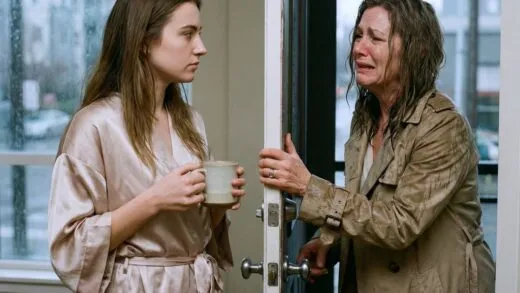
The dam inside her gave way. And this time, she didn’t cry like someone lost. She cried like a mother remembering the sound of her child’s voice. From the hallway, Brian heard it, and for the first time in five years, he let the tears fall too.
The results came back on a Thursday morning. Brian sat alone at his desk, the envelope resting under his fingers like a weight he hadn’t prepared for. He didn’t need to open it, not really. He already knew. He had known the moment she whispered Leo’s name with that ache in her voice only a mother could carry.
Still, seeing it in ink made something in him finally exhale. Donna Bennett is the biological mother of Leo Blake.
He leaned back in his chair, eyes fixed on the ceiling, the edges of his vision blurring. It was no longer a question of if; it was now what.
That evening, Brian returned home to the quiet apartment he shared with Lisa. She was sitting on the couch, reading. She looked up when he entered, and something in her expression told him she already knew. Maybe it was the way his face had changed, or maybe she’d seen it coming long before he did.
He sat across from her, clasping his hands. “I need to talk to you.”
Lisa closed her book slowly. “It’s her, isn’t it?”
Brian nodded. “Yes, she’s Leo’s mother.”
Lisa’s gaze softened, not with sorrow, but with understanding. “And she was yours, too.”
He didn’t deny it. They had both known this marriage wasn’t built on love. It had been comfort, companionship—something quiet they reached for in the aftermath of separate griefs.
Lisa leaned forward, resting her elbows on her knees. “You were always halfway somewhere else, Brian. I didn’t resent it. I just… hoped maybe we could grow into something steady.”
“I’m sorry,” he said, his voice barely audible.
She gave a sad smile. “Don’t be. Go where your heart never left.”
She stood, kissed him once on the forehead, and walked away without packing bags or slamming doors. Just… gone. And it was the kindest goodbye he had ever received.
The next morning, Brian knocked gently on the apartment door where Donna was staying. She was sitting by the window, her hair pulled back, looking stronger than she had days ago, though a quiet nervousness flickered behind her eyes. When she saw him, she stood but didn’t come closer.
“I know,” she said before he could speak, “about the test.”
He nodded. “It’s real.”
She smiled, but it didn’t reach her eyes. “I guess that means I really existed. At least… to someone.”
Brian took a careful step forward. “Donna.”
But she raised her hand gently. “I’m not the same woman you loved,” she said, her voice calm, steady. “I don’t even know if I’m her anymore.”
He looked at her, truly looked—at the scar on her face, the softness in her posture, the fear she tried to hide behind quiet strength.
“No,” he said slowly. “You’re not the same, and neither am I.”
She swallowed hard.
“But you’re still Leo’s mom,” he continued. “And you’re still the woman I waited for. I just didn’t know I was still waiting.”
Donna blinked, lips trembling slightly. “I don’t have a map back to who I was,” she whispered. “I’m afraid of being someone new, of being someone not enough.”
“You don’t have to be her,” he said. “You just have to be here, with us.”
There was a long silence. Then she stepped forward, and he took her hands into his. They were small and cold, but they didn’t pull away.
“We’re a mess, Brian,” she said quietly.
He smiled through the thickness in his throat. “I know. But we’re our mess.”
Later that night, Brian found Leo curled up on the couch, drawing. He looked up as Brian entered. “Did she remember me today?” Leo asked.
Brian sat beside him. “She’s remembering more every day.”
Leo nodded, satisfied. Brian wrapped an arm around his son. “We’re going to be okay,” he said softly. “Not perfect, not easy, but together.” And that was enough.
The mornings began slowly now. Donna would wake to the sound of soft sunlight filtering through the curtains—not alarms or street noise, no sirens, no cold concrete floors, just warmth and the rhythmic ticking of a small wall clock she had grown to trust.
Once a week, she sat in a quiet room with a therapist named Marla. They talked, sometimes in words, sometimes just in silence. It was strange at first—naming things, saying “trauma” out loud, owning a grief she hadn’t even fully remembered. But piece by piece, the fog started to lift.
Between sessions, Donna learned how to live again. She burned rice the first time she tried cooking on her own, then laughed until she cried. She watched YouTube tutorials on folding shirts properly. She wrote in a plain leather journal, one line a day.
Today, I smiled without guilt….