
He wouldn’t let a soul get close to him, standing as a silent, trembling fortress of pain and defiance. It didn’t matter if it was the frantic medics with their sterile equipment, the on-call veterinarian, or even the battle-hardened SEAL team that had physically pulled him from the line of fire.
The animal was badly hurt, losing blood at an alarming rate that painted a grim picture on the clinic floor. Every time a well-meaning human hand reached out, he met it with snapping jaws and a look of cold, calculating recognition of a threat.
The consensus among the gathered staff was that he was dangerous, unstable, and likely beyond any conventional help. They whispered in the corners of the room, suggesting that he had finally snapped under the weight of his service.
The prevailing theory was that the trauma of the field had pushed him past the point where he could ever trust a human hand again. That theory held firm until a rookie SEAL stepped into the middle of the growing storm, moving with a calm that defied her rank.
She was young, held no high position of power, and had gone almost entirely unnoticed in the loud commotion of the emergency. She leaned in, ignoring the warnings of those around her, and whispered six words into the heavy, tense air of the clinic.
These six words were not found in any standard manual; they belonged to a single, highly classified unit. The dog didn’t just stop his aggression; he went completely, unnervingly still as if a switch had been flipped.
He locked eyes with her, searching her face for a specific kind of truth, and then slowly extended his mangled leg into her open palms. What the experts in the room hadn’t grasped was that she knew his hidden history, his true identity, and exactly what he had lost in the dust of the battlefield.
When a elite dog like that decides to shut out the rest of the world, sometimes it takes the one right voice to pull him back from the edge of the abyss. It was nearly 2100 hours when the heavy glass doors of the Bayside Emergency Veterinary Clinic were thrown open with a violent, echoing crash.
Two Military Police officers backed into the lobby first, their heavy boots slipping on the polished tile surface. Their uniforms were a chaotic mess of dried mud and dark, irregular stains that told a story of a desperate extraction.
Trapped on a sagging gurney between them was a wounded Belgian Malinois, his powerful muscles tight and ready to strike at a moment’s notice. He wasn’t wasting energy on pointless barking or growling; he was simply tracking every movement and every shadow in the room.
He watched the staff like a live explosive waiting for a single tripwire to be touched by an unsuspecting hand. “Call sign: Ghost,” one of the MPs managed to say between heavy, ragged breaths as they stabilized the gurney.
“Shrapnel wound. He’s refusing any kind of approach, and he’s already taken a chunk out of a field medic’s sleeve.” The officer looked exhausted, his eyes darting toward the dog with a mix of respect and genuine fear.
“We tried to get field tourniquets on him to stop the flow, but he wouldn’t let us get near the site of the injury.” Before the officer could even finish his sentence, Ghost gave a sudden, violent jerk that rattled the metal frame of the gurney.
He snapped the leather muzzle halfway off his face with a strength that seemed impossible for an injured animal. A nearby nurse let out a sharp cry of alarm and scrambled back to get out of his immediate striking range.
“Good grief,” the attending vet muttered while pulling on a pair of tight latex gloves, his brow furrowing in concern. “What kind of animal are we dealing with here? This isn’t a standard K9 unit behavior.”
“He’s a SEAL team dog,” the MP answered quickly, his voice dropping to a more somber tone. “Or he was. His handler is KIA, killed in action during the same blast that took the dog’s leg.”
“We found the dog trying to drag his own weight toward the extraction point, refusing to leave the side of his fallen partner.” A junior technician tried to move in with a heavy harness sling, hoping to stabilize the dog for an X-ray.
Ghost lunged instantly—not a wild, panicked movement, but a calculated and frighteningly fast strike aimed at the equipment. The heavy harness hit the floor with a loud metallic clatter that echoed through the sterile hallway.
One tech dived for cover behind the bulky X-ray machine, while another immediately started toward the locked cabinet where the heavy sedatives were kept. “He’s going to lose that limb if we don’t act now,” a lieutenant remarked from the doorway, watching the scene unfold with grim detachment.
“We can’t even get within arm’s reach of him to assess the damage. We can’t stop the bleeding if we can’t touch him, and that’s a lot of significant muscle damage.” The veterinarian let out a frustrated remark, his patience wearing thin as the clock ticked.
“Prepare a full sedative load, three cc’s intramuscular. I have no intention of being a casualty myself on a Tuesday night.” Ghost seemed to recognize the word “sedative,” or perhaps he just felt the shift in the room’s frantic energy.
He sensed the way the hands reached out with a false confidence that comes from underestimating a professional soldier. He let out a long, haunting howl that seemed to vibrate through the floor and freeze the blood of everyone present.
Then, with his claws skidding on the cold metal of the gurney, he reared up and tore through the remains of the leather muzzle entirely. White foam was visible at the corners of his mouth, and dark stains continued to trail down his hind flank, marking his territory in red.
Despite the opening and the lack of restraint, he didn’t try to bolt for the exit doors. Instead, he backed himself into a corner, his tail tucked low and his chest heaving with every ragged, painful breath.
His ears were pinned back hard against his skull, and his eyes never wavered from the circle of people surrounding him. They were trying to “fix” him without bothering to see if he was even ready to be touched by strangers.
“He is completely unhandleable, a total liability,” someone whispered from the safety of the back of the room. “He’s gone too far into the red zone,” another voice added, heavy with professional skepticism.
“It isn’t just the physical pain that’s driving him. He looks absolutely terrified, like he’s still back in the blast zone.” No one tried to stop the vet as he finished prepping the heavy syringe with a steady, clinical hand.
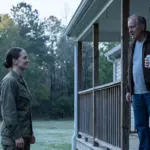
That was the exact moment a new figure appeared in the open doorway, casting a long shadow over the tile. She was quiet and steady, standing with her arms folded firmly across her chest.
She wore dusty SEAL fatigues, her hair pulled back into a tight, regulation bun that showed she was still on duty. Her boots were clearly worn and coated in the fine silt of a recent operation.
She didn’t carry a clipboard, and she didn’t lead with her rank or a loud voice; she just brought a sense of absolute stillness to the chaos. At first, nobody in the frantic room even realized she was there, with the sole exception of Ghost.
His ears gave a tiny, almost imperceptible twitch, and for the first time in over an hour, the low rumble of his growling stopped. She didn’t make a grand entrance or shout orders like the senior corpsman, who was currently stomping around the clinic.
Petty Officer Riley Hart walked softly across the threshold, her movements deliberate and non-threatening. Her uniform was wrinkled from a long, uncomfortable transport, and her sleeves were pushed up to her elbows.
“Get back, Hart,” the senior corpsman barked as soon as he noticed her presence. “This isn’t some training exercise for juniors to practice on.”
She didn’t move an inch, nor did she bother to waste energy on an argument. Her focus was entirely on Ghost, and the Malinois hadn’t looked away from her since she arrived at the door.
He was still panting hard, his side pulsing with every rapid heartbeat, but his pupils had narrowed and sharpened with focus. His frame was still rigid, but the defensive bracing had lessened slightly.