The morning light over the northern highway was less of a dawn and more of a gray realization. It was the kind of cold that didn’t just sit on the skin but tried to pry its way underneath it—sharp, clean, and indifferent. On either side of the asphalt, the pine forests stood in rigid formation, a wall of dark green bristling against a sky the color of a bruised peach.
Traffic had thickened, bottlenecked by roadwork that seemed to have been abandoned for the season. Orange cones and blinking arrows heralded the delay, while men in high-visibility jackets stood like sentinels, their breath pluming in the frigid air. It was a landscape where time stretched thin, where drivers stared through windshields with glazed eyes, thinking about anywhere but here.
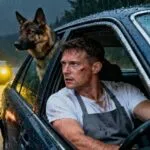
Cade Rourke drove with both hands on the wheel, his posture upright and effortless. At forty, he carried his height—just over six feet—with a quiet density. He wasn’t built like a gym rat chasing aesthetics; he was built like a man who had trained because survival required it. His face held the angular, clean-shaven geometry of American masculinity: a strong jaw, high cheekbones, and blue-gray eyes that scanned the horizon with a practiced, distant alert.
He wore his standard uniform for solo travel: a long-sleeved camouflage combat shirt and matching trousers. The fabric was worn soft but kept immaculate, fitted to his frame without restricting a single range of motion. A tactical belt hugged his waist, carrying a utility pouch and a holster that looked more like a toolkit than a weapon mount. On his left wrist, a heavy black-faced watch caught the weak winter sun as he adjusted his grip. It wasn’t a costume. It was habit. It was armor.
Cade was heading toward Briar Hollow, a pinprick of a town he’d selected specifically for its lack of history. He told himself he was starting over, though he knew better. “Starting over” was just a bedtime story people told themselves to tolerate the morning. He had left the Navy SEALs six months ago—officially retired, unofficially adrift. The war hadn’t followed him home with loud bangs; it came in the silence of empty rooms and the way his body remained coiled to strike long after the threat had vanished.
He wasn’t thinking about the past when he saw her.
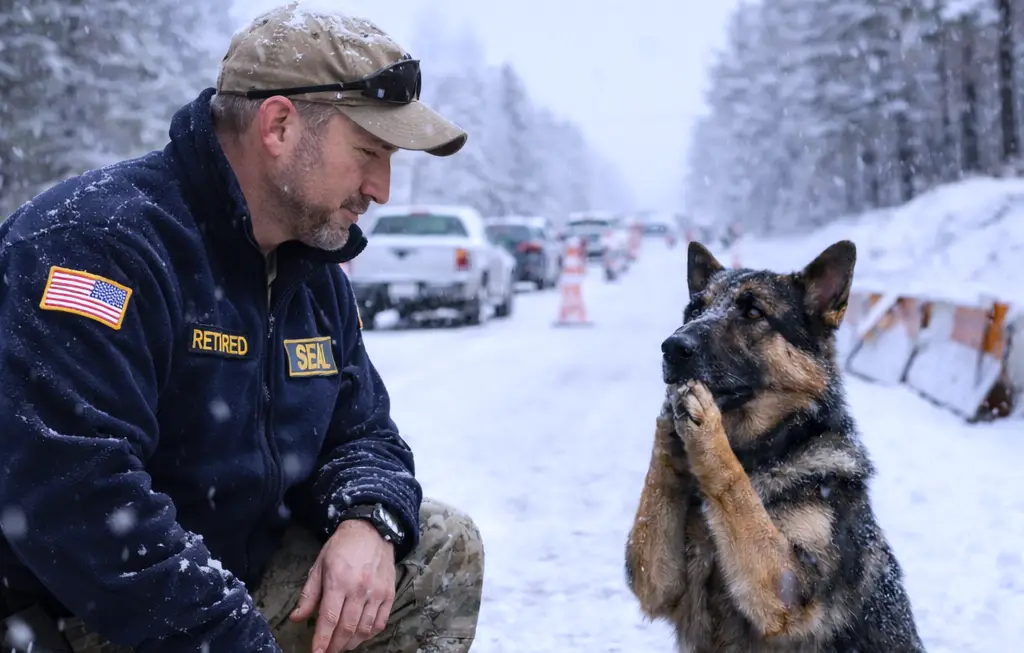
She stood near the median, just past the rumble strip where the construction widened the shoulder. Cars thundered by, kicking up slush and grit, but the dog didn’t flinch. She was a German Shepherd, her black and tan coat thick but matted with road grime and winter debris.
She sat bolt upright, her spine a straight line against the chaos. Her front paws were pressed together, lifted slightly off the cold ground, almost touching. It looked like a trick, or a prayer. But Cade knew anatomy; he saw the tremor in her flanks. She wasn’t performing. She was exhausting the last of her strength to stay visible.
Beside her, tucked precariously against the concrete barrier, sat a white foam cooler box stained with mud. Inside, barely registering as more than shadows, three tiny shapes were curled into a desperate knot. Puppies. Weeks old. Running out of time.
Cade eased his foot off the accelerator. Logic kicked in, the voice of his training: Traffic is moving. Stopping is a hazard. Not your sector. He cataloged the scene in a heartbeat. No owner. No leash. No collar visible from this distance.
He could keep going. He should keep going.
The dog didn’t look at the passing sedans or the eighteen-wheelers. She looked right at him. Her eyes were a warm, burning amber, devoid of panic. There was no wild begging in that gaze, only the crushing resolve of a creature that had played its last card and was waiting to see if the universe would fold. Cade had seen that look on human faces before, usually right before the end.
He drove past her.
The truck rolled another thirty yards. His chest tightened, a sharp, physical pressure that had nothing to do with his heart and everything to do with his conscience. His jaw clenched until his teeth ached.
He checked the rearview mirror. She hadn’t moved. She was a statue of expectation, her head turned to follow the empty space where his truck had been.
“Dammit,” Cade swore softly.
He pulled onto the shoulder, the gravel crunching loudly under his tires. He killed the engine and sat for a second, listening to the ticking of cooling metal and the hiss of passing tires. This was how it always started. One small deviation. One choice to open a door that should have stayed shut.
He opened the door anyway.
The cold hit him like a physical blow. Cade crossed the distance to the dog with deliberate, fluid steps, keeping his hands visible and his body language neutral. The Shepherd tracked him, her ears swiveling, but she didn’t bare her teeth. Up close, the tragedy was in the details: the ribs visible beneath the heavy coat, the faint, hairless groove around her neck where a rope had once been tied too tight for too long.
“You did this on purpose,” Cade murmured. It wasn’t an accusation. It was respect.
He crouched beside the foam box and peeled back the Styrofoam lid. The puppies were impossibly small, their eyes barely open, fur patchy and soft. They let out thin, high-pitched whimpers as the cold air rushed in, blindly seeking warmth. Without a second thought, Cade shrugged out of his jacket and wrapped the box in it, tucking the sleeves to seal in the heat.
He lifted the bundle. The mother dog rose instantly. She didn’t jump or cower; she simply stood, fluid and controlled, and stepped back to give him operational space. When he turned back toward the truck, she fell in step beside his left knee, heeling perfectly without a command.
She hopped into the back seat and sat down, spine straight, looking forward. It was unnerving. She acted as if she had rehearsed this extraction a thousand times. As Cade climbed into the driver’s seat, the light caught a dull glint at her throat. A rusted metal tag hung from a frayed leather collar, the surface pitted by corrosion. Only one letter remained legible, etched deep enough to survive the elements.
An ‘L’. Or maybe an ‘I’. A fragment of a name, or perhaps just a beginning.
The road stretched on. The pine forests gave way to open fields dusted with a hard frost. The truck’s heater hummed, battling the chill. In the back seat, the German Shepherd didn’t curl up to sleep. She remained seated, alert, watching the world blur past.
Fifteen minutes later, the sensation hit Cade. It was a familiar, unwelcome crawler—a prickling at the base of his skull, the tightening between his shoulder blades. The feeling of being watched.
He glanced at the rearview mirror. The dog had turned her head. She was studying him, not with animal curiosity, but with a terrifyingly human assessment. She leaned forward, her nose twitching, and then, with deliberate slowness, placed one heavy paw on his shoulder.
The touch was gentle but firm. Cade’s grip on the steering wheel turned white-knuckled. His heart hammered a sudden, violent rhythm against his ribs. He pulled the truck onto a turnout and killed the engine, his hand drifting instinctively toward the utility pouch on his belt.
He rested his forehead against the steering wheel, inhaling deeply through his nose, exhaling through his mouth. Tactical breathing. Four count in, four count hold, four count out. He grounded himself, pushing back the memories of other roads and other sudden stops.
When he lifted his head, the dog hadn’t moved. Her paw was still on his shoulder, warm and heavy through his shirt. She wasn’t warning him of a threat outside. She was anchoring him.
“All right,” he whispered, his voice rough. “I see you.”
He stepped out of the truck and scanned the treeline, just to be sure. Nothing but winter silence and the gray sky. When he got back in, the pressure in his chest had uncoiled. The dog withdrew her paw and settled back against the seat. Her watch was done.
They drove the rest of the way to Briar Hollow in a companionable silence.
Cade turned down the narrow road leading to the edge of town as the sun climbed higher, sharpening the shadows of the trees. He pulled into the gravel drive of a small rented house tucked against the forest. It was a simple, boxy structure, unremarkable in every way—exactly what he wanted.
He carried the foam box inside, placing it near the floor heater in the kitchen. The puppies began to stir, their soft mewling filling the quiet space. The German Shepherd followed him in, stopping just inside the doorway to survey the perimeter.
Cade straightened and met those amber eyes. “You can stay,” he said, the certainty in his voice surprising him. “For now.”
The dog’s ears flicked. She walked over to the box and lay down, curving her body around it like a protective wall. Cade watched as her breathing finally slowed, the tension draining from her muscles as if she had been holding herself together with sheer will for days.
He sank into a kitchen chair, exhaustion washing over him. Outside, the wind whispered through the pines. Inside, four new heartbeats filled the room. Cade didn’t know the dog’s name yet, or why that single rusted letter on her tag felt like an omen. He didn’t know that the choice he’d made on the side of the highway had just altered the trajectory of his life.
He only knew that for the first time in months, something had pierced the numbness of his existence—not with a bang, but with trust.