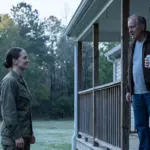
The house sat on the edge of the forest like an afterthought, a single-story structure with weathered gray siding that seemed to absorb the twilight rather than reflect it. A narrow porch faced the tree line, where the pines pressed in close, forming a natural palisade that blocked the wind and kept the world at a comfortable distance. It was the kind of place chosen by people who didn’t want to be found, or by those who needed the silence to be loud enough to drown out their own thoughts.
Inside, the warmth from the heater pooled slowly, fighting the chill that radiated from the floorboards. Cade set the foam box near the vent, angling it with military precision so the draft would warm the puppies without drying out the air. He moved with a methodical economy of motion, every gesture measured. In his previous life, a mistake in calculation meant a flag draped over a coffin. Here, it just meant a cold draft, but old habits were etched into his bones.
The puppies were shifting now, a tangle of soft fur and high-pitched squeaks. Alive. Fragile. Cade crouched there longer than necessary, watching their ribs expand and contract, counting the breaths the way he used to count seconds between mortar impacts.
The German Shepherd stepped fully into the room. She was medium-large, her frame lean beneath the black and tan coat, her movements possessing a fluid grace that spoke of reserved power. Her ears swiveled like radar dishes, mapping the acoustics of this strange new territory. She didn’t sniff frantically; she observed.
Only when Cade sat back on his heels did she move. She approached the box with deliberate care and curled her body around it, a living barrier between her offspring and the unknown. She rested her chin on her paws, her amber eyes locking onto Cade’s face. The tension in her shoulders dropped a fraction—barely visible, but to Cade, it was a shout.
He held her gaze for a long beat. “Vesper,” he said softly.
The word hung in the quiet air. Evening Star. The light that appears when the day begins to fail but refuses to let the darkness win. The dog lifted her head slightly, acknowledging the sound. It wasn’t a question; it was a baptism.
The puppies needed names too. They were distinct little personalities even in their blindness. The smallest one, darker than the rest and already trying to climb over his siblings, Cade named Mika. The one with the restless paws who couldn’t seem to settle became Pip. The third, a quiet female with a pale, thumbprint smudge of white on her chest, he called Junie. Vesper watched the christening with a tilted head, her expression unreadable but intensely attentive.
The first night passed in jagged fragments. Cade didn’t trust the bed in the back room yet; it felt too far from the door. He slept in the armchair near the heater, boots still laced, his jacket folded under his head. He woke in starts—sometimes to the thin cry of a puppy, sometimes to the silence of the woods, and once, in the dead hour before dawn, to the phantom echo of a scream that wasn’t there.
He jerked upright, heart hammering a frantic rhythm against his ribs. Vesper was already there. She had risen from her post and placed herself between him and the dark hallway, standing broadside. She wasn’t growling. She was simply there, a solid anchor in a room that felt like it was spinning.
Cade watched her silhouette against the faint light of the window. His pulse slowed. He exhaled, the sound long and ragged.
“I’m good,” he whispered.
Vesper waited until his breathing leveled out before she returned to her puppies. She knew.
Morning arrived with a pale, anaemic light that revealed the dust motes dancing in the air. The romance of the rescue faded into the logistics of reality. Cade bundled the puppies into the truck, Vesper shadowing his every step, and drove into Briar Hollow.
The town revealed itself as a collection of faded postcards: a diner with steam-fogged windows, a hardware store with a hand-painted sign, and a post office that looked like it hadn’t changed since the Carter administration. People on the sidewalk glanced at his truck without interest, until they saw the German Shepherd in the back seat. Then, they looked twice.
The veterinary clinic was a low brick building on the outskirts, smelling of antiseptic and wet fur. Dr. Helen Mercer was waiting. She was a woman in her late fifties, tall and spare, with silver-blonde hair pulled back into a severe knot. Her movements were efficient, stripped of unnecessary flourish. She handled the puppies with hands that were gentle but firm, the hands of someone who had seen enough life and death to respect both equally.
“They’re young,” she said, her voice dry. “Too young to be weaned. Whoever dumped them didn’t care if they made it through the night.”
Vesper stood by the metal exam table, her eyes tracking Dr. Mercer’s every move. She didn’t bristle, but she didn’t wag her tail. She was evaluating the threat level. When the vet reached out to check Vesper’s neck, parting the thick fur to reveal the hairless, scarred groove of an old injury, she paused.
Mercer’s brow furrowed. “I’ve seen this before,” she murmured. She looked up at Cade, her eyes sharp behind wire-rimmed glasses. “Not the dog. The situation.”
Cade leaned against the doorframe, crossing his arms. “Go on.”
“Someone came in last week,” Mercer said, pulling off her latex gloves with a snap. “An older woman. Local. She was asking about a German Shepherd and a litter of puppies. She was frantic. Said they’d been taken.”
Cade felt a subtle click in his mind, like a round chambering in a rifle. “Did she leave a name?”
“No,” Mercer replied. “But she left an impression. She was terrified. Not of the dogs—for them.”
Cade gave Dr. Mercer his contact information. She wrote it down on a notepad, underlining the number twice. “If you find her,” the vet added, “tell her they’re safe. She looked like she hadn’t slept in days.”
The drive back to the house was quiet, but the silence had changed. It was no longer empty; it was heavy with questions. Cade had thought this was a simple case of abandonment—a cruel act by a callous owner. But frantic old women didn’t dump puppies on frozen highways.
Over the next three days, a routine established itself. It was a rhythm Cade hadn’t expected to tolerate, let alone welcome. Feedings every four hours. Cleaning the box. Short walks along the perimeter of the forest where the ground was frozen hard. The physical demands of caring for the animals left him exhausted in a new way—a good tiredness, one that settled in his muscles rather than his mind.
Vesper adapted with frightening speed. She learned the acoustic signature of the house: the groan of the porch step, the tick of the heater, the specific vibration of Cade’s truck in the driveway. By day, she followed him from room to room, never underfoot, always maintaining a tactical distance. By night, she positioned herself to cover both the front door and the puppies.
It was on the fourth evening that the atmosphere shifted.
The sun had just dipped below the tree line, painting the sky in bruises of purple and gold. Cade was at the kitchen table, nursing a cup of black coffee, when Vesper stood up. It wasn’t a casual movement. It was a snap to attention.
Her ears pricked forward, her body going rigid as a drawn bowstring. Cade set his mug down without a sound.
“What is it?”
Vesper didn’t look at him. She walked to the front door, her claws clicking softly on the linoleum, and stopped. She didn’t bark. Instead, she turned her head and fixed Cade with an intense, meaningful stare. She took two steps toward him, then turned back to the door.
Come. Look.
Cade stood up, the old instincts flooding his system with adrenaline. He moved to the door and opened it, stepping out onto the porch.
The evening was still. The forest stood like a held breath. There were no headlights on the road, no sound of an engine, no crunch of footsteps on gravel. Just the wind moving through the pine needles with a sound like rushing water.
But Vesper remained tense at his side, her nose lifting to taste the air, her gaze locked on the curve of the road where it disappeared into the trees. She was tracking something Cade couldn’t see and couldn’t hear.
He stood there for a long moment, scanning the darkness, feeling the hair on his arms rise. He didn’t believe in ghosts. He believed in patterns, in cause and effect. And the pattern was changing.
Vesper finally relaxed, letting out a sharp exhale through her nose. She turned and walked back inside, settling down next to the puppies as if the danger had passed—or postponed.
Cade remained on the porch for another minute, watching the shadows lengthen. He thought about the rope scar on Vesper’s neck. He thought about the older woman Dr. Mercer had described. And he realized that the highway hadn’t been an ending for these dogs. It had been an escape.
Someone had wanted them gone. And now, Cade suspected, that someone was beginning to wonder where they were.
“All right,” he said to the empty yard. “We’ll be ready.”
He went back inside and locked the door. The heavy deadbolt slid home with a sound that felt less like security and more like a declaration of war.