Every Christmas Eve, Graham Elridge did the same thing. He stood by the tall window in his living room, scotch in hand, staring out at the quiet snowfall that blanketed the town of Snow Ridge, Vermont.
The scene outside looked like something from a postcard, warm lights glowing from every house, smoke curling gently from chimneys, the faint sound of holiday music drifting through the crisp air. Inside his home, however, the silence was absolute. Graham’s house was large, modern, and immaculately clean, every surface gleaming, every piece of furniture in perfect order…
The tree in the corner was decorated with silver and white ornaments, elegant but cold. No presents sat beneath it. The fireplace was dark.
The only sound came from the ticking of a clock and the occasional creak of old wood reacting to the cold. He stood still, his reflection cast faintly in the glass before him. The snow outside fell in thick, soft flakes, swirling in the glow of the streetlamp at the end of the driveway.
Somewhere down the road, someone laughed, a dog barked, wind chimes jingled on a neighbor’s porch. He had everything on paper. At thirty-five, Graham was the founder and CEO of one of the most successful health tech companies on the East Coast.
His name was known in boardrooms and business magazines. In town, however, he was simply known as the man who lived alone in the big house on Pine Hollow Road. He did not attend the annual Christmas festival.
He never joined the carolers. He did not wave from his porch. In Snow Ridge, where people still borrowed sugar and brought pies to new neighbors, Graham Elridge was a ghost in a tailored coat.
And yet, every year, on Christmas Eve, he found himself here, by the window, waiting. For what, exactly, he could never explain. I do not know who I am waiting for, he thought.
A stranger? A shadow? Or maybe just a sound that breaks the silence. Maybe even a miracle in the snow. He took a small sip of the scotch and set the glass back on the table without tasting it.
Every detail of the evening seemed painfully familiar. The untouched dinner on the stove. The folded blanket on the arm of the couch.
The single strand of lights on the tree that never blinked. All of it repeated like a ritual, year after year. All of it heavy with memory.
Snow piled higher on the windowsill as the night deepened. Graham glanced at the clock. Almost nine p.m. Another Christmas Eve nearly come and gone, just like the last.
And the one before that. Still, he stayed by the window. Still, he watched.
The ache in his chest was quiet but constant. Not sharp, just ever-present, like a song you could not quite hear but could never stop feeling. And then, it came.
A sound. Faint, but unmistakable. Three short knocks on the front door.
Graham turned sharply, unsure he had heard right. He stood frozen for a second. No one ever knocked on his door, certainly not on Christmas Eve.
Another pause. Then the knock came again, this time a little louder, followed by the crunch of snow beneath small feet. He moved toward the door slowly, each step across the hardwood floor feeling heavier than the last.
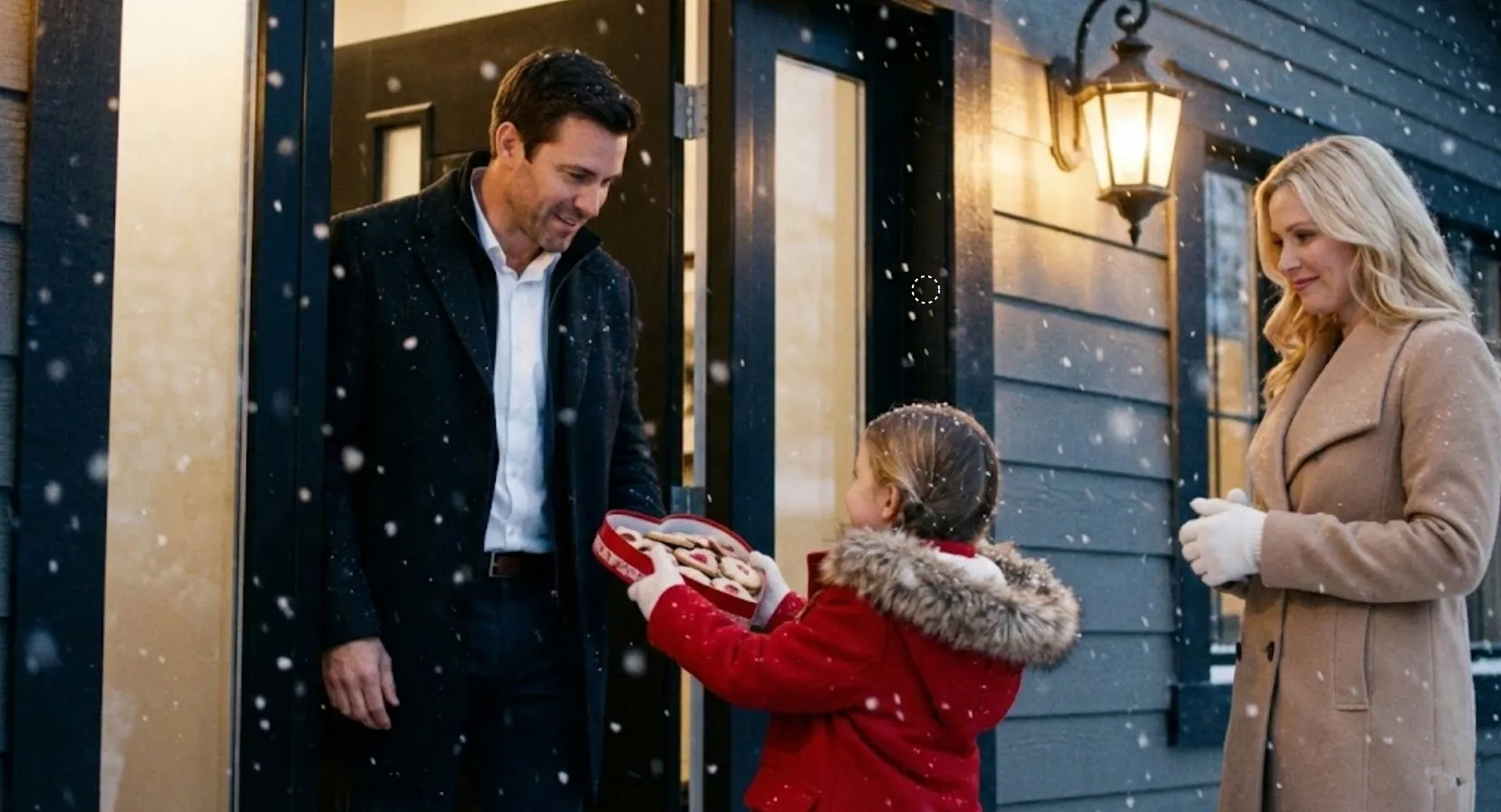
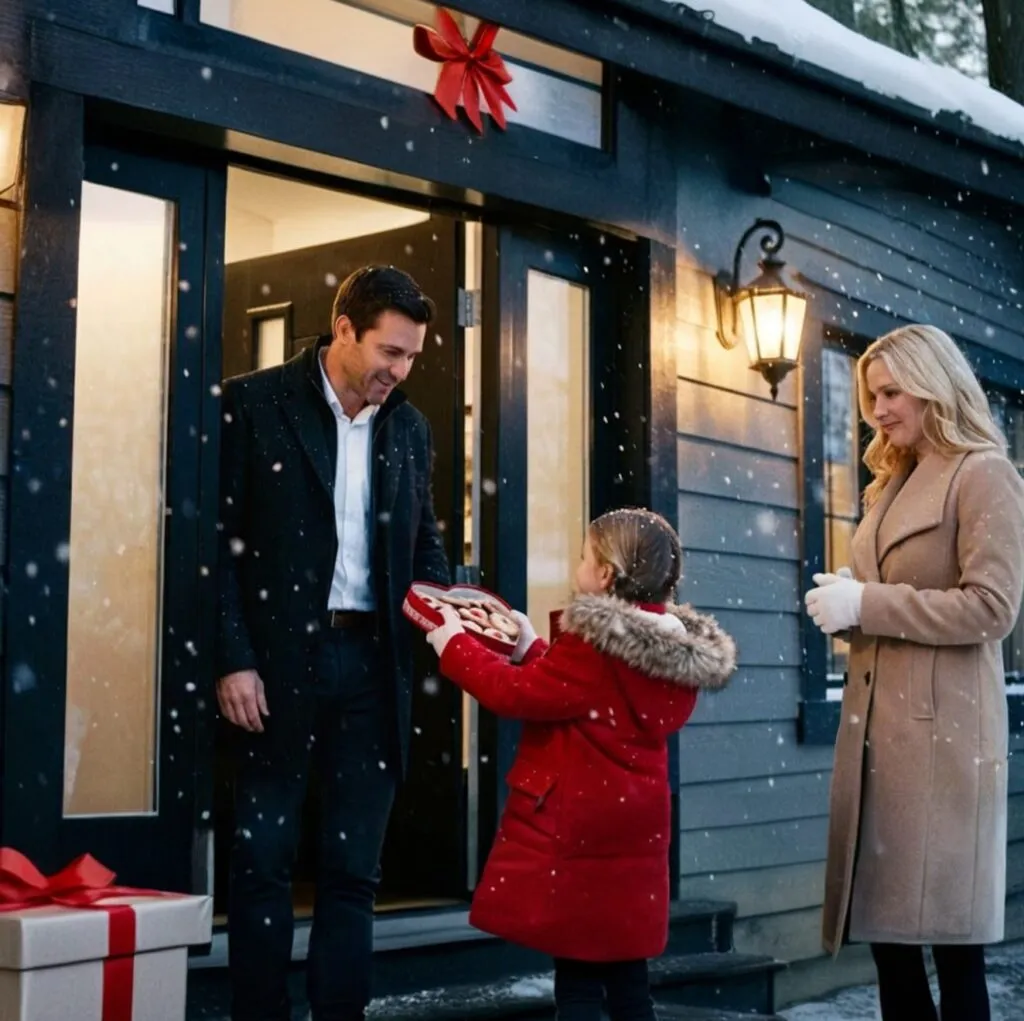
At the entryway, he hesitated before placing his hand on the brass handle. When he opened the door, the winter air rushed in, cold and fresh and startling. And there, on his front step, stood a young woman with pale blonde hair pulled neatly beneath a worn knitted scarf, snow clinging to the hem of her coat.
Beside her, a little girl in a bright pink dress and white mittens held up a small box wrapped in red paper, her cheeks flushed from the cold. They both looked up at him, blinking against the falling snow. The girl smiled shyly.
The woman opened her mouth to speak. Graham said nothing. He simply stared.
They stood together on the porch, three strangers in the soft hush of Christmas night, snow swirling gently around them, just as the church bells in the distance began to ring. The woman smiled softly, her breath visible in the cold air. Hi, she said.
I hope we’re not interrupting anything. Graham stood in the doorway, uncertain. The little girl beside her tilted her head and held up a small box in her mittened hands.
We brought cookies, she said brightly. We’re giving them to our new neighbors. The woman gave a quiet laugh.
She insisted we deliver them tonight, said Christmas cookies taste better when they’re shared. Graham looked from the girl to the woman. Something about them felt completely out of place and yet oddly right.
I see, he said finally. We just moved in, she continued, down the street, blue house with the red door. She extended a gloved hand.
I’m Lila Hartwell, and this is my daughter, Poppy. The girl gave a small wave. Hi.
Graham realized he’d been standing silent too long. He cleared his throat and stepped aside. Would you like to come in? He asked.
The words felt foreign on his tongue. Lila raised her brows slightly. Are you sure? He gave a small nod.
Yes, it’s cold. Lila smiled, warmer this time. Thank you.
She guided Poppy inside, brushing snow from their coats. As Graham closed the door, something shifted. The silence in the house, once heavy, felt almost breathable.
Poppy looked around wide-eyed, taking in the tall ceilings, the bare tree, and the warm light. Wow, she whispered. It looks like a castle.
It’s just a house, Graham said softly, but it’s really, really quiet, she added. Lila smiled, but her eyes wandered thoughtfully over the space. No music, no scent of food, no sign of daily life.
They followed Graham into the kitchen. Lila placed the cookie box on the counter while Poppy wandered to inspect the cupboards. I hope you like chocolate chip, Lila said, opening the box.
We tried gingerbread, but someone got creative with the spices. Poppy giggled. I thought it needed cinnamon and ketchup.
Graham chuckled, genuinely. The sound surprised even him. I’m glad you went with chocolate chip.
Suddenly, Poppy sniffed the air and her eyes widened. Is that hot chocolate? she asked. Graham turned quickly.
He had forgotten the pot warming on the stove. He moved to switch off the heat. It is, he said.
Would you like some? Yes, please, Poppy said, bouncing slightly. He reached for the mugs. His hand paused over the usual stack, then moved to the back of the cabinet.
He pulled out a pair of old ceramic cups, ivory with blue floral trim. Gently, he wiped the dust from their rims before pouring the cocoa. He handed one mug to Poppy, the other to Lila.
She accepted it with a glance, brief but knowing. This is really good, Poppy said after a sip. I’m glad, Graham replied.
She swung her legs under the chair, feet not quite touching the floor. We’ve been bringing cookies to every house we can, she said. Mom says it’s our family tradition.
Even if it’s just us two, it’s something we started a few years ago, Lila added. To teach her that giving is what makes the season feel like Christmas. Graham said nothing.
He just watched Poppy sip cocoa from a mug that hadn’t been touched in six years. There was something about her, her joy, her honesty, that reached into places heat and light never had. And for the first time in a very long time, Graham didn’t feel like a stranger in his own home.
The kitchen carried the same cold perfection that defined the rest of the house. Spotless countertops, minimal decor, and everything in its proper place. But tonight, something unexpected sat at the center of the table.
A slightly cracked tray of homemade cookies, wrapped in parchment and tied with string. Graham placed three ceramic mugs of hot cocoa on the table, carefully sliding a napkin under the smallest one so Poppy’s little hands would not burn. He moved with quiet precision, unfamiliar with the rhythm of hosting.
They gathered around the table. Lila draped her scarf over the back of her chair. Poppy wiggled in her seat, legs swinging, her pink dress peeking out from under her coat.
For a while, there was only the clink of spoons and the crunch of cookie crumbs. Outside, snow fell in a hush, blanketing the street in white. Poppy’s eyes wandered to the small artificial Christmas tree in the corner, bare except for a pale star at the top.
Why is your tree sad, Mr. Graham? she asked. Graham blinked. Sad? She nodded.
It looks like it has no one to play with. Lila chuckled softly. Graham, caught off guard, let out a dry, genuine smile.
Well, he said, it’s been living alone for a while. I guess it got used to it. That answer seemed to satisfy her, for the moment.
As Lila and Graham chatted about the town and the cafe where she worked, Poppy quietly slipped from her chair. Neither of them noticed right away. She tiptoed to the tree, untied the pink bow from her blonde hair, and carefully fastened it to one of the top branches.
Then she pulled out a handful of brightly wrapped candies from her coat pocket and hung them across the lower branches. Finally, she tugged gently at the hem of her dress, unthreaded a thin piece of white lace, and draped it like a garland around the middle of the tree. There, she announced, stepping back.
Now it has friends. Graham turned, startled. The little tree, once forgotten, now sparkled softly, clothed not in polished ornaments, but in the offerings of a five-year-old girl.
Lila stood beside him, covering her mouth, eyes glassy. Graham walked over. He knelt beside Poppy and gently adjusted the bow.
I think, he said softly, this might be the happiest the tree has ever been. Poppy beamed. Lila looked at Graham, not as a mystery, not as the man alone in the big house, but as someone who had quietly opened his world to something fragile and real.
Later, as the clock neared ten, Lila bundled Poppy into her coat and gloves. Snow had started to gather on the walkway. Graham walked them to the door.
Thank you for having us, Lila said. It meant more than you know. Thank you for coming, Graham replied.
Just as Lila reached for the door, Poppy darted back. She threw her arms around Graham’s waist and squeezed. Then she leaned up on tiptoes and whispered, I left my bow on the tree, so tomorrow it won’t look lonely.
Graham stood still, eyes fixed on her as she skipped back to her mother’s side. He watched them walk into the snow, their figures slowly fading down the hill. Inside, the cocoa mugs remained on the table.
The air still held the warmth of laughter, and across the room, on the once forgotten tree, the soft pink bow fluttered gently in the heat from the vent. It was the first thing someone had left behind in his home in years, and the first thing that had not been taken back. The snow did not melt for weeks.
The town of Snowridge, remained blanketed in white, its streets lined with icicles and windows frosted in lace. But for Graham Elridge, something had changed since that night. The silence in his home still lingered, but it no longer felt hollow, just quiet, like a room waiting to be filled.
And then, gently, his routine shifted. It began with morning walks down Main Street, then came short visits to the local bakery where Lila worked part-time. The first time he stopped in, she looked surprised, pleasantly.
He ordered coffee and a croissant, thanked her, and left. The next day, he returned. Poppy was there, sitting behind the counter with a coloring book and apple juice.
When she saw him, her face lit up. Mr. G, she called. The nickname stuck.
Soon, Graham came in daily. Sometimes he stayed five minutes, sometimes twenty. He asked Lila about her dream of opening a cookie stall at the winter market.
She laughed it off, saying she lacked the time, money, and paperwork. Graham just nodded. A few days later, an email arrived in her inbox, a local grant application from a new start-up initiative backed by Elridge Innovations.
No signature, no explanation. But Lila knew. She never mentioned it.
Neither did he. Meanwhile, Graham and Poppy grew close in the effortless way that only happens when someone listens, really listens. She invited him to the winter craft fair.
He showed up, awkward in a scarf, holding cider and pretending not to smile. She talked him into helping her build a snowman in the town square. He did, leather gloves and all.
At the library’s holiday story hour, he sat beside her, reading aloud in silly voices while she giggled through every page. Mr. G reads funny, she whispered to Lila later. I like it.
Still, something unspoken hovered between Graham and Lila. Their connection was warm but cautious. They laughed easily but moved carefully.
He never pushed, she never assumed. Then one day, in the bakery, Graham cleared his throat and asked, if you’re free, maybe you and Poppy would like to come over for dinner. Lila raised a brow.
Are you cooking? He smiled, sheepish. Attempting to. She glanced at Poppy, who squealed, yes.
That Friday evening, the air was crisp with pine and chimney smoke. Graham’s home looked different. The tree in the corner still stood, but now it wore Poppy’s candies and pink bow.
A few handmade paper snowflakes dangled in the window. Lila arrived, carrying Poppy’s backpack and a bottle of wine. She stopped short as a warm, spiced scent reached her from the kitchen.
Is that cinnamon? She asked. Graham appeared in the doorway, apron over his and nutmeg. I hope I didn’t ruin it.
He led them to the dining table, where three plates were set with mismatched silverware. In the center was a tray of galettes de pommes, small French apple tartlets. Lila stared, eyes wide.
I mentioned these once, she murmured. My mom used to make them when I was little. I haven’t tasted them in years.
Graham gave a small shrug, not quite meeting her eyes. You said they were your favorite. I thought I’d give it a try.
She stood frozen, touched beyond words. Then, quietly, she placed the wine on the counter, stepped forward, and wrapped her arms around him. It was not romance, not yet, but it was something deeper than politeness.
When she pulled back, her voice trembled. I don’t know what to say. You don’t have to, he said.
In the kitchen, Poppy had already grabbed a tartlet and was humming a Christmas tune, slightly off-key, as she licked cinnamon from her fingers. Lila blinked away tears. Graham turned back toward the oven, giving her a moment of privacy, pretending not to notice.
But something unspoken lingered in that small, glowing kitchen. It was not just kindness, not just comfort. It was the beginning of something neither of them had dared to name, something that, for the first time in a very long time, felt a little bit like home.
The following week, winter deepened. Snow blanketed the sidewalks like powdered sugar, and the town moved in slow, muffled rhythm. Most evenings, Graham walked Lila and Poppy home after dinner or cocoa.
And though they spoke often, the truest moments came in the quiet, when neither tried to fill the silence. One night, after Poppy had fallen asleep on the rug with a book across her chest, Lila tucked a blanket over her and looked toward Graham. He sat in the armchair, turning a mug between his hands.
She adores you, Lila said softly. He smiled faintly. I adore her too.
They let the silence stretch, a kind of peace that invited truth when it came. You’re good with her, Lila said. Most men wouldn’t know how.
But you, listen. Graham’s gaze drifted to the fireplace, long gone cold. I think it’s because, he said quietly, I always thought I’d be a father.
Lila turned, eyes softening. My wife was six months pregnant when she died, he said. Setting down his mug.
Car accident. It was snowing that night. The words came without decoration.
Just the truth. Stripped bare. I was supposed to meet her for dinner.
She was late. I was annoyed, then worried. Then came the call.
Lila said nothing. She only listened. They didn’t save the baby, he continued.
A boy. We’d just picked his name. He swallowed hard.
After that, I worked. That’s all I did. I even tried to adopt later, but they said I wasn’t suitable.
He gave a small, bitter laugh. Too isolated. Too unstable.
They weren’t wrong. Lila crossed the room and sat across from him, elbows on her knees. That’s not who you are now.
He looked at her, but his voice stayed quiet. Maybe not anymore. She hesitated, then spoke, almost to the floor.
Poppy’s dad left when I told him I was pregnant. Said he wasn’t ready. I haven’t seen him since.
Graham’s eyes softened. It was hard, she said. Not just raising her.
The judgment. Everyone thinking I’d ruined my life. You didn’t, he said simply.
Not even close. Their eyes met, holding steady. There was no pity, only understanding.
Two people who had lost differently but deeply. For a long while, they sat in silence. The air felt fragile but calm.
Two quiet hearts learning to breathe and sink again. Eventually, Lila rose, gathered her sleeping daughter into her arms, and thanked him for the evening. When the door closed behind them, Graham remained in the dim glow of the lamp, the ticking clock marking each second of the stillness.
Then his gaze fell to something on the table. The cookie box. It still sat where Poppy had left it the first night.
Red cardboard with a crumpled corner and a faded green ribbon. He hadn’t moved it. Neither had they.
He reached for it slowly, fingers brushing the edge. For a moment, he simply held it, feeling the weight of what it represented. Not sugar or flour or ribbons, but something far rarer.
Connection. For years, he had kept every surface spotless, every schedule rigid, every emotion filed neatly away. But now, looking at that simple little box, he felt the walls he’d built start to bend.
The tears surprised him. They came softly at first, like snow melting from a roof, then faster, until he could no longer hold them back. He bowed his head, shoulders shaking in the silence, the box cradled in his hands.
He cried for the boy who never came into the world. For the woman he lost. For the years he’d hidden behind success and solitude.
And for the small, miraculous chance that maybe, somehow, life was offering him one more try. Not the same dream. Not the same family.
But a second chance. To love. To give.
To open the door again. Not just for others. But finally, mercifully, for himself.
It began with a knock at Lila’s door. Not Graham’s this time, hers. She opened it to find a man standing on her porch, wrapped in a too-new coat, a duffel bag at his feet, and a look on his face that made her stomach twist.
Lila, he said, as if his voice still belonged here. We need to talk. That man was Daniel Reeves, Poppy’s biological father.
The man who had walked out the moment Lila told him she was pregnant, five and a half years ago. Now, without warning, he was here, in Snow Ridge, and claiming he wanted to be part of his daughter’s life. But he was not here to ask.
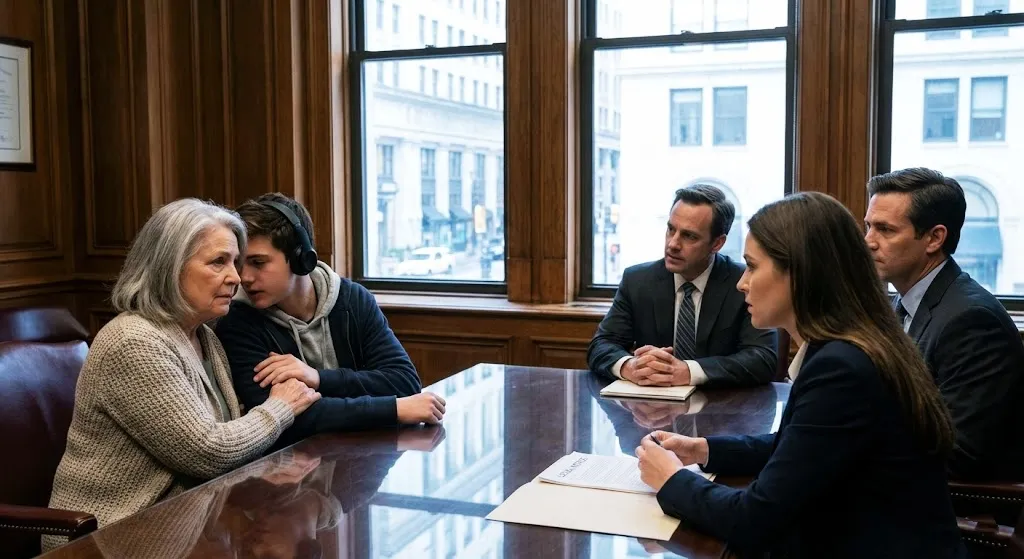
By the end of the week, Lila received an official letter from a local attorney. Daniel had filed for partial custody. He had moved to Vermont, found temporary work, and claimed he was ready to step up.
Lila sat on the floor of her living room, letter trembling in her hands. Poppy was at school, Graham was at work. She had never felt more alone.
She could not afford a lawyer. And worse, some part of her still carried that old shame, that echo of people whispering she was irresponsible, unstable, too young, too alone. Daniel had money now, charm, a good haircut.
In court, he could spin any story he wanted. When she told Graham that night, her voice barely rose above a whisper. He listened without interruption, then gently set his mug down and asked, Do you want me to help? Lila hesitated.
She looked down at her hands, unable to meet his eyes. I do not want to take advantage of you, she said. This is not your responsibility.
I… I am embarrassed even saying it. Graham stepped closer. Lila, he said quietly, you never asked me for anything.
I am not doing this because you begged me or because I feel obligated. He waited until she looked up. I am doing this because you and Poppy deserve someone to stand beside you.
That is all. You do not have to carry this alone. Her throat tightened.
She nodded, tears threatening to spill, but she kept them in. Within two days, Graham had quietly hired one of the most respected family law attorneys in the state. Lila protested at first, but he only said, Let me do what I can, please.
He also agreed to serve as a character witness. The courtroom was small and wood-paneled, tucked away in the next town over. Lila sat stiffly beside her attorney while Daniel leaned confidently across the aisle.
Graham sat in the second row, his suit immaculate, his face unreadable. Then the judge called him forward. Graham stood, straightened his jacket, and walked to the witness stand.
He spoke clearly, calmly. I have known Lila Hartwell and her daughter for several months, he began. In that time, I have watched this woman raise a child with more love, grace, and strength than many two-parent households I have seen, he paused, locking eyes with the judge.
Poppy is happy, well cared for, deeply loved. She is thriving, because of her mother. Daniel’s lawyer tried to rattle him with questions about his connection, his intentions, but Graham held firm.
I am not family, he said, but I care deeply about them, and if this court is worried about whether Poppy will have a stable, safe life, I would offer anything I have to ensure it. Then he turned slightly, voice lowering just enough to soften the room. If what Poppy needs is a father figure, if she needs someone who will be there, day after day, in every quiet moment that matters, then I am ready.
He looked directly at Daniel. Not because I want to replace anyone, but because I will never walk away. Silence fell across the courtroom, even the clerk paused in her typing.
Lila sat frozen, tears streaking her cheeks now, her hand clutched over her heart. In that moment, the man who once locked the world out had just opened it wide, and everyone in that room could feel it. One year later, Snow Ridge looked just as it always did in December, quiet streets lined with wreaths, strings of white lights glowing beneath layers of frost, and pine trees wrapped in red ribbon outside every shop.
But the house at the end of Pine Hollow Road was different now. Inside, the once cold walls echoed with laughter, wrapping paper littered the living room floor, ribbons trailed under the coffee table, and a faint sweet scent of freshly baked cookies hung in the air. Careful with the frosting, Poppy! Lila called from the kitchen sink, laughing.
I am being careful! Poppy shouted back from the table, her face dusted with flour, a pink apron tied over her dress. This one is for Mr. G, I want it to look like a Christmas tree, not a blob. Graham entered the room just in time to hear that, still brushing Snow from his coat.
He paused in the doorway, smiling to himself. Hey, he said, hanging the coat on the rack. What are we turning into a blob this time? Poppy grinned and held up a green smeared cookie that vaguely resembled a tree.
Graham stepped closer and knelt beside her. It’s perfect, he said. Poppy beamed.
I made it with extra icing, because I know you always say you don’t want any, but then you eat mine anyway. Graham pretended to gasp. You have cracked my secret.
Lila handed him a warm mug of cider, brushing flour from his shoulder. Welcome home, she said. He looked at her then, really looked at her, her golden hair pulled up in a loose bun, sleeves rolled, cheeks flushed from the oven’s heat.
This was the version of her he loved most. Not that he had ever said it out loud, neither of them had. They did not need to.
Everyone in town knew. The way Graham walked beside her at the winter market, holding Poppy’s handmade crafts like they were priceless treasures. The way Lila always saved him the last piece of cranberry scone at the bakery, even when it sold out.
The way he showed up at school, plays and snowball fights, with thermoses of cocoa and mittens tucked in his pockets for emergencies. They never announced they were together. They did not have to.
And when the judge finalized the paperwork two months ago, officially approving Graham’s adoption of Poppy as her legal guardian, no one questioned it. Not even the town gossip. After all, he had already been showing up for her every day.
He never tried to replace anyone, he just became what she needed. And she? She filled every silent room he used to live in. Now, the living room was scattered with toys and music.
A stack of Christmas books waited on the couch. The small, artificial tree that once stood bare now overflowed with mismatched ornaments, some store-bought, most made by Poppy’s hands. One still held the pink bow she had left behind that very first night.
As dusk settled and the snow began to fall again, Graham opened the front door, letting in a gust of cold air. Where are you going? Lila asked from the kitchen. He turned and grinned.
Just checking. For what? He looked out across the quiet street, lights twinkling in windows, and said, Just wanted to see what it feels like when the doors open. He paused, then looked back at her and Poppy, flower covered and glowing in the kitchen light.
Turns out, he added, it feels a lot like home. The Christmas tree this year was nearly twice as tall as the one from last year. It brushed the ceiling with its twinkling star, every branch decorated with handmade ornaments, candy canes, and little hearts cut from red and green felt.
Lila stood back with her arms folded, watching the lights flicker across the room. Poppy had gone overboard, as usual, with glitter and glue, and Graham had let her, also as usual. Now, the three of them stood together in the living room, bathed in the soft golden glow of the tree and the crackling fire.
Snow was falling gently outside. Through the tall windows, flakes clung to the glass, blurring the edges of the world in white. Poppy leaned against Graham’s side, her hand tucked in his.
She wore her favorite pink holiday dress, the one with the satin ribbon tied in the back, and carried a tray of warm cookies with careful concentration. Lila stepped closer, slipping her hand into Graham’s free one. She looked up at him, her voice low and full of meaning.
You saved us, she whispered, me and Poppy. You gave us back something we never thought we’d have again. But Graham shook his head, gently tightening his fingers around hers.
No, he said. You two saved me. His gaze dropped to Poppy, who was now humming a carol under her breath, adding one last cookie to the tray.
I didn’t know what a family was supposed to feel like, he continued. Not really. Not until I opened that door and found you both standing there.
Lila’s eyes glistened. Graham turned to Poppy and knelt down so they were eye to eye. She smiled at him, soft and sweet, with powdered sugar still dusted on her cheek.
From now on, he told her, every Christmas, I’ll be the one knocking on the door first. Just to remind you how much I love walking through it. Poppy’s face lit up.
She leaned forward and kissed his cheek, then carefully picked up the tray of cookies again. Time to knock, she declared proudly. Graham opened the front door, letting in the crisp night air.
The world outside was hushed, glowing with lights and the faint sound of bells from the church tower downtown. The little girl in the pink dress stepped onto the porch, holding the tray steady. Then, with a giggle, she turned and knocked gently, once, twice, three times, on their own door.
Lila laughed. Graham smiled. The door was already open, but it did not matter.
Because this time, the knock was not about entering. It was about welcoming others in. Across the street, a moving truck was parked outside the small cottage on the corner.
The porch light flicked on as Poppy called out, cookies for the new neighbors. Inside, the warmth of home followed them. Lila, Graham, and Poppy stood arm in arm under the porch light as the snow continued to fall, catching in their hair and eyelashes, soft as breath.
The church bells rang again. Twelve chimes. Midnight.
Christmas Day. Graham looked down at the two people beside him, their laughter, their light, their love, and for the first time in many years, he felt the peace he had once believed he would never find again. They stepped back into the house, leaving the door open behind them.
And for just a moment, under the falling snow, it seemed as though the whole world paused to listen. Then, in the softest hush, came the sound of three hearts beating in rhythm, and the quiet promise of a life just beginning. And that was the story of The CEO Who Waited Alone Every Christmas.
A quiet tale of love, loss, and the miracle of second chances.