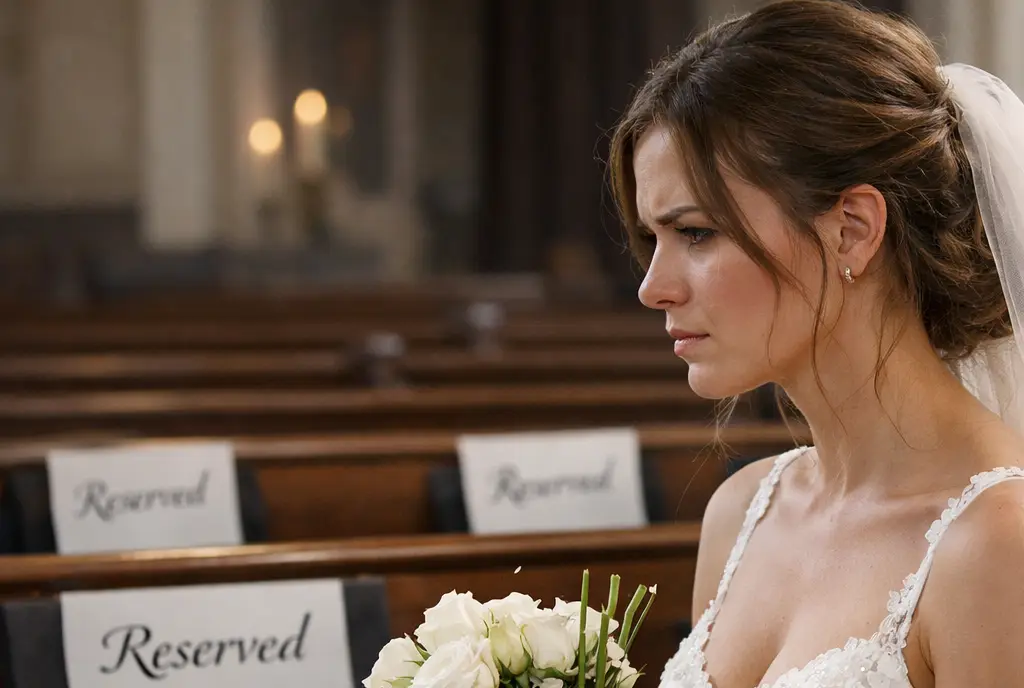
My name is Elena. I am 34 years old, and on my wedding day, the front row of pews in the chapel—the one marked with white satin ribbons reserved for the bride’s immediate family—was completely, painfully empty. No one from my side walked me down the aisle.
No one from my side sat in those seats we had carefully reserved. A few hours earlier, while I was getting my hair done, my phone had lit up with the last text from my mom, a cheerful little sentence that felt like a slap in the face. “We are setting sail now, honey! Signal is cutting out. Have a great party!”
Your brother’s Mediterranean cruise is already underway. It was not a joke. It was not a misunderstanding.
She had actually picked a discounted luxury boat trip over my wedding. My brother had texted me the week before, laughing about it like it was nothing. “This deal was once-in-a-lifetime, the ship leaves Friday, you get it.”
I stood there in my white dress, listening to the organ music start, pretending I did not see those empty spaces, pretending it did not matter that my own family had decided that an all-you-can-eat buffet and ocean views were more important than seeing me say my vows. People later told me they were sure my family had their reasons, as if there was any good reason for a mother to skip her daughter’s wedding for a last-minute travel deal. The funny part is, they all assumed I would just swallow it, forgive, and move on, because that is what I had always done.
They thought I would smile through the hurt, and wait for whatever “later celebration” my mom kept promising. But months after that day, when the roles were reversed, and they were suddenly the ones begging me to show up for a massive family wedding of their own, I finally stopped playing the understanding daughter. I just smiled and said, “Not this time.”
If you think choosing a vacation over your child’s wedding is the worst part of this story, wait until you hear how far my family went to defend that choice, and what I finally did to make them taste their own lesson. Before all of that, before the empty pews and the fake promises to celebrate later, it actually started pretty simply. My name is Elena.
I live in Chicago and work as a graphic designer for a marketing firm, mostly remote, juggling Zoom calls, client revisions, and endless emails. I met my now-husband Mark in a used bookstore five years ago. We both reached for the same vintage sci-fi novel in a dusty bin, both ready to walk away if the interaction was awkward.
Instead, we ended up talking until the owner flipped the sign to “Closed” and practically chased us out. From that day on, that bookstore felt like the unofficial starting point of my real adult life. When Mark proposed, he did it in our tiny kitchen, sliding a ring across the counter while we were making homemade pasta on a snowy Tuesday night.
It felt obvious that our wedding date should be the anniversary of that first meeting, an autumn weekend far enough out that everyone in our lives could plan around it. We booked a historic hotel ballroom downtown, sent in the deposit that made my stomach flutter, and started sending save-the-dates to co-workers and friends whose calendars fill up months in advance with kids’ activities, business trips, and limited vacation days. At the beginning, my mom, Brenda, acted thrilled.
She cried on FaceTime when I held up my hand to show her the ring, said she was proud of me, and immediately launched into questions about colors, floral arrangements, and what kind of dress I imagined. She repeated more than once, “I wouldn’t miss my only daughter’s wedding for anything in the world.” My younger brother, Ryan, who works in real estate and always acts like he’s closing a million-dollar deal, dropped a quick congrats in the family group chat, along with a couple of jokes about the open bar and how he was going to charm all the bridesmaids.
My dad, Robert, who is retired now, said he had always wanted to see the hotel we chose, and maybe we could do a family dinner there before the wedding. For a little while, it felt like everyone was pulling in the same direction. Then, a few weeks after we put the deposit down and started paying vendors, my mom called me, sounding oddly hesitant, the way she does when she is about to make her problem my responsibility.
She said she had just realized my chosen date overlapped with an “exclusive” Mediterranean cruise package Ryan had found. She launched into a speech about how hard he works, the volatile market, the stress of sales, how this trip is the one thing that keeps him from burning out. At first, I thought she was just venting, so I said something like, “That is tough timing, but we booked the venue months in advance.”
She paused, then asked, very carefully, if Mark and I could move the wedding. Not by a day, not by shifting the time, but to an entirely different month so Ryan wouldn’t have to lose his non-refundable deposit. She moved straight into her greatest hits list of sacrifices from my childhood, stories I have heard a hundred times about the things she gave up to raise us, how she always put her children first, and how she expected us to do the same for each other.
The message underneath was clear: a good daughter is flexible when the family needs her to be. I reminded her that changing the date would mean losing thousands of dollars on the venue, renegotiating contracts with vendors, and probably forcing half our guests to rebook travel they had already arranged. She immediately accused me of being rigid and dramatic, said a wedding was just one day, and that mental health and “family bonding experiences” were long-term things.
A few minutes after we got off the phone, Ryan texted me directly. He launched into a whole explanation about how he had found an unbelievable “last-minute” deal on this cruise line, how everything was all-inclusive, and how outrageous the cancellation fees would be. He ended by saying he really needed this break for his sanity, and that he knew I would understand because I have always been the “chill one.”
When I did not immediately cave, my mom started bringing it up constantly in calls and messages, sometimes gently, sometimes with that sharp edge in her voice. She said that as the sister I should be more accommodating, that I was putting one single party over my brother’s well-being, that weddings can be moved, but ships have strict schedules. Meanwhile, I was staring at spreadsheets of my colleague’s schedules, vendor timelines, and our budget, realizing that we had already built our lives around this date.
I told her calmly, over and over, that we were keeping it. That was when the tone really shifted. In the family group chat, she began complaining in vague terms about people who do not think about others and how some children forget everything their parents have done for them.
Ryan posted an Instagram story about people who act like the world revolves around their “little events,” paired with a screenshot of the cruise itinerary, which was about as subtle as a brick. It was the first time I saw the pattern so clearly with no way to explain it away in my head: in my mother’s mind, my wedding was optional.
My brother’s luxury cruise was not. The official break came in the most casual, almost cheerful way possible. A few weeks before the wedding, my phone buzzed with a group text from my mom that said, word for word: “We will celebrate later, dear. The cruise is set. We will plan a special dinner just for you, when everyone is back on land.”
There were a couple of heart reactions from relatives who, I realized, did not fully understand what that message meant. I did. My stomach dropped. There was no question in that message.
No opening for a conversation. No apology. It was a statement of priorities.
My wedding was the thing that could be postponed. My brother’s discounted Italian vacation was not. I called her immediately.
When she answered, she sounded annoyed, like I had interrupted packing. I asked her straight out if that text meant she, my dad, and Ryan were not coming to the wedding. She sighed, long and dramatic, and said, “Elena, you know how rare these tickets are. Your brother has worked himself to the bone. He needs this ocean air. We can have a nice dinner when we get back. Maybe invite a few relatives. It will still be special.”
I told her a dinner after the fact was not the same as watching her daughter get married. I said, “This is my wedding, Mom. Not a birthday you can celebrate any weekend.” She snapped back that I was being ungrateful, that I was refusing to see the bigger picture, that family has to be flexible for each other.
When I asked where that flexibility was when it came to me, there was a beat of silence. Then she changed the subject and said she did not want to argue. My dad texted me later that night.
It was short. Just, “I am sorry, kiddo. I wish the timing had worked out. We will make it up to you.” I stared at that message for a long time before typing back. “So you are really choosing to sit on a boat deck next to Mom and Ryan instead of coming to your only daughter’s wedding?” He never answered.
I imagined him in his recliner, reading my text, feeling guilty, and then putting the phone down because confronting my mother would be harder than disappointing me. In the days leading up to the wedding, my social media feed filled with pictures of my family in Europe. Ryan posted endless shots of the ship’s pool, ocean views, plates of pasta, all with captions about “La Dolce Vita” and resetting with the people who matter most.