A week later, they discharged me. I wasn’t fully healed; I was still sore, still slow, and still bruised in places I couldn’t see. I would be on strict bed rest for weeks. But I could walk. I could think. And I could make decisions. Which was all that mattered.
My father arrived at 10 in the morning to pick me up. He’d brought a suitcase.
“You’re staying with us until you recover,” he said. He didn’t ask. He announced it. The way he announced everything. No arguments.
“That’s kind of you, Dad. But Debra’s picking me up. She has a spare room, and since she’s a nurse, it makes sense.”
His face changed. Not dramatically. Gerald Thomas never let the mask slip far. But the corners of his mouth tightened.
“You’d rather stay with a stranger than your own family?”
“She’s not a stranger. She’s been my emergency contact for three years.”
Something moved behind his eyes. A calculation. But it didn’t land. He didn’t connect it to the proxy. Not yet.
“Fine,” he said. He picked up the suitcase he’d brought and walked out without saying goodbye.
That evening, Meredith texted: Dad’s upset. You’re being ungrateful, after everything he’s been through.
I read it. I set my phone down. I didn’t respond.
At Debra’s apartment, I sat at her kitchen table and called Kessler. We went over the timeline.
He confirmed the filings: the court motion to void the fraudulent deed, the police report for forgery, and notification to the mortgage lender about the disputed title. Everything was ready. Everything was in order.
“Sunday,” I said.
“Sunday,” he agreed.
That night, my father called. I almost didn’t answer, but I needed to hear it.
“By the way,” he said, his tone casual, almost rehearsed. “Grandma Lillian’s house. I’ve been handling the estate stuff. Don’t worry about it. I’ll explain when you’re feeling better.”
He was testing me, checking the perimeter, seeing if I knew.
“Okay, Dad,” I said. “Thanks for taking care of it.”
I hung up and set the phone face down on the table. Debra was watching me from the kitchen doorway.
“How do you do that?” she asked. “How do you sound so calm?”
“Practice,” I said. “Twenty-nine years of practice.”
Let me tell you about my father’s church.
First Grace Community Church sits on a tree-lined road in a suburb west of Philadelphia. White steeple, red brick, parking lot that fills up every Sunday by 9:45.
About 120 people attend weekly—families, retirees, small business owners, teachers. The kind of congregation where everyone knows your name, your kids’ names, and what you brought to the last potluck.
Gerald Thomas had been a deacon there for fifteen years. He ushered at the door. He read Scripture from the lectern. He organized the men’s breakfast.
He shook every hand in the room after the service, looked people in the eye, and asked about their kids.
When the church needed a new roof, Gerald led the fundraising campaign. When someone’s furnace broke in January, Gerald fixed it for free and wouldn’t take a dollar.
Pastor David mentioned him in sermons. “A man of faith and sacrifice.” That was the phrase. I’d heard it so many times I could feel it in my teeth.
Every first Sunday of the month, the church held a community potluck gathering in the fellowship hall—folding tables, casserole dishes, paper plates, and a standing microphone near the front where people shared blessings and prayer requests.
Gerald always spoke. He always talked about gratitude, about family, about what it meant to give without expecting anything in return.
A hundred and twenty people believed every word. This coming Sunday was the first Sunday of the month.
I called Kessler on Saturday evening. “Can you be there at noon?”
“I’ll be there at eleven thirty.”
I hung up and sat on Debra’s couch. My ribs still ached when I breathed too deeply. The bruises on my forearms had faded from purple to yellow.
I could walk without wincing now, slowly but upright. I wasn’t planning a scene. I was planning a conversation. But when a hundred and twenty people are in the room, every conversation becomes a stage.
Sunday morning, 7 AM. I woke up before the alarm. I stood in front of Debra’s bathroom mirror and looked at myself.
The bruise along my jawline was almost gone. The one under my left eye had turned a faint green. My collarbone was still sore when I lifted my arm too high.
I looked like someone who’d been hit by a truck, because I had been.
I put on a white button-down shirt and black slacks. Simple, clean, no jewelry except the small silver studs Lillian had given me on my twenty-first birthday.
I pulled my hair back, washed my face, and didn’t bother with makeup.
I picked up the manila folder from the kitchen table.
Inside were copies of Lillian’s will, the original deed in my name, the county’s lien records showing my father’s mortgage, and the redacted incident report Pat had provided—the one with my father’s words printed in black ink on hospital letterhead.
I slid the folder into my bag.
Debra drove. We didn’t say much. She turned onto the church road at 11:20 and parked near the back of the lot. The steeple caught the sun.
“Are you sure about this?” she asked.
“I’ve never been more sure.”
She squeezed my hand. “Whatever happens in there, I’ll be right outside.”
I nodded. I opened the car door.
Kessler was already there. I spotted him near the entrance. Gray suit, leather briefcase, standing by the flagpole with the patience of a man who billed by the hour and had nowhere else to be.
He saw me. He gave a single nod.
I walked through the front doors. The service was already underway. Hymns, warm air, the smell of old carpet and coffee. I slipped into the last pew and sat down.
My father was in the front row. He turned at the sound of the door and saw me.
His face lit up. The proud father. The grateful deacon. The man of faith and sacrifice. He raised his hand and waved.
I waved back. A small wave. A patient wave.
Meredith sat beside him. She glanced at me. She didn’t wave.
The service ended at noon. The congregation filed into the fellowship hall. A wide, low-ceilinged room with fluorescent lights and folding tables arranged in rows.
Foil pans of baked ziti and green bean casserole. Paper plates stacked beside a tower of napkins. The standing microphone near the front, plugged into a small speaker that hummed quietly.
Gerald was already up there. He always was. He stood beside the microphone with his hands clasped in front of him, waiting for the room to settle.
A hundred and twenty people found their seats. Chairs scraped against linoleum. Children darted between tables. He tapped the mic.
“Good afternoon, everyone. I want to start with something personal today.”
The room quieted.
“As many of you know, my youngest daughter Wendy was in a serious car accident last month. She was in a coma.”
The doctors weren’t sure she’d make it. He paused. He was good at pauses.
“But God is faithful. And today… today, Wendy is here with us.”
He turned and gestured toward me. I was standing near the back wall. Every head in the room turned.
Applause. Warm, genuine applause. A woman in the second row pressed her hand to her heart. An elderly man nodded.
“As a father,” Gerald continued, his voice cracking at exactly the right moment, “there is nothing more terrifying than almost losing your child. I prayed every single night. I never left her side.”
I felt the words land in my chest. Not like a wound, but like a key turning in a lock.
I never left her side. He said that to a hundred and twenty people who had no reason to doubt him.
“Family is everything,” he said. “That’s what I’ve always taught my girls.”
He looked at me. He smiled. He opened his arms, just slightly. The universal gesture of a father expecting an embrace.
I smiled back. I walked toward him. The room watched with soft, expectant eyes.
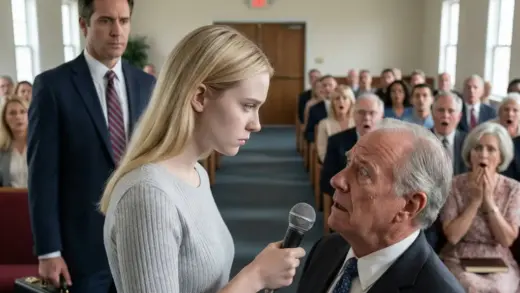
“Dad,” I said, loud enough for the first three rows to hear. “Can I say a few words?”
He didn’t hesitate. He couldn’t. Not in front of a hundred and twenty people who had just heard him call me his miracle.
“Of course, sweetheart.”
He handed me the microphone. His smile was wide, confident. He stepped to the side, hands behind his back, playing the supporting role perfectly.