I opened Roger’s contact and typed a message. Need to talk. Can you come by the store? His reply came quickly. Be there in 20. I set the phone down and looked around the store. The shelves I’d stocked for decades. The register that had served generations. The coffee aisle where the woman had stood minutes earlier. Everything looked the same. But deep in my gut, where instinct lives, I knew something was very wrong.
Who was she? And why was she with Brad? When you need to find the truth, you call someone who knows how to look for lies.
Roger Stevens had been my friend for 40 years. And in that time, I’d learned that he had a particular way of listening. It wasn’t the polite nodding most people do while waiting for their turn to talk. It was real listening. The kind where he’d tilt his head slightly, eyes focused, picking apart every word like he was solving a puzzle.
He walked into Harper Family Market 23 minutes after I’d sent the text. Grey hair cut military short, jeans, and a flannel shirt, with reading glasses hanging from a cord around his neck. He was 67 years old and still moved like a man who’d spent three decades chasing criminals through back alleys.
“You look like hell,” he said by way of greeting.
“Thanks, Roger.”
He glanced around the empty store. “You closed?”
“Sure, flipped the sign. Figured we needed privacy.”
“Must be serious.” He pulled up a stool behind the counter and settled in. “What’s going on?”
I didn’t know where to start, so I started with Ivy. I told him about the ice cream at the park. The whisper, the fear in her eyes when she’d said watch him. Roger didn’t interrupt. He just pulled a small notebook from his pocket—he always carried one, even in retirement—and jotted down notes.
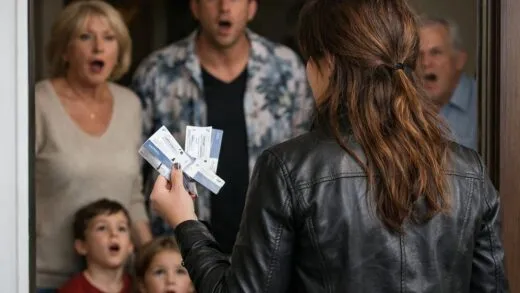
Then I told him about this morning. The woman with the dark hair and leather jacket. Coffee and cinnamon. The way she’d avoided my eyes. How I’d seen her 20 minutes later getting into a car with Brad.
“You get a plate number?” Roger asked.
“No, I was too surprised.”
“Description of the vehicle?”
“Silver sedan. Maybe a Honda or Toyota. I wasn’t paying attention to the car.”
He made another note. “What about the woman? Height, weight, distinguishing features?”
I thought back, trying to remember details. “5’6″, maybe 5’7″. Thin, dark hair in a ponytail. Mid-30s. Expensive-looking leather jacket, brown with zippers.”
“You said she reminded you of someone.”
“Yeah, but I can’t place it. Just a feeling.”
Roger tapped his pen against the notebook. “And Brad’s never mentioned a woman.”
“Never.”
“But you’ve been giving him $40,000 a year for seven years.”
“For Ivy,” I said quickly. “The money’s for Ivy.”
“Right.” Roger’s tone was neutral, but I knew what he was thinking. “Stephen, when’s the last time Brad gave you an update on how that money’s being used?”
I opened my mouth to answer and realized I couldn’t. Not a real answer, anyway. Brad had never sent receipts, never explained expenses. He just accepted the check every January with a quick thanks and moved on.
“He’s raising a daughter alone,” I said, defensive now. “I’m sure it’s going to good use. I’m sure.”
Roger set his pen down and looked at me. “But Ivy told you to stop sending money and to watch Brad. That’s not normal, Stephen. Seven-year-olds don’t say things like that unless something’s wrong.”
“I know.”
“So what do you want me to do?”
That was the question, wasn’t it? I’d called Roger because some part of me knew I needed help. But saying it out loud felt like crossing a line I couldn’t uncross.
“I need to know what’s going on,” I said finally. “I need to know if Ivy’s safe. If Brad’s… I don’t know. Doing something he shouldn’t be.”
Roger leaned back on the stool, arms crossed. “You want surveillance? Watching someone’s comings and goings from outside their property on a public street? Not illegal. Not particularly ethical if you’re doing it to a family member, but not illegal.”
The word family hit harder than it should have. Brad wasn’t blood, but he was Willa’s husband. Ivy’s father. For seven years I’d sent him money because that’s what family did. Now I was talking about spying on him like he was a suspect.
“I don’t want to betray his trust,” I said quietly.
“Then don’t.” Roger’s voice was firm. “Go home. Forget about the woman. Forget about Ivy’s warning. Tell yourself everything’s fine and keep writing those checks.”
I looked up sharply. “You think I should ignore this?”
“No.” He met my eyes. “I think you need to decide what matters more: Brad’s trust or Ivy’s safety.”
The words hung in the air between us. “She’s seven years old,” Roger continued. “She came to you scared enough to whisper a warning in a park. She told you to stop sending money and to watch her father.”
“Kids that age don’t make things up, Stephen. They don’t have the imagination for it. If Ivy’s worried, there’s a reason.”
I thought about Ivy’s face at the park. The way she’d gripped my sleeve. The fear in her eyes. “What do we do?” I asked.
Roger picked up his pen again. “We start simple. I’ve still got some equipment from my detective days. Cameras, recording devices. All legal for private investigation purposes. We set up outside Brad’s house. Watch who comes and goes. See if the mystery woman shows up again. Track his routine. Look for patterns.”
“For how long?”
“As long as it takes.” He flipped to a fresh page in his notebook. “Could be a few days. Could be a couple weeks. Depends on what we find. And if we find nothing, then you’ll know Ivy was confused. And you can sleep better at night.”
Roger looked at me over his reading glasses. “But I’ve been doing this a long time, Stephen. And my gut says we’re going to find something.”
Mine did too. That was the problem. “When do we start?” I asked.
“Tomorrow morning. I’ll bring the equipment. We’ll park down the street from Brad’s place, see what happens.” He stood, tucking the notebook back into his pocket. “Get some rest tonight. Once we start this, you need to be ready for whatever we find.”
I nodded, but I knew I wouldn’t rest. I hadn’t really rested since Ivy’s whisper at the park. Roger headed for the door, then paused with his hand on the frame.
“Stephen, you’re doing the right thing. Protecting a kid always is. Even if it means going behind Brad’s back.”
“Especially then.” He pushed the door open, and the little bell above it chimed. “See you tomorrow. 6 a.m.”
The door closed behind him, and I was alone in the store again. I stood there for a long moment, looking at the coffee aisle where the woman had stood that morning. At the register where she’d paid in cash. At the front window where I’d watched her drive away with Brad.
Tomorrow we’d start watching. Start looking for answers. And I’d cross a line I’d never imagined crossing. As I drove home, I felt like I was crossing a line. But I had to know. For Ivy. Money tells a story; I just had to read it.
Before we started watching Brad, I needed to look at my own records. That evening, I spread seven years of bank statements across my kitchen table. The house was quiet, except for the hum of the refrigerator and the occasional creak of old wood settling.
I’d made coffee, strong black, the way Gloria used to make it when we’d sit up late doing taxes or planning Willa’s college fund. The mug sat untouched beside me as I worked, steam rising into the dim light above the table.
January 2018. $40,000 wired to Bradley Wallace. The memo line read, Family Support.
January 2019. Same amount. Same memo.
I went through every year. 2020, 2021, 2022, 2023, 2024. $40,000 every single time, like clockwork. $280,000 total. I’d known the amount, obviously. I wrote the checks, authorized the transfers, but seeing it laid out like this—seven years in a row, seven identical transactions—made it real in a way it hadn’t been before.
That was a fortune. A small fortune, maybe, but more money than most people saw in a lifetime. And what did I have to show for it?
I pulled out a shoebox I kept in the hall closet. The one with receipts and correspondence, anything related to Brad and Ivy. I sorted through seven years of paperwork, looking for proof that the money had been used properly. Proof that Brad was grateful. Proof of anything, really.
What I found was nothing. No thank-you notes. No updates on Ivy’s education or activities. No pictures of school events or birthday parties. Not a single piece of paper showing how the money had been spent or why it was needed.
The only communications I had were text messages, and they were brief. Almost cold. In January 2019, he’d written, Got the transfer, thanks. The next year, Just received, appreciate it. By 2021, it was down to, Transfer came through. Not even a full sentence most years. Just acknowledgment that he’d taken the money and moved on.
I pulled up my phone and scrolled back through our text history. Hundreds of messages over seven years, and almost all of them were initiated by me. I’d ask how Ivy was doing in school. Could I take her to the park this weekend? Did she need winter clothes? I could pick some up.
Brad’s responses were always short. She’s fine. Sure. We’re good. Never details. Never stories about what Ivy was learning or who her friends were. Never invitations to come over for dinner or join them for anything. Just the bare minimum required to keep me from asking more questions.
And then there were the early requests. I flipped through my calendar, checking dates. Every year, like clockwork, Brad would text me in November or December, asking if I could send the payment early.
In November 2019, he’d written about expenses coming up before Christmas. December 2020, house repairs. November 2021, Ivy’s school stuff. I’d always said yes. Always sent it early. Because family helped family. And I’d promised Willa I’d take care of her daughter.
But now, looking at the pattern, something felt wrong. What kind of expenses came up every single year at the exact same time? And why did a man receiving $40,000 annually need it early? What was he spending it on that couldn’t wait a few weeks?
I opened my laptop and pulled up Brad’s social media, something I rarely did. His Facebook was sparse. A few photos of Ivy from years ago. Some posts about sports teams. Nothing personal.
His privacy settings were tight, so I could barely see anything. But one thing I could see was that his relationship status had changed two years ago, from widowed to in a relationship. Then six months later, it went back to blank.
He’d never mentioned dating anyone. Never introduced anyone to Ivy or me. Who had it been? And what happened? I thought about the woman from this morning. The coffee and cinnamon. The way she’d touched Brad’s arm before getting in the car. Was she the one? Or someone new?
I pulled out a legal pad and started making notes. Not because I knew what I was looking for, but because Roger had taught me once that patterns emerged when you wrote things down. I wrote down everything I could think of.
Brad asking for money early every November or December. Never providing updates or receipts. Minimal communication. No family involvement. The relationship status change from two years ago. The mystery woman today.
Then I wrote down my questions. Where was the $280,000 going? Who was the woman? Why did Ivy want me to stop sending money? What was Ivy afraid of?
I set the pen down and looked at the pile of bank statements. Seven years of faith. Seven years of trust. Seven years of believing Brad was doing right by my granddaughter. Because I couldn’t imagine a father doing anything else.
But what if I’d been wrong? I got up and walked to the living room, where Willa’s urn still sat on the mantle. Beside it was a framed photo of Willa, Gloria, and me at Lake Rayburn the summer before the accident.
Willa was laughing, head thrown back, Gloria’s arm around her shoulders. Both of them looked so alive. “I’m trying, Willa,” I said to the photo. “I’m trying to do right by Ivy. I just don’t know if I’ve been doing it the right way.”
The house was silent. I picked up another photo from the bookshelf, this one of Ivy from last year. She was sitting on the front steps of Brad’s house, arms wrapped around her knees, not quite smiling. I’d taken it during one of my visits. At the time I’d thought she looked thoughtful. Now I wondered if she’d looked sad.
How long had she been trying to tell me something was wrong? I gathered all the bank statements and organized them by year, added the screenshots of our text messages, the information about his social media, the notes I’d just written, everything Roger might need to understand what we were dealing with. I put it all in a folder and set it by the front door so I wouldn’t forget it in the morning.
Two hundred and eighty thousand dollars. That number kept echoing in my head. Not because it was money I couldn’t afford to give. The store did well enough and Gloria and I had been careful savers. But because it represented seven years of promises. Seven years of trying to honor Willa’s memory by taking care of her family.
What if her family didn’t need taking care of? What if they’d been taking advantage? I poured the cold coffee down the sink, rinsed the mug, and stood at the kitchen window looking out at the dark street.
Tomorrow at six in the morning, Roger and I would park outside Brad’s house and start watching. Start looking for answers to questions I should have asked years ago. I should have felt guilty, should have felt like I was betraying Brad’s trust by spying on him.
But all I felt was determined. Ivy had asked me to watch, had trusted me enough to whisper a warning, and I’d failed her for seven years by not asking the hard questions, by accepting Brad’s silence as normal. I wouldn’t fail her anymore. Tomorrow Roger and I would start watching. Whatever we found, I was ready.
Some truths are buried in plain sight. The urn sat on my mantle for seven years. I never opened it.
After organizing all the bank statements and preparing the folder for Roger, I should have gone to bed. It was past eleven and we were meeting at six in the morning. But I stood in the living room staring at that brass urn the way I’d stared at it a thousand times before, and something felt different.
The woman at the store had bought coffee and cinnamon, two items, nothing else. I’d been trying all evening to figure out why that bothered me, and now standing here in the dim light with nothing but silence and the weight of seven years pressing down, I finally understood. Coffee and cinnamon.
My eyes moved from the urn to the framed photo beside it. Willa, Gloria, and me at Lake Rayburn. All of us smiling. All of us believing we had more time.
“I’m sorry,” I whispered to Gloria’s image. “I should have looked sooner.”
I’d avoided the urn for seven years. I told myself it was because I couldn’t let go, because opening it meant accepting that Willa was really gone. But maybe the truth was simpler. Maybe some part of me had known even then that something was wrong.
I lifted the urn from the mantle. It was heavier than I remembered, about the size of a shoebox, cold brass against my palms. The lid was sealed with a simple threaded cap, the kind you could unscrew with your hands.
For a long moment, I just held it. I thought about Gloria standing in this exact spot seven years ago crying so hard she couldn’t breathe. I thought about the funeral. The closed casket. Brad’s face carefully neutral as he accepted condolences. I thought about Ivy, six months old and oblivious, sleeping through her mother’s memorial service.
I carried the urn to the kitchen table and set it down under the overhead light. My hands shook as I gripped the lid. “Forgive me, Willa,” I said and twisted.
The lid came off easily. Too easily. Like it had been opened before.
Inside was a clear plastic bag tied at the top with a twist tie. Through the plastic, I could see dark powder almost black in the harsh kitchen light. It looked like ash. Looked exactly like what you’d expect cremated remains to look like.