I untied the bag and peered inside. The powder was coarse, not fine. Grainy. I reached in and let some run through my fingers.
It felt wrong. Too rough. Too textured. Then I smelled it.
Coffee. Not the faint burnt smell of cremated remains. Not the sterile nothing of ash. But coffee. Rich, dark, unmistakable.
My stomach turned. I brought the bag closer, inhaling deeper. Yes. Definitely coffee. And something else underneath it. Something sweet and spicy.
Cinnamon. The kitchen tilted. I gripped the edge of the table to steady myself. No. No, this couldn’t be right.
This was Willa. This was my daughter. They’d told me it was her. Brad had identified her. The funeral home had handled everything.
I dumped the contents of the bag onto the table. Brown powder spilled out in a heap. Coffee grounds darker in some spots, lighter in others. I sifted through it with my fingers, searching for something, anything that looked like bone. Like the fragments they tell you remain after cremation.
Nothing. Just coffee. And mixed throughout, flecks of reddish-brown that I recognized immediately from 35 years of running a grocery store. Cinnamon. Ground cinnamon.
I touched one of the flecks to my tongue. Sweet. Spicy. Definitely cinnamon.
The powder wasn’t ash. It was coffee grounds and baking spices, the kind you’d buy at any store. The kind a woman with dark hair and a leather jacket had bought from my store just this morning.
For seven years I’d kept this urn on my mantle. For seven years I’d treated it like it was sacred. Gloria had stood here crying, had kissed the cold brass, and whispered goodbye to our daughter.
She’d died six months later, with a broken heart, believing Willa’s remains were resting above our fireplace. And it was coffee. Kitchen scraps. A joke.
The rage hit me so hard I couldn’t breathe. I swept my arm across the table, sending the urn clattering to the floor. It rang like a bell as it bounced, hollow and mocking.
“Damn you!” I shouted at no one. At Brad. At whoever had done this. “Damn you!”
I braced my hands on the table, shoulders heaving, staring down at the pile of coffee and cinnamon scattered across the wood. Seven years. Seven years of grief. Seven years of Gloria destroying herself with sorrow.
Seven years of me honoring an empty promise, paying money to a man who’d helped fake my daughter’s death. Because that’s what this was. Had to be.
If the urn was fake, then the funeral was fake. If the funeral was fake, then maybe the body was fake. And if the body was fake… my phone was in my hand before I’d consciously decided to pick it up.
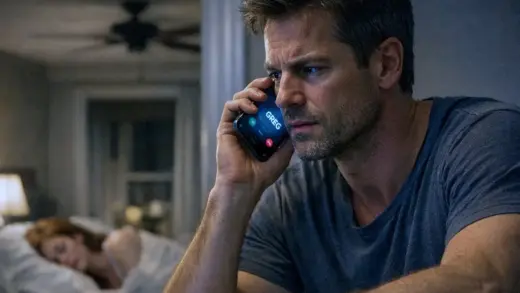
I pulled up Roger’s contact and called. He answered on the second ring, voice groggy. “Stephen, it’s almost midnight.”
“The urn!” My voice came out hoarse, shaking. “Roger, the urn is fake.”
Silence on the other end. Then, more alert. “What do you mean, fake?”
“I opened it. It’s not Willa. It’s coffee. Coffee and cinnamon. Just like the woman at the store bought this morning.”
I heard rustling like he was sitting up. “You’re sure?”
“I’m looking at it right now. Spread all over my kitchen table.” I laughed, but it came out broken. “My wife died thinking our daughter’s ashes were on the mantle. And it was coffee the whole time.”
“Stephen.” Roger’s voice was calm, steady. The detective voice. “Listen to me. Don’t touch anything else. Don’t clean it up. I’m coming over right now.”
“They lied to us.” The words felt thick in my throat. “The funeral. The body. Brad identified someone who wasn’t Willa. They burned someone else and gave us kitchen scraps in a brass box.”
“I’m ten minutes away. Stay there. Don’t call Brad. Don’t call anyone. I’m coming.”
The line went dead. I stood in my kitchen, surrounded by coffee grounds and cinnamon, staring at the overturned urn on the floor. The house was silent, except for my ragged breathing.
Seven years ago, they’d told me my daughter was dead. They’d shown me a closed casket. They’d handed me this urn and told me it contained her remains. And I’d believed them.
Gloria had believed them. We’d mourned. We’d broken. We’d died a little bit ourselves. And it was all a lie.
I looked at the scattered coffee grounds. At the cinnamon mixed throughout. At the empty brass urn lying on its side. My daughter’s urn was a lie. What else had they lied about?
Surveillance is mostly waiting. But when something happens, everything changes.
Roger brought the cameras the next morning. He’d stayed until nearly 1 a.m. the night before, documenting the coffee grounds and cinnamon from the urn, photographing everything and scribbling notes into his small notebook. Before leaving, he told me to get some sleep and that we’d start surveillance at dawn.
I tried. I lay awake, thinking about brass urns, kitchen scraps, and seven years of trust that might have been misplaced. When Roger knocked at 5:30, I was already dressed.
“You look terrible,” he said, hauling two black duffel bags inside. “Didn’t sleep? Figured.”
He set the bags on my kitchen table and unzipped one. Inside were cameras, lenses, recorders, and equipment I didn’t recognize. “We’ll park down the street from Brad’s house. Public road. Legal surveillance. Two old guys sitting in a car.”
“What are we watching for?”
“Patterns. Who comes and goes. When Brad leaves. When he gets home. And whether your mystery woman shows up again.” He lifted a camera with a long lens. “And maybe we learn where $280,000 went.”
We drove to Brad’s neighborhood in Roger’s gray sedan, a car so ordinary it blended into any street. He parked three houses down, far enough not to draw attention, close enough to see the driveway and front door clearly. Then we waited.
Brad left at 7:45. He backed out, turned toward the main road, and disappeared. Roger wrote the time down.
“Usual schedule?” Roger asked.
“He used to be in construction management, I think. I haven’t asked in years.”
Roger nodded but said nothing. We stayed until noon, then rotated. Roger went home. I stayed, watching the house, glancing at Ivy’s upstairs window, hoping she was all right.
Nothing happened that afternoon. Brad came home at 6, went inside, and didn’t come back out. A normal evening. The second day followed the same rhythm. Brad left at 7:45, came home at 6.
Roger and I took shifts documenting everything. Then, late afternoon on day two, the woman arrived. The same silver sedan from the store. She pulled into Brad’s driveway at 2:30, walked to the front door, and unlocked it.
“She has a key,” I said, calling Roger.
He arrived 20 minutes later with the telephoto lens. We watched as Brad and the woman sat on the couch. We couldn’t hear them, but we could see her lean close, see Brad laugh, see her touch his arm with easy familiarity.
They looked comfortable, familiar. “Who is she?” I asked. “When did Brad last mention dating?”
Roger snapped photos. “He hasn’t. Not once.”
She stayed two hours. When she left, Brad walked her to her car. They stood in the driveway talking. Her hand rested on his chest. His hand settled at her waist. Then she drove off.
Roger wrote down her license plate. The third day she came back. Same time, same routine. Stayed an hour. Left.
That weekend when I took Ivy for ice cream, Brad didn’t mention her. Didn’t mention dating. Acted like nothing had changed, but something had. By day four, we knew Brad’s routine. Up at seven. Gone by 7:45. Home by six. The woman visited every other afternoon.
Then on the fourth morning, everything shifted. Brad left at 10 a.m.
“That’s new,” I said.
Roger started the engine. “Let’s see where he goes.”
We followed him, keeping distance. Past Harper Family Market. Past familiar streets. Into the industrial district on the east side of town. Warehouses. Loading docks. Semi-trucks.
Brad turned onto East Industrial Avenue and pulled into a worn parking lot. A large brick warehouse. Building 447. Narrow windows. Few cars. He parked near a side entrance and went inside.
Roger stopped across the street behind a delivery truck. “What is this place?” I asked.
Roger searched on his phone. “Warehouse. Owned by a holding company. Used for storage or light manufacturing.”
“Why would Brad be here?”
“That’s what we need to learn.” We waited. Forty-five minutes passed before Brad came out, got in his car, and drove away. We stayed.
“What do you think he’s doing in there?” I asked.
Roger tapped his notebook. “Could be storage. A side operation. Meetings. With her. Maybe.” He wrote down the address. “We come back. Watch this place like his house.”
I stared at the building. Tall, sealed windows. Quiet. Empty looking. But Brad had just spent forty-five minutes inside.
“There’s something in there,” I said.
Roger nodded. “Yeah. And we’re going to find out what it is.”
I spent the entire night pacing through my house, unable to sleep. Unable to think about anything except the voice we’d heard inside the warehouse. The crying. The pleading. The words that replayed over and over in my head like a broken record. I’ve been here for seven years. When Roger knocked on my door at seven that morning, I had already been awake for hours. “You look worse than yesterday,” he said, as he carried his laptop bag inside. “Didn’t sleep? Figured.”
He placed the laptop on my kitchen table and opened it. “Stephen, I need you to sit down for this.”
“What is it?”
“Just sit, please.”
I sat. Roger pulled up a video file. “Remember when I told you I still have contacts on the force? One of them accessed security footage around the warehouse. All public cameras. Traffic monitoring. Completely legal. And… and this.”
He pressed play. The footage was black and white and grainy, the kind used on nightly news broadcasts. A wide shot of East Industrial Avenue appeared, the timestamp showing early afternoon three days earlier. Cars passed. A delivery truck. Nothing unusual.
Then a woman entered the frame from the left, walking along the sidewalk. “That’s the warehouse,” Roger said, pointing to a building in the background. “That’s the side entrance Brad uses.”
The woman walked closer to the camera. Her face was partially turned away, but as she moved, the angle shifted. Roger paused the video. “Look at her face, Stephen.”
I leaned closer. The image wasn’t sharp, but it didn’t need to be. Dark hair pulled back. Thin frame. Something familiar in her posture and the way her head tilted slightly as she walked.
My heart stopped. “No,” I whispered.
“Look closer.” Roger zoomed in. The pixels blurred, but the shape remained. The nose. The cheekbones. That subtle tilt of the head I had seen thousands of times when she was a teenager, when she was in college, when she stood beside me on her wedding day.
“That’s not possible,” I said, though my voice was shaking.
Roger opened another window. “I ran the image through facial recognition software, compared it to Willa’s driver’s license photo from seven years ago.”
Two images appeared side by side. On the left, Willa’s license photo from 2017. Younger, smiling. On the right, a still frame from the warehouse footage. Older, no smile. Darker hair, but the same face.
“97% match,” Roger said softly. “Stephen, that’s Willa.”
The room tilted. I grabbed the edge of the table to steady myself. “No, she’s dead. We buried her. We had a funeral.”
“You had a closed casket funeral,” Roger said gently. “You cremated someone. But you never saw a body. And the urn was filled with coffee grounds.”
I stared at the screen, at my daughter’s face. Changed, older, but unmistakably alive.
“She’s alive,” I whispered.
“Yes. Willa’s alive.”
“Yes.” The words didn’t make sense. For seven years, I had mourned her. I had stood at her empty grave with its false headstone, and talked to her like she could hear me. For seven years, her urn sat on my mantle, and I believed it held her ashes.
And she was alive.
The grief came first. Not relief, not joy. Grief, crushing and suffocating. Grief for seven years, stolen from us. Seven years Gloria and I could have spent with our daughter. Seven years Ivy could have known her mother.
The rage followed. “Gloria died believing Willa was dead,” I said, my voice breaking. “She died of a broken heart. And our daughter was alive the entire time.”
Roger stayed silent.
“I paid Brad $280,000,” I continued. “$280,000 to care for Ivy because her mother was supposedly dead.”
“I know.”
“Ivy thinks she’s an orphan,” I said, standing abruptly. “She doesn’t even know her own mother is alive. How could Willa let us believe this? How could she let Gloria die thinking—”
“Stephen,” Roger said firmly, “we don’t know the full story.”
“What story could possibly justify this?” I asked.
“I don’t know,” he said. “But think about what we heard yesterday. That voice in the warehouse. She was crying, begging. She said she’d been there for seven years. Does that sound like someone who chose to disappear?”
I stopped. The words echoed again in my mind. I’ve been here for seven years. “She’s not free,” Roger continued. “She’s being held there. And Brad is the one keeping her.”
The rage shifted, focused. Brad had lied to me for seven years. He identified a body that wasn’t my daughter. He took my money. He let Gloria die. He kept Ivy from her mother. Brad had imprisoned my child.
“We need to go there now,” I said, moving toward the door.
Roger blocked me. “Not yet. She’s alive. She’s being held prisoner. And if we rush in without knowing everything, we could make it worse,” he said. “We don’t know who else is involved. We don’t know what Brad has over her. We don’t know how dangerous this is.”
“I don’t care.”
“Stephen,” Roger said, gripping my shoulders. “Your daughter has survived seven years in that warehouse. If we act recklessly, she could get hurt.”
The words stopped me cold.
“We need the full truth,” Roger said. “Then we get her out safely.”
“How?”
“We talk to her,” he said. “Away from Brad. The footage shows she leaves the warehouse briefly each afternoon. If she has a routine, we approach her then.”
“And say what?”
“We tell her you’re here,” Roger said quietly. “That you know she’s alive. That you want to help.”
I sank back into the chair, head in my hands. My daughter was alive. And for seven years, I had believed she was dead. I couldn’t wait anymore. I had to see her.
Roger had wanted to wait. Plan it out. Catch her when she came outside during the day. Approach her somewhere safe. But how was I supposed to go home and sleep knowing my daughter—my daughter, who I’d mourned for seven years—was alive? She was locked in some warehouse while I sat in my empty house staring at fake ashes.
I couldn’t do it. So at nine o’clock that night, I got in my car. I didn’t even tell Roger I was going. I just drove.
He was already there when I pulled up. Standing by his car across from building 447, arms crossed, waiting. He’d known. Of course he’d known.
“Couldn’t sleep either?” I said.
“I figured you’d do something stupid.” He wasn’t smiling. “If we’re doing this, we do it my way. We go in. We stay calm. We listen. Got it?”
“Yeah.”
“I mean it, Stephen. No matter what she says. No matter how angry you get.”
I nodded. I didn’t trust myself to speak. The warehouse looked wrong at night. Like something out of a nightmare. One light in an upper window. Everything else dark.
We crossed the street. The side door Brad always used—Roger tried the handle. Unlocked. He looked at me. “Private investigation. Reasonable cause. Someone’s in danger.”
“I know.”
“Just making sure we’re clear.” He pushed the door open.