My name is David Mercer, and the day my wife finally returned from her month-long European escapade, she stood on our front porch with her suitcase tilted back. She was staring at a brand-new deadbolt like it was a coiled snake. Above her, the porch light buzzed with that irritating, flickering hum.
Inside, Hannah’s baby monitor crackled with the soft white noise that had become the soundtrack to my entire existence for the last thirty days. Lauren tried to jam her key into the lock twice. Metal scraped against metal, harsh and unyielding. Nothing happened.
“David!” Her voice jumped an octave, sharp with confusion. “What did you do?”
I didn’t open the door. I kept the security chain fastened and simply slid a manila folder up against the glass of the storm door. It was heavy with the weight of a court seal. There were dates, a few lines of bold text, and a signature that didn’t care about her excuses or her jet lag.
Through the glass, I watched her face drain of color so quickly it looked artificial.
“No,” she whispered, her breath fogging the glass. “No, no. This can’t be happening.”
Across the walkway, our neighbor, Mrs. Delaney, paused mid-stream while watering her hanging baskets. Her mouth hung slightly open as if she’d just witnessed a car wreck. Lauren pressed her palm flat against the door, her desperation mounting.
“You can’t lock me out of my own house!” she screamed.
“You left your one-year-old daughter,” I said, my voice calm, almost detached from exhaustion. “For a month. You didn’t think there would be a price?”
That is where most people picture the story ending—with her gasp, the click of the lock, and the divorce papers. But the truth is, it started four weeks earlier in the short-term parking garage at Fort Wayne International Airport. There was a biting Indiana wind cutting right through my jacket, and Hannah was crying in the backseat of my beat-up Ford F-150.
Lauren stood at the curb, clutching a rolling suitcase and a shiny new passport holder. She was tapping her foot as if I were the inconvenience making her late. Her friends—college girlfriends who still referred to each other as “roomie”—were already inside, giddy for their “Paris-Rome Tour.”
Lauren had been talking about this trip for months as if it were oxygen she needed to survive. Meanwhile, Hannah was strapped into her car seat, her cheeks flushed pink, her tiny fists opening and closing in distress. She could feel it. Babies always can.
“Lauren,” I said, keeping my voice low so the passersby wouldn’t stare. “It doesn’t have to be a whole month.”
She stared past me at the sliding automatic doors, refusing to make eye contact. “David, don’t start.”
“Start what?” I asked, incredulous. “Asking my wife not to fly to Europe with her friends while I work full-time and take care of a baby by myself?”
She finally looked at me, and there was that hard shine in her eyes—the look that meant she had already made up her mind and was just waiting for me to get on board.
“She’s your daughter too,” she said, dismissive.
“That’s not the point,” I countered. “The point is you’re acting like Hannah is a jacket you can just hang up in the closet for thirty days.”
Lauren’s jaw tightened, her patience snapping. “You’re making it sound like I’m abandoning her.”
“What do you call it?” I asked.
Her shoulders lifted and fell in a dramatic sigh, as if she were reciting a monologue she had rehearsed in the mirror. “Oprah says women spend their whole lives pouring into everyone else until they wake up empty. I’m not waking up empty, David. I need space. I need to feel like me again.”
I stared at her, dumbfounded. “We’re quoting Oprah to justify ditching a toddler?”
“Don’t mock me,” she snapped. “I’m a person, not just a wife and a mom.”
Hannah let out a piercing scream that made two strangers turn their heads. I opened the back door and leaned in, resting my heavy palm on my daughter’s belly. She quieted to ragged hiccups the second she felt my touch.
My throat burned with held-back emotion. When I stood up, my breath came out in white clouds against the cold air.
“You want space, fine,” I said, my voice hardening. “But a month in Europe isn’t space, Lauren. It’s running.”
Lauren’s phone chimed. She glanced down, and I saw the tiniest flicker of guilt get instantly replaced by impatience.
“It’s with my friends,” she said again, as if the company she kept made the abandonment moral.
I won’t pretend our marriage had been perfect before this. I was fifty-two, a maintenance supervisor at a tired apartment complex near Glenbrook Square. I fixed busted furnaces, leaky pipes, and doors that people kicked in when they were drunk or mad. I liked things that stayed put and worked right.
Lauren was thirty-eight, an office coordinator at a dental practice. She had a bright smile, a quick laugh, and was the kind of woman who could make small talk with a brick wall. But she also had a restless streak that never fully settled, even after Hannah was born. Lately, she talked about “identity” like she’d misplaced it under the couch cushions.
That morning, she kissed Hannah’s forehead too fast. “Be good for Daddy,” she sang, her tone overly cheerful.
Hannah grabbed Lauren’s scarf with a death grip. For half a second, Lauren froze. I thought, Maybe she’ll feel it. Maybe she’ll stay. Then, Lauren peeled Hannah’s tiny fingers off, one by one, and forced a smile.
“See? She’s fine.”
Hannah screamed again, louder this time. Lauren yanked her coat straight and lifted her suitcase. “I’ll FaceTime every day.”
“Okay,” I said, defeat washing over me. “And when the time difference hits and Hannah’s teething at two in the morning?”
Lauren rolled her eyes. “You always do this. You make everything heavier than it has to be.”
“It is heavy,” I said before I could stop myself.
For a moment, the airport noise blurred—the wheels on concrete, the distant announcements, the slam of a car door. All I heard was Hannah crying and the thud of my own heartbeat. Lauren stepped closer and touched my arm, her touch as light and impersonal as a stranger’s.
“David, I just need a break. Don’t punish me for needing a break.”
She used the word “punish” like I was her father, like she was asking permission to stay out late instead of leaving her parental responsibilities behind. I wanted to beg. I wanted to yell. Instead, I swallowed everything down because Hannah was watching me through wet lashes, and I refused to give her a father who falls apart in a parking garage.
Lauren backed toward the doors. “Text me when you get home.”
Then she turned and walked away without looking back. I stood there until the sliding doors swallowed her up. Hannah’s screaming softened into hiccups. I reached back and squeezed her tiny hand through the car seat strap.
“Okay,” I whispered. “It’s you and me, kiddo.”
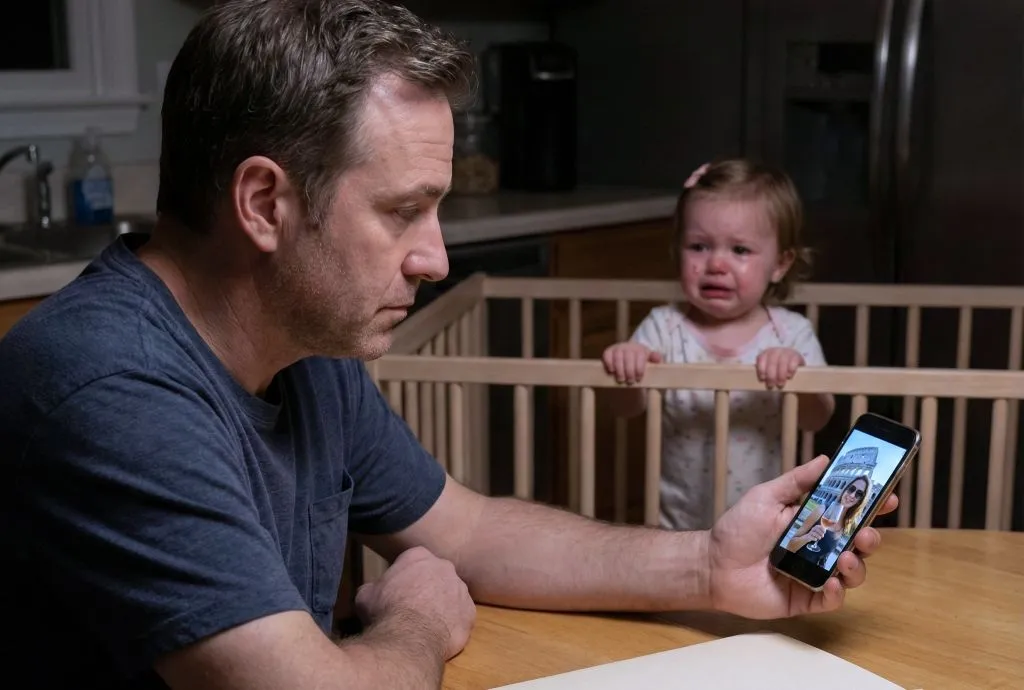
On the drive home, the radio played something cheerful, acting like the world hadn’t just fundamentally changed. My phone buzzed at a red light. It was a photo of the terminal from Lauren. The caption read: Finally breathing again.
I stared at it long enough that the guy behind me honked. That was the first time the thought landed in my chest—not revenge, not yet. Just a clean, cold kind of truth. If she wanted thirty days like she didn’t have a family, then I was going to stop pretending she did.
The first night without Lauren, I didn’t sleep so much as I took turns being awake. Hannah woke up at midnight, then again at 1:40, and again at 3:05, like she was punching a time clock. Each time the baby monitor hissed to life with that crackly little burst of static, my stomach clenched before my eyes were even open.
The apartment was quiet in that deep, hollow Indiana way. No sirens, no city roar, just the hum of the refrigerator and the furnace clicking on and off. The air smelled faintly of formula and warm laundry because I’d run the dryer twice trying to keep up with the bibs and onesies.
By the third wake-up call, I was standing in the kitchen in my socks. I bounced a one-year-old on my shoulder while the microwave clock glowed 3:12 AM like it was judging me.
“Honey,” I whispered, pacing between the sink and the fridge. “Daddy’s got you. Daddy’s here.”
Hannah’s face was hot against my neck, her little fist curling into my shirt, and I felt a sharp, ugly jealousy toward my own wife. Lauren was probably toasting with champagne at some airport lounge while I was measuring life in ounces of formula and minutes of sleep.
I didn’t even know where the extra pacifiers were. Lauren always knew where everything was. I rummaged through drawers like a thief in my own house until I found one, washed it with shaking hands, and Hannah finally latched onto it with the kind of desperation that made my chest ache.
That was the first thing I learned: You can’t take a “break” from a baby. You can only leave someone else holding the weight.
By day three, my body started doing that thing it does when it’s running on fumes. Everything felt too loud, too bright, too close. The clink of a spoon in a bowl made me flinch. The cheap apartment carpet under my feet felt itchy. The smell of sour milk on my sleeve followed me around like a fog.
And I still had to go to work.
I was the maintenance supervisor at Maple Grove Apartments, a complex full of aging buildings, older tenants on fixed incomes, and young couples who thought their rent checks included miracle repairs. My phone never stopped. Furnace out. Toilet running. Garbage disposal jammed. Door won’t lock.
On Monday, I carried Hannah into the office with her diaper bag slung over my shoulder like I was hiking the Appalachian Trail. Ron Keller, my lead tech—a sixty-one-year-old man who smelled like coffee and motor oil no matter what soap he used—looked up from his clipboard.
“Where’s Lauren?” he asked.
“Europe,” I said, trying to sound like it was a normal Tuesday answer.
Ron’s eyebrows lifted. “With the baby?”
“With her friends,” I said.
Ron just stared at me. Then he glanced down at Hannah, who was chewing the strap of her sippy cup like it was a full-time job.
“Well,” he said slowly. “That’s something.”
I tried daycare. I tried babysitters. I tried calling two women from a church bulletin board, even though I hadn’t stepped foot in that church in years. Everything was booked, overpriced, or sounded like a scam. So I did what dads do when the world doesn’t make room for them: I made it work anyway.